By Robert Balgac, Founder, Black Swan Insurance Group | October 5, 2026
Search "7702 plan" and the ads arrive fast: a secret section of the tax code, retirement income the IRS supposedly cannot touch, the thing affluent families use and nobody told you about. It is a good pitch. It is also selling you a section number.
Section 7702 is not a plan. It is not an account, a product, or a strategy. It is a qualification test sitting in the Internal Revenue Code that decides one thing: whether a contract gets taxed like life insurance. Nothing in it promises a return, caps a fee, or funds a policy.
There is real news underneath the marketing, and it is narrower than the headline. A 2021 change replaced the interest-rate assumptions insurers use when they design contracts like indexed universal life. That shifts how much premium can fit into a policy. It does not create a retirement account, and it does not make a badly designed policy work.
The short answer: Section 7702 is the tax-qualification test that determines whether a contract is treated as life insurance. A 2021 update replaced the fixed 4% and 6% interest assumptions with a floating formula, which generally allows more premium relative to a given death benefit. That is a design change, not a performance promise. Passing Section 7702 is also separate from passing the seven-pay MEC test under Section 7702A, and neither test protects you from fees, cap changes, underfunding, or lapse.
Key Takeaways
- Section 7702 is a tax-qualification test for life insurance, not a retirement plan, an account, or an IRS-approved product
- The 2021 update changed the assumed interest rates used in the funding formulas, which can allow more premium relative to a death benefit
- More funding room is a calculation change, not a promise of better crediting, lower charges, or a better outcome
- Passing Section 7702 does not mean the contract passed the separate seven-pay MEC test under Section 7702A
- The risks the update did not touch — cost of insurance, cap changes, loan interest, funding durability, lapse — are the ones that actually decide whether the policy works
What Section 7702 Actually Is
An indexed universal life policy is permanent life insurance first. The death benefit and the contract terms are the product. Index-linked crediting, cash value and any potential tax-advantaged access are features built on top of that insurance chassis, and Section 7702 is the test that keeps the whole thing inside the tax treatment life insurance receives.
Under the current statute, a contract has to be life insurance under state law and satisfy one of two actuarial tests.
Two Ways a Policy Can Qualify
Cash Value Accumulation Test (CVAT). The cash surrender value can never exceed the net single premium needed to fund future benefits at that moment. Cash value stays tethered to the death benefit rather than the other way around.
Guideline Premium and Corridor Test (GPT). This caps how much premium can go into the contract relative to the death benefit, and adds a corridor rule requiring the death benefit to stay a set percentage above cash value — a percentage that shrinks as the insured ages.
Most IUL contracts use GPT because it usually allows more funding flexibility for cash accumulation than CVAT does.
The product is not the strategy. The design is the strategy. Two policies can pass the same section of the tax code and only one of them was engineered to do the job you are buying it for.
The Sections That Actually Decide Your Tax Bill
Section 7702 is the gatekeeper. It does not work alone:
- Section 101(a) excludes death benefits from gross income when paid because of the insured's death, subject to exceptions such as the transfer-for-value rule
- Section 72(e) governs living distributions — withdrawals and loans — and generally taxes gains only after you have recovered basis, provided the policy is not a MEC
- Section 7702A determines MEC status through the seven-pay test, a completely separate calculation from Section 7702 qualification
A qualifying, non-MEC policy that stays in force can offer tax-deferred cash-value growth and generally favourable loan treatment. That is potential tax-advantaged access when the policy is properly structured, funded and managed. It is conditional, and the conditions are where most of the disappointment lives.
What Section 7702 does not do: guarantee index credits, cap policy charges, promise a return, or keep the policy funded. Calling a product a "7702 plan" hides exactly that gap. Ask what the contract actually is — IUL, whole life, or another permanent product — before anything else.
What Changed in 2021, and What It Did Not
The update often mislabelled a SECURE Act change came from a different law. Section 205 of the Consolidated Appropriations Act, 2021 (Public Law 116-260) replaced the fixed 4% and 6% interest-rate floors Section 7702 had used since the 1980s.
From Fixed Rates to a Floating Formula
The old rules assumed a flat 4% for CVAT and 6% for guideline premium limits. Those numbers fitted the decade they were written in and became unrealistic in a low-rate environment.
The new framework ties the applicable accumulation-test minimum rate to average applicable federal mid-term rates, capped at 4%, with guideline premium minimums running two points higher. For contracts issued in 2021, a transition rule set the insurance interest rate at 2% until the first scheduled adjustment.

In plain terms: a lower assumed interest rate means it takes more premium to reach the same net single premium or guideline limit. That creates more room for premium relative to a given death benefit.
What Design Room Actually Buys You
What the change can do:
- Allow more premium to be directed toward cash value within GPT limits
- Adjust guideline premium calculations on new contracts
- Leave corridor requirements intact, so the cash-value-to-death-benefit relationship still applies
What did not change:
- Policies still have to satisfy Section 7702 for life insurance tax treatment
- Premiums are still paid with after-tax dollars
- MEC rules under Section 7702A still apply independently
- An outstanding loan at lapse can still create a taxable event
No later federal law has materially changed the 2021 framework. The floating-rate rule still governs contracts issued after December 31, 2020.
Take two otherwise identical contracts issued five years apart under different rate assumptions. The one built under the lower statutory rate may permit a larger premium relative to its death benefit. That is a change in a formula, not a promise that the policy will credit more interest, cost less, or perform better. Caps, participation rates and cost of insurance are set by the carrier and can move.
Zero is your hero in a down year — but the floor applies to the credited interest, not to the charges. A statutory formula change does not pay your cost of insurance either.
What the Critics Get Right
The people who roll their eyes at "7702 plan" marketing are right about most of it, and saying so is not a concession.
They are right that the name is deliberately confusing, borrowing the authority of the tax code to make a product sound like a government programme. They are right that a section number tells you nothing about whether the policy in front of you was designed for cash value or for commission. And they are right that "tax-free" gets used as a headline when the accurate version carries four or five conditions.
Where the criticism overshoots is concluding that the underlying tool is therefore worthless. Bad marketing is not the same as a bad contract. A properly structured, funded and managed policy is a real thing; it just has almost nothing to do with the ad that brought you here.
Passing Section 7702 Is Not Passing the MEC Test
A policy can clear Section 7702 cleanly and still fail the seven-pay test under Section 7702A. If cumulative premiums in the first seven years exceed the seven-pay limit, the contract becomes a modified endowment contract.
That matters because MEC treatment flips the order of taxation. Withdrawals and loans come out income-first rather than basis-first, and a 10% additional tax can apply before age 59½. The IRS line is the one you cannot cross if you want the policy to keep its intended tax treatment — and crossing it is not casually reversible.

The Ultimate IUL Blueprint
If you want the full framework — how the funding tests interact, what max-funding without crossing the MEC line actually looks like, and which numbers to demand before you sign anything — that is what the Blueprint covers.
Where a 7702-Qualified IUL May Actually Fit
Section 7702 qualification is table stakes. Fit is a separate question, and income alone does not answer it.
Stronger Fit
- Household income of $150K+ with stable or growing cash flow
- Roughly $500–$2,500 per month of funding capacity that does not touch emergency reserves
- A real permanent protection, legacy or business-continuity need that stands on its own
- Already funding retirement accounts, or deliberately looking for a second tax-advantaged bucket
- Tax-frustrated or Roth-limited, and comfortable with a long time horizon
- Willing to review the contract annually rather than file it away
Weaker Fit
Not everyone should buy an IUL. Section 7702 defines what a life insurance contract is; it does not make the contract a good idea for your situation.
- Unstable income, or thin emergency reserves
- High-interest debt that needs triage before a decades-long premium commitment
- Money likely needed before the contract builds accessible value
- A need that is really about the largest death benefit for the lowest premium — term insurance usually wins that comparison, and there is no reason to buy a permanent contract to solve a temporary problem
- Unwillingness to manage the policy, or a belief that the section number does the work
Late-start high earners face a tighter window. At 45 to 55 the accumulation period is compressed, health underwriting matters more, and you need an honest read on whether premiums survive a downturn or a career change.
How to Compare It With What You Already Have
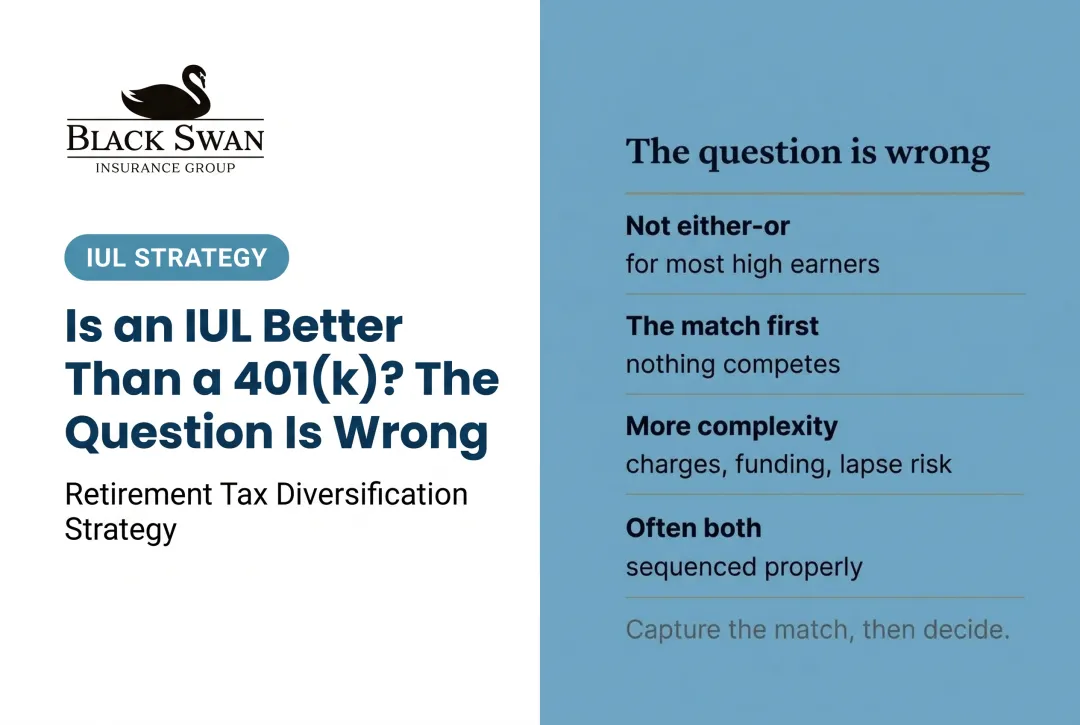
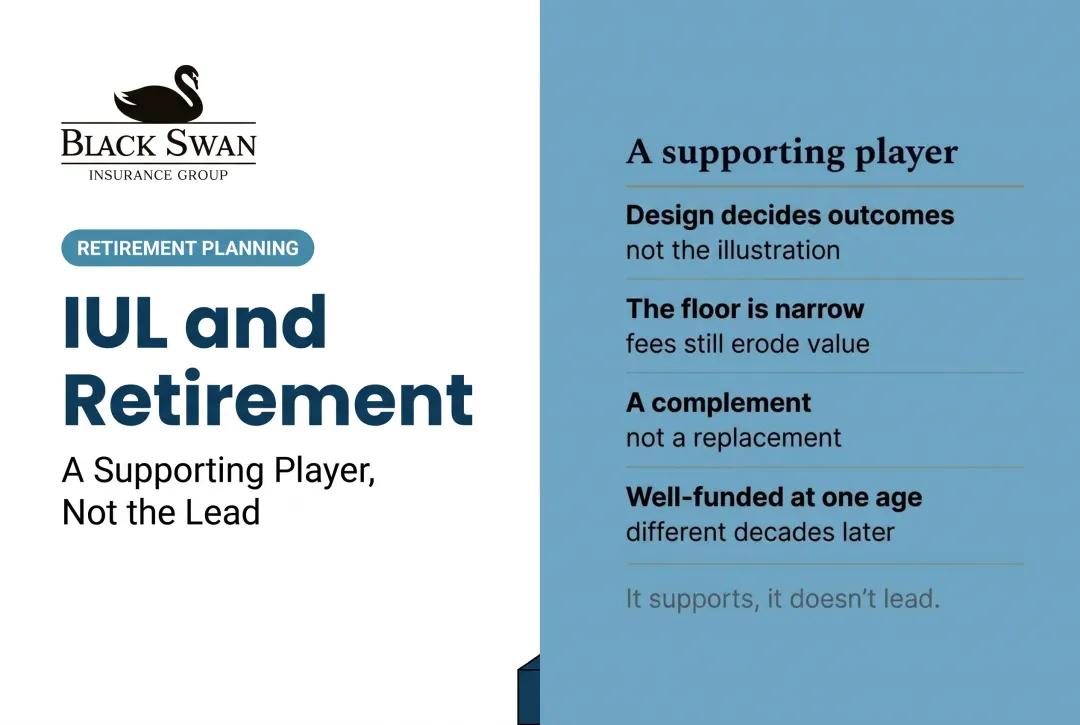
An IUL is not a 401(k) replacement and is not trying to be. A 401(k) is not the enemy either; depending on it as the only serious bucket is the part worth examining.
| Vehicle | 2026 limit | Tax treatment | Key consideration |
|---|---|---|---|
| IUL | No IRS contribution limit; the guideline premium test caps funding relative to death benefit | Death benefit generally income-tax-free; loans tax-favoured while non-MEC and in force | Requires ongoing premium and active management |
| Traditional 401(k) | $24,500 elective deferral | Pretax in, taxable out | The employer match is the best return in the stack |
| Roth IRA | $7,500 ($8,600 at 50+) | After-tax in; qualified withdrawals tax-free | Income phase-outs may remove eligibility |
| Taxable brokerage | No limit | Capital gains and dividends taxed annually | Full liquidity, no death benefit |
| Nonqualified annuity | No IRS limit | Income-first taxation under Section 72 | No permanent death benefit |
A sensible order of operations for most households: build reserves and clear high-interest debt, capture the full employer match, fund the tax-advantaged accounts available to you, then diversify into taxable savings. Permanent insurance is a conversation after those steps, when there is a genuine protection need, consistent surplus cash flow, and enough time horizon to absorb the early-year costs.
Stress-Test the Design Before You Fund It
Ask for illustrations showing what happens when crediting drops below current projections, caps decline, cost of insurance rises faster than expected, a premium is missed or reduced, and a loan is taken and not repaid.
Do not buy the highlight reel. Watch the game film. If the policy only works in the best-case column, that is not a plan — it is a wish with a binder.
Ask your agent for the contract type and which qualification test it uses, the death benefit and premium schedule, both guaranteed and current ledgers, surrender values by year, the loan provisions including rates and repayment terms, and the contract's specific seven-pay limit.

Your actual tax treatment depends on the specific contract, your circumstances, your state, and whether the policy stays in force. Coordinate with a tax professional alongside whoever is designing the policy.
Risks to Understand Before You Fund a Policy
- Cost of insurance typically rises with age, and it is charged whether or not the index credits anything
- Administrative charges, rider costs and early-year surrender charges reduce value in exactly the years the illustration looks most optimistic
- Caps and participation rates are not fixed. Carriers may adjust non-guaranteed elements within contract limits
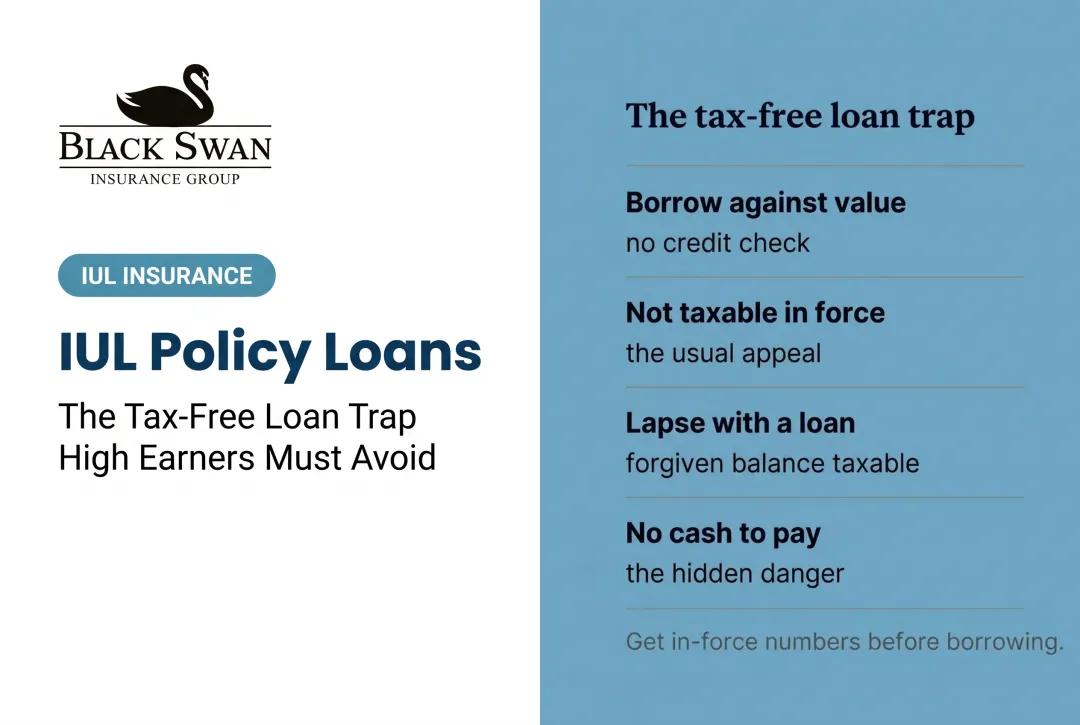
- Loan interest compounds against cash value, and an outstanding loan at lapse or surrender with gain in the contract can create taxable income with no cash received to pay it
- Underfunding is the most common failure mode. A policy that only works at full premium is fragile by design
- Crossing the seven-pay limit changes distribution taxation under I.R.C. § 7702A, and it is technical to unwind
- Illustrated values are not guarantees. Read the guaranteed column first
Find Out Where You Actually Stand
This starts with the Tax-Free Wealth Blueprint Fit Review. If you earn $150K+ and are trying to work out whether a 7702-qualified policy belongs anywhere in your retirement strategy, we run your numbers, stress-test the funding, show the fees, the loan assumptions and the risks, and tell you what the design would actually have to do. If it does not fit, we will tell you that too.
Frequently Asked Questions
Is a "7702 plan" a real retirement account?
No. Section 7702 is a tax-qualification test for life insurance contracts. There is no account, no IRS programme and no registration. Any product marketed under that name is a life insurance policy, and the first question to ask is which kind.
What did the 2021 change actually do?
It replaced the fixed 4% and 6% interest assumptions used in the Section 7702 funding tests with a floating formula tied to applicable federal mid-term rates. In practice it generally allows more premium relative to a given death benefit. It changed a calculation, not the economics of any particular policy.
Does passing Section 7702 mean my policy is not a MEC?
No. MEC status is decided separately by the seven-pay test under Section 7702A. A contract can satisfy Section 7702 and still become a MEC, which changes how withdrawals and loans are taxed.
Can I take money out of a 7702-qualified IUL?
You can surrender the policy or take withdrawals and loans against cash value. Surrender charges, taxable gain above basis, a reduced death benefit and tax consequences from an outstanding loan at lapse can all apply. Access is a design outcome, not an automatic feature.
Is a 7702 IUL better than a 401(k)?
They answer different questions. A 401(k) offers pretax contributions and often an employer match; a properly designed IUL offers permanent protection and potential tax-advantaged access. For most high earners the useful framing is a second bucket after the obvious accounts are funded, not a replacement for them.
Should I buy term insurance instead?
If the only goal is the most death benefit for the lowest premium over a defined period, term is usually the cleaner answer and worth saying plainly. Permanent coverage earns its place when there is a lasting protection need and a reason to want cash value alongside it.
Sources
- 26 U.S.C. § 7702 — Life insurance contract defined
- Consolidated Appropriations Act, 2021 (Public Law 116-260), Section 205
- IRS — 401(k) limit increases to $24,500 for 2026
- NAIC — Life Insurance
- I.R.C. § 7702A and Rev. Proc. 2008-39 (modified endowment contracts and the seven-pay test)
Disclosure: This article is educational and is not personal tax, legal or investment advice. Indexed universal life is life insurance first. Actual results depend on policy design, carrier, crediting options, caps, participation rates, expenses, funding and ongoing management. Policy loans and withdrawals may reduce cash value and death benefit and can create tax consequences if the policy lapses or becomes a modified endowment contract. This strategy is not appropriate for everyone. Consult qualified tax and legal professionals about your own situation. Illustrated values are not guarantees; actual results depend on policy terms, crediting, costs and funding.
And remember, it's not what you earn, it's what you keep… enjoy the ride.