By Robert Balgac, Founder, Black Swan Insurance Group | October 9, 2026
"Max-funded IUL" sounds like something you could shop for — one price, one best provider, a comparison table and a winner. It is not a product, and searching for it as though it were is the first mistake.
It is a policy design strategy: a way of structuring an indexed universal life contract to accept as much premium as tax law allows without crossing into modified endowment contract territory. If you earn $150K+, have maxed the 401(k) and hit the Roth phase-out, the appeal is obvious — a bucket with no contribution ceiling. The ceiling exists anyway. It is just written in your own policy rather than in a published table.
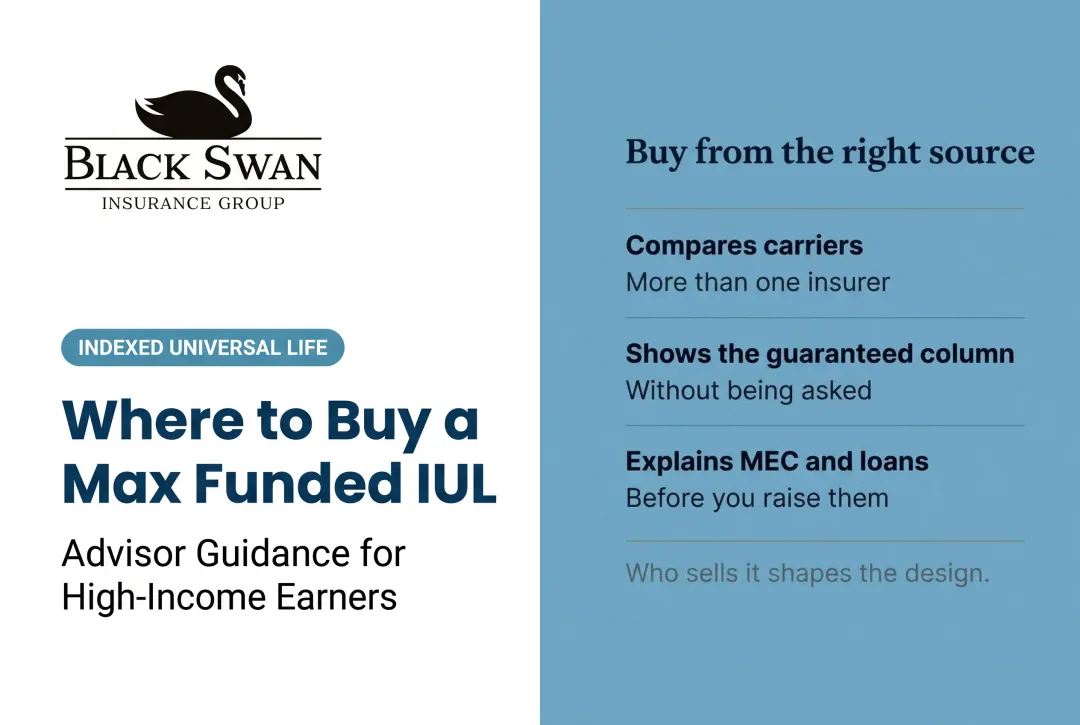
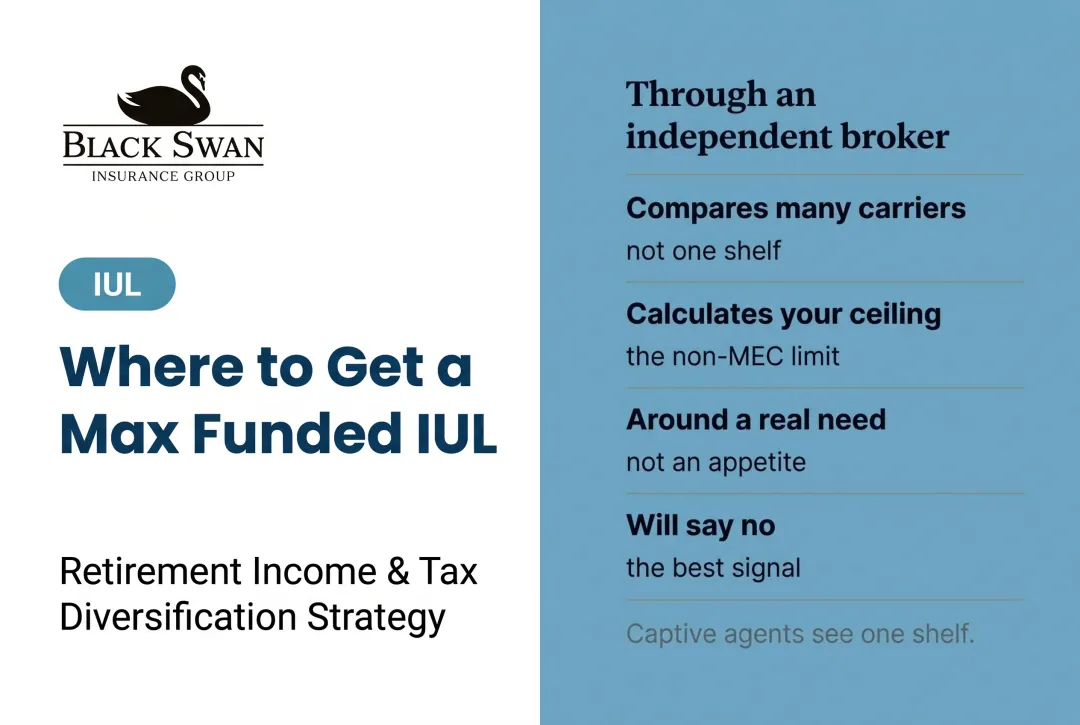
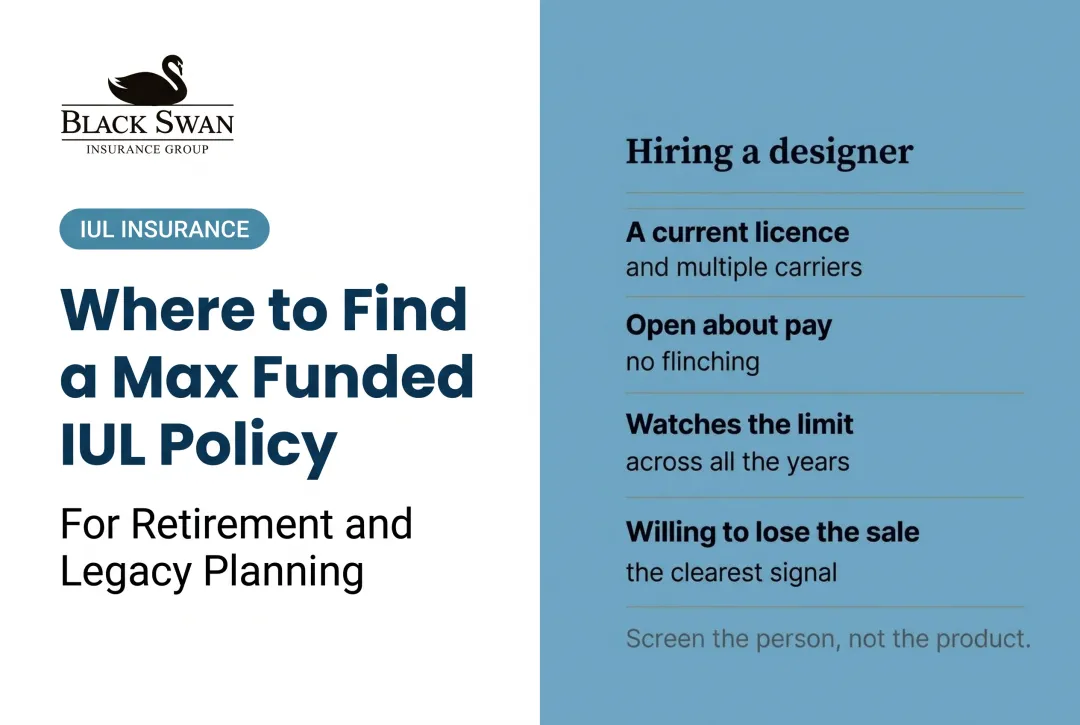
The short answer: There is no "where" to find one, because there is no product to find. What you are actually looking for is a licensed, independent professional who can run comparable illustrations across several carriers, show you the MEC limit year by year, and tell you honestly when the answer is no. The design is the deliverable, not the policy.
This is life insurance first. A max-funded design leans the death benefit down to push more of each dollar into cash value, but the contract is still insurance, still priced on your mortality, and still subject to charges that rise with age.
IUL sales reached $3.8 billion in new premium in 2024, up 4% year over year with policy counts up 10%, according to LIMRA's 2024 sales report. More demand means more agents, more carriers, and considerably more conflicting advice.
Key Takeaways
- Max-funded IUL is a design approach, not a product — limits depend on your age, health and death benefit
- Start with a licensed, independent professional who can compare several carriers side by side
- Verify any producer's licence through your state insurance department before you sign
- Demand guaranteed and non-guaranteed illustration columns, never a single projection
- Fit depends on stable surplus cash flow and a real protection need, not tax appeal
- The 7-pay test runs cumulatively across seven years — this needs monitoring, not a one-time check
What "Max-Funded" Actually Means
Indexed universal life is permanent coverage: a death benefit paired with a cash-value account. The insurer links interest crediting on that cash value to an external index such as the S&P 500. Your money is not invested in the index; a crediting formula decides how much interest is added.
"Max-funded" means paying the highest premium the policy and IRS rules allow, typically using a leaner death-benefit design so more of each dollar builds cash value instead of covering insurance costs.
The Mechanics
- Section 7702 defines when a contract qualifies as life insurance for tax purposes (IRS guidance), using the cash-value-accumulation test or the guideline-premium test with a death-benefit corridor.
- The 7-pay test (Section 7702A) caps how much premium can go in during the first seven contract years before the policy becomes a Modified Endowment Contract.
- Caps, participation rates, spreads and floors shape how much indexed interest is credited each year.
- Policy charges and surrender provisions reduce cash value regardless of index performance.
The Floor Is Not a Safety Net for Everything
A floor protects against negative index crediting in a bad market year. It does not protect against monthly cost-of-insurance charges, loan interest or surrender fees. An underfunded or poorly managed policy can still lose cash value in a year the floor applies.
Zero is your hero in a down year — but the floor applies to the credit, not to the charges.
Illustrations use current, non-guaranteed assumptions. Ask for guaranteed values separated from illustrated ones before you compare anything.

Where These Designs Come From
| Route | What you get | What to verify |
|---|---|---|
| Independent brokerage | Access to multiple carriers and designs | Which carriers the broker actually represents |
| Captive agent | One insurer's product line | Whether that single carrier fits your needs |
| CPA or estate attorney referral | A vetted introduction | The referred agent's license and IUL experience |
| Direct insurer channel | A streamlined application | Whether the design is customized or templated |
Start with someone who can run illustrations across multiple eligible carriers. A single illustration from a single company tells you almost nothing about whether that policy is your best option — it tells you what one carrier's software produced from one set of inputs.
Before You Share Any Financial Information
Verify the person's licence through your state insurance department and confirm they are authorised to sell in your state. The NAIC recommends checking both agent and company licensing along with complaint history before moving forward.
Then ask five screening questions:
- Which carriers do you represent?
- How is your compensation disclosed?
- Can you show guaranteed and non-guaranteed values separately?
- How will you monitor MEC limits over the funding period?
- What happens to the policy if I reduce or stop premiums?
A professional who answers all five without discomfort is worth your time. One who deflects on compensation has told you what you needed to know.
Black Swan is an independent brokerage based in Springboro, Ohio, representing multiple carriers including F&G Annuities and Life, Corebridge, Occidental and Transamerica. Our process runs five steps: financial goals review, policy customisation, index strategy selection, application and approval, and annual review. That is one example of a brokerage-led process, not a claim that every reader qualifies or that this approach is available in every state.
Whichever route you take, gather two or three comparable illustrations with matching assumptions: same age and underwriting class, same premium schedule and death-benefit option, same index strategies and loan assumptions, same planned income start date. Apples-to-oranges illustrations make bad designs look good, which is frequently the point.
The Ultimate IUL Blueprint
If you are weighing how hard to fund a policy, the Blueprint walks through what the design must survive: funding levels, the MEC line, caps and charges, loan timing, and what to demand from an illustration.
How the Maximum Is Determined
There is no universal dollar figure. The ceiling depends on your age and underwriting class, the death benefit you select, how many years you plan to fund, and the carrier's specific product rules. Two 45-year-olds in the same health class applying for different death benefits end up with materially different funding limits.
Minimum Against Maximum Premium
Every IUL has a minimum premium required to keep coverage active and a maximum premium the contract can accept while remaining a non-MEC. Max-funding aims close to that upper boundary, usually paired with the lowest death benefit that still meets your protection needs and the carrier's minimums.
A simplified hypothetical, not actual policy figures:
| Design approach | Death benefit | Relative premium capacity | Cash-value efficiency |
|---|---|---|---|
| Minimum death-benefit design | Lower | Lower funding ceiling | Higher |
| Higher death-benefit design | Higher | Higher funding ceiling | Lower (more cost of insurance) |
Raising the death benefit increases how much premium you can put in, but the higher cost of insurance slows cash-value growth. The right design balances contribution room against long-term efficiency, and it still has to clear MEC testing over time.
Monitoring the Seven-Year Window
MEC testing is cumulative across the first seven contract years, not a one-time check at issue:
- Unscheduled or excess premium payments can trip the 7-pay limit
- Reducing the death benefit within those seven years can retroactively affect testing
- A 1035 exchange can restart or alter testing rules
Confirm any funding change with your agent and a tax professional before the payment moves — not after, when the status has generally already set.

When Funding to the Limit Is the Wrong Move
Maxing out premium is not automatically clever. It can compromise emergency reserves, debt repayment, 401(k) and other qualified-plan contributions, and business liquidity.
Loans and withdrawals add a further layer: loans accrue interest and reduce the death benefit; low cash value plus an outstanding loan can trigger a lapse; and a MEC designation, or a lapse with a loan on the books, changes the tax treatment significantly.
What the Critics Get Right
The strongest fair criticism of max-funding is that the strategy's incentives point the wrong way.
The agent's compensation scales with premium. The buyer's benefit does not scale the same way — past a certain point, additional funding simply moves money into a contract with charges, a surrender schedule and a cap, when a taxable brokerage account would have been more liquid and cheaper. Critics also note that the lean death benefit, which makes the design efficient, is in tension with the only part of the contract that is actually guaranteed.
Both points land. They are the reason the fit checklist below is as restrictive as it is.
What the criticism does not address is the buyer who has genuinely exhausted the qualified buckets, has a permanent protection need regardless, and wants a differently-taxed source of future income. For that person the question is not whether to max-fund in the abstract — it is what premium level is sustainable in a bad year, which is a design question with a real answer.
A great IUL is engineered. A bad IUL is sold.
How to Vet the Person Selling It
Not every agent who sells IUL knows how to design one responsibly. Before committing, confirm they:
- Hold current state licensing and relevant IUL design experience
- Have access to multiple carriers, not one
- Provide written compensation disclosures
- Share financial-strength ratings for each proposed insurer
- Are willing to recommend no purchase when that is the honest answer
Get the Full Cost Picture
Ask for the complete charge structure: premium loads, administrative charges, cost of insurance, rider charges, surrender charges, loan provisions and future charge changes.
Then request side-by-side illustrations showing guaranteed values, current illustrated values, reduced-crediting scenarios, lower-premium scenarios, early-exit values, and what happens if the policy lapses.
An illustration is a model, not a guarantee.
Compare Crediting Terms With Documentation
Cap rates, participation rates, spreads and loan rates change, and some carriers have adjusted them mid-contract. Ask for current carrier documentation rather than a verbal claim about historical performance. Past crediting rates do not bind future ones.
Confirm the Protection Need and the Oversight Plan
Confirm the proposed death benefit genuinely matches your family's protection need. Cash-value efficiency should not come at the cost of leaving dependents, business partners or estate obligations underinsured — that is the one failure the product cannot recover from.
Insist on a written funding and review plan covering premium due dates, MEC monitoring, annual check-ins, beneficiary updates and loan management.
This is not set-it-and-forget-it. It is design-it, fund-it, review-it.
Black Swan includes annual policy reviews as standard, which is a useful feature to look for anywhere. No brokerage can guarantee policy performance, tax outcomes or carrier behaviour.

Who Fits
Stronger Fit
- A genuine, ongoing need for permanent life insurance
- Stable surplus cash flow beyond everyday expenses — typically $150K+ earners past the Roth phase-out
- Good insurability
- A long horizon and the willingness to review the policy annually
- A plan that already covers emergency savings and retirement accounts
That profile commonly includes high-income professionals seeking tax diversification alongside existing 401(k) or Roth savings, practice and business owners wanting protection and liquidity outside the business, affluent families with wealth-transfer goals, and late-start high earners with a shorter runway.
Weaker Fit
Not everyone should do this. An IUL is the wrong tool if you need short-term liquidity, cannot reliably fund premiums year after year, have not captured an available employer match, lack basic emergency reserves, or are chasing maximum market returns rather than permanent coverage. If your need is temporary, buy term — it is cheaper and does the job.
An IUL complements 401(k)s, IRAs, Roth accounts, brokerage portfolios, term insurance, whole life and annuities. It replaces none of them.
Fit-or-no-fit checklist: Do I have a real, lasting protection need? Can I fund this consistently for years, not just this year? Have I maxed lower-cost tax-advantaged accounts first? Do I have adequate emergency reserves already? If you are unsure, bring in a qualified tax or legal professional before any trust, business or estate decision.
Risks to Understand Before You Max-Fund
- The 7-pay limit is cumulative and unforgiving. A single off-schedule payment can cross it, and MEC status is generally permanent.
- A lean death benefit cuts both ways — it improves cash-value efficiency and reduces your funding headroom.
- Cost of insurance rises with age, so a premium that is comfortable at 40 may not cover charges at 70.
- Caps and participation rates can be lowered after issue, subject to contract minimums.
- Surrender charges run for years; an early exit returns less than you paid in.
- Underfunding to stay clear of the MEC line can leave the policy too thin to survive later charges.
- The loan is not the problem. The unmanaged loan is the problem.
Find Out Where You Actually Stand
This starts with the Tax-Free Wealth Blueprint Fit Review. If you earn $150K+ and are weighing a max-funded design, we model the premium schedule against the 7-pay limit year by year, show the remaining room, compare designs across carriers, read guaranteed against illustrated values, and stress-test the funding through lower-crediting and reduced-income years. If a brokerage account serves you better, we will say so. If IUL does not fit, we will tell you that too.
Frequently Asked Questions
Where can I find a max-funded IUL?
Through a licensed independent broker who can compare multiple carriers and design the contract around your limits. Confirm state availability, licensing, costs and MEC limits before proceeding.
What is the maximum funding for an IUL?
There is no single figure. The limit depends on your age, underwriting class, chosen death benefit, premium timing, funding period, carrier rules and the IRS 7-pay test.
How do I know whether an IUL is truly max-funded?
Request the planned premium, death benefit, MEC limit, guaranteed values, illustrated values and funding assumptions in writing, then compare that design against at least one alternative illustration.
Can max-funding an IUL trigger MEC status?
Yes — that is the central risk. Exceeding the applicable 7-pay limits causes MEC status, changing how loans and withdrawals are taxed. Confirm every premium change with your insurer and a tax professional first.
Is a max-funded IUL suitable for everyone?
No. It can suit people with a genuine permanent insurance need, stable surplus cash flow and a long horizon. It is a poor fit for short-term goals, limited liquidity or inconsistent funding capacity.
Does a bigger death benefit let me fund more?
Generally yes, because the 7-pay limit derives partly from the death benefit. But the higher cost of insurance reduces cash-value efficiency, so more room is not automatically a better design.
Sources
- LIMRA — 2024 U.S. individual life insurance premium sets new sales record
- IRS — guidance on Section 7702 (24-0008)
- NAIC — How to choose an insurance agent
Disclosure: This article is educational and is not personal tax, legal or investment advice. Indexed universal life is life insurance first. Carrier names and processes are described for research purposes and are not recommendations; availability, licensing, rates, caps and charges vary by carrier and state, and all guarantees are subject to the issuing insurer's claims-paying ability. Illustrated values are not guarantees; actual results depend on policy design, carrier, crediting options, caps, participation rates, expenses, funding and ongoing management. This strategy is not appropriate for everyone. Policy loans and withdrawals reduce cash value and the death benefit, and can create tax consequences if the policy lapses or becomes a modified endowment contract. Consult your own tax, legal and financial professionals for advice specific to your situation. Any potential tax-advantaged access depends on the policy being properly structured, funded and managed.
And remember, it's not what you earn, it's what you keep… enjoy the ride.