By Robert Balgac, Founder, Black Swan Insurance Group | October 5, 2026
Permanent life insurance keeps surfacing in retirement conversations for a reason. High-income professionals, executives and business owners run out of room in the 401(k) and the Roth, and start looking for ways to diversify how future income gets taxed.
Indexed universal life enters that conversation carrying a phrase that does more selling than any other in this industry. The marketing is not entirely wrong. It is incomplete in a way that matters, because it skips premium requirements, internal costs, MEC rules, and what happens when a loan-heavy policy lapses.
There are three distinct tax benefits here, not one. Each has its own rules, and each can be lost. Anyone presenting them as a single blanket exemption is either confused or selling.
The short answer: Cash value typically grows tax-deferred, though premiums are paid with after-tax dollars. A qualifying death benefit generally passes to beneficiaries income-tax-free, with real exceptions. Properly structured policy loans can avoid current income tax while the policy stays in force and is not a MEC. MEC status, overwithdrawals or a lapse with an outstanding loan can create surprise taxable income — sometimes with no cash received to pay it. Every one of these is conditional on design, funding and the contract staying solvent.
Key Takeaways
- Cash value typically grows tax-deferred, but premiums are paid with after-tax dollars
- A qualifying death benefit generally passes income-tax-free, though exceptions exist
- Properly structured loans can avoid current income tax while the policy is in force and not a MEC
- MEC status, overwithdrawals or a lapse with an outstanding loan can trigger taxable income
- This is one piece of a larger plan, not a substitute for your qualified accounts
What the Three Benefits Actually Are
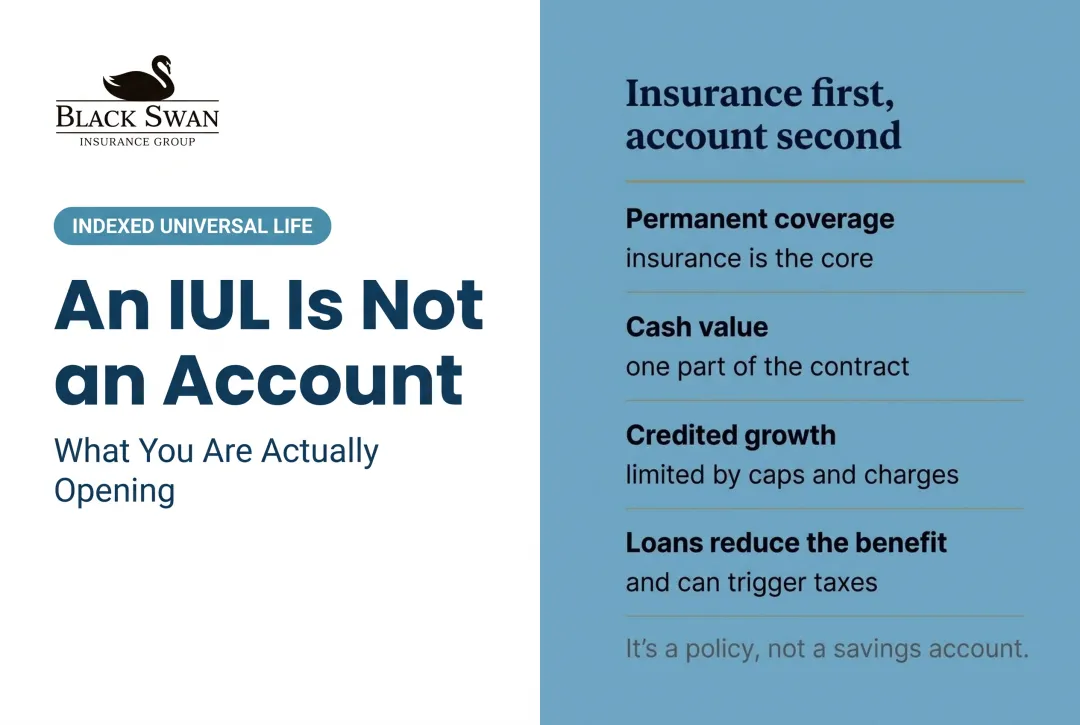
An IUL is permanent life insurance with a death benefit and a cash-value account. That cash value can earn interest linked to an external index such as the S&P 500, subject to your contract's terms.
The part that trips people up: this is not a market position. You are not buying shares or funds inside the policy. The insurer credits interest based on index performance, filtered through caps, participation rates, floors, spreads and internal costs including cost of insurance.
- Tax-deferred accumulation — cash value grows without annual tax reporting on internal gains
- Income-tax-free death benefits — proceeds paid by reason of death are typically excluded from taxable income
- Potential tax-advantaged access — withdrawals and loans that may avoid current taxation under specific conditions
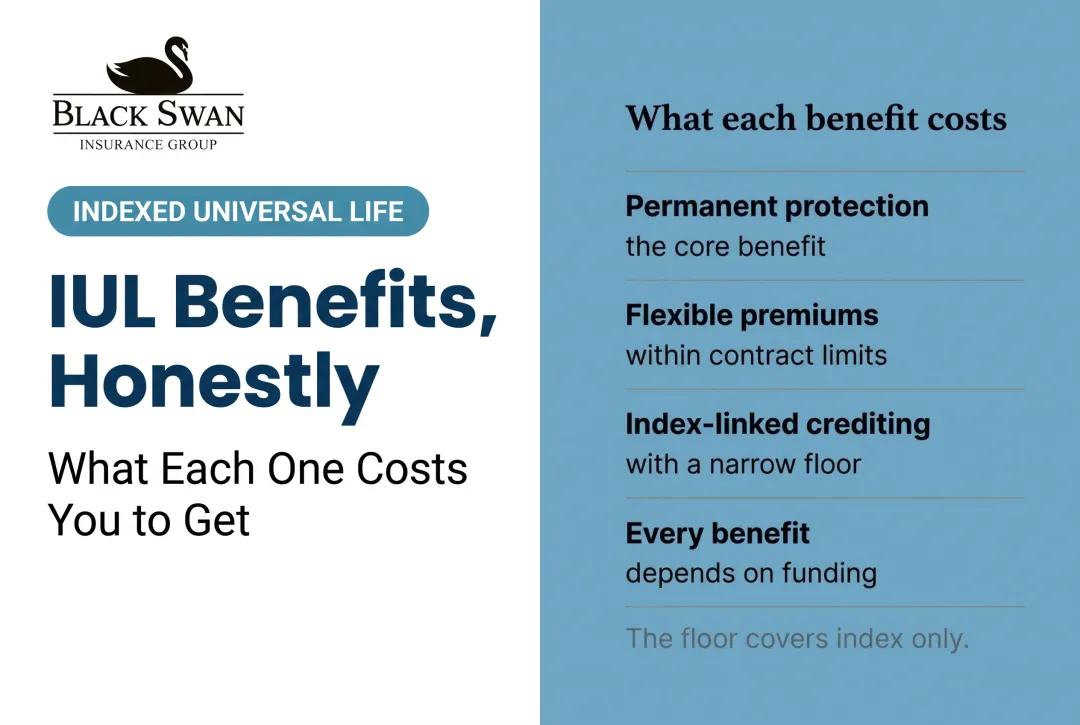
Every one is conditional on how the policy is designed, funded, owned and accessed, and on whether it stays solvent. None is automatic.
Benefit One: Tax-Deferred Growth
Cash value in a qualifying policy accumulates without you reporting credited interest as income each year, letting growth compound without annual tax drag — much like a 401(k) before withdrawal.
Deferral is not elimination.
- Withdrawals or a full surrender expose gains above your cost basis to ordinary income tax
- The IRS treats surrender proceeds above policy cost as ordinary income, per IRS Publication 525
- Premiums are paid with after-tax dollars and are generally not deductible — the break applies to internal growth and certain distributions, never to money going in
Illustrations routinely underplay the cost side. Administrative charges, cost of insurance, cap and participation limits and surrender charges all reduce net performance. Compare guaranteed values against non-guaranteed projections before treating deferral as a return story.

Benefit Two: The Death Benefit
Under Section 101(a) of the Internal Revenue Code, death benefits from a qualifying policy are generally excluded from a beneficiary's gross income. This is the feature most people mean when they say life insurance is tax-free, and it is the most robust of the three.
It supports income replacement for a surviving spouse or dependents, business continuity if an owner or key partner dies, estate liquidity so heirs are not forced into a quick sale, and legacy transfers.
"Generally" is carrying weight in that sentence. The exceptions:
- Transfer-for-value — if a policy was sold or transferred for consideration, some or all of the death benefit can become taxable
- Employer-owned life insurance — Section 101(j) limits the exclusion unless notice-and-consent steps were completed before issue
- Estate tax inclusion — income tax exclusion is separate from estate tax. If the insured retained incidents of ownership, proceeds can still enter the taxable estate under Section 2042
Outstanding loans and withdrawals also reduce what beneficiaries receive. A policy that looked strong on paper can pay out far less if it was heavily borrowed against in its final years.
Start with a real insurance need, not a tax angle. Have ownership structure reviewed professionally where estate size or business use is involved.
Benefit Three: Access, and Where the Marketing Gets Sloppy
Two different mechanisms get blended together constantly.
Withdrawals permanently remove money. Typically not taxed up to your basis — what you have paid in premiums — and taxable as ordinary income beyond that.
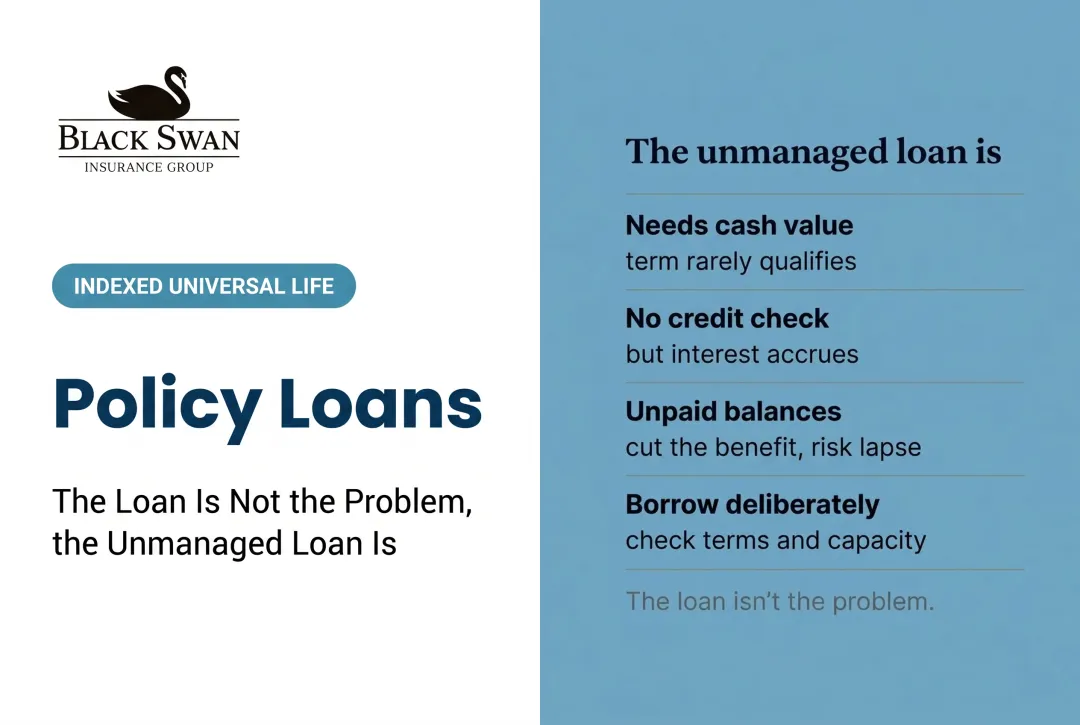
Policy loans are different. You are borrowing against cash value with the insurer holding it as collateral. Because it is structured as debt, a loan on a non-MEC policy that stays in force generally is not treated as taxable income when taken.
What the loan pitch leaves out:
- Loans accrue interest, and unpaid interest is added to the balance
- Loans reduce available cash value and death benefit under policy terms
- Excessive borrowing increases lapse risk, particularly when crediting runs below projection
- If the policy lapses or is surrendered with a loan outstanding, the previously untaxed loan amount can become taxable income — with no new cash reaching you at that moment
Favourable treatment holds only while the policy avoids modified endowment contract status. Under IRC Section 7702A, a policy becomes a MEC when cumulative premiums in the first seven contract years exceed the seven-pay limit. Once it does: distributions are taxed income-first rather than basis-first; loans and even policy pledges can be treated as taxable distributions; and a 10% additional tax may apply, subject to statutory exceptions.
A worked example, hypothetical only. A policyholder has $80,000 basis and $150,000 total cash value on a non-MEC policy. A $50,000 loan is generally not taxed when taken, because it is debt. If the policy later lapses with that $50,000 plus accrued interest outstanding, the gain tied to the loan can become taxable income in the year of lapse — though no new cash reached the policyholder. Illustrative math, not a projection.

Tax-deferred is not tax-free. The IRS is waiting, not gone — and with a loaned policy that collapses, it arrives at the worst possible moment.
What the Critics Get Right
The criticism of how these benefits get marketed is largely deserved, and conceding it improves the analysis rather than weakening it.
Critics are right that presenting a loan against your own death benefit as "income" obscures what is actually happening. They are right that the conditions attached to every one of these benefits are real, numerous, and rarely disclosed with the same enthusiasm as the benefits themselves. And they are right that a Roth distribution is genuinely tax-free while this is conditionally untaxed, and the two should never be described in the same words.
Where the criticism runs out is the death benefit. Section 101(a) is not marketing — it is statute, and for a household with a genuine protection need it is a real and substantial advantage. The error is letting the strongest of the three benefits be used to sell the weakest.
How Each Benefit Disappears
Overfunding triggers MEC status. Pay too much too fast in the first seven policy years and you fail the seven-pay test. The favourable loan and withdrawal treatment is then gone for the life of the contract. Monitor funding after issue and after any material change, such as a death benefit reduction.
Underfunding creates a slow-motion failure. Rising insurance charges, weak crediting years and unpaid loan interest quietly erode sustainability. None of it shows immediately and all of it compounds: cost of insurance increases with age; non-guaranteed crediting assumptions may not hold; and excessive loans reduce the cushion available to absorb future charges.
Lapse or surrender with a loan is the tax trap. The reportable gain can become taxable income even though no new cash was received. This is the most misunderstood risk in IUL ownership. Coordinate with a tax professional before surrendering or materially changing a policy — not afterwards.
Other trade-offs: surrender charges can apply for a decade or longer; withdrawals permanently reduce the death benefit; illustrations often assume favourable index performance; and a policy that looks solid on paper can still underperform a retirement-income projection in real conditions.
The Ultimate IUL Blueprint
If you want the framework for keeping all three benefits intact — funding levels that avoid the MEC line, loan timing that does not threaten the policy, and what to demand from an illustration — that is what the Blueprint covers.
Who These Benefits Actually Reach
Stronger Fit
- A genuine permanent death-benefit need beyond the tax angle
- Household income of $150K+ with stable surplus cash flow after other retirement priorities and liquidity needs
- Insurability and a time horizon long enough to fund the policy properly
- Willingness to review funding, MEC status and loan balances annually
- A comparison already run against term insurance, whole life, Roth and 401(k) options and taxable accounts
Weaker Fit
Not everyone should buy an IUL. Each of the three benefits has a condition attached, and a household that cannot meet the conditions gets none of them.
- The tax treatment is the only reason the policy is being considered
- No permanent protection need — term insurance is the answer for a temporary one
- Funding cannot be sustained through a bad year
- Emergency reserves are thin, and this would compete with them
- Nobody intends to monitor MEC status or loan balances
The Evaluation Sequence
- Confirm a genuine permanent death-benefit need — beyond tax, does this household need lifelong coverage?
- Check funding capacity — stable surplus cash flow after other priorities?
- Assess insurability and horizon — health and age affect both cost and runway
- Compare against alternatives — term and whole life, Roth and 401(k), taxable brokerage, on cost, liquidity, guarantees and limits rather than tax headlines
- Request a full illustration review — separate guaranteed from non-guaranteed, and stress-test lower crediting against caps, participation rates and surrender schedules
- Schedule annual reviews — funding needs, health and goals change

Risks to Understand Before You Rely on the Tax Treatment
- Every benefit is conditional on the policy being properly structured, funded and managed
- Premiums are after-tax and not deductible — the break never applies to money going in
- Crossing the seven-pay limit makes the contract a MEC permanently, taxing distributions income-first with a possible 10% additional tax
- A lapse with a loan outstanding can create taxable income with no cash received
- Transfer-for-value can make a death benefit taxable
- Section 101(j) limits the exclusion on employer-owned policies without prior notice and consent
- Estate tax is separate from income tax — retained incidents of ownership can pull proceeds into the taxable estate
- Withdrawals above basis are ordinary income and permanently reduce the death benefit
- Surrender charges can run a decade or longer
Find Out Where You Actually Stand
This starts with the Tax-Free Wealth Blueprint Fit Review. If you earn $150K+ and the tax treatment is what drew you in, we check which of the three benefits your situation actually reaches, confirm MEC headroom, model what a lapse with a loan would cost, and compare Roth and taxable alternatives on identical terms. If it does not fit, we will tell you that too.
Frequently Asked Questions
Is the retirement income from an IUL tax-free?
It is generally a loan against your own cash value, not taxed while the policy stays in force and is not a MEC. That is conditional, and a lapse with a loan outstanding can create taxable income. A Roth distribution is genuinely tax-free; this is not the same thing.
Is life insurance over $50,000 taxable?
That threshold refers to employer-provided group-term coverage under Section 79, not an individually owned policy. An individually owned death benefit follows Section 101(a), so face amount alone does not determine taxability.
Can I use an IUL for retirement?
It can supplement income through carefully managed withdrawals or loans, requiring years of consistent funding and ongoing monitoring. Loan interest, lapse risk and internal costs all weigh against other retirement tools, which should be exhausted first.
When can I cash out?
Surrender and withdrawals depend on your policy terms. Cashing out early can trigger surrender charges, and any gain above basis is generally taxed as ordinary income.
What makes a policy a MEC?
Cumulative premiums in the first seven contract years exceeding the seven-pay limit under IRC § 7702A. It is permanent, and it changes how every distribution afterwards is taxed.
Should I just use a Roth instead?
If you are still eligible to fund one, yes — fund the Roth first. Its tax treatment is unconditional and its costs are a fraction of a policy's. A permanent policy is a separate conversation about protection.
Sources
- 26 U.S.C. § 101 — Certain death benefits
- 26 U.S.C. § 7702A — Modified endowment contracts
- IRS Publication 525 — Taxable and Nontaxable Income
- NAIC — Life Insurance
- IRC §§ 101(j) and 2042 (employer-owned life insurance; proceeds and incidents of ownership)
Disclosure: This article is educational and is not personal tax, legal or investment advice. Indexed universal life is life insurance first. The worked example uses hypothetical figures. Tax treatment depends on policy design, ownership, funding history and current law, all of which can change. Actual results depend on policy design, carrier, crediting options, caps, participation rates, expenses, funding and ongoing management. Policy loans and withdrawals may reduce cash value and death benefit and can create tax consequences if the policy lapses or becomes a modified endowment contract. Consult a qualified tax professional about your own situation. Illustrated values are not guarantees; actual results depend on policy terms, crediting, costs and funding. This strategy is not appropriate for everyone.
And remember, it's not what you earn, it's what you keep… enjoy the ride.