By Robert Balgac, Founder, Black Swan Insurance Group | October 9, 2026
Most people shopping for an indexed universal life company are really asking a different question: who can I trust with thirty years of premium? That is a reasonable question, and it does not have a brand-name answer. Picking a carrier by logo or by the highest number on a glossy illustration is the single most common mistake in this market, because that number is a projection built on assumptions the carrier can revise after your money is in.
If you earn $150K+ and have maxed the 401(k), the stakes are concrete. IUL combines a permanent death benefit with flexible premiums and cash value credited partly by reference to a market index. Caps, participation rates, internal charges, loan provisions, underwriting standards and lapse risk vary significantly between carriers. U.S. individual life insurance new premium hit $17.5 billion in 2025, with IUL contributing $4.5 billion, up 17% from 2024, according to LIMRA's 2025 sales data. More carriers competing for attention means more reasons to look past the marketing.
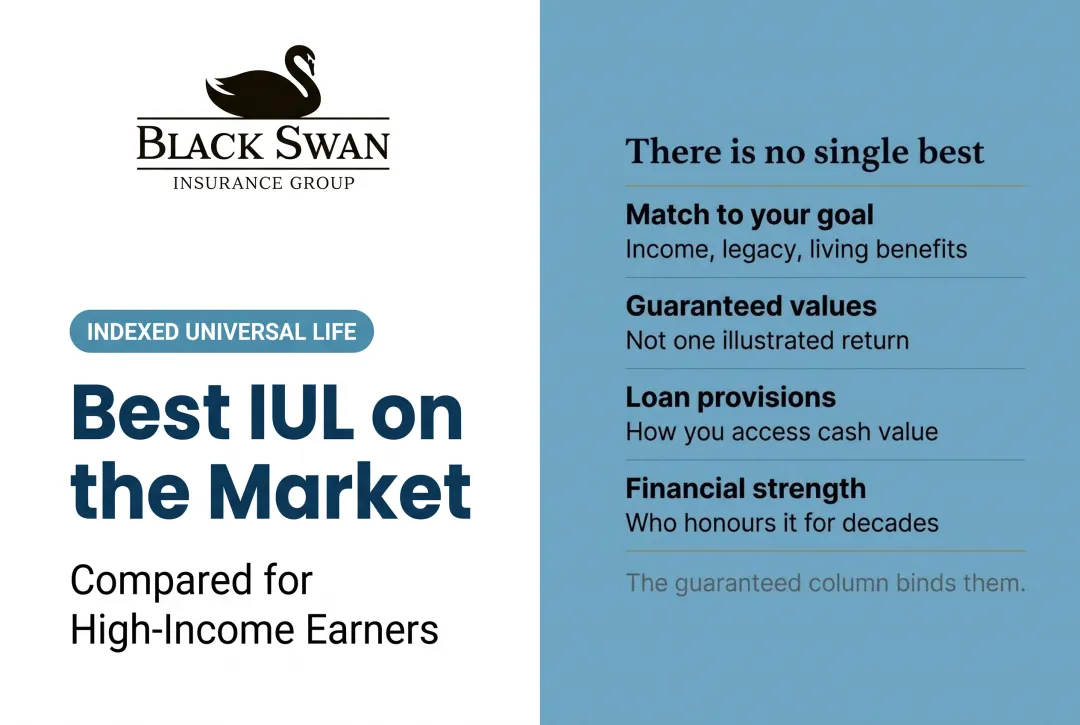
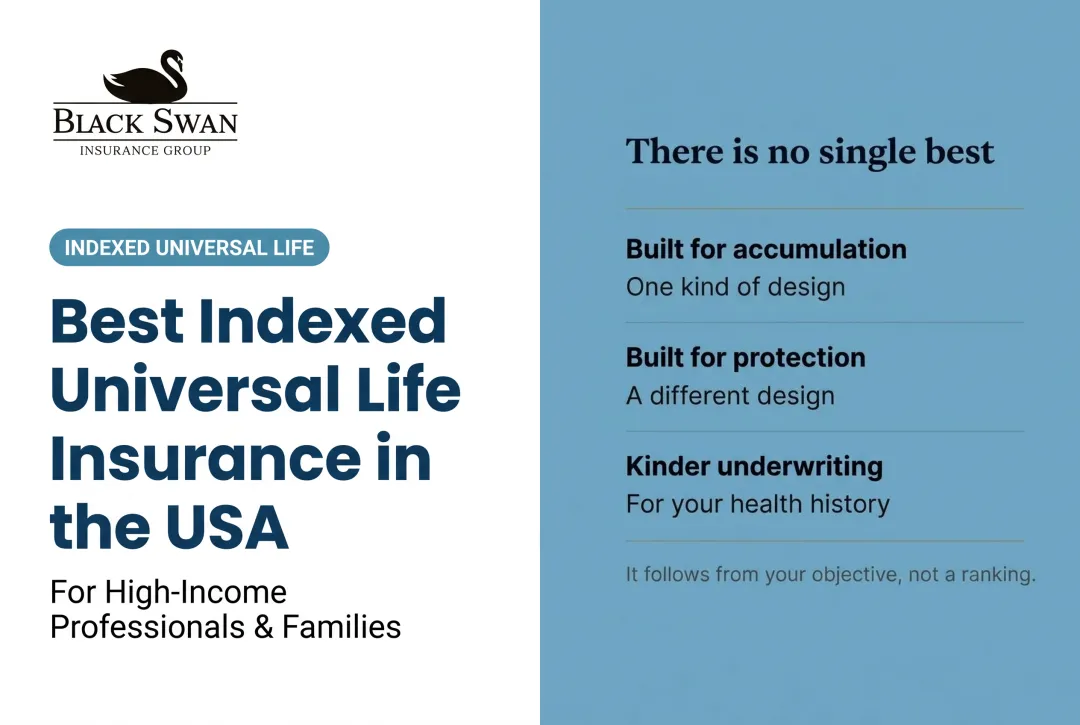
The short answer: There is no honest advance ranking of IUL companies by performance. The things that determine your outcome — caps, participation rates, spreads, cost of insurance — are mostly non-guaranteed and set by the carrier after you buy. What you can verify beforehand is financial strength of the exact issuing entity, complaint history, contractual guarantees, charge structure and loan mechanics. Those are the real selection criteria, and they are the ones nobody advertises.
Key Takeaways
- Treat IUL as permanent coverage, not a market investment; results follow contract terms and funding
- Compare financial strength, complaints, charges, guarantees, crediting methods and loan terms before applying
- A brokerage designs and compares policies; only the carrier issues the contract and pays claims
- Carrier fit is personal — weigh IUL against term, whole life and retirement accounts
- Request current, stress-tested illustrations; caps and participation rates change over time
The Mechanics That Decide Everything
Indexed universal life provides a death benefit alongside cash value that can earn interest linked to an external index such as the S&P 500. You do not own the index. The insurer calculates credited interest using a formula tied to index performance, then applies policy charges that reduce cash value regardless of how the index performed.
Every IUL policy runs on the same machinery:
- Premium allocation splits your payment between insurance costs and cash value accounts
- Cost of insurance and administrative charges come out monthly, whether or not the index performs
- Floors set a minimum crediting rate, often 0%, protecting against negative index years
- Caps and participation rates limit how much upside you actually receive
- Spreads reduce credited interest by a set percentage in some indexed-account designs
- Policy loans and withdrawals give access to cash value but carry real consequences
A floor does not make the policy safe. Cash value can still erode — and the policy can lapse — when underfunding relative to illustrated premiums, rising cost of insurance with age, high fees or a stretch of weak crediting years, and unpaid policy loans stack up.
Pacific Life's own account guide is blunt about it: the floor applies to index-based interest, not to the insurance charges that come out either way.
Zero is your hero in a down year — but the floor applies to the credit, not to the charges.

Before comparing company names, separate the two roles in this market. Carriers issue policies and carry the claims-paying obligation. Brokerages help you shop, compare and design coverage. Both matter. They are not interchangeable, and conflating them is how people end up believing their agent guaranteed something.
The Ultimate IUL Blueprint
Before you shortlist a single company, the Blueprint covers what any design has to survive: funding levels, caps and charges, the MEC line, loan timing, and what to demand from an illustration.
Companies Worth Knowing
A research shortlist, not a definitive ranking. Verify every entry against current carrier illustrations, independent financial-strength ratings, complaint data and policy documents.
Black Swan Insurance Group appears first because it is confirmed to offer IUL guidance — but it is a brokerage, not a carrier. The four companies after it are licensed carriers that issue and guarantee IUL contracts.
Black Swan Insurance Group
An Ohio-founded insurance brokerage established in 2017 by Robert Balgac, who grew up in Eastern Europe and built his career with Fortune 500 companies before starting the firm. It offers guidance across life insurance, annuities, IUL and retirement-related planning. It does not issue or guarantee any IUL contract.
What may distinguish it for high-income professionals, business owners and families:
- A five-step process covering financial goals review, policy customisation, strategy selection, application support and annual reviews
- Access to a panel of carrier partners reportedly including Mutual of Omaha, John Hancock, Transamerica, Athene and Ameritas, among others
- A stated focus on ongoing service rather than a one-time sale
Before working with any brokerage — this one included — confirm which carriers, states and services are currently active, how the firm is compensated, and whether it can genuinely compare multiple carriers against your profile. Service quality does not replace your own analysis of the underlying contract, charges and guarantees.
Snapshot: Brokerage (not carrier) • IUL and retirement-planning guidance • Documented five-step client process • Carrier panel requires current verification • Annual review model • Ohio-based, licensing varies by state
Pacific Life
The current lineup includes Pacific Horizon IUL 2, Pacific Horizon ECV IUL (positioned for higher early cash surrender values), Pacific Trident IUL, Pacific Indexed Estate Preserver 3, and a survivorship version covering two lives.
Horizon IUL 2 stands out for breadth: eight indexed accounts, including one-year, multiyear and volatility-control strategies linked to the S&P 500, Invesco QQQ and BlackRock iBLD Endura indices, plus optional chronic-illness and long-term-care riders and an indexed-loan option. Breadth has a cost — eight accounts is eight allocation decisions to manage for decades.

Pacific Life Insurance Company holds an A+ (Superior) rating from AM Best, affirmed December 2025, alongside AA− from Fitch, Aa3 from Moody's and AA− from S&P. Those ratings reflect claims-paying ability, not the performance of any specific policy.
Snapshot: Carrier • Five IUL product variants including survivorship • A+/AA−/Aa3/AA− across four agencies • Eight indexed accounts on flagship • Optional chronic-illness and LTC riders • Verify state availability
Penn Mutual
A mutual life insurer. Accumulation IUL is issued through its subsidiary, The Penn Insurance and Annuity Company, and is not available in New York — so confirm ratings for the issuing entity, not the parent.
Indexed accounts are tied to six strategies linked to S&P 500 performance excluding dividends, each with its own floor, cap, participation rate and spread. A policy value enhancement is credited regardless of index performance, though it does not prevent charges from reducing overall policy value.
One clause worth flagging: loans nullify the no-lapse guarantee on Accumulation IUL until fully repaid. If your plan involves borrowing for retirement income later, that is not a footnote.
Ratings include A+ from AM Best (affirmed April 2026), Aa3 from Moody's, A+ from S&P and AA− from Fitch.
Snapshot: Mutual carrier structure • Accumulation and Survivorship IUL • Six S&P 500-linked accounts • A+/Aa3/A+/AA− • Agent-distributed • Loans suspend no-lapse guarantee
Nationwide
The catalog includes Indexed UL Accumulator III, Indexed UL Protector II 2020, Survivorship Indexed UL 2020, and a YourLife series offered only in New York.
Accumulator III offers strategies linked to the S&P 500, a multi-index blend, Nasdaq-100 and the BNP Paribas Global H-Factor index. Both Accumulator III and Protector II 2020 list chronic-, critical- and terminal-illness benefits alongside Overloan Lapse Protection II.
Rider names tell you almost nothing. Eligibility rules, benefit limits, charges and claims procedures determine whether a rider delivers value. Read the actual rider definition before assuming a feature applies to you.
Nationwide Life Insurance Company carries an A+ rating from both S&P and AM Best, plus A1 from Moody's, per its 2025 annual report. The Accumulator III line is positioned for executive benefit plans and business succession planning.
Snapshot: Carrier • Accumulator III, Protector II and Survivorship IUL • Four indexed strategies including Nasdaq-100 • A+/A+/A1 • Overloan Lapse Protection II available • Business-planning use cases common
John Hancock
The lineup includes Protection IUL, Accumulation IUL and survivorship versions of both. LifeCare is a distinct hybrid combining IUL with long-term-care benefits, enhanced as recently as February 2026.
Every policy in the January 2026 consumer guide includes a guaranteed 0% annual indexed-interest floor. Accumulation IUL offers an optional Chronic Illness Rider that accelerates death benefits for a qualifying illness — accelerated payments reduce both the death benefit and remaining policy value, and the rider carries its own monthly charge.
Vitality GO is bundled into named IUL products at no extra cost, with a paid Vitality PLUS tier for additional rewards. Model any wellness savings separately from guaranteed values; eligibility and program rules vary.
Ratings for John Hancock Life Insurance Company (U.S.A.) include AA− from S&P, Aa3 from Moody's, A+ from AM Best and AA from Fitch, as of September 2026 reporting.
Snapshot: Carrier • Protection, Accumulation and Survivorship IUL plus LifeCare hybrid • 0% guaranteed floor • AA−/Aa3/A+/AA • Vitality wellness program • Agent-based underwriting required
| Company | Type | IUL Focus | Ratings Source | Notable Feature |
|---|---|---|---|---|
| Black Swan Insurance Group | Brokerage | Guidance & comparison | N/A (not a carrier) | Five-step planning process |
| Pacific Life | Carrier | Accumulation & estate planning | AM Best A+, Fitch AA− | 8 indexed accounts |
| Penn Mutual | Mutual carrier | Survivorship & accumulation | AM Best A+, S&P A+ | Policy value enhancement |
| Nationwide | Carrier | Business & legacy planning | AM Best A+, S&P A+ | Overloan Lapse Protection |
| John Hancock | Carrier | Wellness-linked & hybrid LTC | AM Best A+, Fitch AA | Vitality program, 0% floor |
A note on what is not on this list. Protective's Indexed Choice UL closed to new sales effective 9 March 2026. It still appears on plenty of "top companies" pages. That is a useful test: if a roundup lists a product that no longer exists, the rest of its research is probably the same vintage.
What the Critics Get Right
The fair criticism of any "top companies" article is that it is almost always written by a party compensated when you buy, ranks on features that are current rather than contractual, and implies a universal winner that does not exist.
We are a brokerage. We are compensated when a policy is placed. That is a conflict, and the correct response is to disclose it rather than pretend to neutrality.
The deeper point is that carrier selection is a second-order decision. The variance between a well-designed and badly designed contract at the same carrier exceeds the variance between carriers for the same design. Put differently: you can pair an A+ insurer with a design completely wrong for your funding capacity and lose money on both ends. Rating agencies do not assess suitability, and nothing in an AM Best report tells you whether the premium you were quoted is one you can sustain.
A great IUL is engineered. A bad IUL is sold.
How These Were Assessed
Ranking by current cap rate or highest illustrated cash value is a shortcut that misleads. Both figures are non-guaranteed and can change after purchase.
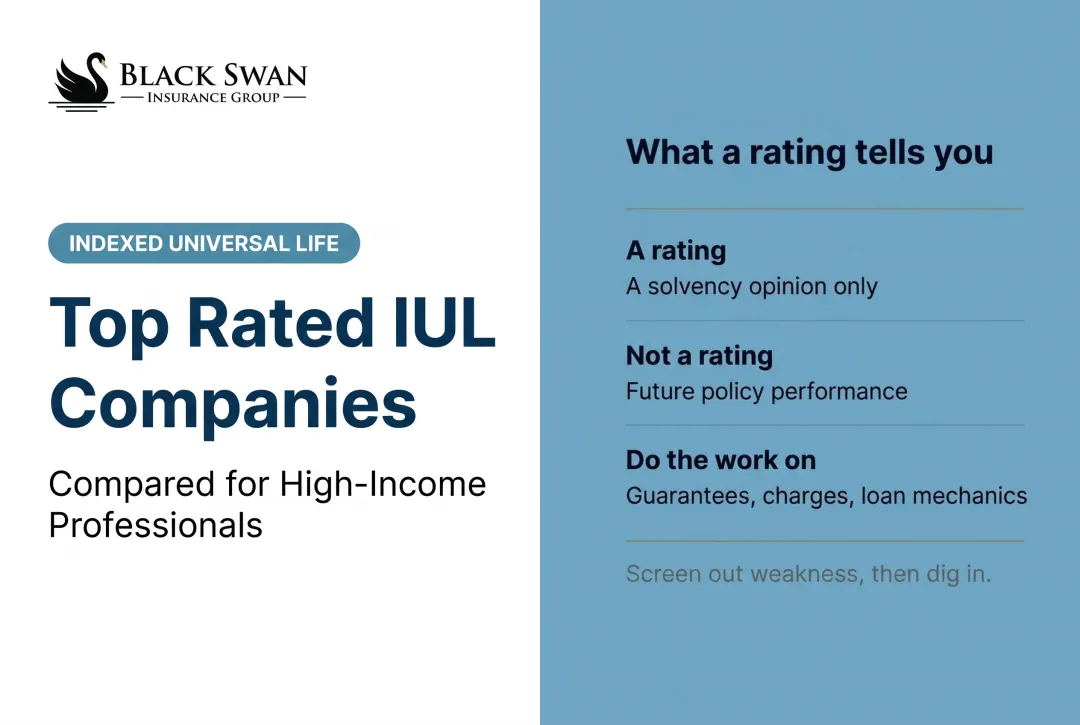
Financial strength. AM Best, S&P, Moody's and Fitch rate an insurer's ability to meet ongoing obligations, not product performance. A high rating suggests the carrier will still be paying claims in thirty years. It says nothing about whether a particular policy's caps or charges suit you. Different agencies use different scales — identical letters do not signal identical risk.
Complaint data. The NAIC's complaint index compares a carrier's share of complaints to its share of premiums for a coverage type and state, where 1.0 means complaints proportional to market share. The NAIC recommends searching by exact legal company name, state and insurance type over the past three years rather than relying on general reputation.
Policy economics: cost of insurance, premium loads, administrative and surrender charges, guaranteed against non-guaranteed cash value, and death-benefit flexibility.
Index-crediting mechanics: index selection, fixed-account alternatives, floors, caps, participation rates, spreads, and whether rate-change history is disclosed. That last one is underrated — a carrier's record of cutting caps on in-force policyholders is the closest thing to evidence of future behaviour you will find.
Loan and liquidity design: fixed against variable loan rates, participating loans, overloan protection, and how borrowing affects long-term sustainability.
Scenario stress-testing: lower crediting rates, interrupted premiums, rising insurance costs, and a compressed funding window for late-start buyers.
An illustration is a model, not a guarantee.
Every scenario was also compared against term insurance, whole life, 401(k) and IRA contributions, Roth strategies and taxable brokerage accounts. A policy that looks strong in isolation can still be the wrong tool beside a better-suited alternative.

Stronger Fit
- Earning $150K+ with surplus cash flow after reserves, debt and maxed retirement contributions
- A genuine permanent protection, business or legacy need
- Insurable at a reasonable rate class with a long funding horizon
- Willing to review the contract annually
Weaker Fit
Not everyone should buy one. Step back if an employer match is unclaimed, reserves are thin, liquidity is needed within a few years, income is unstable, or the protection need is temporary — term insurance is cheaper and does that job completely.
Risks to Understand Before You Choose a Company
- Carrier strength is not policy suitability. The two are routinely conflated in marketing.
- Caps and participation rates are non-guaranteed and can be reduced after issue within contract limits.
- Products get withdrawn, as Protective's Indexed Choice UL closure demonstrates.
- Riders have eligibility thresholds that may exclude you at the moment you need them.
- A loan can nullify a no-lapse guarantee on some contracts until repaid.
- MEC status is generally permanent and changes loan and withdrawal taxation.
- Lapsing with a loan outstanding can create taxable income with no cash received.
This is not set-it-and-forget-it. It is design-it, fund-it, review-it.
Find Out Where You Actually Stand
This starts with the Tax-Free Wealth Blueprint Fit Review. If you earn $150K+ and are choosing between companies, we define the objective first, run identical assumptions across carriers, read guaranteed values against illustrated ones, verify ratings and complaint data for the exact issuing entity, confirm current product availability, and stress-test each design through lower crediting, paused funding and extended loans. We explain compensation before anyone funds anything. If business succession, estate planning or retirement income is involved, we will tell you to bring in a tax or legal professional before signing. If IUL does not fit, we will tell you that too.
Frequently Asked Questions
What are the alternatives to indexed universal life insurance?
Term life offers temporary, lower-cost protection. Whole life and guaranteed universal life provide stronger guarantees. 401(k)s, IRAs and Roth accounts focus on retirement accumulation. Choose based on whether you need temporary coverage, guarantees, liquidity or tax-advantaged growth.
Which companies are most trustworthy?
Trustworthiness comes from financial-strength ratings, claims-paying history, complaint trends and policy transparency — not brand recognition. Check AM Best, S&P, Moody's, Fitch and NAIC complaint data for the exact issuing entity, which is often a subsidiary rather than the name on the brochure.
How does indexed universal life insurance work?
Premiums cover insurance costs and fund cash value, which earns interest linked to an index through floors, caps and participation rates. Fees, loans and withdrawals reduce value, and an underfunded policy can lapse.
What should I compare when choosing a company?
Financial strength, guaranteed values, charges, crediting methods, caps, participation rates, loan provisions, riders and state availability. Request stress-tested illustrations using identical assumptions across every carrier.
Is this a good fit for high-income professionals and business owners?
It can be, when you need permanent protection, have stable surplus cash flow, and keep adequate reserves after funding core retirement accounts. If not, term insurance or retirement accounts usually deserve priority.
Can a brokerage issue an indexed universal life policy?
No. A brokerage helps compare, design and place coverage. The licensed carrier issues the contract, sets credited rates, holds the obligations and pays claims. If anyone at a brokerage promises you a crediting rate, they are describing something they do not control.
Sources
- LIMRA — U.S. individual life insurance new premium tops $17.5 billion in 2025
- Pacific Life — Horizon IUL account guide
- AM Best — Pacific Life rating report
- NAIC — How to file and research complaints against insurance carriers
Disclosure: This article is educational and is not personal tax, legal or investment advice. Indexed universal life is life insurance first. Black Swan Insurance Group is an insurance brokerage and does not issue or guarantee any policy. Carrier products, riders, caps, participation rates, rating affirmations and state availability change frequently — products may be withdrawn from sale — and must be confirmed against current carrier materials before applying; ratings reflect an insurer's claims-paying ability, not the suitability of any contract. Illustrated values are not guarantees; actual results depend on policy terms, crediting, costs and funding. Any potential tax-advantaged access depends on the policy being properly structured, funded and managed. Actual results depend on policy design, carrier, crediting options, caps, participation rates, expenses, funding and ongoing management. This strategy is not appropriate for everyone. Policy loans and withdrawals reduce cash value and the death benefit, and can create tax consequences if the policy lapses or becomes a modified endowment contract. Consult your own tax, legal and financial professionals for advice specific to your situation.
And remember, it's not what you earn, it's what you keep… enjoy the ride.