By Robert Balgac, Founder, Black Swan Insurance Group | October 5, 2026
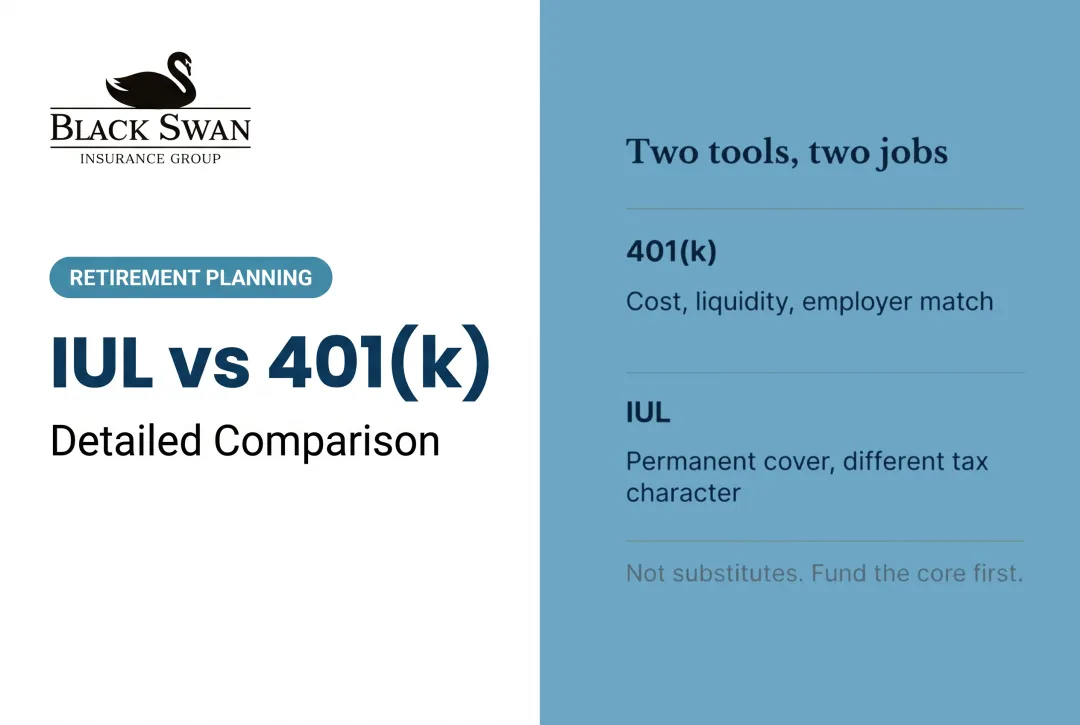
Ask ten advisors whether an IUL or a 401(k) is better and you will get ten answers, most of which miss the point. These two are not competing for the same job. One is built to accumulate assets. The other is life insurance first, with cash value as a design feature layered on top.
The question worth asking is not which one wins. It is what happens when every retirement dollar you own sits in the same tax bucket, and whether that concentration is a risk you meant to take.
The short answer: A 401(k) is an employer-sponsored retirement account built for accumulation, with contribution limits, market exposure and required distributions. An IUL is permanent life insurance with an index-linked cash value that may offer potential tax-advantaged access when properly structured, funded and managed. For most high earners this is not either/or — the 401(k) comes first, the employer match comes first of all, and an IUL is evaluated separately with surplus cash flow once a real protection need exists.
Key Takeaways
- A 401(k) is built for retirement accumulation; an IUL is life insurance first, with cash value as a design feature
- Capturing the full employer match is difficult for any insurance strategy to justify skipping
- Tax-deferred is not tax-free — traditional balances are generally taxable on the way out, and RMDs eventually force the timing
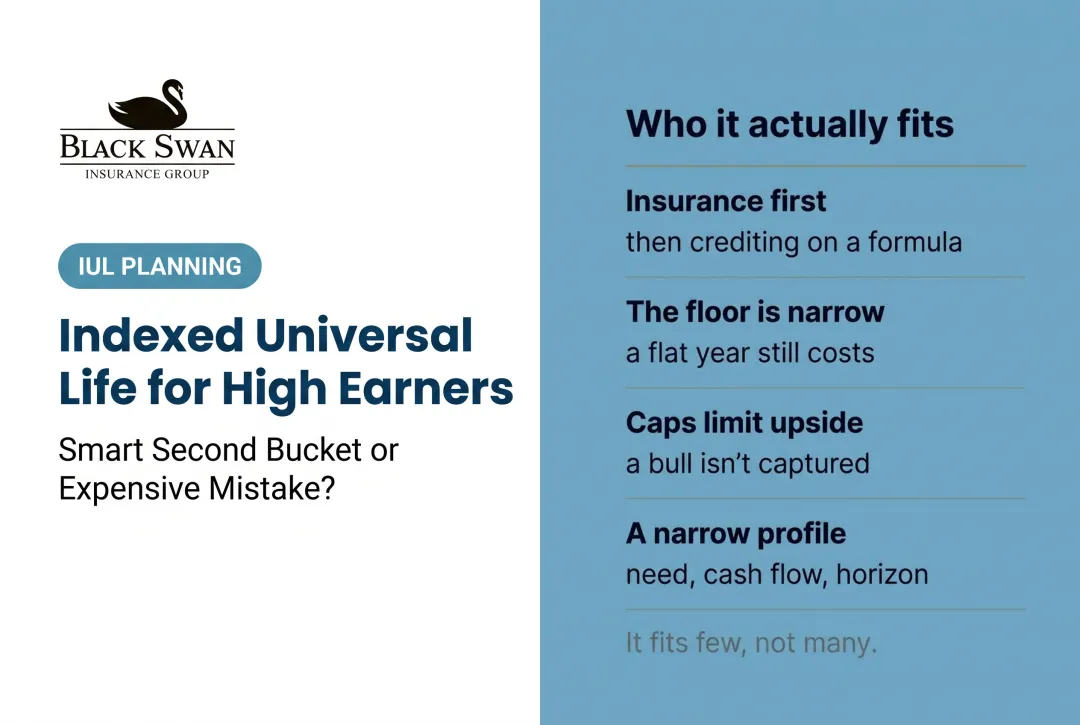
- Index crediting has a floor on the credit, not on the charges, and caps and participation rates are not fixed
- Most high earners coordinate both rather than choosing one, funding an IUL from surplus cash flow rather than redirected contributions
The Real Question Is Not 401(k) Versus IUL
A 401(k) exists to build retirement assets through your contributions, any employer match, and investment growth. An IUL exists primarily to pay a death benefit; cash-value accumulation is a feature of the contract, not its core function.
Your 401(k) can be a great player. It is not the whole offense.
The 401(k) is not the problem. Depending on it as the only bucket is where high earners get exposed — because every dollar in a traditional plan is taxed on the way out, at whatever rates exist then, on a schedule the IRS eventually sets for you.
| Factor | 401(k) | IUL |
|---|---|---|
| Primary purpose | Retirement asset accumulation | Death benefit first; cash value is secondary |
| Contribution limits | IRS annual deferral and combined caps | No IRS premium cap; policy design and tax-law limits apply |
| Growth and risk | Full market exposure and full market risk | Index-linked crediting with floor, cap and participation rate |
| Taxes and access | Traditional: pre-tax in, taxed out. Roth: after-tax in, tax-free qualified out | Tax-deferred growth; potential tax-advantaged access through loans and withdrawals when properly structured |
| Protection and RMDs | Generally no death benefit; traditional RMDs from about age 73 | Death benefit while in force; no 401(k)-style RMDs |
Contributions and Funding
The IRS caps 401(k) funding each year. For 2026, employees can defer $24,500, plus an $8,000 catch-up at age 50 or older. If you turn 60 through 63 this year, SECURE 2.0 raises that catch-up to $11,250. Combined employee and employer contributions max out at $72,000, or up to $83,250 with the enhanced catch-up, per the IRS retirement topics contribution guidelines.

An IUL has no IRS-imposed annual premium ceiling. Premiums must stay inside policy design limits and federal tax-law guardrails — including staying under the seven-pay limit that creates Modified Endowment Contract treatment — and funding has to stay strong enough to keep the contract in force for decades.
Growth and Market Exposure
Your 401(k) balance rises and falls with the investments you select inside the plan. Full market exposure, full market risk.
An IUL's cash value is not invested in an index. The index is a measuring stick. Crediting applies a floor, a cap and a participation rate. One structure noted by the NAIC's IUL Illustration Subgroup is a 0% floor with 100% participation on a capped index strategy.
Zero is your hero — but the floor applies to the credit, not to the charges. In a flat year the index credits nothing and the policy still bills cost of insurance, administration and riders.
Taxes and Access
- Traditional 401(k): contributions are pre-tax, withdrawals are taxed as ordinary income
- Roth 401(k): contributions are after-tax, qualified withdrawals come out tax-free
- IUL: cash value grows tax-deferred. Potential tax-advantaged access through policy loans and withdrawals depends on contract status, MEC status, basis, loan management and the policy staying in force
Tax-deferred is not tax-free. The IRS is waiting, not gone.
Protection, Costs and Required Distributions
A 401(k) generally carries no death benefit. It has investment and administrative fees, and traditional accounts face required minimum distributions from around age 73 under current law. Roth 401(k) accounts avoid lifetime RMDs.
An IUL provides a death benefit while the contract stays in force, along with insurance charges and an ongoing management requirement. It carries no 401(k)-style RMD.
What an Indexed Universal Life Policy Actually Is
An indexed universal life policy is permanent life insurance with a cash value bucket tied to index-crediting rules. It pays a death benefit to beneficiaries, and it builds cash value linked to an index without you owning shares of that index.
Every premium dollar splits three ways: policy costs, the death benefit, and cash value. That split is why early-year cash value looks thin next to a simplified retirement-account projection. Insurance costs front-load in a way a brokerage account does not.
Where an IUL Can Add Value
- Permanent protection that does not expire the way term does
- Tax-deferred cash-value accumulation inside the contract
- Potential policy-loan access for supplemental income, when the policy is healthy
- Tax diversification alongside a taxable and a tax-deferred bucket
The Trade-Offs
- Insurance charges and administrative fees reduce net crediting
- Caps and participation rates can change within contract limits over time
- Loan interest accrues on any policy loan taken
- Surrender charges apply if you exit early
- Lapse risk rises if premiums stop or funding falls short
That lapse risk is not theoretical. A Society of Actuaries and LIMRA study of universal life policies from 2015–2021 found higher early-year lapse rates by policy count than by amount for IUL policies without a secondary guarantee. Smaller policies lapsed more often than larger ones, and policies with a secondary guarantee performed better across nearly every policy year.

What the Critics Get Right
The IUL critics are not crazy, and pretending otherwise costs credibility. They are right that illustrations have been used as sales tools rather than models. They are right that fees and caps can quietly erase the advantage a brochure implies. And they are right that a policy sold to someone with no permanent insurance need is an expensive way to solve a problem they did not have.
Where the criticism stops short is assuming every policy is the same policy. Bad design is real. It is not the same thing as a bad tool. The question worth asking is not whether IUL is good or bad in the abstract, but whether a properly structured, funded and managed policy does a job your current buckets cannot.
Underfunded policies are where dreams go to become surrender charges. The biggest IUL mistake is not the index. It is underfunding.
What a 401(k) Does Well, and Where It Stops
A 401(k) is an employer-sponsored plan funded through payroll deduction, often with a match or profit-sharing contribution on top.
Why It Is the Right Default
- Contributions happen automatically, before the money can be spent
- Many employers offer a match, which is the closest thing to an immediate, unearned gain in the plan
- Contribution limits are higher than most other tax-advantaged accounts
- Traditional or Roth treatment is often available
Where It Stops
- Investment losses fall entirely on you
- Plan fees and investment menus vary widely by employer
- Traditional withdrawals are taxed as ordinary income
- Early withdrawals before 59½ generally add a 10% penalty, with limited exceptions
- Required minimum distributions eventually force withdrawals on someone else's schedule
None of that makes a 401(k) a bad tool. It makes it a tool built for one job: long-term accumulation with employer support. Useful does not mean complete.
The Ultimate IUL Blueprint
A plain-English walkthrough of how funding, design, loans and tax limits interact — including the questions to ask before you accept any illustration.
Which One Comes First for You
Decide from your own financial picture, not from a product ranking. Work through these before comparing anything:
- Are you capturing your full employer match?
- Is there high-interest debt that should be cleared first?
- Are emergency reserves actually in place?
- How much is already going into retirement accounts?
- Is there a genuine, ongoing life insurance need?
- What is your expected retirement income, tax position and liquidity requirement?
Stronger Fit for Prioritising the 401(k)
- An employer match you have not fully captured
- Straightforward accumulation is what you need, without added complexity
- Reasonable plan fees and a solid investment menu
- Permanent life insurance is not a current priority
Stronger Fit for Evaluating an IUL
- A clear, standalone need for permanent coverage
- Surplus cash flow remaining after core retirement savings and reserves
- A funding horizon long enough for the contract to mature
- A deliberate want for tax diversification or legacy protection beyond the 401(k)
- Willingness to review the policy annually rather than set it and forget it
Weaker Fit for an IUL Right Now
Not everyone should buy an IUL. Until the 401(k) is maxed and the match captured, this comparison is premature.
- Unstable income, or funding that only works when nothing goes wrong
- High-interest debt still running the household
- Thin or absent emergency reserves
- Money likely needed before the contract builds accessible value
- No permanent insurance need that stands on its own merits
- A need that is purely about maximum death benefit for the lowest premium — term insurance usually wins that comparison outright, and there is no reason to dress it up as anything else
Why Most High Earners Use Both
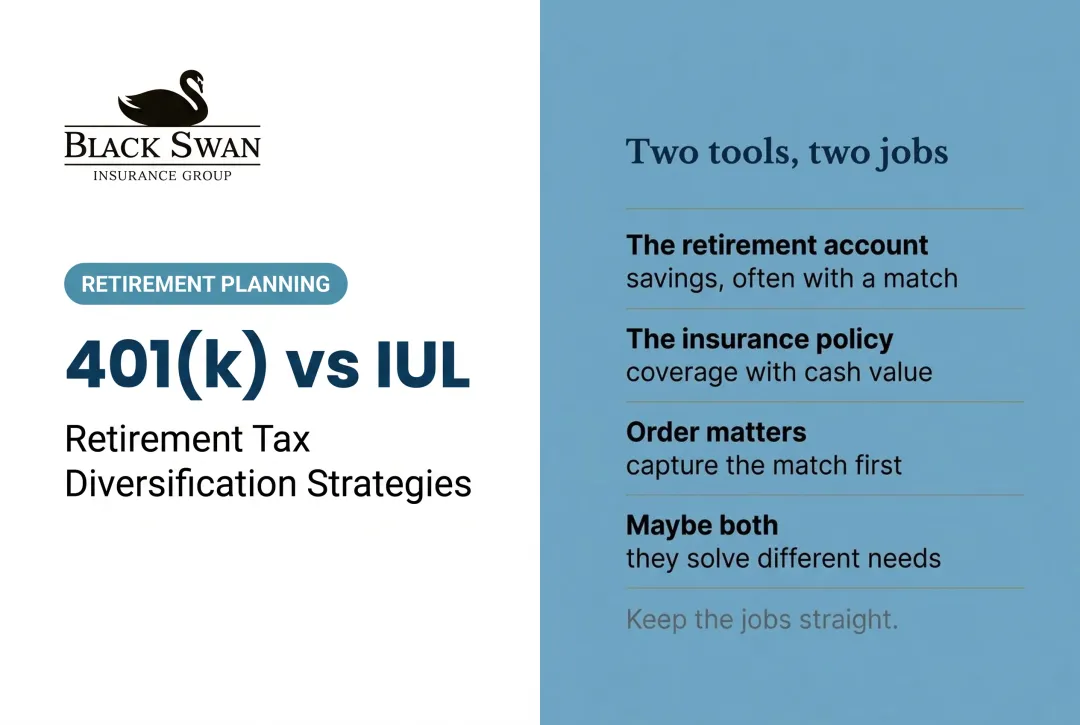
For most high-income households this is not either/or. A common sequence:
- Capture the full employer match
- Fund core retirement savings to plan targets
- Evaluate an IUL separately, with surplus cash flow
- Use the policy for permanent protection and optional supplemental income later

It is not 401(k) versus IUL. It is taxable, tax-deferred and tax-advantaged buckets doing different jobs at different times.
Stress-Test Before You Commit
- Guaranteed policy values against non-guaranteed, current-assumption values
- Conservative crediting scenarios against current crediting scenarios
- Whether premiums stay affordable if income or budget changes
- What happens to the death benefit and cash value if you take policy loans
- Lapse risk under a worst-case funding scenario
- What those same dollars could accomplish elsewhere
A Hypothetical Late-Start Scenario
The following is a hypothetical illustration, not an actual client case, and is provided for educational purposes only.
Consider a 52-year-old physician earning $310,000 a year. She began contributing seriously to her 401(k) at 38, already captures her full employer match, and holds roughly $650,000.
She is healthy, keeps six months of reserves, and has about $2,500 a month of surplus cash flow after other priorities. She carries a $1.2 million mortgage, wants permanent coverage for her spouse, and needs tax diversification — most of her retirement savings sits in tax-deferred accounts.
- 401(k): already optimised for match and contribution limits
- Permanent insurance need: clear and unmet
- Surplus cash flow: sufficient to fund a policy without straining the budget
- Time horizon: roughly 13 years to typical retirement age. Workable, but compressed
- Insurability: favourable at her current age and health
Under this profile, an IUL funded from surplus cash flow — not from redirected 401(k) contributions — can reasonably supplement the plan. Someone with less surplus, no clear insurance need, or an unfunded emergency reserve would get a different answer.

Same premium. Different design. Completely different outcome. The right answer depends on her numbers, not on a generic ranking of products.
Risks to Understand Before You Fund Anything
- Charges apply every year, including zero-credit years. Insurance, administration and rider charges reduce policy value even when the index credits nothing.
- Caps, participation rates and current charges are not fixed. Carriers may adjust non-guaranteed elements within contract limits. Read the guaranteed column, not only the illustrated one.
- Underfunding is the most common failure mode. Reduced or missed premiums slow cash-value growth and raise lapse risk, particularly in early years.
- A lapse or surrender with gain and an outstanding loan can create taxable income — potentially with no cash received to pay it.
- Crossing the seven-pay limit changes distribution taxation. MEC treatment is technical and not casually reversible (I.R.C. § 7702A; Rev. Proc. 2008-39).
- An IUL does not replace a qualified plan. It is generally discussed as a supplemental bucket after alternatives, starting with the employer match, have been evaluated.
Find Out Where You Actually Stand
This starts with the Tax-Free Wealth Blueprint Fit Review. If you earn $150K+ and want to know whether an IUL belongs alongside your 401(k), we review income, funding capacity, timeline, protection need and existing coverage, then stress-test the funding, fees, loan assumptions and lapse risk against your own numbers. If it does not fit, we will tell you that too.
Frequently Asked Questions
Is an IUL better than a 401(k)?
They answer different questions, so it is not a straight comparison. A 401(k) prioritises employer matching and accumulation; an IUL adds permanent protection, potential cash-value access, and a different cost and tax profile. Capturing an available match is difficult for any insurance strategy to justify skipping.
Can I have an IUL and a 401(k) at the same time?
Yes, and most people who hold both use them for different jobs. Affordability and coordination are what matter, so review the fit before committing funding to a long-term premium.
Should I stop my 401(k) to fund an IUL?
That is rarely the right sequence, particularly while an employer match is unclaimed. An IUL is generally funded from surplus cash flow rather than redirected retirement contributions.
What are the biggest risks of using an IUL for retirement income?
Lapse from underfunding, shifting caps or crediting terms, ongoing insurance charges, and loan interest that reduces cash value and death benefit. A lapse or surrender with an outstanding loan can also create a tax bill.
How much will $100,000 in a 401(k) grow in 20 years?
Growth depends on contributions, allocation, fees and market returns over the period. Run projections under several conservative and moderate assumptions rather than relying on one optimistic figure.
Does an IUL have required minimum distributions?
No. An IUL carries no 401(k)-style RMD. Traditional 401(k) balances are generally subject to RMDs from around age 73 under current law, while Roth 401(k) accounts avoid lifetime RMDs.
Sources
- IRS — Retirement Topics: Contributions — 2026 deferral, catch-up and combined limits
- NAIC IUL Illustration Subgroup — floor, cap and participation structures
- Society of Actuaries and LIMRA, 2015–2021 UL Lapse Rate Study — early-year lapse rates with and without secondary guarantees
- I.R.C. § 7702A — Modified Endowment Contract and the seven-pay test
- Rev. Proc. 2008-39 — IRS correction procedure for inadvertent MECs
- NAIC, Life Insurance Illustrations Model Regulation (Model #582) — annual reports and non-guaranteed element disclosure
Disclosure: The information on this page is educational in nature and does not constitute personalized financial, tax, or legal advice. Life insurance products vary by carrier, state, and individual underwriting. Policy performance depends on actual credited interest, charges, and premium consistency — not illustrated projections. Consult a licensed insurance professional and, where appropriate, a tax or financial advisor before making any insurance or financial decision. Policy loans and withdrawals reduce cash value and the death benefit, and can create tax consequences if the policy lapses or becomes a modified endowment contract. Indexed universal life is life insurance first. Illustrated values are not guarantees; actual results depend on policy terms, crediting, costs and funding. This strategy is not appropriate for everyone.
And remember, it's not what you earn, it's what you keep… enjoy the ride.