By Robert Balgac, Founder, Black Swan Insurance Group | October 5, 2026
Borrowing against a policy is the part of an IUL that gets sold hardest and inspected least. The pitch is simple: access your cash value, pay no tax, skip the credit check. The part that gets skipped is what the loan does to the policy underneath it.
A policy loan is real borrowing. Interest accrues whether or not you pay it, the death benefit drops by the balance, and insurance charges keep running the whole time. None of that makes a loan wrong. It makes it a decision that has to be modelled before it is taken.
The short answer: An IUL policy loan lets you borrow against accumulated cash value without selling assets or passing a credit check. Loan proceeds are generally not taxable while the policy stays in force. If the policy lapses or is surrendered with a loan outstanding and gain in the contract, the forgiven balance can become taxable income — potentially with no cash received to pay the bill. Request an in-force illustration showing guaranteed and non-guaranteed values before you borrow.
Key Takeaways
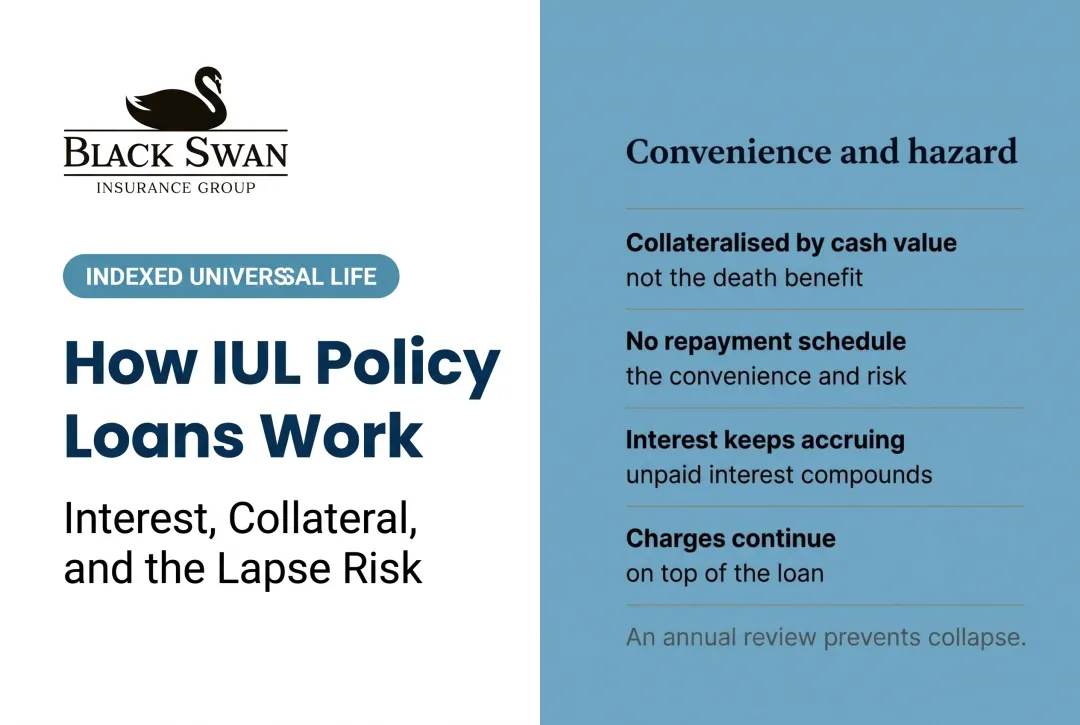
- A policy loan is secured by cash value, not the death benefit, and the two are different numbers on your statement
- Interest accrues even when you make no payments, and insurance charges continue regardless of the loan
- The floor protects the index credit, not the policy — a loaned policy can still lose ground in a flat year
- A lapse or surrender with gain and an outstanding loan can create taxable income with no cash attached to pay it
- Request an in-force illustration at guaranteed and reduced non-guaranteed values before borrowing, not the original sales projection
What an IUL Policy Loan Actually Is
An IUL is permanent life insurance first. The cash value you borrow against is a feature of that contract, not a savings account sitting beside it — which is why a loan has to be judged by what it does to the insurance, not just by what it puts in your hand.
An IUL policy loan is money advanced by your insurer using your policy's cash value as collateral. It is not a withdrawal, and it does not come out of the death benefit directly.
The NAIC describes cash value as premiums paid minus fees and insurance costs — the same asset a policy owner can borrow against (NAIC). Four numbers on your statement look similar and are not interchangeable. Confusing them is where borrowing decisions go wrong.
Four Values You Need to Separate
- Death benefit — what beneficiaries receive; you cannot borrow from it directly
- Accumulated cash value — the total living value built inside the policy
- Cash surrender value — cash value minus surrender charges, if you closed the contract today
- Net available loan value — what the insurer will actually advance, generally cash value less surrender charges and existing debt
Why Index Crediting Is Not a Market Return
Your cash value is not invested in an index. The index is a measuring stick. Its movement determines how much interest is credited, subject to a floor (commonly 0%), a cap that limits the upside, and a participation rate that sets your share of the movement.
Zero is your hero — but the floor applies to the credit, not to the charges. In a flat year the index credits nothing and the policy still bills you.
Carriers differ on which buckets a loan is drawn from. Some pull from fixed and declared-rate value first and only reach indexed accounts if those run short. That provision is contract-specific, so read your own loan and allocation language rather than a general rule.
A loan is not evidence the policy is healthy. It means value is available. The balance, the rate charged, your ongoing funding, and the policy charges all have to be watched together, because any one of them drifting increases lapse risk.
How Much You Can Borrow, and How to Request It
There is no universal percentage. Capacity depends on the insurer's calculation of available value less collateral requirements — not on the size of your death benefit.
Guardian notes that owners typically cannot borrow more than 90% of current cash value, though rules vary by carrier (Guardian). Treat that as one company's benchmark, not an industry standard.
What to Gather Before You Request Funds
- Current cash value and cash surrender value
- Any existing loan balance and accrued interest
- Surrender charges still in effect
- Minimum and planned premium amounts
- Your policy's maximum loan provision
The Request Process
- Confirm eligibility — check the policy holds enough available value to support the loan
- Contact your insurer or broker — review the loan provision and current values together
- Submit the request — specify loan type and whether the amount is gross or net
- Verify delivery instructions — confirm where and how funds are sent
- Retain documentation — keep the request and the stated terms on file

Processing times vary by carrier, policy status, and whether extra verification is needed. National Life states that loan processing may take up to 3–5 business days once all required information is received (National Life Group). Confirm your own carrier's timeline before you count on the money.
Policy loans generally skip traditional credit underwriting. The policy still needs enough value and enough funding to keep paying its own charges.
Five Questions to Ask Before You Sign
- What is the current loan rate, and can it change?
- How does interest accrue — daily, monthly, or annually?
- Does the loan change the interest credited to the remaining cash value?
- Is repayment required, or can the balance be carried?
- What happens to the loan if I surrender, or if the policy lapses?
Run the answers against your own illustration before you request funds, not after.
Where Policy Loans Go Wrong
The flexibility is real. Funds can be used for any purpose, there is no underwriting, and you reach liquidity without selling assets or giving up coverage. The costs are equally real.
- Interest keeps accruing even when you make no payments
- Net cash value and death benefit fall as the balance grows
- Insurance charges still run whether or not you repay
- Crediting can slow, which slows any recovery in value
- Lapse risk rises when debt outpaces available value
What the Critics Get Right
The people who warn about IUL loans are right about three things, and it is worth saying so plainly. Illustrations have been used to sell borrowing strategies that were never stress-tested. Some policies were funded too thinly to survive a loan at all. And a number of owners were told the money was tax-free without being told what has to stay true for that to hold.
Where the criticism overshoots is treating the loan itself as the defect. The loan is not the problem. The unmanaged loan is the problem. What separates the two is funding, design and whether anyone reviews the policy after the sale.
The Lapse Sequence
An outstanding loan is a liability against the contract. When cash value and premium funding cannot cover ongoing charges plus accruing interest, the policy moves toward lapse. Under many contracts, if policy debt exceeds accumulated value less surrender charges, the contract terminates and coverage ends. The exact trigger is contract-specific — check yours.

The tax-free loan story breaks if the policy collapses with loans outstanding. That is the trap: the tax bill arrives at the exact moment the asset disappears.
Tax Treatment
Potential tax-advantaged access through loans and withdrawals exists only when the policy is properly structured, funded, and managed. While the policy stays in force, loan proceeds are generally not treated as taxable income. That changes on a lapse or surrender with debt outstanding, where amounts exceeding your basis become taxable.
Modified Endowment Contracts follow different rules. If a policy crosses the seven-pay limit under I.R.C. § 7702A, loans and withdrawals are taxed on a last-in-first-out basis — gains come out as ordinary income before basis — and an additional 10% federal tax may apply before age 59½ unless an exception applies (I.R.C. § 72). Crossing that line is not casually undone; any correction process is specialised and issuer-led (Rev. Proc. 2008-39).
This is educational information, not tax advice. Confirm your policy's MEC status and review the numbers with a tax professional.
Ask for the Illustration Before the Money
Request an in-force illustration showing:
- Guaranteed and non-guaranteed values
- Projected loan balance and the interest assumption behind it
- Premium requirements going forward
- Death benefit outcomes under more than one scenario
Do not buy the highlight reel. Watch the game film. Lower crediting, higher charges, a rising loan rate or reduced funding each change the outcome in ways a best-case projection will not show you.
Loan or Withdrawal: They Are Not the Same Decision
A loan borrows against cash value and accrues interest; the policy stays in force and many contracts let you repay on your own schedule. A withdrawal permanently removes value under the policy's withdrawal provisions.
| Feature | Policy Loan | Withdrawal |
|---|---|---|
| Repayment | Optional in many contracts | Not applicable — the value is gone |
| Interest | Accrues on the outstanding balance | None |
| Death benefit impact | Reduced by the outstanding balance | Reduced permanently |
| Typical tax treatment | Generally not taxable while in force | Generally tax-free up to basis paid in |
| Lapse risk | Rises if debt exceeds available value | Rises if the withdrawal is excessive |
Exact treatment depends on your contract and the policy's status. Confirm loan interest, withdrawal limits and tax handling with your carrier before moving any cash.
Compare It Against the Alternatives
A policy loan should be measured against the other places the money could come from:
- A bank loan or line of credit — rate, covenants, approval time
- Home equity borrowing — rate, and the risk attached to the property
- Securities-based lending — margin calls and market exposure
- A business line of credit — personal versus business liability
- A 401(k) loan — repayment terms, the effect on retirement contributions, and what happens if you leave the employer
- Existing cash reserves — the opportunity cost of spending dry powder
Premium Financing Is a Different Thing
Borrowing from an existing IUL is not premium financing, where an outside lender advances funds to pay ongoing premiums. Premium financing adds leverage, lender terms, interest-rate risk and separate collateral requirements. It is a different strategy carrying different risks, not a variation on a policy loan.
The Ultimate IUL Blueprint
A plain-English walkthrough of how funding, design, loans and tax limits interact — including the questions to ask before you accept any illustration.
Who a Policy Loan May Fit
Stronger Fit
- A real liquidity need with a defined purpose, not a convenience spend
- Illustrated values showing the policy can carry the loan without drifting toward lapse
- A total cost that genuinely beats bank debt, home equity and spending reserves
- Acceptance of how an unpaid balance changes the death benefit for beneficiaries
- A planned retirement-income strategy supported by adequate policy values
- Willingness to review the balance and the policy every year
Weaker Fit
Not everyone should buy an IUL. A policy bought primarily for the loan feature is the single most common version of this that fails.
- Limited cash value or tight premium capacity
- Unstable income, or funding that only works when nothing goes wrong
- An already high existing loan balance
- No clear repayment intention
- Underperforming crediting that has not been stress-tested
- A strong need to preserve the full death benefit for beneficiaries
- A need that is really about cheap temporary coverage — term insurance is the cleaner answer, and borrowing is not a reason to hold a permanent policy you did not otherwise need
Late-start high earners face a shorter runway. If you are building cash value later in your career, weigh the funding time the policy needs, your insurability, near-term liquidity and the alternative income tools before assuming a loan strategy fits your timeline.
The product is not the strategy. The design is the strategy. Two people can hold the same policy and only one of them can safely borrow against it.
Managing the Loan After the Funds Arrive
Getting the money is the easy part. What follows decides whether the coverage survives it.
Monitor It
- Review the loan balance and accrued interest at least annually
- Confirm premiums are still being paid as required
- Check whether the loan is eroding the projected death benefit or the cash-value trajectory
Choose a Repayment Approach
- Pay interest only to stop the balance compounding
- Make partial principal payments as cash flow allows
- Repay in full when it is possible
- Carry the balance deliberately, only once you understand the long-term tradeoff
Stress-Test It Every Year
Request a current statement and a fresh in-force illustration each year, then test the numbers against lower credited interest than projected, a higher loan rate, reduced premium payments and a longer loan duration.

Any repayment plan should account for cash flow, tax position and beneficiary objectives — and should assume the loan will not be repaid exactly as first planned.
Risks to Understand Before You Borrow
- Interest accrues whether or not you pay it. The balance compounds against the policy, and insurance charges continue on top of it.
- The floor protects the credit, not the charges. In a zero-credit year the policy still bills cost of insurance, administration and rider charges, so cash value can fall.
- Caps, participation rates and current charges are not fixed. Carriers may adjust non-guaranteed elements within contract limits. Read the guaranteed column, not only the illustrated one.
- A lapse or surrender with gain and an outstanding loan can create taxable income — potentially with no cash received to pay it.
- Crossing the seven-pay limit changes distribution taxation. MEC treatment is technical and not casually reversible (I.R.C. § 7702A; Rev. Proc. 2008-39).
- Surrender charges vary by carrier and product. Confirm the exact schedule in your own contract rather than assuming a standard one.
Find Out Where You Actually Stand
This starts with the Tax-Free Wealth Blueprint Fit Review. If you earn $150K+ and are weighing a policy loan, we test the loan balance, the funding, the crediting assumptions, MEC status and lapse risk against your own contract before discussing whether borrowing belongs in the plan. If it does not fit, we will tell you that too.
Frequently Asked Questions
Can I borrow from my IUL policy, and how does the loan work?
Yes. Eligible owners can borrow against available cash value, with the insurer holding the policy as collateral. Your contract sets the limits, the rate and how interest is handled.
How much can I borrow against my IUL policy?
It depends on available cash value, existing debt and insurer rules. There is no universal percentage. Check your current values or ask your carrier directly.
Do I have to pay back an IUL loan?
Many policies do not require a fixed repayment schedule. Interest still accrues, and an unpaid balance reduces the death benefit and raises lapse risk over time.
Is it smart to borrow against life insurance?
It can be, when the policy is healthy, the loan cost is clear and there is a repayment plan. Request an in-force illustration and compare the other liquidity options before you borrow.
What is the difference between a policy loan and a withdrawal?
A loan is borrowed against cash value and accrues interest. A withdrawal permanently removes value. Interest, death benefit impact and tax treatment all depend on your specific contract.
Can a policy loan actually cause the policy to lapse?
Yes. If the loan balance plus accruing interest outpaces available value and funding, the contract can terminate. That is the scenario worth modelling before borrowing, not after.
Sources
- NAIC — Life Insurance — cash value and policy loan definitions
- Guardian — typical borrowing limits against cash value
- National Life Group — loan processing timelines
- I.R.C. § 7702A — Modified Endowment Contract and the seven-pay test
- I.R.C. § 72 — additional tax on early distributions
- Rev. Proc. 2008-39 — IRS correction procedure for inadvertent MECs
- NAIC, Life Insurance Illustrations Model Regulation (Model #582) — in-force illustrations and non-guaranteed element disclosure
Disclosure: The information on this page is educational in nature and does not constitute personalized financial, tax, or legal advice. Life insurance products vary by carrier, state, and individual underwriting. Policy performance depends on actual credited interest, charges, and premium consistency — not illustrated projections. Consult a licensed insurance professional and, where appropriate, a tax or financial advisor before making any insurance or financial decision. Policy loans and withdrawals reduce cash value and the death benefit, and can create tax consequences if the policy lapses or becomes a modified endowment contract. Indexed universal life is life insurance first. Illustrated values are not guarantees; actual results depend on policy terms, crediting, costs and funding. This strategy is not appropriate for everyone.
And remember, it's not what you earn, it's what you keep… enjoy the ride.