By Robert Balgac, Founder, Black Swan Insurance Group | October 9, 2026
This is the line-item version. Not the summary, not the metaphor — the actual rules, limits, vesting schedules, crediting mechanics and failure modes of both instruments, laid beside each other so a $150K+ earner can stop arguing about which one "wins" and start checking which one does what.
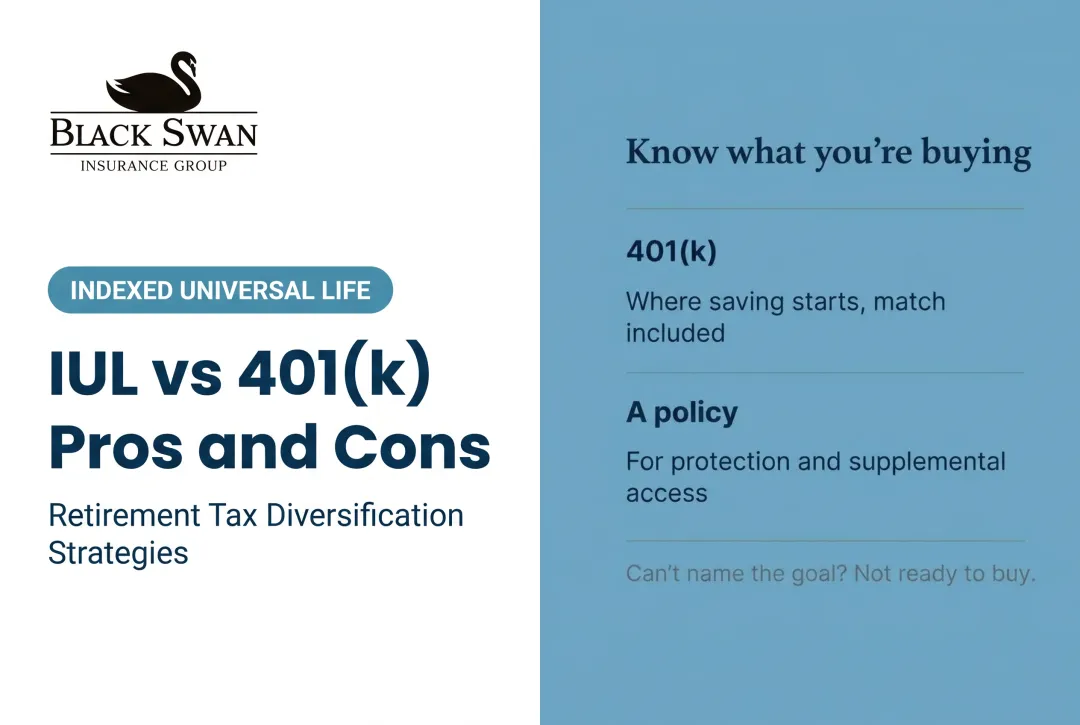
The reason the detail matters: most people compare these two on projected ending balances, and a projected ending balance is the single least reliable number in either document. A 401(k) is a qualified retirement account built for long-term investing. An indexed universal life policy is permanent life insurance with a cash-value component that may credit interest based on an index. Choosing on growth charts alone means overlooking employer matching, underwriting, policy charges, contribution rules and what happens if a contract lapses.
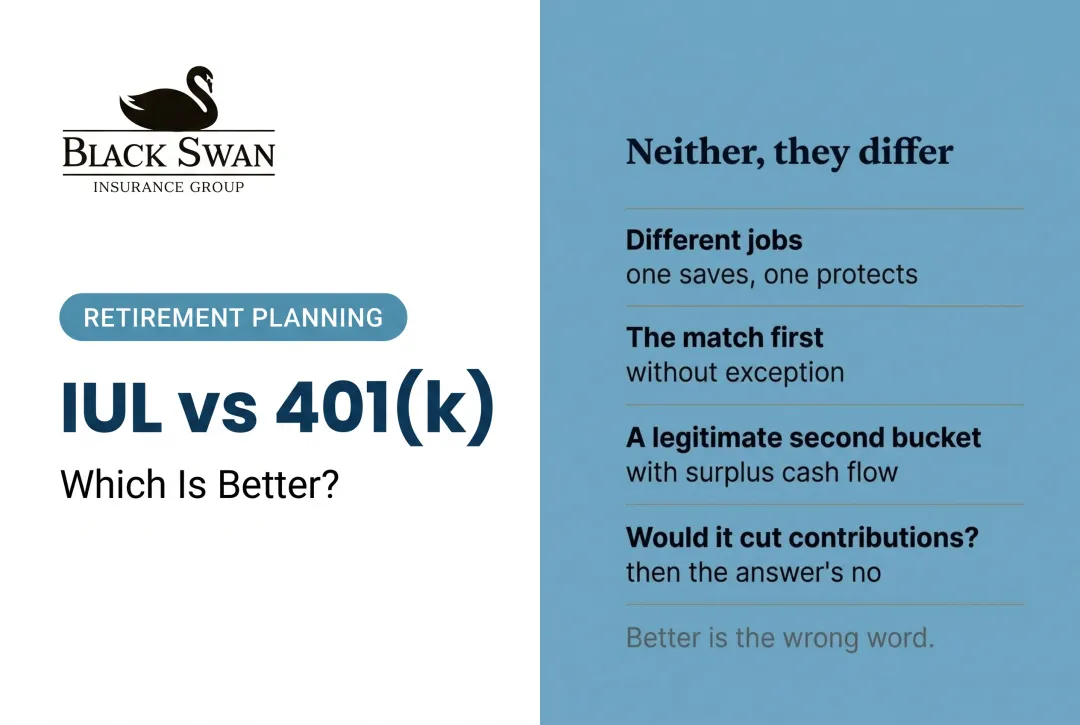
The short answer: These are not substitutes and the detailed comparison proves it rather than resolving it. A 401(k) wins decisively on cost, liquidity and the employer match. A policy adds a permanent death benefit and a different tax character, at materially higher cost and with ongoing management obligations. Capture the match, fund the core, then decide whether the second instrument solves a problem you actually have.
The 401(k) is not the villain. A one-bucket retirement plan is the villain.
Key Takeaways
- A 401(k) builds retirement savings, often with an employer match; a policy pairs permanent coverage with potential cash-value growth
- Compare total costs, tax treatment, access rules, crediting mechanics and death benefits — not projected balances
- Treat non-guaranteed illustrations as models, and review guaranteed values, caps and lapse scenarios separately
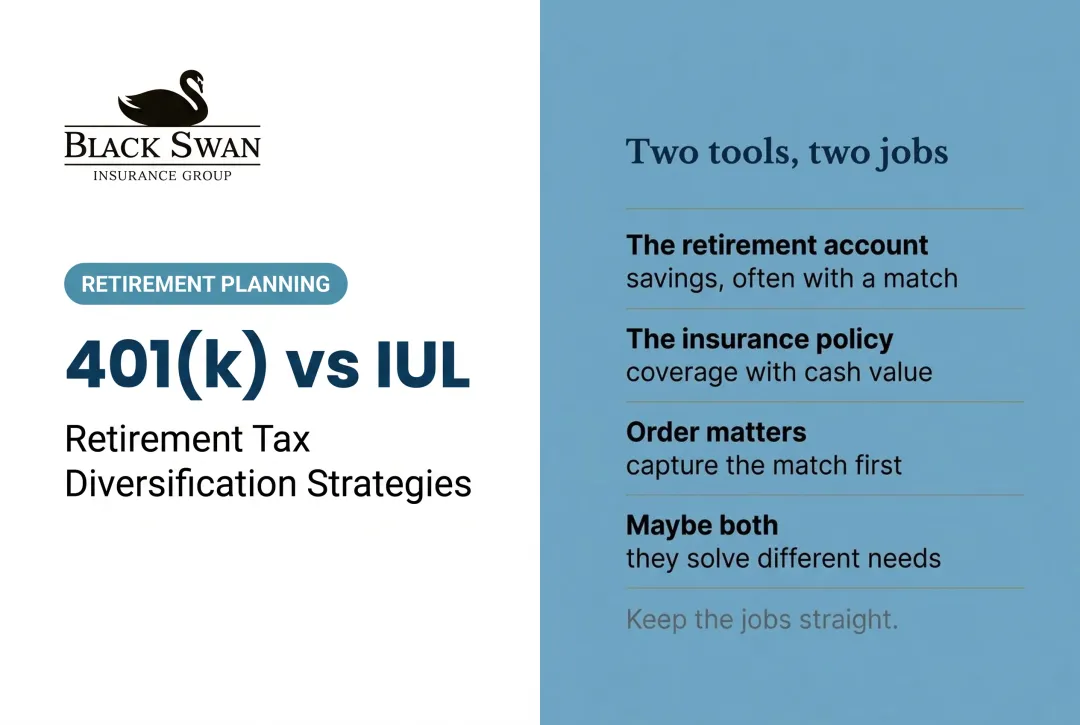
- Most plans work better using both for different jobs than swapping one for the other
- Nothing in an insurance contract replicates an employer match
Funding and Contribution Limits
Policy premiums are based on design, age, health, underwriting and coverage amount rather than a standardised cap. Overfunding past the IRS seven-pay test triggers modified endowment contract status, which changes how loans and withdrawals are taxed (IRS Revenue Ruling 2007-38).
401(k) limits for 2026, per IRS Notice 2025-67:
- Employee elective deferral: $24,500
- Standard catch-up, age 50+: $8,000
- Catch-up for ages 60–63: $11,250
- Combined employer and employee annual-additions limit: $72,000, or 100% of compensation if less, excluding catch-up contributions
The $72,000 figure is the ceiling for total annual additions including employer money. It is separate from your personal elective deferral limit, and high earners routinely conflate the two.
Growth and Risk Mechanics
Policy crediting depends on four moving parts:
- Cap — the maximum interest credit for a given period
- Participation rate — the percentage of index movement used in the calculation
- Spread — an amount subtracted from index gains before crediting
- Floor — typically 0%, meaning the index credit itself will not go negative
A floor does not mean cash value cannot decline. Cost-of-insurance charges, administrative fees and loan interest can still reduce it in a year with a zero index credit (Guardian Life).
Zero is your hero in a down year — but the floor applies to the credit, not to the charges.
A 401(k) has no cap on gains and you carry full market risk. A bad year in the S&P 500 is felt directly in your balance, undiluted.

Taxes and Access
| Feature | Traditional 401(k) | Roth 401(k) | IUL |
|---|---|---|---|
| Contribution tax treatment | Pre-tax | After-tax | Premiums paid with after-tax dollars |
| Distribution tax treatment | Taxable | Tax-free if qualified | Loans generally not currently taxed if in force and not a MEC |
| Early access penalty | 10% before 59½, with exceptions | Same as traditional for earnings | No IRS early-withdrawal penalty, but loans accrue interest and surrender charges may apply |
| RMDs | Begin around age 73–75 | None for original owner | None |
A 401(k) hardship withdrawal is still taxable income and may still trigger the 10% penalty unless a specific exception applies. Hardship status alone is not an automatic waiver (IRS).
On the protection side: a policy pays a death benefit to beneficiaries, generally income-tax-free. Outstanding loans reduce that payout, and if the policy lapses with a loan balance the gain can become taxable income. A 401(k) has no built-in death benefit — beneficiaries inherit the balance and owe tax on pre-tax dollars as they distribute.
The Fundamentals Behind the Numbers
How a Policy Is Built
Three moving parts: a permanent death benefit, a cash-value account, and a crediting method tied to an index. The insurer does not invest your premiums in the market. It uses options strategies to fund the crediting formula within the caps and participation rates the contract sets.
This is where illustrations mislead. Carrier projections show hypothetical future values based on assumed crediting rates. The NAIC requires illustrations to separate guaranteed from non-guaranteed values precisely because the non-guaranteed figures are not locked in at issue.
Ask up front: request both the guaranteed minimum scenario and the illustrated scenario. If an agent shows you only one number, ask why — and keep asking until you get the ledger.
An illustration is a model, not a guarantee.
How a 401(k) Is Built
Employees defer a percentage of salary, pre-tax or Roth, into options chosen from the plan menu. Employers may match or add profit-sharing dollars. Three mechanics matter more than most people realise:
- Vesting. Employee deferrals are always 100% yours. Employer contributions may vest on a three-year cliff or a six-year graded schedule (IRS).
- Rollovers. A direct rollover moves funds to another eligible plan without withholding. Taking cash instead triggers mandatory 20% withholding and possible penalties.
- Early-distribution exceptions. Death, disability, substantially equal periodic payments and separation from service at or after 55 can avoid the 10% penalty (IRS).
Why the Purpose Gap Matters
Comparing the two on hypothetical ending balances misses the point entirely. A 401(k) should be evaluated as a retirement account: fees, investment menu, employer match. A policy should be evaluated as insurance that happens to build cash value: underwriting, cost of insurance, policy charges.
If you need temporary income replacement — until the children are through college, say — compare term life against a policy, not a 401(k). If you need permanent coverage, the real question is whether you can sustain premiums for decades, not whether year one looks attractive.
The same policy-first lens applies to the floor. It protects credited index performance only. It does not protect against mortality charges, administrative fees or loan interest reducing actual cash value.

The Ultimate IUL Blueprint
If you have worked through the line items and want to know what a defensible design looks like, the Blueprint covers funding levels, charges, the MEC line, loan timing and what to demand from an illustration.
What the Critics Get Right
The detailed comparison is where the criticism of IUL is at its most persuasive, because the details are not flattering.
Plan-level investment costs are measured in basis points; policy costs in early years are measured in percentage points of premium. The match is a return the insurance industry cannot manufacture. Surrender charges can lock you in for a decade. Caps can be cut after issue. And the product is routinely sold to people who have not maxed their plan, by someone paid on the premium.
None of that is unfair. What it does not resolve is the position of someone who has already maxed everything, cleared the Roth phase-out, and now holds a retirement balance sheet in which one legislative change rewrites the plan. For that person the comparison is no longer "which instrument is cheaper" but "what does a second tax character cost, and is it worth it". Sometimes the answer is still no. A taxable brokerage account is a perfectly respectable second bucket and costs a fraction as much.
Stronger Fit
A policy is worth evaluating when:
- You have a legitimate permanent death-benefit need, not a "someday" intention
- You earn $150K+ with stable surplus cash flow beyond core retirement savings
- Your health supports favourable underwriting
- Your horizon is long enough to absorb early policy costs
- You want supplemental tax-advantaged access alongside other accounts
Weaker Fit
It is a poor fit — and not everyone should buy one — when:
- You need maximum short-term liquidity
- You have no actual permanent insurance need
- You are relying on optimistic non-guaranteed projections as if they were promises
- Funding the premium means cutting 401(k) contributions or emergency savings
The Both/And Sequence
Most households do not choose. The common sequence: capture the match first, then evaluate whether a policy adds protection or tax diversification without displacing core savings or reserves. Use that as the starting framework, then stress-test the maths against your match, reserves, insurability and horizon.

The Due-Diligence Checklists
Evaluation sequence
- Identify your retirement income goal — what income, from how many sources?
- Calculate current savings and surplus cash flow — what is actually left after existing obligations?
- Review employer-plan benefits — match formula, vesting schedule, fund fees
- Determine the insurance need and its duration — temporary (term) or permanent?
- Assess health and insurability — underwriting affects both cost and availability
- Compare alternatives — Roth IRA, brokerage account, whole life, annuities
Before you sign a policy
- Guaranteed versus non-guaranteed values in the illustration
- Current and guaranteed caps and participation rates
- Spread charges, if applicable
- Cost of insurance and administrative fees
- Surrender charge schedule and duration
- Loan interest rate and how loans affect the death benefit
- Premium flexibility and minimum funding requirements
- MEC risk if premiums are increased or accelerated
- Death-benefit options, level versus increasing
- The specific conditions that could cause a lapse
Two Fact Patterns
The late-start high earner. A hypothetical 52-year-old physician who spent a decade on loans before earning power arrived, with roughly 13 years to a target retirement age. Sustainable funding matters more than maximum illustrated growth; existing accounts need a fresh look for gaps; insurability is time-sensitive because health changes close the window; and liquidity needs — tuition, aging parents — compete with premiums. Illustrative, not a predicted result.
The business owner. Most net worth sits inside the company. Different tools cover different parts of that risk: a 401(k) for tax-deferred savings kept separate from the business, term insurance for affordable coverage while debt is outstanding, permanent insurance for long-term protection plus potential supplemental cash value, and succession planning for the company itself. A policy does not replace any of these. It is one piece among several.

One published industry example describes a simple order: fund the 401(k) through the match, continue to the contribution limit, then direct additional savings toward a policy (Ethos). The rationale is tax diversification and permanent coverage, not a documented performance outcome. Treat it as a sequencing idea, not proof the order suits everyone.
Risks to Understand Before You Commit
- Opportunity cost — a premium dollar is not a matched dollar, and the match is the highest-certainty return in this entire comparison.
- Front-loaded charges mean early-year cash value often sits well below premiums paid.
- Caps and participation rates can be reduced going forward, subject to contract minimums.
- Surrender charges can run a decade or more.
- Underfunding causes lapse, and a lapse with an outstanding loan can produce taxable income with no cash received.
- MEC status is generally permanent and removes the living-access advantage.
- The 401(k) is not risk-free either: market exposure, a single tax treatment and mandatory distributions from 73.
Find Out Where You Actually Stand
This starts with the Tax-Free Wealth Blueprint Fit Review. If you earn $150K+ and you are weighing a policy against or alongside your 401(k), we examine protection needs, budget, existing retirement accounts, time horizon and whether premium funding stays sustainable before anything is recommended. We stress-test the design through lower-crediting and zero-credit years and show the charges in plain numbers. If IUL does not fit, we will tell you that too.
Frequently Asked Questions
How much will $10,000 in a 401(k) be worth in 20 years?
It depends on contributions, returns, fees and timing. Using a historical long-run S&P 500 average as an illustrative, non-guaranteed reference, $10,000 could grow to roughly $72,000 over that period. The figure is hypothetical, not a projection for your account.
Is an IUL better than a 401(k)?
Neither is universally better. A 401(k) is primarily a retirement account; a policy is permanent life insurance with cash-value potential. Compare matching, insurance need, costs, access rules and sustainability before deciding.
Can I have both an IUL and a 401(k)?
Yes, and many high earners do. A policy works best as a supplement once permanent coverage needs and sustainable surplus funding both exist — not as a replacement for core retirement savings.
What are the disadvantages of an IUL?
Complexity, insurance and administrative charges, crediting caps, non-guaranteed illustrations, premium funding requirements and lapse risk. Cash value may not grow as illustrated, particularly in low-crediting years.
Can I move my 401(k) to an IUL?
Not as a direct rollover. The IRS does not list life insurance as an eligible rollover destination. Taking a distribution to fund premiums is generally taxable and may trigger a 10% early-withdrawal penalty. Talk to a tax professional first.
Are IUL policy loans really tax-free?
Loans generally avoid current income tax while the policy stays in force and is not a modified endowment contract. A lapse or surrender with an outstanding loan can create taxable income. Review your contract terms carefully.
Sources
- IRS — Notice 2025-67 (2026 retirement plan limits)
- IRS — Revenue Ruling 2007-38
- IRS — 401(k) plan hardship distributions
- IRS — Vesting schedules for matching contributions
- IRS — Exceptions to tax on early distributions
- Guardian Life — Indexed universal life insurance
- NAIC — Life Insurance Illustrations
- Ethos — IUL vs 401(k)
Disclosure: This article is educational and is not personal tax, legal or investment advice. Indexed universal life is life insurance first. Contribution limits, catch-up amounts and required minimum distribution ages change and should be confirmed with the IRS or your plan administrator. Any potential tax-advantaged access depends on the policy being properly structured, funded and managed. Actual results depend on policy design, carrier, crediting options, caps, participation rates, expenses, funding and ongoing management. Illustrated values are not guarantees; actual results depend on policy terms, crediting, costs and funding. This strategy is not appropriate for everyone. Policy loans and withdrawals reduce cash value and the death benefit, and can create tax consequences if the policy lapses or becomes a modified endowment contract. Consult your own tax, legal and financial professionals for advice specific to your situation.
And remember, it's not what you earn, it's what you keep… enjoy the ride.