By Robert Balgac, Founder, Black Swan Insurance Group | October 5, 2026
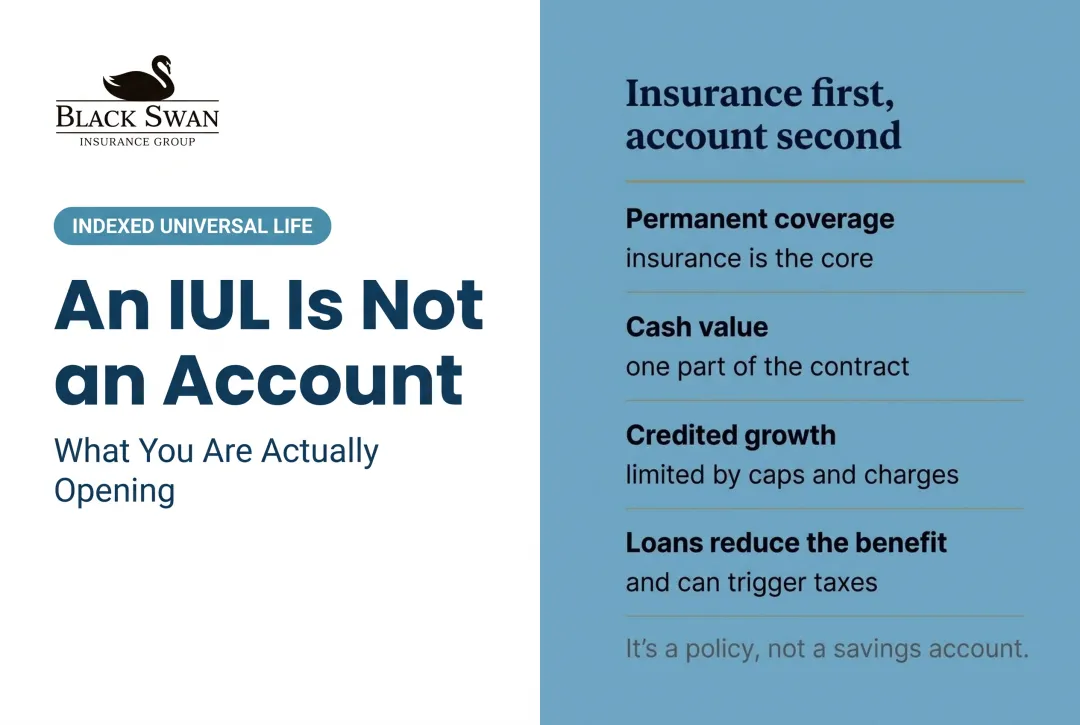
Indexed universal life is permanent life insurance pairing a death benefit with a cash-value account. That account earns interest based on how an external market index performed, using a formula the insurance company sets and controls.
The part most buyers never hear: an IUL never invests your premium in the stock market or an index fund. The insurer credits interest according to index performance, and caps, participation rates, floors, fees and the cost of insurance all decide what actually lands in your account.
Demand keeps climbing. LIMRA reported a record $4.5 billion in IUL new premium during 2025, up 17% year over year. More $150K+ earners are being shown these policies than at any point in the last decade — usually right after they max the 401(k) and hit the Roth phase-out.
Here is what the product actually is, what it costs, who it suits, and why it has to be compared against the alternatives rather than preferred over them by default.
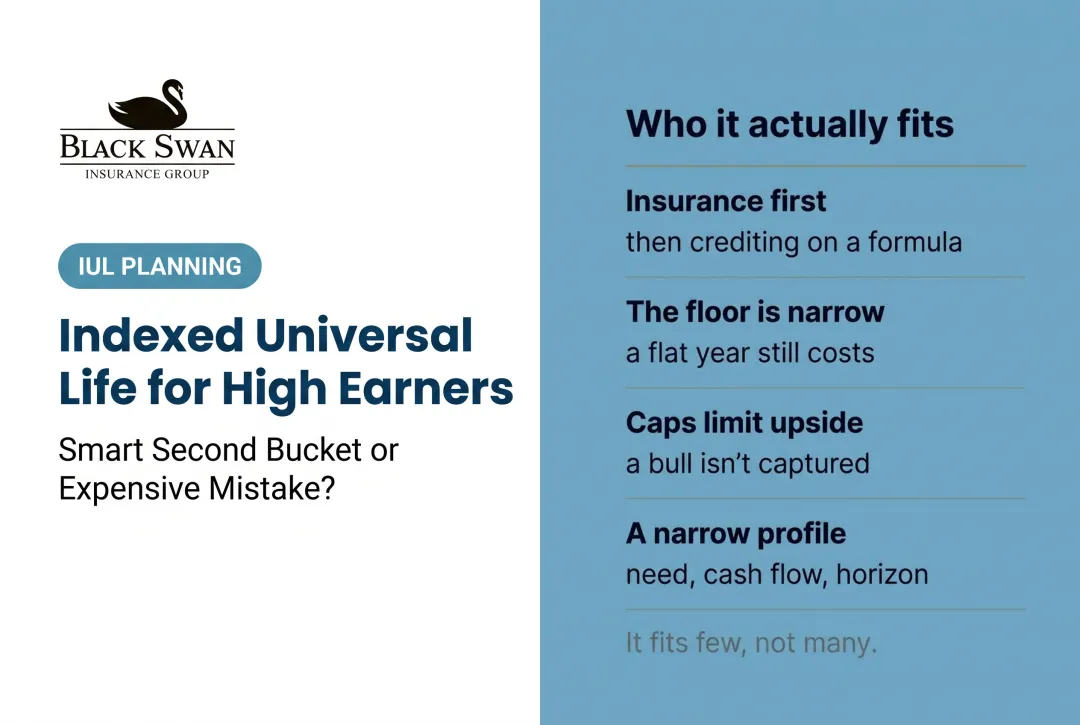
The short answer: An IUL is permanent life insurance first, with cash value credited on an index-linked formula limited by a cap and scaled by a participation rate, floored at typically 0%. The floor blocks a negative index credit — it does not block fees, cost of insurance, loan interest or lapse. Premiums are flexible, but underfunding is the most common way these contracts fail. It earns consideration only with a real permanent insurance need, stable funding capacity, liquidity elsewhere, and a clear advantage over the alternatives.
Key Takeaways
- It is permanent life insurance first — cash-value growth is the secondary feature, not a conventional savings account
- Index-linked crediting can limit index losses, but caps, fees, loans and lapse risk still erode policy value
- Flexible premiums still require enough funding to cover insurance costs; skipping payments is not free
- Buy only with a genuine insurance need, good health, funding capacity, liquidity elsewhere and a clear edge over the alternatives
How the Policy Works
Two moving parts:
- Death benefit — paid to beneficiaries, as long as the policy stays in force
- Cash value — an account inside the policy that can grow and that you may access while alive
Every premium splits. Some covers the cost of insurance, which rises with age. Some pays administrative and rider charges. Whatever remains goes to cash value. Your full premium does not become savings.
Take a policy linked to the S&P 500 with a 9% cap, 100% participation and a 0% floor:
- Index gains 12% → the policy credits 9%, the capped maximum
- Index drops 15% → the floor holds the credit at 0% rather than a loss
Hypothetical, not a forecast. NAIC's 2019 IUL illustration guidance uses similar sample parameters, including caps as high as 11.75%, purely to show how the arithmetic functions.
The Three Terms That Decide Your Credit
- Cap — the maximum rate credited for a period, however well the index does
- Participation rate — the percentage of the index gain used in the calculation
- Floor — the minimum credited rate when the index falls, often 0%
The floor protects against index-based losses. It does nothing about fees, insurance charges, outstanding loans, withdrawals or a lapse. Those apply regardless of what the index did.
Zero is your hero in a down year — but the floor applies to the credit, not to the charges. That one sentence prevents most of the disappointment in this category.
Most contracts also offer a fixed-account option alongside the indexed strategies. Available indices, crediting methods, caps and charges vary by insurer and contract, so two IULs can behave nothing alike.
Premiums and death benefit can be adjusted within policy limits, and that flexibility has a ceiling. Underfunding, excessive withdrawals or rising insurance costs can push a policy toward lapse even after years of payments.

Benefits, Risks and Costs
What a properly structured, funded and managed policy offers: lifelong coverage while funded; premium flexibility within contract limits; cash-value accumulation linked to index performance; tax-deferred growth under current IRS rules; and potential tax-advantaged access through withdrawals or policy loans.
That access carries conditions. Withdrawals and loans reduce the death benefit, raise lapse odds, and accrue interest if unpaid. A policy that lapses or is surrendered with a loan outstanding and gain in the contract can produce an unexpected tax bill — the IRS treats surrender proceeds above cost basis as taxable income.
The risks that are not eliminated by the floor:
- Credited growth is not guaranteed. Insurers can adjust caps and participation rates going forward
- The account can still lose value. Cost of insurance, admin fees, withdrawals and loan interest keep deducting regardless of index performance
- Flexible premiums can mislead. A policy affordable in year one can demand far more later to stay in force
- Lapse is a documented outcome. A SOA and LIMRA study covering 2015–2021 found IUL lapse rates rose in nearly every policy year, with IUL showing consistently higher lapses during the pandemic
What drives the cost: age, health and tobacco use; coverage amount and underwriting class; policy design and death-benefit option; funding schedule and insurer pricing. There is no universal price.
Ask for a current, insurer-approved illustration showing guaranteed values beside non-guaranteed assumptions, surrender values and break-even timing, and lapse projections under realistic funding. Skip anything built solely on historical index returns.
What the Critics Get Right
Anyone approaching this page already sceptical has reasons, and they hold up.
Critics are right that the marketing consistently oversells the floor, presenting downside protection that only ever applied to the credit. They are right that caps and participation rates are levers the carrier controls and can pull after you have committed a decade of premiums. And they are right that the lapse data is not flattering — a product where a meaningful share of buyers do not make it to the payoff has a design or a distribution problem.
Where the criticism runs out is in treating "not for most people" as "not for anyone." For a household that needs permanent coverage regardless, has funded everything else, and can carry the premium through a bad stretch, this is a legitimate structure. It is just a much smaller group than the marketing implies.
Who It Fits
Stronger Fit
- A genuine need for permanent rather than temporary life insurance
- Household income of $150K+ with stable surplus cash flow beyond expenses and emergency savings
- Willingness to fund consistently for the long term and review annually
- Liquidity already established outside the policy
- Interest in combining protection with cash-value flexibility, in that order
Income alone does not determine fit. The same criteria apply regardless of the size of the paycheck.
Weaker Fit
Not everyone should buy an IUL. Most people who search this term should not, and any honest explanation has to start there.
- The need is low-cost temporary coverage — term insurance is the direct answer and costs a fraction as much
- No emergency fund yet
- High-interest debt still running
- Funding cannot be committed for years
- You want simple, low-cost investing without insurance attached
- The money may be needed in the near term
Run this checklist first: Is there a real permanent coverage need? Are you insurable at a reasonable rate? Can the funding survive a job change or a downturn? What are the beneficiary and estate goals? Who will own the policy? What liquidity do you need outside it? Have you involved a CPA or attorney?
The Ultimate IUL Blueprint
If you clear that checklist, the Blueprint covers the design decisions that follow: funding levels, minimum death benefit, the MEC line, index-strategy selection and loan timing.
How It Compares
Against Term and Whole Life
Term life provides temporary protection at a much lower cost with no cash value. It fits mortgage coverage and income replacement during the working years, and when the need is temporary it is simply the better product.
- Term — lower cost, temporary coverage, no cash value
- Whole life — fixed premiums, stronger contractual guarantees
- IUL — flexible premiums, index-linked upside, fewer guarantees
Whole life is also permanent but behaves differently, locking in fixed premiums and stronger guarantees. An IUL trades some of those guarantees for flexibility and index-linked upside, subject to caps and participation rates that can change.

Against Other Universal Life Designs
- Standard UL — interest at a rate the insurer declares
- Variable UL — cash value directly in investment subaccounts, with real market losses
- IUL — an index-crediting formula with a floor, plus caps and participation limits
Against Qualified Accounts and Brokerage
| Feature | 401(k)/IRA | Taxable brokerage | IUL |
|---|---|---|---|
| Primary purpose | Retirement savings | Flexible investing | Life insurance plus cash value |
| Employer match | Often available | None | None |
| Investment control | Limited to plan options | Full control | Insurer-set crediting formula |
| Liquidity | Restricted before 59½ | High | Limited, via loans and withdrawals |
| Death benefit | None | None | Yes |
Qualified plans and the employer match come first. For 2026 the IRS set elective deferral limits at $24,500 for 401(k)-type plans and $7,500 for IRAs, with a catch-up contribution available at 50 and over.
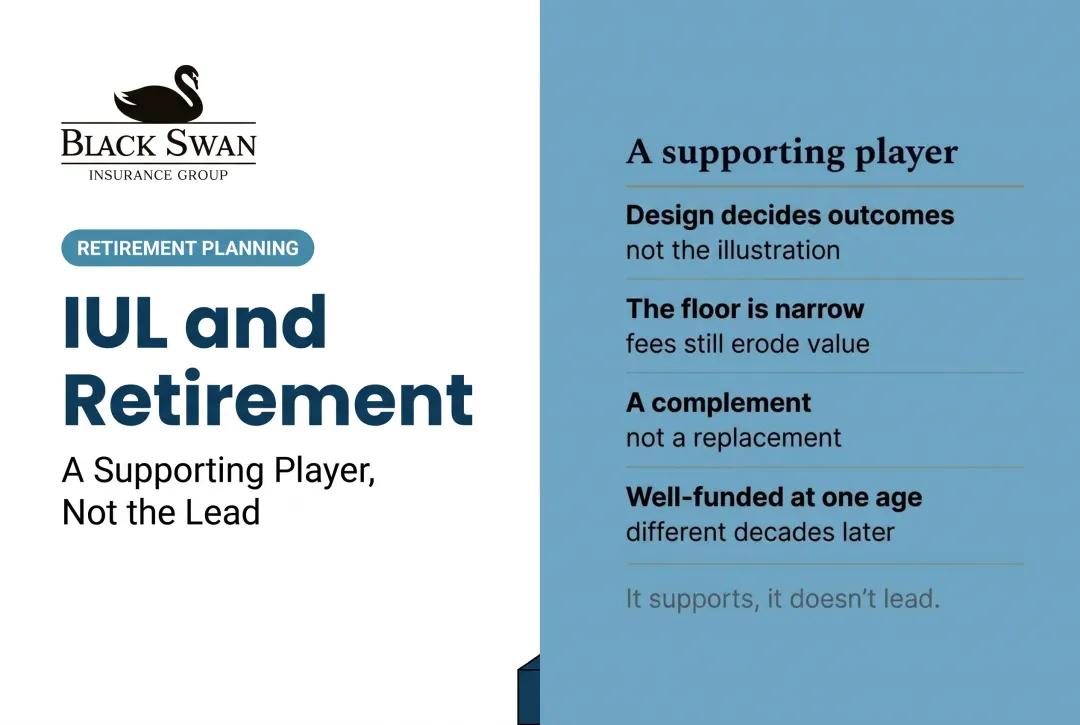
A 401(k) is not the enemy here. Depending on it as the only serious bucket is the part worth examining — but skipping a match to fund a premium is almost always the wrong trade.
Use each tool for what it does: term for a temporary protection need, qualified accounts for retirement tax treatment and the match, a brokerage account for liquid flexible investing, and permanent insurance when you need lasting protection plus features the others do not provide.
How to Review a Proposal
Start from the death-benefit need, not a projected return. Nail down affordability, funding period, beneficiary and ownership structure, and the balance you want between protection and cash-value growth.
Request both guaranteed and non-guaranteed illustrations showing multiple funding levels, conservative assumptions beside optimistic ones, changing caps and participation rates over time, policy expenses, surrender values and loan terms, and what happens if the policy lapses.
Then stress-test it against job loss or a few years of reduced contributions, retirement and lower earned income, poor index performance across several years, and rising cost-of-insurance charges. If it does not hold up, revisit the design before buying rather than after.

Seven Questions for Whoever Is Selling It
- Which carrier issues the policy, and what is its financial strength rating?
- What is contractually guaranteed versus projected?
- How and when can caps or participation rates change?
- What happens after a missed premium?
- How are policy loans credited and charged?
- What is the surrender charge schedule?
- How will annual reviews actually work?
If the agent cannot explain the downside, they have not earned the upside conversation.
Risks to Understand Before You Buy
- Charges continue in a 0% crediting year, so cash value can fall with the floor intact
- Cost of insurance rises with age and is deducted whatever the index did
- Caps and participation rates are non-guaranteed and can be reset after you commit
- Underfunding is the leading cause of failure, and premium flexibility makes it easy
- Surrender charges make an early exit expensive
- Loans reduce the death benefit and accrue interest, and a lapse with a loan outstanding and gain in the contract can create taxable income with no cash received
- Crossing the seven-pay limit makes the contract a MEC under I.R.C. § 7702A and changes distribution taxation permanently
- Lapse leaves no coverage at an age when replacing it may not be possible
- Illustrated values are not guarantees
Find Out Where You Actually Stand
This starts with the Tax-Free Wealth Blueprint Fit Review. If you earn $150K+ and are weighing a policy, we run your numbers, stress-test the funding, show the fees, caps and loan assumptions, and compare it honestly against term plus qualified accounts. If it does not fit, we will tell you that too.
Frequently Asked Questions
What is indexed universal life insurance?
Permanent life insurance with a death benefit, flexible premiums, and cash value that may earn interest linked to an external market index. It is not direct market investing; the insurer credits interest according to policy terms.
How much does it cost to start one?
It depends on age, health, tobacco use, coverage amount, design and funding strategy, plus underwriting. A general price is not useful — ask for an individualised illustration.
How should it be structured?
By coordinating the death-benefit goal, a sustainable premium, cash-value objectives, guarantees, tax treatment, liquidity needs and loan provisions — then running lapse stress tests before signing.
Is it a good place to put money?
It is life insurance first, and evaluating it purely as a place to put money is the error that produces most of the regret. It may support certain protection and cash-value goals; compare its costs, caps and risks against the alternatives.
Is it better than a 401(k)?
They serve different purposes. A 401(k) carries employer matching and dedicated retirement tax treatment; an IUL provides protection with cash-value potential. Neither replaces the other, and the match comes first.
Why do affluent households use IUL?
Usually after identifying a genuine permanent insurance need and reviewing retirement, estate and tax-diversification goals. Wealth alone does not make it suitable — the same need, funding and risk checks apply.
Sources
- LIMRA — U.S. individual life insurance new premium tops $17.5 billion in 2025
- SOA and LIMRA — 2015–2021 UL lapse rate study
- NAIC — IUL illustration guidance materials
- NAIC — Life Insurance
- I.R.C. § 7702A and Rev. Proc. 2008-39 (modified endowment contracts and the seven-pay test)
Disclosure: This article is educational and is not personal tax, legal or investment advice. Indexed universal life is life insurance first. Actual results depend on policy design, carrier, crediting options, caps, participation rates, expenses, funding and ongoing management. Policy loans and withdrawals may reduce cash value and death benefit and can create tax consequences if the policy lapses or becomes a modified endowment contract. Contribution limits and tax rules change. This strategy is not appropriate for everyone. Illustrated values are not guarantees; actual results depend on policy terms, crediting, costs and funding. Consult your own tax, legal and financial professionals for advice specific to your situation.
And remember, it's not what you earn, it's what you keep… enjoy the ride.