By Robert Balgac, Founder, Black Swan Insurance Group | October 5, 2026
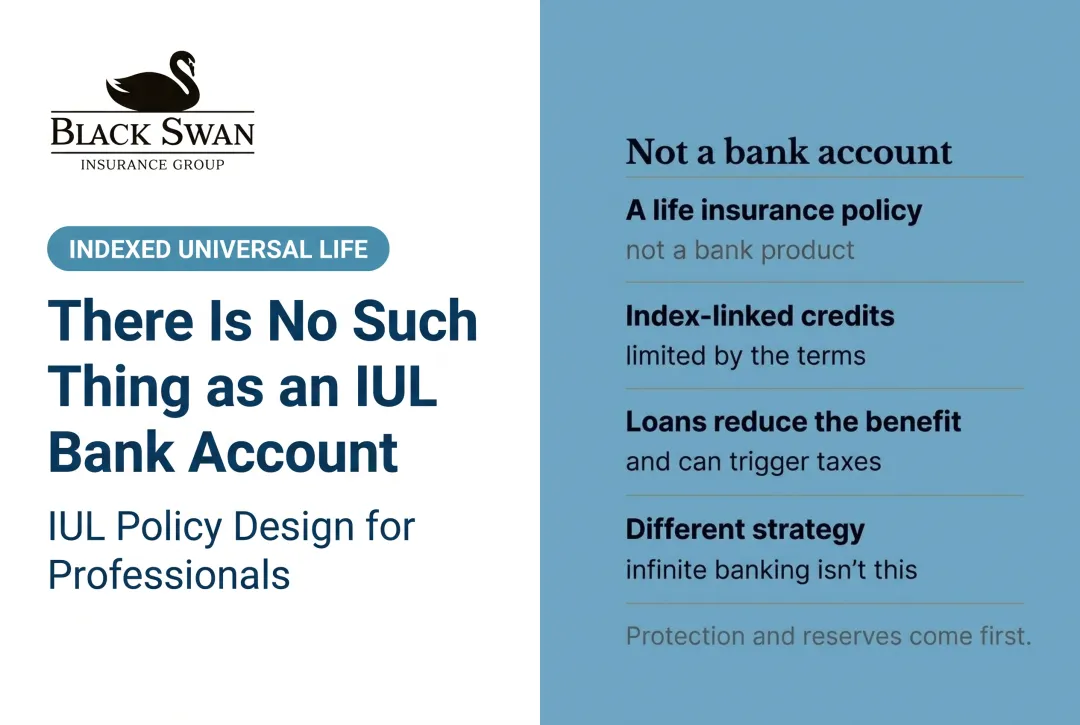
If you searched "IUL account" expecting something resembling a savings or brokerage account, the first correction matters more than anything else on this page: it is not one. The phrase almost always refers to the cash-value component inside an indexed universal life insurance policy.
That is not pedantry. It changes what you should expect. An account has a balance you own. This is a contract, with a cost of insurance charged monthly, a carrier-controlled crediting formula, a surrender schedule, and consequences for stopping.
The NAIC describes indexed universal life as coverage where interest is tied to the performance of an external index, with a guaranteed minimum interest rate built in. You do not own the index and you do not receive its dividends. The insurer uses it as a reference point.
If you earn $150K+ and someone has framed this as "a tax-free account," start by getting the category right.
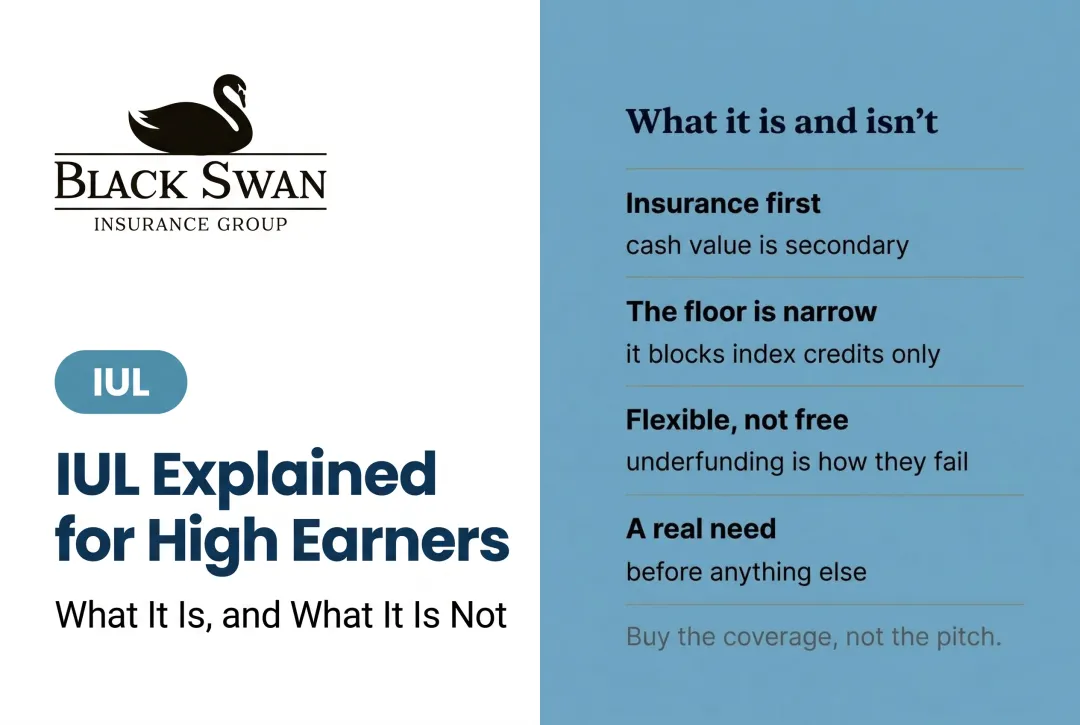
The short answer: An IUL is permanent life insurance first; the cash value is one component of the contract, not a standalone account. Index crediting can grow value with a floor against a negative credit, while caps, participation rates and ongoing charges limit what you actually keep. Loans and withdrawals reduce the death benefit and can create tax consequences. It fits with a long horizon, sustainable funding and a real insurance need — and it is not FDIC-insured, because it is not a bank product.
Key Takeaways
- It is permanent life insurance first; cash value is one part of the contract
- Index crediting can grow value with a downside floor, but caps and charges still limit the result
- Loans and withdrawals reduce the death benefit and can create tax consequences
- It fits best with a long horizon, sustainable funding and a genuine insurance need
- It is not FDIC-insured and it does not deliver market returns
What You Are Actually Buying
The moving parts:
- Death benefit — paid to beneficiaries when the insured dies
- Premium payments — your contributions, often adjustable within limits
- Cost of insurance — the ongoing charge for the death benefit itself
- Policy expenses — administrative fees, rider charges, contract costs
- Cash value — the accumulation component, growing partly through index-linked interest
Each premium dollar splits between insurance costs, fees and cash value. The split varies by insurer, age, health class, coverage amount and design. A 35-year-old in excellent health funding aggressively sees a completely different allocation from a 55-year-old funding at minimum.
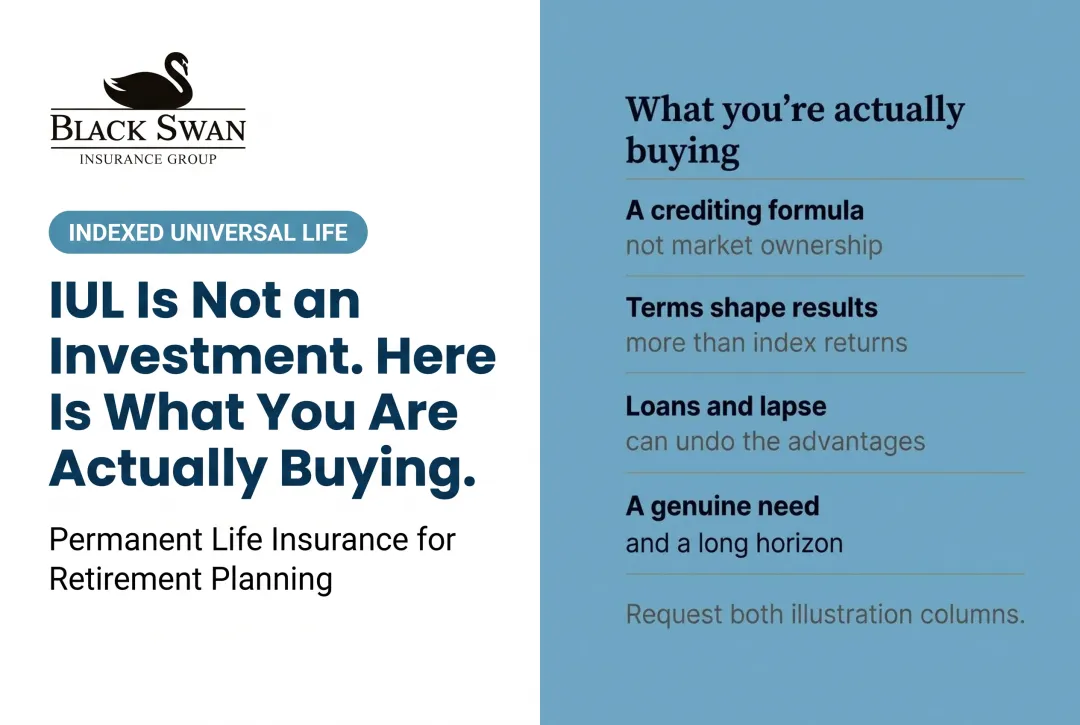
This is not buying stocks or index funds. The insurer uses index movement as a formula input, then applies its own rules to decide how much interest lands in your account.
Four Terms Control the Credit
- Floor — the minimum credited rate, often 0%, protecting against a negative index year
- Cap — the maximum the formula can credit, however high the index climbs
- Participation rate — the percentage of index gains used in the formula, sometimes 100%, often less
- Spread — an amount subtracted from index gains before crediting applies
A worked case: the reference index rises 12% and the policy has an 8% cap. The account is credited 8%, not 12%. Now the index drops 15%. A 0% floor prevents a negative index credit — which is not the same as the account value staying flat.

Charges still apply in a 0% year. Cost of insurance, administrative fees and rider charges continue deducting from cash value even when crediting is zero. Net cash value can decline in a weak year, floor or no floor.
Zero is your hero in a down year — but the floor applies to the credit, not to the charges. If someone told you otherwise, that is the thing to go back and check.
Flexibility, and Its Ceiling
Universal life allows flexible premiums and adjustable death benefits, within limits. Underfunding — paying less than what is needed to cover insurance costs — draws cash value down faster and eventually causes a lapse if not corrected.
Two ways to reach cash value: withdrawals, which reduce cash value and can lower the death benefit directly, and policy loans, where the insurer advances money against your cash value and charges interest, with any unpaid balance reducing the net death benefit.
What It Costs
Find each of these in the illustration and the contract:
- Cost of insurance — charged monthly, based on age, health and coverage amount
- Premium loads — a percentage deducted from each payment
- Administrative charges — flat or per-thousand fees for upkeep
- Rider costs — for optional benefits such as accelerated death benefits
- Surrender charges — penalties for cancelling or reducing coverage early
- Loan interest — the rate charged on any outstanding balance
These continue regardless of index performance. A weak year does not pause them; a strong year does not eliminate them.
Which is why this is a long-term structure and a poor home for money you might need next year. Surrender charges and the time it takes for cash value to outgrow early costs mean short horizons rarely work.
The Tax Rules, Stated Conditionally
Cash value grows tax-deferred. You can typically access it through policy loans, which are generally treated favourably while the policy stays in force and is not a modified endowment contract. Death benefits are typically received income-tax-free.
Every one of those advantages is conditional on the policy being properly structured, funded and managed. IRS Revenue Ruling 2005-6 explains how a contract must qualify as life insurance under the cash value accumulation test or the guideline-premium and corridor rules.
Overfund too aggressively in the early years and the contract fails the seven-pay test and becomes a MEC. Loans and withdrawals are then taxed income-first, and a 10% additional tax can apply before age 59½.

Surrendering with an outstanding loan can also create unexpected taxable income. Have a tax professional review the design before funding aggressively.
What the Critics Get Right
The objection that this product is marketed under a misleading name is correct, and it is worth conceding at the top rather than the bottom.
Critics are right that calling it an "account" invites people to picture a balance they own outright, when what they own is a contract with a monthly charge against it. They are right that the illustration is the sales tool and the guaranteed column is the contract, and that the gap between the two is rarely walked through. And they are right that a buyer who needed liquidity, or who could not sustain the premium, would have been better served by almost anything else.
Where the criticism stops is the case where permanent protection is genuinely required. There the question stops being "account or not" and becomes which permanent structure survives the next twenty years of your actual cash flow.
Lapse Risk Is Real
A policy ends when premiums stay consistently below what rising insurance charges require, when several years of weak crediting stack up, when withdrawals pull cash value down, or when loan balances compound faster than the contract can support.
Life insurance is not FDIC-insured. The FDIC explicitly lists life insurance among products outside its coverage. An IUL also does not guarantee market returns. An illustration showing years of 8% credits is a projection built on assumptions that can change, not a promise.
Who It Fits
Stronger Fit
- A genuine need for permanent life insurance, not temporary coverage
- A horizon of 15 years or more to let cash value develop past the early charges
- Household income of $150K+ with stable surplus cash flow beyond emergency savings and other priorities
- Reasonable insurability for competitive underwriting
- Willingness to review the policy periodically rather than file it away
Physicians, attorneys, executives and other high earners often max the available qualified plans and want more tax diversification. This can be one piece of that picture — evaluated alongside 401(k) and Roth contributions, never as a replacement.
Practice and business owners face a related question: building protection and assets outside the business itself, which intersects with buy-sell agreements and succession planning and belongs in a conversation with legal and tax professionals.
Late-start high earners in their late 40s or 50s need a different lens. Rather than trying to catch up through aggressive funding, the priorities are realistic timelines, current health, genuine funding capacity and liquidity needs.
Weaker Fit
Not everyone should buy an IUL. If what you actually want is an account, open one — a brokerage account or a Roth will serve you better.
- The lowest-cost temporary coverage is what you need — term insurance wins that outright and is worth saying plainly
- You want guaranteed, predictable accumulation without variability
- You may need liquid funds soon
- You want a simple, hands-off approach
- You have no interest in monitoring the contract year to year
How It Compares
| Option | Primary purpose | Guarantees | Liquidity | Tax treatment |
|---|---|---|---|---|
| Term life | Temporary death benefit | Fixed premium and term only | None, no cash value | Death benefit generally tax-free |
| Whole life | Permanent protection plus guaranteed growth | Guaranteed cash value and premium | Loans and withdrawals | Tax-deferred growth |
| IUL | Permanent protection plus index-linked potential | Floor on crediting only | Loans and withdrawals, interest applies | Tax-deferred growth, MEC rules apply |
| 401(k)/Roth | Retirement savings | None; market risk | Limited before retirement age | Pre-tax or tax-free growth |
| Taxable brokerage | General investing | None | Fully liquid | Capital gains and dividend taxes |
No option is universally superior. Fit depends on protection needs, timeline, tax position and liquidity requirements.
The Ultimate IUL Blueprint
If a permanent need exists and you are moving to the design stage, the Blueprint covers funding levels, the MEC line, index-strategy selection, loan timing and what to demand from an illustration.
Evaluating and Applying
The Process
- Financial goals review — clarify what you are actually trying to accomplish
- Policy customisation — match coverage amount and design to the needs analysis
- Funding strategy — determine a range you can genuinely maintain
- Application and underwriting — with a carrier suited to your profile
- Annual review — revisit performance and funding every year

Gather first: age, health history and current medications; income, net worth and existing coverage; beneficiaries and financial goals; expected funding level and retirement timeline.
Reading the Illustration
Every illustration shows guaranteed and non-guaranteed columns. Do not skip the guaranteed side because the other one reads better.
- Separate guaranteed values from projected values
- Check the assumed crediting rate against historical caps for that product
- Inspect every charge line, not just the headline rate
- Identify the break-even year where cash value exceeds premiums paid
- Examine how the death benefit changes over time at different funding levels
- Run a near-0% crediting scenario and see whether the policy holds
Five Questions for Any Agent
- How can caps, participation rates, spreads or fixed-account rates change over time?
- What premium keeps this in force under conservative assumptions?
- What happens if I reduce or skip a payment?
- How do loans affect cash value, death benefit and lapse risk?
- What are the surrender charges, and what triggers MEC status?
An independent professional who can compare designs across carriers is worth more than a single-carrier pitch.
Risks to Understand Before You Fund One
- It is not a bank account and not FDIC-insured, and treating it as either is the root of most disappointment
- Charges continue in a 0% crediting year, so net cash value can fall with the floor intact
- Cost of insurance rises with age and is deducted every month regardless of crediting
- Caps, participation rates and spreads are non-guaranteed and can be reset by the carrier
- Surrender charges make an early exit costly, often for a decade or more
- Underfunding causes lapse, and premium flexibility makes drifting easy
- Loans reduce the death benefit and accrue interest, and a lapse or surrender with a loan outstanding and gain in the contract can create taxable income with no cash received
- Crossing the seven-pay limit makes the contract a MEC under I.R.C. § 7702A and changes distribution taxation permanently
- Illustrated values are projections, not promises
Find Out Where You Actually Stand
This starts with the Tax-Free Wealth Blueprint Fit Review. If you earn $150K+ and are weighing this, we run the funding against your real cash flow, read the guaranteed column, model a near-0% crediting stretch, and price term plus qualified accounts alongside it. If it does not fit, we will tell you that too.
Frequently Asked Questions
Is an IUL account like a savings account?
No, and the name is the problem. It is the cash-value component of a life insurance contract, with a monthly cost of insurance, a carrier-controlled crediting formula and a surrender schedule. Any potential tax-advantaged access to that value later depends on the contract being properly structured, funded and managed. It is not FDIC-insured.
How much does one cost?
It depends on age, health, coverage amount, design, funding strategy, riders and underwriting class. There is no universal price; ask for a personalised illustration.
How does the cash value grow?
Premiums cover insurance costs first, and what remains may receive index-linked interest subject to a floor, cap, participation rate, spread and ongoing charges. Growth is not guaranteed beyond the floor.
How do I open one?
You apply through a licensed insurance professional, complete underwriting, review the approved illustration carefully — including the guaranteed column — and pay premiums to place the policy in force.
Is it a good place to put money?
It is life insurance first, and that framing is where the useful answer starts. It may suit someone needing permanent coverage with long-term cash-value potential. Compare it against simpler, cheaper alternatives before deciding.
Should I buy term instead?
If the protection need is temporary, yes. Term is cheaper, simpler and better suited to that job, and there is no reason to buy permanent coverage for a temporary problem.
Sources
- NAIC — Life Insurance
- IRS Revenue Ruling 2005-6
- FDIC — Financial products that are not insured
- NAIC — Life Insurance Illustrations
- I.R.C. § 7702A and Rev. Proc. 2008-39 (modified endowment contracts and the seven-pay test)
Disclosure: This article is educational and is not personal tax, legal or investment advice. Indexed universal life is life insurance first and is not a bank product; it is not FDIC-insured. Actual results depend on policy design, carrier, crediting options, caps, participation rates, expenses, funding and ongoing management. Policy loans and withdrawals may reduce cash value and death benefit and can create tax consequences if the policy lapses or becomes a modified endowment contract. This strategy is not appropriate for everyone. Illustrated values are not guarantees; actual results depend on policy terms, crediting, costs and funding. Consult your own tax, legal and financial professionals for advice specific to your situation.
And remember, it's not what you earn, it's what you keep… enjoy the ride.