By Robert Balgac, Founder, Black Swan Insurance Group | October 9, 2026
Most IUL conversations stop at the accumulation phase. The illustration climbs, the ledger looks healthy, and everybody shakes hands. The hard part — the part that decides whether this works — happens twenty years later, when you start taking money out.
That is the subject of this article. Not whether a policy can accumulate, but whether it can distribute. For a $150K+ earner who has maxed the 401(k), passed the Roth phase-out and is looking at a retirement funded almost entirely from one taxable bucket, the appeal of a second bucket with different tax character is obvious. The question is whether the contract you are being shown can actually carry an income stream for thirty years without collapsing.
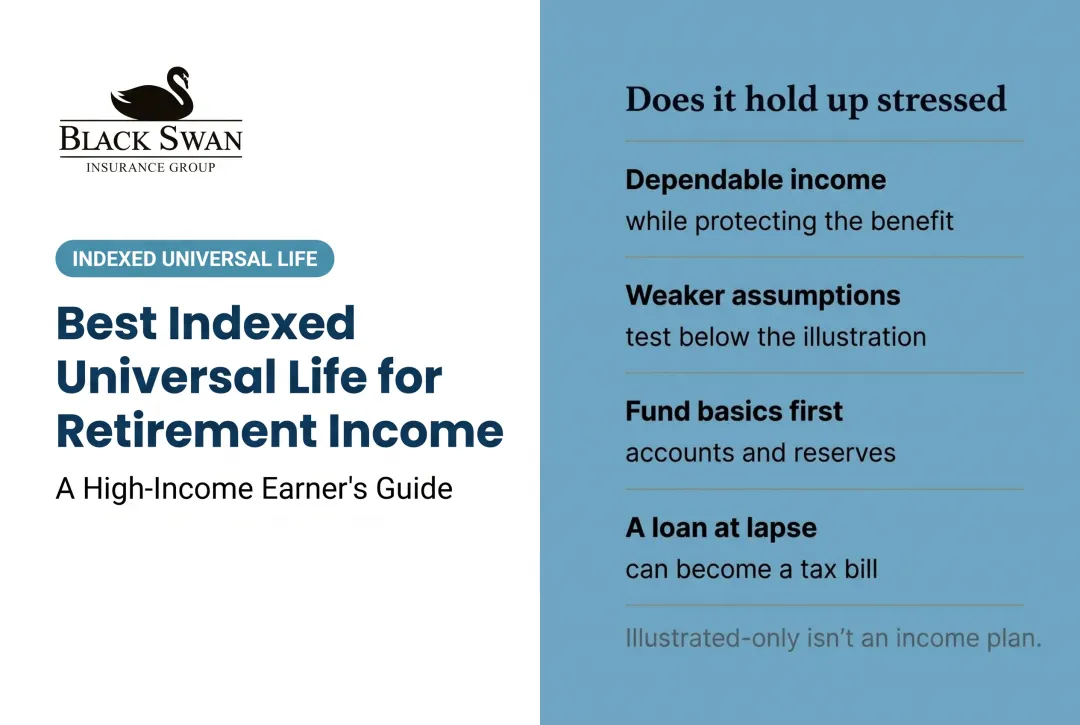
The short answer: A properly designed, properly funded IUL can supplement retirement income with potential tax-advantaged access when properly structured, funded and managed. It cannot replace a 401(k), IRA, Roth or annuity, and it is only as good as the funding discipline behind it. The distribution phase is where underfunded policies die — loan interest compounding against a cash value that is no longer being fed.
The loan is not the problem. The unmanaged loan is the problem.
Key Takeaways
- An IUL supplements retirement income; it does not replace a 401(k), IRA, Roth IRA or annuity
- Confirm the death-benefit need, cash flow, insurability and reserves before you buy
- Review guaranteed versus non-guaranteed values, charges, caps and surrender terms separately
- Policy loans add flexibility but create real debt that can trigger tax at lapse
- Annual reviews and stress tests are what keep the policy honest to the original plan
The NAIC requires insurers to separate guaranteed from non-guaranteed values in every illustration precisely because projected cash values are scenarios, not promised returns. Read the distribution years of that ledger as carefully as the accumulation years.
When an IUL Earns a Place in an Income Plan
An IUL for retirement income works when you want permanent life insurance first, with tax diversification and future cash-value access as secondary benefits. It rarely works when the insurance need is an afterthought bolted on to justify the premium.
Signs It May Fit
- Stable surplus cash flow beyond retirement contributions, debt payments and emergency reserves
- A long time horizon, typically 15 to 20 years or more, to absorb early policy charges
- Liquidity available outside the policy for near-term needs
- A genuine working understanding of caps, floors and participation rates
- Willingness to review the policy annually and adjust funding
Most buyers who clear that bar are high-income professionals and business owners who have already maximised available qualified contributions and want a comparison point, not a replacement.
Signs It Does Not
An IUL is frequently misused when it is bought:
- Primarily for the illustrated return rather than the insurance
- With a plan to fund only the minimum premium long-term
- As a substitute emergency fund
- At the expense of employer matching or cash reserves
- Expecting it to generate a contractually guaranteed paycheck
Run a quick fit-or-no-fit check across permanent insurance need, health and underwriting outlook, target retirement date, funding capacity, liquidity outside the policy, current tax position, and a real comparison against alternatives. If more than one or two are shaky, pause before applying.
What You Need in Place First
Separate the income need from the insurance purpose before you look at a single projection.
The Planning Inputs
Gather current income, savings rate and outstanding debts; emergency reserves and existing coverage; retirement accounts, expected retirement date and desired retirement spending; and expected Social Security and other income sources.
Those inputs matter because the gap between expectation and reality is wider than most people assume. In EBRI's 2025 Retirement Confidence Survey, workers' median expected retirement age was 65, while retirees' median actual retirement age was 62.

Three years is not a rounding error on a funding schedule. It is three years of premiums that may never arrive and three extra years of distributions. A full cash-flow analysis, run before any policy is added, has to account for it. Your profile shapes the insurance need too: a W-2 professional, an executive, a practice owner and a business owner with concentrated income or succession risk are four different problems.
The Policy and Underwriting Information
Insurers price IULs individually. Expect to review age, health, tobacco status and family history; coverage amount, underwriting class and riders; and planned premium, death-benefit option and policy type.
Request the complete document set as well — the full illustration or in-force illustration if the policy already exists, plus the contract, expense pages and the ledger of guaranteed versus non-guaranteed values.
The Professional Review
IRS rules on modified endowment contracts treat loans and distributions differently, often on an income-first basis. Confirm your policy's MEC status with a tax professional before you rely on loans for income. Ongoing review matters as much as the initial design, which is why needs assessment, policy tailoring, transparent enrollment and annual reviews are a sequence rather than a one-time event.
The Ultimate IUL Blueprint
If you are designing a policy that will one day have to pay you, the Blueprint covers funding levels, charges, the MEC line, loan timing and what to demand from an illustration before you sign it.
How the Income Actually Works
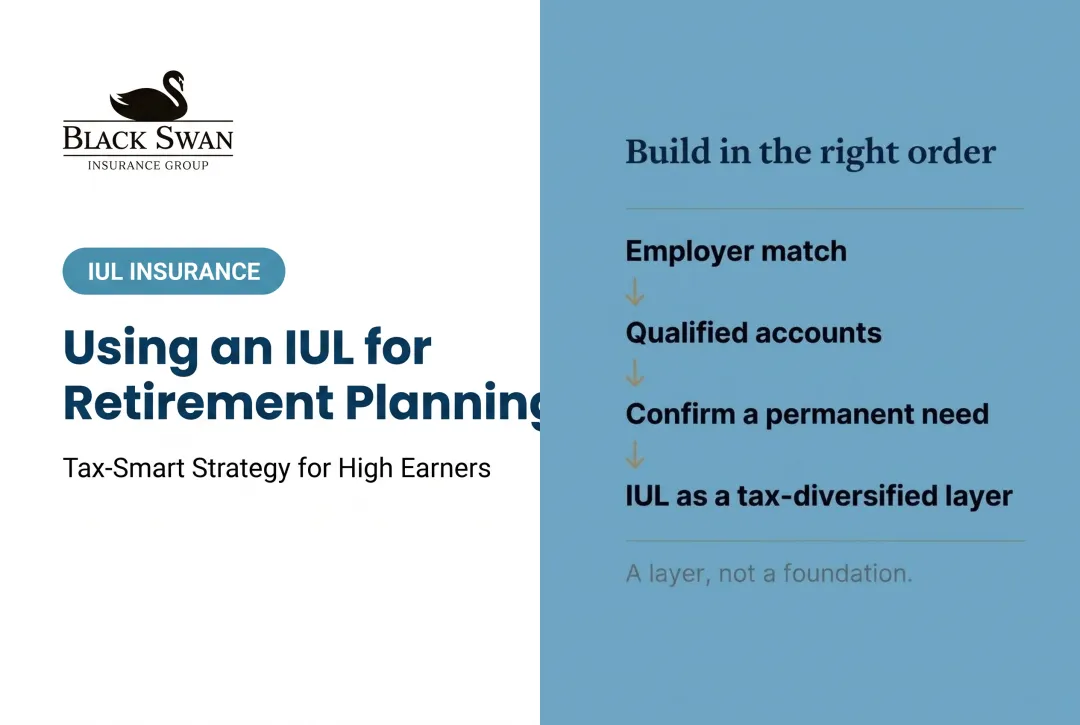
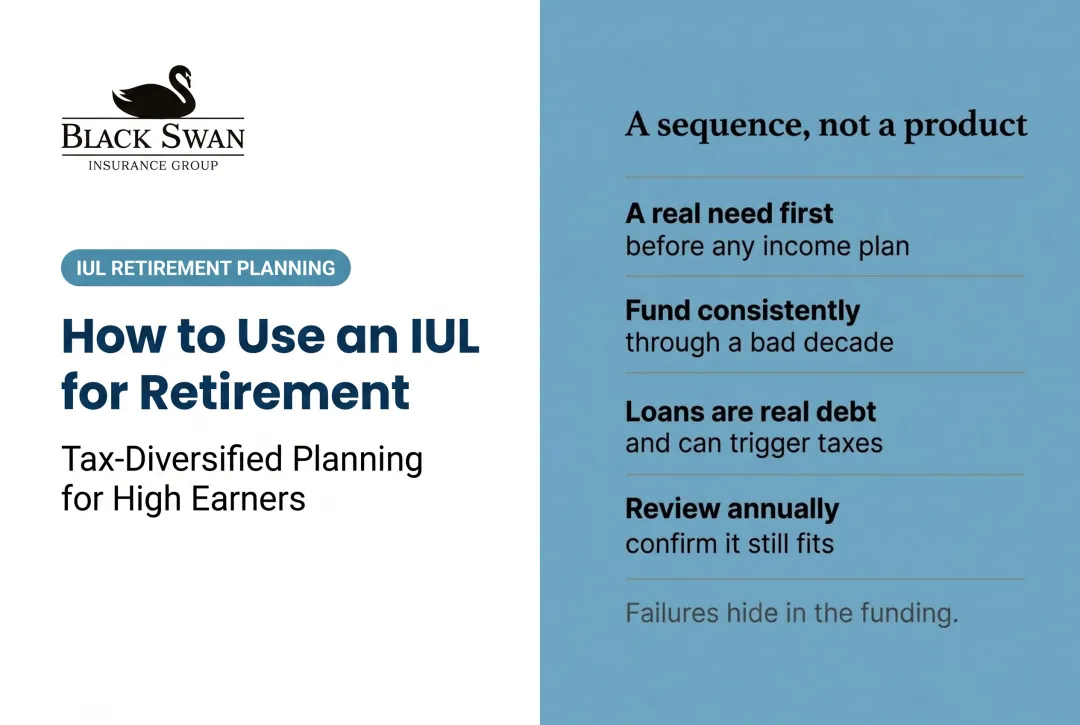
Responsible use follows a sequence: establish the purpose, compare alternatives, design sustainable funding, verify the contract, and monitor the policy — all before you ever take a distribution.

Design
Define the permanent insurance need first. Select a death benefit that supports the family, business or estate objective — not the amount that produces the prettiest cash-value projection. Then coordinate the proposed premium with qualified contributions and employer matching, emergency reserves and debt repayment, and investment savings and business liquidity needs.
The common setup mistakes are predictable: choosing coverage based solely on maximum illustrated cash value, underestimating long-term cost of insurance, and assuming flexible premiums mean funding can simply stop without consequence.
Funding
Premiums cover insurance costs, administrative charges and the index-linked or fixed-account crediting strategy you select. Caps, participation rates, spreads and floors then determine how much interest is credited. Cash value is not invested in the index. In a zero-crediting year, charges and any loan interest still accrue, so total policy value can fall even when the credited rate did exactly what the floor promised.
Confirm issue details, premium allocation and beneficiary designations match what you applied for. Small mismatches here create expensive problems later.
Distribution
This is the phase that decides the outcome.
Educational example, not predictive: consider a policy funded at the planned premium for 20 years, then used for retirement withdrawals starting in year 21. If credited returns run below the illustrated rate and the owner also takes policy loans, charges and loan interest can erode cash value faster than new credits replace it. That path can push the policy toward lapse years earlier than the original ledger showed.
Loans accrue interest and reduce both cash value and death benefit while outstanding. Repayment is not mandatory, which is exactly the trap — unpaid balances compound and raise lapse risk every year they sit there.
Monitoring
Review at least annually: the updated in-force illustration and current cash value; surrender value and outstanding loan balance; current cap, participation rate and cost-of-insurance changes; and premium payment history against the plan.
Warning signs are declining net cash value, rising required funding, a growing loan balance, missed premiums, or a policy drifting toward lapse. Stress-test with conservative crediting assumptions, interrupted contributions, a longer life expectancy and higher withdrawals than originally planned.
Exit
Surrendering, exchanging, reducing or lapsing all carry consequences for coverage, surrender charges, outstanding loans and taxes. The NAIC notes that a policy generally lapses once an unpaid loan balance exceeds cash surrender value — and that can trigger taxable income on the gain even though no cash changed hands. Model any replacement, reduction or termination before acting.

What the Critics Get Right
The strongest criticism of IUL-as-income is that the strategy depends on the policyholder behaving perfectly for thirty years, and most people do not.
It is correct. The product asks you to fund consistently through a recession, resist overfunding past the MEC line, resist over-borrowing in retirement, and request an in-force illustration every year for decades. Qualified accounts ask almost nothing of you by comparison. And the person selling the policy will not be the one managing the loan balance when you are 78.
What the criticism misses is that the failure is behavioural and structural, not a product defect — and both are addressable with design and a review calendar. But if you are not willing to run that calendar, the criticism applies to you specifically, and the right answer is to buy term and fund the brokerage account instead.
Stronger Fit
Income from a policy is worth modelling if you:
- Earn $150K+, have maxed qualified accounts and are past the Roth phase-out
- Have a genuine permanent protection or business continuity need
- Can fund the design through a downturn without touching reserves
- Will review the contract annually and request a fresh illustration before any loan
- Want a bucket with a different tax character, not a replacement for the ones you have
Weaker Fit
Not everyone should buy this, and you should walk away if you:
- Have an unclaimed employer match or high-interest debt
- Need the cash value to double as an emergency fund
- Cannot commit to the premium through a bad income year
- Want a contractually guaranteed paycheck — that is an annuity question, not an IUL question
- Would treat the policy as something to buy once and never look at again
Best Practices That Actually Hold Up
Discipline matters more than product features. Fund sustainably. Keep outside liquidity intact. Document your assumptions. Treat the annual review as part of the strategy rather than an optional extra.
Keep the policy's job clear, too. Permanent protection, cash-value accumulation, income flexibility and legacy goals are related but distinct, and one favourable illustration does not prove all four will be met. Compare against term plus investments, whole life, fixed or indexed annuities, taxable brokerage accounts, traditional and Roth retirement accounts, and employer plans.
In practice, policies used this way show up among high-income households wanting permanent coverage plus tax diversification, practice and business owners building assets outside a concentrated company, and late-start high earners with a compressed runway. Income coordination usually blends policy cash value with taxable accounts, qualified accounts, Social Security and other assets rather than leaning on the policy alone. Availability, underwriting and tax treatment vary by carrier and state.
Ask for a revised illustration whenever caps, participation rates, premium patterns, health, retirement timing or income needs shift. A five-year-old illustration tells you almost nothing about today's policy.
Risks to Understand Before You Take a Distribution
- Loan interest compounds against a cash value you are no longer feeding. This is the single most common way an income strategy fails.
- A lapse with a loan outstanding can produce taxable gain with no cash in hand to pay it.
- The floor protects the credit, not the charges. Cost of insurance, administrative fees and surrender charges continue regardless.
- Caps and participation rates can be reduced going forward, subject to contract minimums.
- Cost of insurance rises with age, and distributions in your seventies strain a design built at forty-five.
- MEC status is generally permanent and flips distributions to gain-first taxation.
Find Out Where You Actually Stand
This starts with the Tax-Free Wealth Blueprint Fit Review. If you earn $150K+ and you are considering a policy as a future income source, we model the funding and the distribution years together, stress-test lower crediting and zero-credit periods, and lay out the loan assumptions in plain numbers rather than ledger shorthand. If the answer is to max the plan and buy term, we will say so. If IUL does not fit, we will tell you that too.
Frequently Asked Questions
Are IULs good for retirement income?
They may supplement it for people with a genuine permanent insurance need, strong funding capacity and a long horizon. Policy costs, non-guaranteed crediting, loans and lapse risk all require review first.
Is an IUL better than a 401(k) for retirement income?
They serve different purposes. A 401(k) offers matching, higher contribution limits and direct investment access; a policy adds permanent insurance plus a different tax character, usually at higher cost. Capture the match first either way.
What happens if I take policy loans in retirement?
Loans accrue interest and reduce cash value and death benefit while outstanding. If the policy lapses or is surrendered with a balance owed, the gain can become taxable income.
Can an IUL replace a 401(k) or IRA?
Generally no. Evaluate it as a supplemental insurance and cash-value strategy, not a substitute for the contribution limits, tax treatment and employer matching of qualified accounts.
What should I review before buying an IUL for retirement income?
The permanent insurance need, guaranteed versus illustrated values, charges, caps, participation rates, funding requirements, surrender schedule, loan provisions, tax considerations, and results under a conservative stress test.
How do I know if my existing policy is on track?
Request a current in-force illustration each year and compare premiums actually paid against the original schedule. Declining net cash value, a rising loan balance or a reduced cap are all signals to act before the problem compounds.
Sources
- NAIC — Life Insurance Illustrations
- EBRI / Greenwald — 2025 Retirement Confidence Survey
- NAIC — Life Insurance Policy Loans reference
- NAIC — Life Insurance
Disclosure: This article is educational and is not personal tax, legal or investment advice. Indexed universal life is life insurance first. Actual results depend on policy design, carrier, crediting options, caps, participation rates, expenses, funding and ongoing management. Illustrated values are not guarantees; actual results depend on policy terms, crediting, costs and funding. This strategy is not appropriate for everyone. Policy loans and withdrawals reduce cash value and the death benefit, and can create tax consequences if the policy lapses or becomes a modified endowment contract. Consult your own tax, legal and financial professionals for advice specific to your situation.
And remember, it's not what you earn, it's what you keep… enjoy the ride.