By Robert Balgac, Founder, Black Swan Insurance Group | October 9, 2026
If you earn $150K+ and have just discovered that your income has phased you out of direct Roth IRA contributions, you have probably been handed an indexed universal life policy described as "the Roth for people who make too much." That description is marketing, not analysis, and it has cost people real money.
A Roth IRA is a retirement investment account funded with after-tax dollars. An IUL is permanent life insurance with a cash-value feature credited by reference to a market index. More than 34.6 million U.S. households, or 26.2%, owned a Roth IRA in mid-2024, yet most of those households carry no permanent life insurance at all — which tells you these are not competing for the same job in most people's lives.
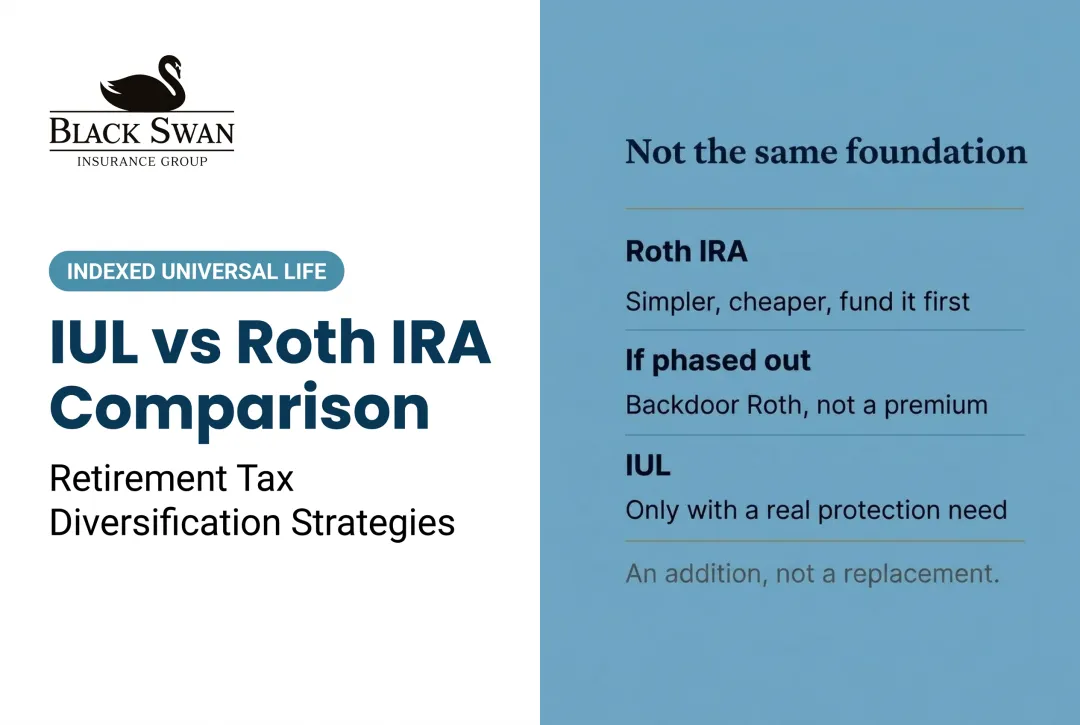
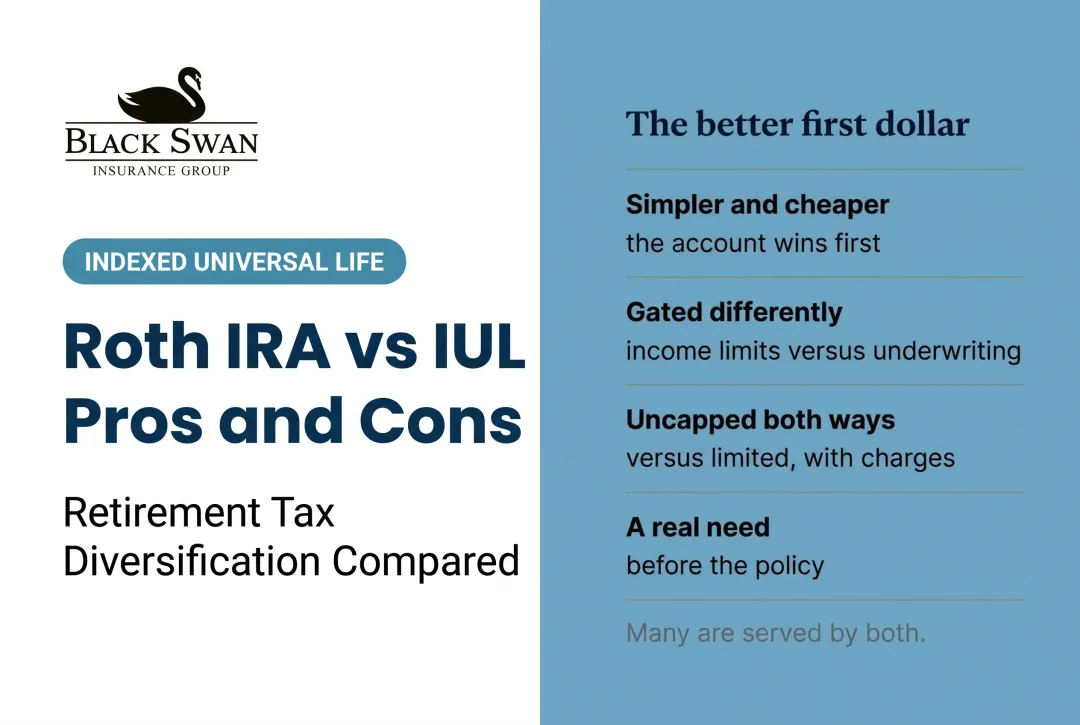
The short answer: A Roth IRA is cheaper, simpler and almost always the first dollar. An IUL earns consideration only once you are past the Roth income limits, have captured every employer match, and have a genuine permanent protection need. The IUL is not a Roth substitute; it is a differently-taxed bucket that happens to carry insurance charges, and you should only pay those charges if you need the insurance.
This is life insurance first. A Roth IRA is not insurance at all, and no amount of side-by-side projection changes what each contract is obligated to do.
Key Takeaways
- A Roth IRA is a retirement investment account; an IUL is permanent life insurance with index-linked cash value
- Roth IRAs offer simpler administration and uncapped market participation; IULs add a death benefit, loan access and funding capacity — with more charges
- An IUL's floor limits negative index credits; policy charges can still reduce cash value
- Fit depends on insurability, time horizon, funding capacity and a real need for permanent protection
- Many high-income households use both rather than treating this as either/or
- Capture the employer match and Roth eligibility before any IUL conversation
The Comparison That Matters
| Feature | Roth IRA | IUL |
|---|---|---|
| What it is | Individual retirement account funded with after-tax dollars, invested through a custodian | Permanent life insurance contract with a death benefit and index-linked cash value |
| 2026 contribution limit | $7,500 ($8,600 at age 50+) | No Roth-style limit; funding is bound by policy design and MEC rules |
| Income eligibility | Phases out at $153,000-$168,000 (single) and $242,000-$252,000 (married filing jointly) | No income limit |
| Growth | Full market gains and losses based on chosen investments | Index-linked crediting with caps, participation rates, spreads, and a floor |
| Fees | Account, advisory, transaction, and fund expenses that vary by provider | Cost of insurance, admin charges, premium loads, and surrender charges that vary by carrier |
| Access | Contributions anytime; qualified earnings tax-free after conditions; no lifetime RMDs | Cash-value withdrawals and loans per contract terms; death benefit for beneficiaries |
Contributions and Eligibility
For 2026, the IRS caps Roth IRA contributions at $7,500, or $8,600 if you are 50 or older — a catch-up of $1,100. The 401(k) elective-deferral limit is $24,500.
Direct contributions phase out between $153,000 and $168,000 for single filers and between $242,000 and $252,000 for married couples filing jointly. You also need earned income, though a non-earning spouse can usually qualify on the working spouse's compensation.
An IUL works differently. There is no annual contribution ceiling and no income phase-out. Funding is bound instead by policy design, insurer premium rules, and modified endowment contract limits. Overfund aggressively and the IRS reclassifies the contract, changing permanently how loans and withdrawals are taxed.
That absence of a contribution limit is the feature most often oversold. "Unlimited" funding capacity is real, but it is bounded by the MEC line on one side and by what you can sustain through a bad income year on the other. Neither bound appears on a sales illustration.
Growth and Fees
With a Roth IRA you pick the investments — stocks, bonds, mutual funds, ETFs — and you keep 100% of the gains and 100% of the losses.
An IUL does not invest in an index. It credits interest using a formula with caps, participation rates or spreads, plus a floor, often 0%, limiting negative crediting. That floor does not stop policy charges from reducing cash value in a flat or down year.
Zero is your hero in a down year — but the floor applies to the credit, not to the charges.

Fee structures differ in kind, not just degree. Roth IRA costs are account- and fund-level expenses that vary by provider and can be driven close to zero. IUL costs include cost of insurance, administrative charges, premium loads and surrender charges specific to each policy. Always ask for a current carrier illustration rather than relying on a general estimate.
What a Roth IRA Does
A Roth IRA is funded with after-tax contributions, so qualified withdrawals come out tax-free provided you meet the IRS age and holding-period rules.
A distribution generally qualifies when the account has been open at least five tax years, and you are 59½ or older, disabled, using up to $10,000 for a first home, or the distribution follows your death.
Withdrawals follow a set order, which is useful if you need money early: original contributions first, always tax- and penalty-free; converted amounts next; earnings last. Early contribution withdrawals generally avoid tax; early earnings withdrawals can trigger tax and penalties.
The original owner faces no lifetime required minimum distributions — a genuine structural advantage over a traditional account. Beneficiaries generally must empty an inherited Roth IRA within ten years unless they qualify as an eligible designated beneficiary.
A Roth IRA tends to fit younger or mid-career savers with a long runway, anyone who qualifies under the income limits and wants a low-maintenance account, and people already capturing their employer match who want a flexible second bucket.
High earners who are phased out often pair Roth access — through conversion strategies, where appropriate — with other tax-diverse buckets rather than treating it as the sole vehicle. Whether any fixed monthly amount is "enough" depends on horizon, returns and the income you will need, not on the account type.
What an IUL Does
An IUL is permanent life insurance carrying a death benefit, flexible premiums within policy limits, and a cash-value account that can earn interest credits linked to an external index such as the S&P 500.
Part of each premium covers cost of insurance and policy charges; the remainder can add to cash value. The split depends on the carrier and the design.
Index crediting is not direct market investing. Your cash value does not buy index shares or earn dividends. A formula determines the credit:
- Cap — the maximum rate credited, however high the index climbs
- Participation rate — the share of index growth used in the calculation
- Spread — an amount subtracted from index gains before crediting
- Floor — the minimum crediting rate, often 0%, limiting negative index years
The floor protects against a negative crediting rate. It does not guarantee cash value will grow, because insurance and administrative charges apply regardless of index performance.

Potential advantages: tax-deferred cash-value growth, no income-based eligibility limits, access through withdrawals or policy loans, and a death benefit for beneficiaries.
Trade-offs: higher costs in early years, surrender charges on an early exit, a cost of insurance that rises with age, and lapse risk if funding falls short.
Funding design adds a further constraint. Premiums exceeding IRS limits under the seven-pay test reclassify the policy as a Modified Endowment Contract, changing how loans and withdrawals are taxed — generally gain-first, with a possible 10% penalty before age 59½.
New IUL premium reached $4.5 billion in 2025, up 17% from 2024, a quarter of all individual life premium sold. Growing adoption is not evidence of suitability for you.
At Black Swan we walk prospective clients away from an IUL about as often as we walk them toward one. If the funding, health or timeline does not support it, we say so.
The Ultimate IUL Blueprint
If you have run out of Roth room and are weighing a second bucket, the Blueprint covers what the design has to survive: funding levels, caps and charges, the MEC line, loan timing, and what to demand from an illustration.
What the Critics Get Right
The sceptics make a strong case here, and it should be stated before someone else makes it for you.
A Roth IRA has no cost of insurance, no premium load, no surrender schedule, no cap on gains and no participation rate. Its tax treatment is written in statute rather than conditional on the policyholder's funding discipline for forty years. Every one of those is a structural advantage over an IUL, and anyone presenting the IUL as simply "a Roth without the limits" is omitting all of them.
Critics are also right that the comparison is usually made by someone who earns a commission on only one side of it.
What the criticism does not resolve is the position the reader is actually in. If you are above the phase-out, the Roth is not the alternative being declined — it is unavailable. The real comparison is between a taxable brokerage account, a backdoor conversion where appropriate, and a permanent policy you need anyway for protection. Framed that way, the IUL is not competing with the Roth's advantages. It is competing with a taxable account, and the honest answer depends on whether the insurance need is real.
A great IUL is engineered. A bad IUL is sold.
Which One Fits
Neither wins outright. The better question is what you are optimising for: retirement accumulation, permanent protection, tax diversification, or legacy.
Stronger Fit for a Roth IRA
- You want simplicity and broad investment choice
- You prefer uncapped market participation over a crediting floor
- You qualify under current income limits
- You do not need permanent life insurance
Stronger Fit for Adding an IUL
- You have a genuine, long-term insurance need
- You can sustain premiums without straining cash flow, including in a bad year
- You are insurable at reasonable health ratings
- You want tax diversification or cash-value capacity beyond what retirement accounts allow
Weaker Fit
Not everyone should buy an IUL. It is a poor fit if you are chasing maximum market participation, need short-term liquidity, have thin emergency reserves, or are covering a temporary need that term insurance handles far more cheaply. Older or less-insurable applicants often find the cost of insurance makes the design uneconomic, and a brokerage account or term policy serves better.
Before deciding, read both the guaranteed and non-guaranteed columns of any IUL illustration against a comparable Roth projection. Compare net cash value, death benefit, surrender value and loan assumptions side by side.
An illustration is a model, not a guarantee.
"Tax-free" needs context on both sides. Roth distributions must meet IRS holding-period and age requirements. IUL loans stay tax-advantaged only while the policy remains in force and is not a MEC.
A sensible funding sequence for most households:
- Build emergency savings and secure appropriate coverage first
- Capture any employer 401(k) match before funding anything else
- Max Roth eligibility or evaluate conversion strategies
- Consider IUL funding only if it remains affordable after the steps above

Four Scenarios
- Early-career saver under the phase-out. A Roth IRA candidate, long horizon, no permanent insurance need yet.
- High-income professional who has maxed everything. May evaluate an IUL for tax diversification and permanent protection, assuming insurability and sustainable cash flow.
- Business owner needing liquidity outside the practice. Permanent protection and cash value may support buy-sell funding or legacy goals — alongside, never instead of, other retirement assets.
- Older or less-insurable applicant. An IUL may not be cost-effective; a Roth IRA, brokerage account or term policy could serve better.
Illustrative, not guarantees. Actual fit depends on underwriting, funding capacity and household-specific goals.
This is not set-it-and-forget-it. It is design-it, fund-it, review-it.
Our review does not start by assuming you need an IUL. We look at existing accounts, coverage, cash flow and goals first, then say honestly whether a policy fits. If it does, we design it and review it annually.
Risks to Understand Before You Redirect a Dollar
- Moving money out of matched or Roth-eligible contributions is almost always the costliest version of this decision.
- Cost of insurance rises with age, and the early years of an IUL are the most expensive relative to value.
- Caps and participation rates can be lowered after issue, subject to contract minimums.
- Surrender charges run for years; an early exit returns less than you paid in.
- Underfunding compounds quietly and surfaces decades after the decision.
- MEC status is generally permanent and removes the tax-advantaged access that justified the policy.
- The loan is not the problem. The unmanaged loan is the problem.
- Roth rules can change, as can life insurance taxation; neither is a permanent guarantee of treatment.
Find Out Where You Actually Stand
This starts with the Tax-Free Wealth Blueprint Fit Review. If you earn $150K+ and have hit the Roth phase-out, we map what each existing bucket is doing, confirm whether a permanent protection need exists at all, read guaranteed against illustrated values on any proposed policy, and stress-test the funding through lower-crediting and reduced-income years. If a backdoor conversion and a brokerage account serve you better, we will say so. If IUL does not fit, we will tell you that too.
Frequently Asked Questions
Is $200 a month enough for a Roth IRA?
It can be a meaningful start over a long horizon. Whether it is enough depends on your retirement age, returns, inflation, existing savings and the income you will need.
Who benefits most from an IUL?
People with a genuine, long-term life insurance need who can sustain premium funding, qualify for reasonable underwriting, and want cash-value or tax-diversification options beyond simpler accounts.
Is an IUL better than a Roth IRA?
Neither is universally better. Roth IRAs emphasise simple, lower-cost retirement investing; IULs combine permanent insurance with cash value, added charges and considerably more complexity to manage.
Can I have both an IUL and a Roth IRA?
Yes, and most eligible households should think in those terms rather than either/or. The decision follows a coordinated review of insurance needs, existing accounts, cash flow and long-term funding capacity.
What are the biggest disadvantages of an IUL compared with a Roth IRA?
Policy charges, surrender periods, capped or formula-based crediting, and lapse risk if underfunded. An IUL also requires ongoing management that a Roth IRA does not.
Can I withdraw money from an IUL or Roth IRA before retirement?
Roth IRA contributions, though not earnings, can usually be withdrawn anytime without penalty. IUL access comes through withdrawals or loans, subject to contract terms and the risk of lapse if loans go unmanaged.
Sources
- ICI — The Role of IRAs in US Households' Saving for Retirement, 2024
- IRS — 401(k) limit increases to $24,500 for 2026; IRA limit increases to $7,500
- LIMRA — 2025 U.S. individual life insurance new premium report
Disclosure: This article is educational and is not personal tax, legal or investment advice. Indexed universal life is life insurance first. Contribution limits, phase-out thresholds and distribution rules change; confirm current figures with the IRS or a qualified tax professional. Illustrated values are not guarantees; actual results depend on policy design, carrier, crediting options, caps, participation rates, expenses, funding and ongoing management, and all guarantees are subject to the issuing insurer's claims-paying ability. This strategy is not appropriate for everyone. Policy loans and withdrawals reduce cash value and the death benefit, and can create tax consequences if the policy lapses or becomes a modified endowment contract. Consult your own tax, legal and financial professionals for advice specific to your situation. Any potential tax-advantaged access depends on the policy being properly structured, funded and managed.
And remember, it's not what you earn, it's what you keep… enjoy the ride.