By Robert Balgac, Founder, Black Swan Insurance Group | October 5, 2026
Real estate investors are drawn to policy loans for a reason that is entirely rational: no underwriting, no closing timeline, no lender asking what the money is for. When a deal needs earnest money in nine days, a source of capital that does not require an application is worth something.
The cost of that convenience is not zero, and it is not charged at closing. It is charged monthly for the rest of the contract, and it is charged hardest if the policy was never funded well enough to carry a balance in the first place.
The short answer: You can borrow against IUL cash value for a deposit, a renovation or a bridge, generally without underwriting and within days. Interest accrues whether or not you pay it, the death benefit falls by the balance, and policy charges continue. Against a HELOC or a portfolio line of credit the policy loan is usually not the cheapest option — its advantage is speed and the absence of a credit check, not price.
Key Takeaways
- Speed and no underwriting are the real advantages; cost rarely is
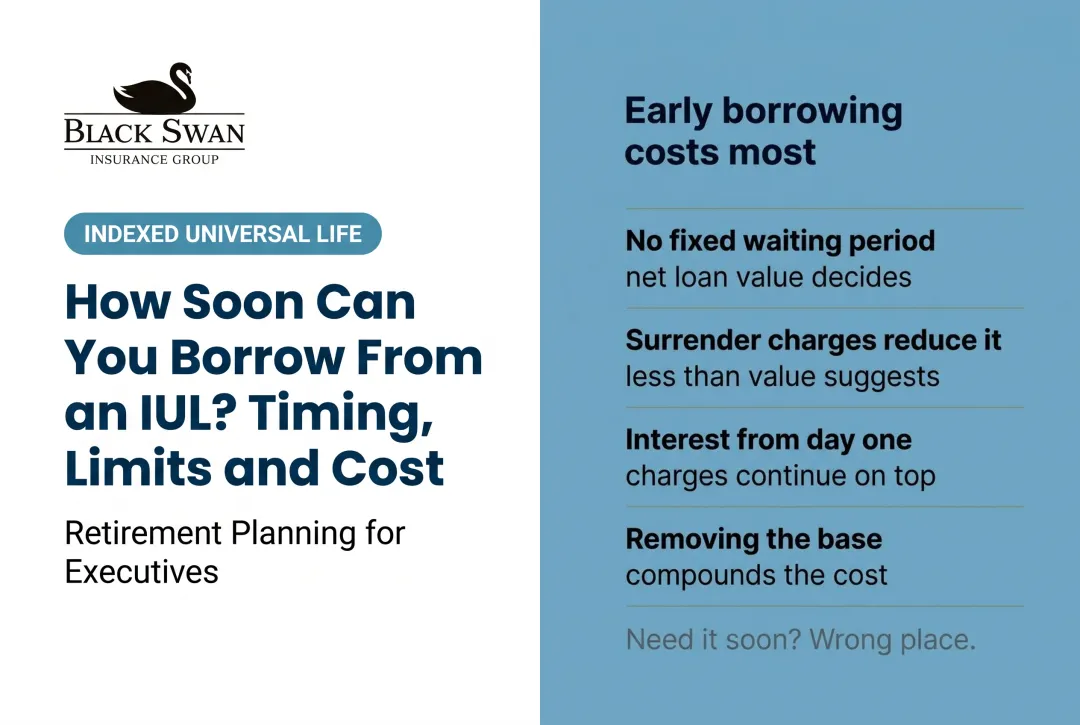
- A policy needs years of sustained funding before it can support a meaningful deal-sized loan
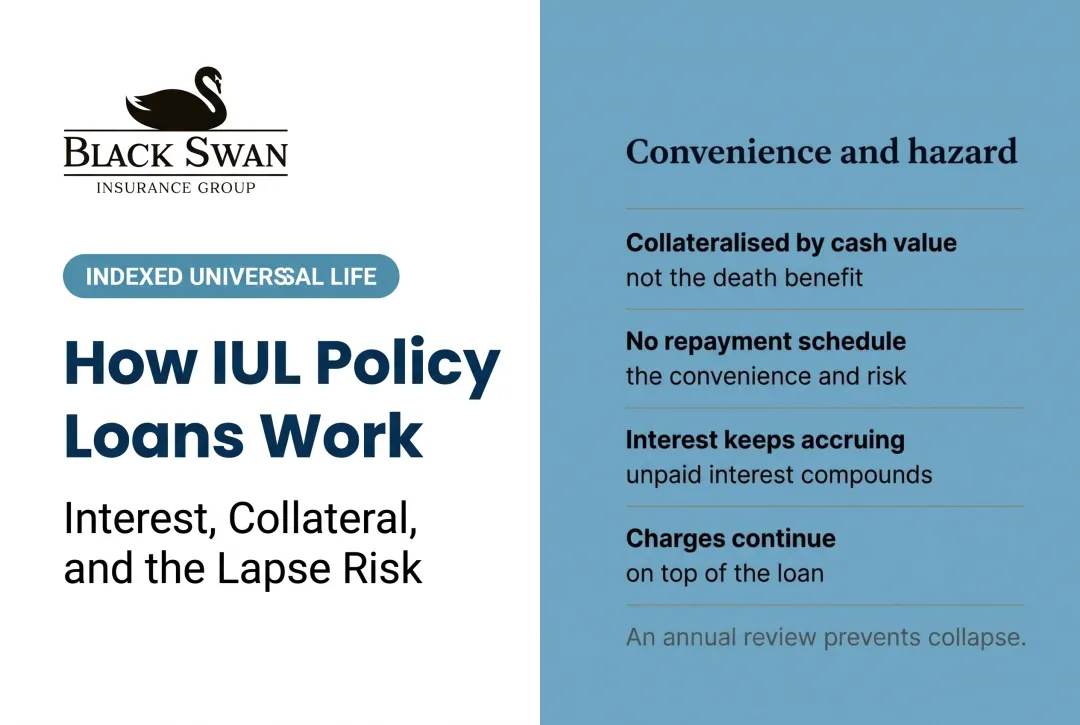
- Interest accrues regardless of payments and compounds if unpaid, while insurance charges continue on top
- Illiquid property plus an accruing policy loan is two illiquid positions stacked on one another
- Compare against a HELOC, a portfolio line of credit and cash reserves before assuming the policy wins
How the Mechanics Work for a Deal
An IUL is permanent life insurance first. Any potential tax-advantaged access depends on the policy being properly structured, funded and managed — and a deal-driven loan tests that management harder than a retirement-income loan does.
- Confirm net available loan value — cash surrender value less existing debt, not accumulated cash value
- Request the loan, specifying gross or net of any fees
- Funds typically arrive within a few business days; confirm your carrier's timeline before relying on it
- Interest begins accruing immediately at the contract rate
- The death benefit is reduced by the outstanding balance
- Policy charges continue to be deducted monthly as normal

Where It Genuinely Fits
- Earnest money on a short fuse, where a HELOC draw would not clear in time
- A renovation bridge repaid from a refinance or sale within a defined window
- Covering a gap between a purchase and a scheduled liquidity event
- A situation where a credit inquiry or DTI impact would jeopardise a mortgage application
The common thread is a short, defined window with an identified repayment source. That is a bridge. It is not a funding strategy.
Think of your IUL cash value like equity in a financial house. You can borrow against it — but this only works if you manage the debt.
Where It Goes Wrong
Investors treat the policy as a revolving credit line. A loan for a deposit is never repaid because the property is refinanced rather than sold. A second loan funds the next deal. Interest capitalises on both. Five years later the balance has grown, the account has not kept pace, and the policy that was supposed to be a family protection asset is a liability.

What the Critics Get Right
Critics are right that presenting a policy as "your own private bank" misdescribes what is happening — you are borrowing the carrier's money at interest against collateral you funded. They are right that investors are unusually prone to over-leveraging this feature, because the mindset that makes someone a real estate investor is the same one that treats available credit as deployable capital.
Where the criticism overreaches is in dismissing the speed advantage. For a specific, bounded use, the absence of underwriting has genuine value that a HELOC cannot match.
Compare It Against the Alternatives
| Source | Typical cost | Speed | Main risk |
|---|---|---|---|
| Policy loan | Contract rate, accrues | Days | Lapse; death benefit reduced |
| HELOC | Usually lower | Weeks | Secured on your home |
| Portfolio line of credit | Competitive | Days | Margin call |
| Hard money | Highest | Days | Short term, high cost |
| Cash reserves | Opportunity cost | Immediate | Leaves you without a buffer |
If the underlying need is family protection rather than deal capital, term insurance plus a brokerage account covers it far more cheaply and keeps the money liquid for the next purchase.

Structuring the Loan So It Does Not Outlive the Deal
The investors who use this well treat the policy loan like any other piece of deal financing: it has a term, a source of repayment and a date.
Write down the exit before you draw. Which specific event repays this — a sale, a refinance, a tenant paying out, a contract settling? "The next deal" is not a repayment source.
Set a hard date and diarise it. A policy loan will never chase you. That is precisely why it needs an artificial deadline that you enforce yourself.
Service the interest from rental income. Even partial interest payments stop the balance compounding, and rental income is the natural place for them to come from.
Cap your total exposure. Decide in advance what proportion of net loan value you are willing to have outstanding at any time — many disciplined investors hold to half — and treat it as a hard limit rather than a guideline.
Review the policy annually, not the loan annually. Request an in-force illustration showing the balance, the projected account value and the termination trigger. A loan that looked comfortable at a 6% credited assumption can look very different after two zero years.
Keep the protection purpose visible. The death benefit is reduced by the balance. If the policy exists partly to protect a family or fund a buy-sell, borrowing against it is borrowing against that promise, and someone other than you carries that risk.
The unthinkable is only unthinkable until it happens.
The Ultimate IUL Blueprint
A plain-English walkthrough of loan mechanics, funding requirements and the questions to ask before you borrow against a policy for a deal.
Who This May Fit
Stronger Fit
- $150K+ income with a policy funded well above minimum for many years, so net loan value is meaningful
- A short, defined window with an identified repayment source
- Capacity to service interest rather than capitalise it
- Separate emergency reserves, so the policy is not the only liquidity available
- An annual in-force review already in place
Weaker Fit
Not everyone should buy an IUL, and buying one in order to fund real estate deals inverts the analysis entirely. The policy is protection that happens to have liquidity, not a credit facility that happens to have a death benefit.
- A young policy still inside the surrender period
- An existing balance not yet repaid
- No identified repayment source
- A cheaper secured option already available
- Deal flow that would tempt a second and third draw

Risks to Understand Before You Borrow
- Interest accrues whether or not you pay it and compounds into the balance if unpaid.
- Policy charges continue on top of the loan and rise with age.
- Two illiquid positions stack — the property and the policy — and neither can be unwound quickly in a bad market.
- Lapse risk rises as debt outpaces available value; the termination trigger is contract-specific.
- A lapse or surrender with gain and an outstanding loan can create taxable income with no cash received to pay it.
- Borrowing early removes the compounding base the policy needs, permanently changing its long-term trajectory.
Find Out Where You Actually Stand
Start with the Tax-Free Wealth Blueprint Fit Review. If you earn $150K+ and are weighing a policy loan against a HELOC for a deal, we price both, model the balance forward with zero-credit years included, and show what it does to the death benefit and lapse risk. If IUL does not fit, we will tell you that too.
Frequently Asked Questions
Can I use an IUL loan for a real estate down payment?
Yes. Funds can generally be used for any purpose, subject to available net loan value and your contract's provisions.
How fast can I get the money?
Often within a few business days once the request is complete, though timelines vary by carrier and policy status. Confirm yours before relying on it for a closing.
Is a policy loan cheaper than a HELOC?
Usually not. A HELOC is typically cheaper. The policy loan's advantages are speed and the absence of underwriting or a credit inquiry.
Will lenders count the policy loan in my debt-to-income ratio?
Treatment varies by lender and situation. Ask your mortgage lender directly rather than assuming it is invisible.
What happens if my deal goes wrong?
The loan remains outstanding and continues accruing. This is why an identified repayment source independent of the deal matters.
Can I keep borrowing for each new deal?
You can until available value runs out, and that pattern is the most common way investors collapse otherwise healthy policies.
Should I fund a policy specifically to borrow for deals?
No. That inverts the analysis. The policy should exist because you need permanent coverage; the liquidity is a secondary benefit, not the reason to buy.
What proportion of cash value should I leave untouched?
Many disciplined investors hold total borrowing to about half of net loan value, leaving room for a bad crediting year. There is no rule, but having a stated ceiling matters more than the number you pick.
Does a policy loan affect my credit score?
Generally no, because there is no credit reporting on a policy loan. That is part of the appeal and part of why it escapes the discipline other borrowing carries.
Sources
- NAIC — Life Insurance — cash value and policy loan definitions
- National Life Group — loan processing timelines
- Guardian — typical borrowing limits against cash value
- Consumer Financial Protection Bureau — HELOCs — home equity borrowing comparison
- I.R.C. § 7702A — Modified Endowment Contract and the seven-pay test
- I.R.C. § 72 — additional tax on early distributions
Disclosure: The information on this page is educational in nature and does not constitute personalized financial, tax, or legal advice. Actual results depend on policy design, carrier, crediting options, caps, participation rates, expenses, funding, loans, and ongoing management. Policy loans and withdrawals reduce cash value and the death benefit, and can create tax consequences if the policy lapses or becomes a modified endowment contract. Consult a licensed insurance professional and, where appropriate, a tax or financial advisor before making any insurance or financial decision. Indexed universal life is life insurance first. Illustrated values are not guarantees; actual results depend on policy terms, crediting, costs and funding. This strategy is not appropriate for everyone.
And remember, it's not what you earn, it's what you keep… enjoy the ride.