By Robert Balgac, Founder, Black Swan Insurance Group | October 5, 2026
There are three ways to take money out of an indexed universal life policy, and they are not variations on a theme. A withdrawal permanently removes value. A loan borrows against it. A surrender ends the contract. Each has a different effect on the death benefit, a different tax consequence, and a different capacity to damage what remains.
People usually arrive at this question for one of two reasons: they need liquidity, or they have concluded the policy was a mistake. Both are legitimate. Both deserve the arithmetic before the decision.
The short answer: Withdrawals are generally tax-free up to your basis and permanently reduce cash value and the death benefit. Policy loans accrue interest and are generally not taxable while the policy stays in force. Surrendering ends coverage, triggers any remaining surrender charge, and makes gain above basis taxable. If the policy lapses or is surrendered with an outstanding loan and gain in the contract, you can owe tax with no cash received to pay it.
Key Takeaways
- A withdrawal is permanent; a loan is debt; a surrender ends the contract — pick deliberately, not by whichever form arrives first
- Withdrawals are generally tax-free up to basis, then taxable; MEC contracts reverse that ordering
- Surrender charges can apply for ten to fifteen years and often mean you receive back less than you paid in
- A lapse or surrender with gain and an outstanding loan can create taxable income with no cash attached
- If the policy no longer fits, replacing it badly is usually worse than owning it badly — get the in-force numbers first
The Three Exits, Compared
An IUL is permanent life insurance first, and every exit route is really a decision about how much of that insurance you are giving up. Any potential tax-advantaged access to cash value depends on the policy being properly structured, funded and managed, and each of these three exits changes that.
| Withdrawal | Policy loan | Surrender | |
|---|---|---|---|
| Coverage continues | Yes, reduced | Yes, reduced by balance | No |
| Repayment | Not applicable | Optional in many contracts | Not applicable |
| Interest | None | Accrues on the balance | None |
| Typical tax treatment | Tax-free to basis, then taxable | Generally not taxable while in force | Gain above basis taxable |
| Main risk | Permanent loss of value and death benefit | Lapse if debt outpaces value | Surrender charge and lost coverage |
Exact treatment depends on your contract and its status. Confirm with your carrier before moving anything.

Withdrawals in Detail
Most contracts permit partial withdrawals after the first policy year, sometimes with a transaction fee and a minimum remaining balance. The amount comes out of cash value permanently and reduces the death benefit, often by more than the withdrawal itself depending on the death benefit option.
Tax treatment follows a first-in-first-out order for non-MEC contracts: you recover basis first, tax-free, and only amounts above basis are taxable. A withdrawal in the first fifteen policy years can also trigger a forced reduction under I.R.C. § 7702 rules in certain designs, which is a detail worth asking about specifically.
Surrender in Detail
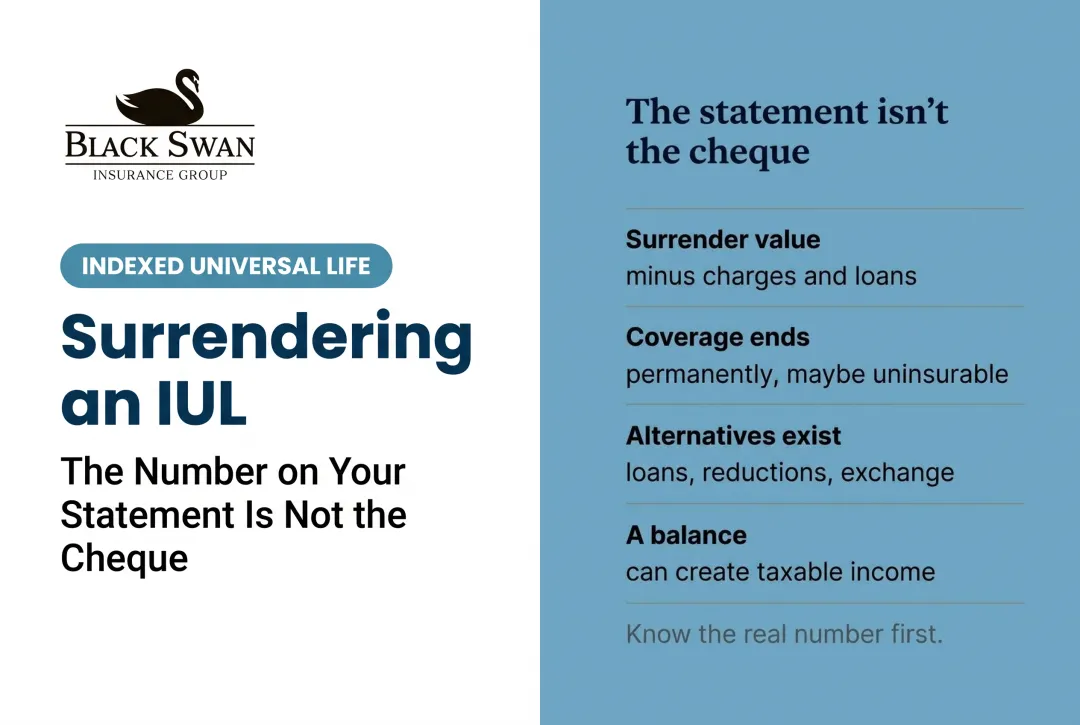
Surrendering ends the contract. You receive the cash surrender value — cash value less any remaining surrender charge and less any outstanding loan. Gain above basis is taxable as ordinary income in the year of surrender. The IRS states that surrendering a life insurance policy for cash may require including in income any proceeds above the policy's cost.
This is not on you. You were the client. You were supposed to be guided. A policy that was designed badly is a diagnosis, not a verdict on your judgement.

The Trap That Catches People
If a policy with a large outstanding loan lapses or is surrendered, the loan is treated as received. Gain above basis becomes taxable income — and the cash is already spent, because you borrowed it years ago. The tax bill arrives at the exact moment the asset disappears. This is the single most damaging outcome available in these contracts and it is entirely avoidable with an annual review.
What the Critics Get Right
Critics are right that surrender charges are punishing and poorly understood at the point of sale, and that a meaningful number of buyers exit in the first several years having lost money. They are right that the tax consequences of a lapsed, loaned policy are rarely explained with the emphasis they deserve.
Where the criticism overreaches is in advising people to surrender on principle. Exiting a policy you have already paid the early charges on can destroy the only value left in it. Too many policies are designed poorly and must be audited — audited, not automatically abandoned.
Before You Take Any Money Out
- Request a current in-force illustration at guaranteed and non-guaranteed values
- Establish your basis, the current loan balance and any remaining surrender charge
- Confirm MEC status, because it reverses the tax ordering
- Model what the policy looks like five and ten years after the withdrawal
- Price the alternatives — cash reserves, a HELOC, a 401(k) loan, a brokerage account withdrawal, or term insurance if all you still need is protection
- If replacement is being suggested, understand a 1035 exchange before surrendering for cash
If the Policy No Longer Fits
Sometimes the honest conclusion is that the contract was wrong from the start. That is worth separating from the question of what to do now, because the second does not follow automatically from the first.
A 1035 exchange moves cash value from one policy to another without triggering tax on the gain. It preserves basis and avoids the immediate tax bill a surrender creates. It also starts a new surrender charge schedule and a new contestability period, and it requires fresh underwriting — so a health change since issue can make it a bad idea even when the numbers look better.
Reducing the death benefit on the existing policy is often overlooked. Lowering the face amount reduces cost of insurance and can rescue a contract that is struggling under charges, without exiting at all. Watch for forced withdrawals under I.R.C. § 7702 rules when reducing in the first fifteen years.
A paid-up or reduced paid-up option, where available, stops premium obligations while retaining some coverage.
Doing nothing, deliberately, is sometimes correct. If the early charges have already been paid and the policy is now past its surrender period, the expensive years are behind you and the remaining economics may be better than they feel.
Get an in-force illustration before choosing among these. A decision made on the account value shown in an app is a decision made on the wrong number.
The Ultimate IUL Blueprint
A plain-English walkthrough of access options, tax ordering, surrender mechanics and the questions to ask before you sign a withdrawal form.
Who Should Take Money Out, and Who Should Not
Stronger Fit
- A defined need, with the amount and purpose established before the form is requested
- Sufficient cash value that the remaining policy still holds on an in-force illustration
- Basis, loan balance, surrender charge and MEC status all confirmed in writing
- A clear comparison showing this beats reserves, a HELOC or a brokerage withdrawal
- Willingness to review the policy annually afterwards
Weaker Fit
Not everyone should buy an IUL, and not everyone who owns one should raid it. Taking money out of a policy you intend to keep for forty years is usually borrowing from the part of the plan with the longest runway.
- Early policy years, where surrender charges dominate and little net value exists
- An existing large loan balance
- No repayment intention and no annual review habit
- A withdrawal that would leave the policy unable to sustain its own charges

Risks to Understand Before You Act
- Withdrawals are permanent and reduce both cash value and the death benefit.
- Surrender charges can apply for ten to fifteen years and often exceed the gain.
- Gain above basis is taxable on surrender, and MEC contracts are taxed last-in-first-out with a possible 10% additional federal tax before 59½ (I.R.C. § 72).
- A lapse or surrender with an outstanding loan and gain can create taxable income with no cash received.
- Reducing cash value increases lapse risk for the remaining contract, because charges continue.
- Replacing a policy has its own costs — new surrender period, new contestability, new underwriting.
Find Out Where You Actually Stand
Start with the Tax-Free Wealth Blueprint Fit Review. If you earn $150K+ and are weighing whether to withdraw, borrow or surrender, we pull the in-force numbers, establish basis and MEC status, and model what the policy does afterwards in a good decade and a flat one. If IUL does not fit, we will tell you that too.
Frequently Asked Questions
Can I take money out of an IUL at any time?
Most contracts permit withdrawals after the first policy year, subject to minimums, fees and available value. Early years usually offer very little net value after surrender charges.
Is an IUL withdrawal taxable?
For a non-MEC contract, withdrawals are generally tax-free up to your basis and taxable above it. MEC contracts reverse that ordering, taxing gains first.
What happens if I cancel my IUL policy?
Coverage ends and you receive cash surrender value less any remaining surrender charge and outstanding loan. Gain above basis is taxable in the year of surrender.
How long do surrender charges last?
Commonly ten to fifteen years, grading down over time. The exact schedule is in your contract and is worth reading before any exit decision.
Can I lose my death benefit by taking withdrawals?
Yes. Withdrawals reduce the death benefit, sometimes by more than the amount withdrawn depending on the death benefit option in force.
Should I surrender a policy that is underperforming?
Not automatically. Get an in-force illustration first. Sometimes the right answer is to adjust funding or the death benefit; sometimes a 1035 exchange is better than a cash surrender.
Sources
- IRS — Life insurance and annuity proceeds — taxation of amounts received on surrender
- NAIC — Life Insurance — cash value, surrender and policy loan definitions
- I.R.C. § 7702A — Modified Endowment Contract and the seven-pay test
- I.R.C. § 72 — additional tax on early distributions
- I.R.C. § 1035 — exchanges of insurance contracts
- NAIC, Life Insurance Illustrations Model Regulation (Model #582) — in-force illustrations
Disclosure: The information on this page is educational in nature and does not constitute personalized financial, tax, or legal advice. Actual results depend on policy design, carrier, crediting options, caps, participation rates, expenses, funding, loans, and ongoing management. Policy loans and withdrawals reduce cash value and the death benefit, and can create tax consequences if the policy lapses or becomes a modified endowment contract. Consult a licensed insurance professional and, where appropriate, a tax or financial advisor before making any insurance or financial decision. Indexed universal life is life insurance first. Illustrated values are not guarantees; actual results depend on policy terms, crediting, costs and funding. This strategy is not appropriate for everyone.
And remember, it's not what you earn, it's what you keep… enjoy the ride.