By Robert Balgac, Founder, Black Swan Insurance Group | October 9, 2026
People search for how to open an IUL account expecting a deposit process. What they find is closer to buying a house: an application, a financial and medical file, a third party deciding whether to accept you and at what price, a contract to read before you sign, and a payment that has to keep arriving for decades.
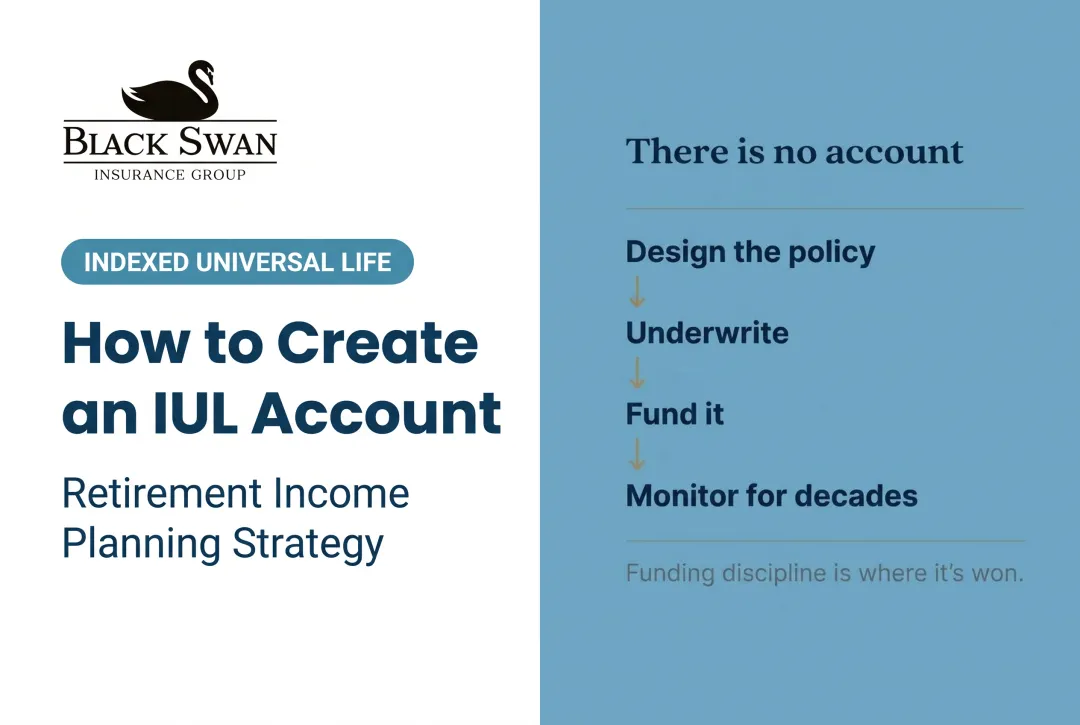
There is no IUL account. You are applying for a permanent life insurance policy, and the gap between those two expectations is where most disappointment starts.
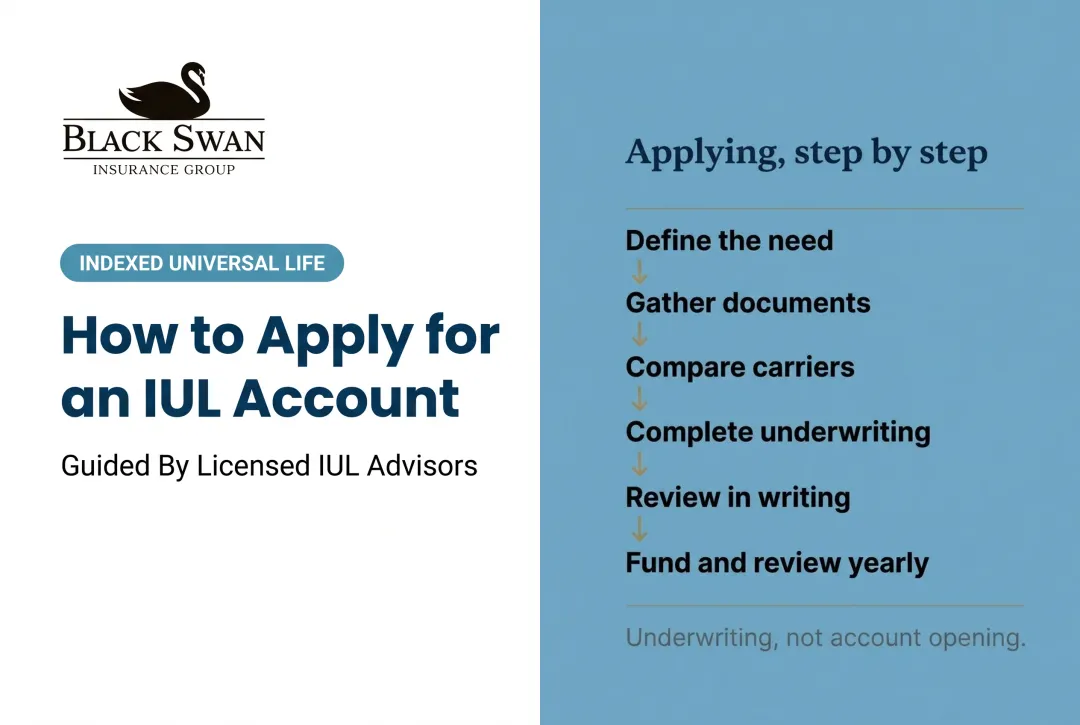
The short answer: Expect five phases — needs analysis, carrier comparison, application, underwriting, and a review of the issued contract before you fund it. Expect to disclose health and finances in detail. Expect the issued policy to differ from the first illustration you were shown. Underwriting can take 24 hours or six weeks. Coverage begins only once you have accepted the contract and paid the initial premium, not when you apply.
This is written for the $150K+ earner who has captured the match, maxed the 401(k) and hit the Roth phase-outs — the profile this product is pitched to hardest, and the one most able to fund it properly if it genuinely fits.
Key Takeaways
- This is an insurance contract with a death benefit and cash-value component, not a deposit account
- The sequence is needs analysis, carrier comparison, application, underwriting, then contract review before funding
- Caps, participation rates, floors and ongoing charges shape real-world performance far more than the headline rate
- Illustrations are projections — read the guaranteed column as the honest one
- Suitability rests on a genuine permanent-insurance need and the ability to fund it through lean years
What You Are Actually Buying
Permanent coverage pairing a death benefit with a cash-value component. Interest credited to that cash value is linked to a selected market index, such as the S&P 500, under formulas written into the contract.
Your premium dollars are not invested in the index. The insurer tracks index movement and uses it as a reference to calculate credited interest. You never own index shares and never receive index dividends.
Three terms govern what you earn. The cap sets the maximum rate the policy will credit regardless of how far the index climbs. The participation rate sets the percentage of index gains used in the formula. The floor, often 0%, sets the minimum credit.
Zero is your hero in a down year — but the floor applies to the credit, not to the charges.
Insurance charges, administrative fees and rider costs keep reducing net cash value during a flat or down year. That single distinction causes more disappointment than any other feature of the product.

| Feature | Term life | Whole life | IUL |
|---|---|---|---|
| Coverage duration | Temporary (10–30 years) | Lifelong | Lifelong |
| Premium flexibility | Fixed | Fixed | Flexible |
| Cash value | None | Guaranteed growth | Index-linked, not guaranteed |
| Complexity | Low | Moderate | Higher |
Flexibility bought with complexity is the trade. The contract is still designed around coverage first; cash-value access is always subject to policy terms, outstanding loans, applicable charges and whether the policy remains in force.
What the Process Actually Looks Like
Phase 1: Needs, Objectives, Affordability
Before anyone discusses design, settle the intended death benefit and beneficiaries; whether you need lifelong or defined-period coverage; the retirement-income or liquidity goals the policy is meant to support; business or estate obligations creating a permanent need; and the surplus cash flow available for premiums including in a slower income year.
Evaluate this alongside employer retirement plans, IRAs, taxable investments, term insurance and whole life — never as an automatic replacement for any of them.
Phase 2: Compare Carriers and Designs
Compare insurer financial strength and claims-paying history; policy charges including cost of insurance and premium loads; guaranteed values against current non-guaranteed projections; crediting methods, caps, participation rates and spreads; and surrender schedules, loan provisions and available riders.
Ask the professional directly whether their comparison is independent or limited to one insurer's lineup. Both answers are legitimate. Only one of them is a comparison.
Phase 3: Application
Applications request identity, contact, employment, income, net-worth, beneficiary, lifestyle and health details. Answer accurately and consistently — inconsistencies between your application and medical records delay underwriting and can create complications at claim time, which your family inherits rather than you.
Have ready: government-issued identification; Social Security or taxpayer identification number; beneficiary names and relationships; a medication list and medical history; physician contact information; and financial records plus existing coverage details.
Phase 4: Underwriting
The insurer evaluates age, health, medical history, lifestyle and finances to set eligibility, underwriting class and premium. Guardian notes that underwriting can take as little as 24 hours or stretch to four to six weeks depending on case complexity.
Some applicants qualify for accelerated underwriting, drawing on prescription history, driving records and medical databases instead of a paramedical exam. Others still need labs, a physical or attending-physician records. Verify requirements with your specific carrier rather than assuming an exam-free path.
Phase 5: Review the Issued Contract, Then Fund It
When the policy arrives, review the death benefit and premium schedule; guaranteed and non-guaranteed cash values; cash surrender value and applicable surrender charges; riders, exclusions and index-strategy allocations; lapse risk under conservative funding assumptions; and beneficiary designations.
Coverage generally becomes active only once you have received, reviewed and accepted the contract and paid the required initial premium.

The Ultimate IUL Blueprint
Before you start, the Blueprint covers what the design has to survive: funding levels, caps and charges, the MEC line, loan timing, and exactly what to demand from an illustration.
What Drives Approval, and What Drives Performance
These are different things, and conflating them is a reliable source of regret.
Approval turns on age and health history, tobacco use and lifestyle factors, the requested death benefit and your financial profile. Carriers sort applicants into tiers such as Preferred Plus, Preferred, Standard or table-rated classes, with exact categories varying by insurer.
Cash-value growth turns on how the premium is allocated: cost of insurance for the death benefit, policy fees for administration and premium loads, the cash value remaining after charges and credited by your index strategy, and the surrender value after any surrender charges.
This published example from one insurer's rate sheet shows how differently crediting structures can be built. It is an illustration only, not a benchmark:
| Strategy | Cap | Participation rate | Floor |
|---|---|---|---|
| Annual point-to-point | 10.50% | 100% | 0.25% |
| High-participation point-to-point | 9.65% | 140% | 0% |
| Point-to-point with spread | No cap | 100% | 0% |
These are alternative strategy options, not benefits received simultaneously. Charges still apply in years when the indexed account credits little or nothing.
Missed premiums, large loans or weak crediting years can cut cash value, reduce the death benefit, or push the policy toward lapse. If funding exceeds IRS limits under the seven-pay test, the contract becomes a Modified Endowment Contract; IRS guidance confirms MEC distributions are generally taxed income-first and may trigger an additional 10% tax before age 59½, absent an exception.
Before accepting any policy, compare the guaranteed column with the current projection. The NAIC's illustration model requires guaranteed values to be shown separately from non-guaranteed ones precisely because projections are not promises.
An illustration is a model, not a guarantee.

Life After Issue
These contracts appear in a handful of planning contexts: family income protection after a primary earner's death; estate or legacy planning including inheritance liquidity; business or practice-owner protection and succession funding; supplemental retirement income alongside 401(k), IRA or Roth savings; and long-term liquidity goals including education funding.
Management does not end at issue. Over the policy's life you will make decisions about premium funding, beneficiary updates, index-allocation choices, and periodic reviews of cash value and lapse risk. Reviews matter most after a major change — marriage, divorce or a new child; business ownership changes or retirement; income disruption or a health change; a large policy loan; or a shift in estate-planning goals.
Loans deserve particular care. They are not bank withdrawals: interest accrues, available cash value falls, the death benefit can drop, and taxable income can arise if the policy lapses or is surrendered with a balance outstanding.
The loan is not the problem. The unmanaged loan is the problem.

What the Critics Get Right
The misconceptions below are not random consumer errors. They are the predictable residue of how this product is marketed, and critics are right to point at the marketing rather than the buyer.
- "I'm opening an IUL account." You are applying for an insurance contract through a licensed agent, and the insurer decides.
- "My cash value grows with the full index return." Caps, participation rates and spreads almost always create a gap between raw index performance and credited interest.
- "A 0% floor means cash value can't drop." The floor applies to index-linked crediting only; charges continue regardless.
- "Flexible premiums mean I can pay whatever, whenever." Underfunding lets charges outpace available cash value and risks lapse.
- "The projected column is my retirement income." It is a model built on current, non-guaranteed assumptions.
Each of those beliefs survives because somebody benefits from it surviving. The fair criticism is not that the product cannot work — it is that the gap between the sales narrative and the contract is wide enough to walk through, and that the person closing the gap should be the buyer's adviser, not the buyer alone.
A great IUL is engineered. A bad IUL is sold.
Who This Fits
Stronger Fit
- A genuine, ongoing need for permanent life insurance
- Stable surplus cash flow able to sustain premiums through lean years
- A long time horizon and willingness to review the policy annually
- Comfort with a materially more complex product than term insurance
- A plan that already covers foundational savings and emergency liquidity
High-income professionals, late-start high earners and business owners building assets outside their practice raise this most often. Income alone is not a suitability test; the fit has to be earned against the conditions above.
Weaker Fit
Not everyone should buy this. It is probably wrong if your primary need is inexpensive temporary coverage, income is irregular or reserves are thin, you need near-term access to the money, insurability is limited or premiums are not sustainable long term, or you prefer simple transparent products.
Term insurance, whole life, traditional universal life, Roth accounts or taxable brokerage investing may meet the objective as well as or better than an IUL.

Six questions to ask before applying: What is my actual permanent insurance need? What happens to this policy under guaranteed assumptions alone? How much premium can I sustain for decades? What alternatives did I compare this against? What charges and loan risks apply to this specific contract? And who will review this policy with me every year?
Risks to Understand Before You Apply
- Underwriting can come back worse than quoted, and the illustration you were shown assumed a health class you may not receive.
- Caps and participation rates can be lowered after issue, within contract minimums.
- Cost of insurance rises with age, and underfunding is the leading cause of policy failure.
- Surrender charges apply for years, making an early exit expensive by design.
- Crossing the MEC line is generally permanent and changes how loans and withdrawals are taxed.
- Lapsing or surrendering with a loan outstanding can create taxable income with no cash received.
This is not set-it-and-forget-it. It is design-it, fund-it, review-it.
Find Out Where You Actually Stand
This starts with the Tax-Free Wealth Blueprint Fit Review. If you earn $150K+ and want to know what to expect before you apply, we establish the protection need first, model funding against the MEC limit, stress-test the design through lower-crediting and zero-credit years, compare carrier designs on identical assumptions, and show charges, surrender schedules and loan terms in plain numbers. If term plus a Roth strategy serves you better, we will say so. If IUL does not fit, we will tell you that too.
Frequently Asked Questions
What do I need to apply?
Requirements vary by insurer but typically include identification, personal and financial details, beneficiary information, health history, a completed application and sometimes a medical exam.
Is this a good investment?
It is insurance first. It may suit people with a genuine permanent coverage need, long-term funding capacity and tolerance for complexity. Compare the alternatives and review charges and guarantees before deciding.
Is an IUL a bank or brokerage account?
No. It is a permanent life insurance contract issued by an insurer, with cash value credited under the policy's specific rules. You are never directly invested in a market index.
Do I need a medical exam?
Many applications involve underwriting that may require an exam, labs or medical records. Some applicants qualify for accelerated underwriting without one, depending on the insurer and health profile.
How long does it take?
It depends on application completeness, underwriting requirements, medical results and insurer workload — anywhere from 24 hours to six weeks. Ask your carrier for a realistic estimate.
When can I access the cash value?
Access depends on available cash value and your contract's terms, usually through loans or withdrawals. Both reduce the death benefit, increase lapse risk and can create tax consequences.
Sources
- Guardian — Life insurance underwriting
- IRS — Revenue Procedure 2001-42
- NAIC — Life Insurance Illustrations
Disclosure: This article is educational and is not personal tax, legal or investment advice. Indexed universal life is life insurance first. Crediting rates, caps and participation rates shown are illustrative examples from published carrier materials and are not offers or benchmarks. Illustrated values are not guarantees; actual results depend on policy design, carrier, crediting options, caps, participation rates, expenses, funding and ongoing management. This strategy is not appropriate for everyone. Policy loans and withdrawals reduce cash value and the death benefit, and can create tax consequences if the policy lapses or becomes a modified endowment contract. Consult your own tax, legal and financial professionals for advice specific to your situation. Any potential tax-advantaged access depends on the policy being properly structured, funded and managed.
And remember, it's not what you earn, it's what you keep… enjoy the ride.