By Robert Balgac, Founder, Black Swan Insurance Group | October 9, 2026
The question is almost never "is IUL good?" For a $150K+ earner who has already maxed the 401(k) and run past the Roth phase-out, the real question is where this sits in a stack of tools you already own — and whether it deserves a place in the stack at all.
An indexed universal life policy combines permanent life insurance with a cash value account that earns interest linked to a market index such as the S&P 500. For someone who has filled the obvious tax-advantaged space, that pairing looks appealing: lifelong coverage, tax-deferred growth, a crediting floor that limits index losses. The mechanics decide whether the appeal survives contact with reality. Policy charges, index caps, participation rates, flexible-premium requirements and loan provisions all shape what you actually get, and none of it shows up clearly in a glossy illustration.
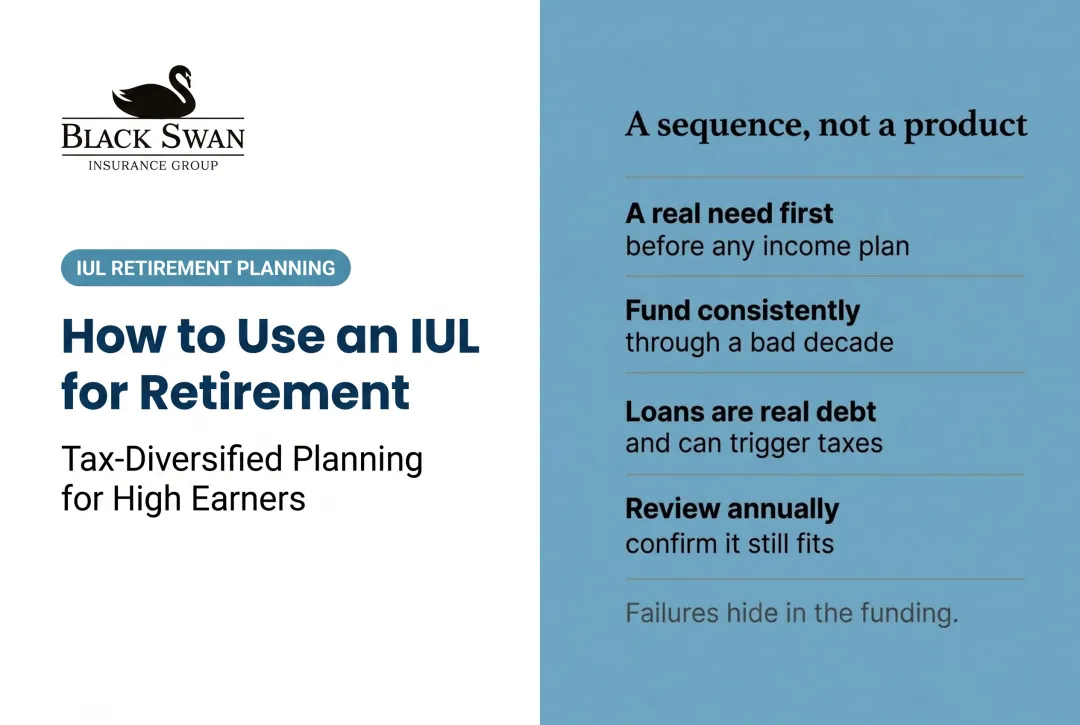
The short answer: An IUL belongs in a retirement plan only after the employer match, the qualified accounts and an honest assessment of whether you need permanent coverage. It is a layer, not a foundation. Where it earns its place is tax diversification for someone who has run out of tax-advantaged room and has a genuine lifelong protection need — and even then, the funding order matters more than the product.
Key Takeaways
- Confirm you need permanent life insurance before treating cash value as a retirement tool
- Index crediting is not stock-market investing; caps, floors, participation rates and fees determine the real result
- Tax-advantaged loans and withdrawals only work if the policy avoids MEC status and stays in force
- Compare against your 401(k), Roth IRA, brokerage account and existing insurance before funding one
- The funding order is the decision; the product choice comes second
Permanent Protection Comes First
An IUL is permanent life insurance with flexible premiums. The cash value is a secondary feature, not the product's reason for existing. Guardian explains that IUL cash value is credited by reference to an index, without the policyholder owning those securities directly.
Before evaluating retirement cash flow, confirm you actually need lifelong coverage — for a spouse, dependents, a business or an estate plan. If you do not, the honest answer is that everything downstream is a tax argument wrapped in an insurance contract, and there are cheaper tax arguments.
Stronger Fit
- High-income professionals and executives with stable surplus cash flow beyond the monthly budget
- Business and practice owners building assets outside a concentrated company
- Affluent families with a genuine permanent-protection need plus interest in tax diversification
- Households with ten or more years before drawing retirement income
The Late-Start High Earner Problem
Reaching peak earnings at 45 to 55 changes the arithmetic. A compressed runway means less time for cash value to clear early policy charges and the surrender-charge period, which is where the product is weakest. Before committing, stress-test current health and insurability (underwriting gets dearer with age), funding capacity that does not crowd out other savings, and how many years actually remain before you need income.
If the answer to the last one is under ten, be sceptical. The design needs time it may not have.
Weaker Fit
Not everyone should use one. Walk away, or wait, if you have not captured the full employer 401(k) match — matched money beats an index cap every time — need liquidity within the next few years, cannot commit to annual reviews and ongoing funding, or mainly want low-cost, direct market exposure.
That funding order is easier to see against real limits. For 2026, the IRS set the 401(k) employee elective deferral limit at $24,500, with combined IRA contributions capped at $7,500. The Roth phase-out begins at $153,000 single and $242,000 joint. Qualified accounts — especially any portion carrying an employer match — come before an IUL.

The 401(k) is not the villain. A one-bucket retirement plan is the villain.
Where It Sits in the Stack
An IUL rarely stands alone. It works as one layer above employer plans, IRAs, Roth accounts, taxable brokerage assets, Social Security and sometimes annuities. For business owners that layer is usually about building assets outside the company — not replacing the rest of the plan.
| Tool | Primary job | Best when |
|---|---|---|
| IUL | Permanent protection + tax-diversified cash value | You need lifelong coverage and have filled other tax-advantaged space |
| Whole life | Permanent protection + guaranteed cash value | You want predictability over upside potential |
| Term life | Temporary protection | You need coverage for a fixed window at the lowest cost |
| 401(k) / IRA / Roth | Tax-advantaged retirement savings | Before anything else, especially with an employer match |
| Annuity | Guaranteed income stream | You want to convert savings into predictable retirement income |
| Brokerage account | Liquid market investing | You want direct market exposure and flexibility |
The useful question is whether permanent need, time horizon, insurability and funding capacity line up — something a fit review should pressure-test before anyone applies.
The Ultimate IUL Blueprint
Before you place this layer in your plan, the Blueprint covers what the design has to survive: funding levels, caps and charges, the MEC line, loan timing, and what to demand from an illustration.
What You Need Before Funding One
A defined retirement-income and protection goal. Document target retirement timing, income sources, beneficiaries, debts, dependents and estate objectives. Decide honestly whether permanent coverage is required, or whether term insurance would meet the protection need for a fraction of the cost.
A complete financial baseline: current income and cash flow, emergency reserves, existing life insurance, retirement account balances and contribution levels, current tax bracket and outstanding liabilities, and business or practice exposure where relevant.
Policy documents and a qualified review. Request the carrier illustration, policy ledger, fee schedule and surrender-charge schedule, then separate guaranteed values from projected ones.
NAIC's Life Insurance Buyer's Guide notes that basic illustrations must show guaranteed and non-guaranteed death benefits and surrender values side by side for years one through ten, then every fifth year after. That comparison is the single most useful page in the document, and it is the one nobody walks you through. Have a qualified professional do it before you fund.
An affordability and monitoring plan. Establish funding you can maintain through a job change, a slow year or a downturn, with a response plan for caps shrinking, charges rising or household income changing.

Operating It Over Decades
Setup. Decide the policy's specific job first — permanent protection, tax diversification, supplemental cash flow, legacy planning, or a combination. Then inspect the contract: compare projected values against guaranteed ones, review premium schedules and death-benefit options, and confirm how the carrier can change caps and participation rates. That last clause tells you more about your future than any projection.
Initiating use. Premiums fund the policy only after cost of insurance and other charges come out. What remains is allocated to index-linked and fixed accounts based on the crediting strategies you select, with values reset annually. You never own shares of the index. The floor, cap, participation rate and any spread determine the credit each year, and those terms vary by carrier.
Zero is your hero in a down year — but the floor applies to the credit, not to the charges.
Funding. Fund from a sustainable, documented budget — not the maximum premium shown in an attractive illustration. Overfunding has a cost of its own: push too hard and you trip the seven-pay test, triggering modified endowment contract status, which changes how loans and withdrawals are taxed and is generally permanent.
Drawing income. Structure distributions through a mix of withdrawals and loans. Factor in loan interest at the guaranteed maximum rate rather than the current one, and coordinate timing with Social Security and other income sources.
The loan is not the problem. The unmanaged loan is the problem.
Monitoring. Review annually: actual cash value against illustrated projections, premium history and policy charges, loan balance and interest accrual, current caps and participation rates, and surrender value and in-force projections. Warning signs are missed premiums, declining cash value, a growing loan balance, or a death benefit that no longer matches your family's needs.
Exiting. Surrendering, replacing or lapsing a policy all carry consequences — surrender charges, lost coverage, and potential taxable income if an outstanding loan exceeds your basis. Talk to a tax professional first, and never cancel existing coverage until replacement coverage is actually in force.
What the Critics Get Right
The strongest fair criticism of putting IUL in a retirement plan is opportunity cost. Every dollar of premium is a dollar not in a low-cost index fund, and the insurance charges are a real, compounding drag that the illustration quietly absorbs into its projection. For a saver with no permanent insurance need, the critics are simply correct: a brokerage account is cheaper, more liquid and more transparent.
The second fair criticism is that the retirement-income case depends on borrowing, and the loan charge is contractual while the index credit funding it is not. If crediting runs below the loan rate for a sustained period, the balance compounds past what the policy can support. That is a documented failure mode, not a hypothetical.
Where the criticism stops short is tax diversification. If every retirement dollar you own sits in tax-deferred accounts, you have made a single, large, undiversified bet on future tax rates. Spreading that risk has value even when the vehicle is imperfect — and for someone phased out of the Roth, the menu of ways to do it is short. That is the honest case, and it is narrower than the sales pitch.
A great IUL is engineered. A bad IUL is sold.
Risks to Understand Before You Commit
The habits that separate policies performing as expected from the ones that disappoint:
- Start with protection, not projections. Treat the death benefit as the reason to buy; treat cash value growth as a secondary benefit.
- Capture the free money first. Full employer 401(k) match, then IRA or Roth contributions, before extra cash goes to a policy.
- Demand stress-tested illustrations. Lower crediting assumptions, extended low-crediting stretches and realistic premium gaps — not only the best case.
- Review every year. Compare guarantees against assumptions, check premium sufficiency, reassess death-benefit need.
- Get compensation and alternatives in writing. Pay structure, carriers considered, surrender implications and MEC limits, in plain language.
An illustration is a model, not a guarantee.
The specific risks that end policies: underfunding, rising cost of insurance with age, caps and participation rates reduced after issue, excessive loans, surrender charges in the early years, and a lapse with a loan outstanding producing taxable income with no cash received.
This is not set-it-and-forget-it. It is design-it, fund-it, review-it.

Find Out Where You Actually Stand
This starts with the Tax-Free Wealth Blueprint Fit Review. If you earn $150K+ and want to know whether an IUL belongs in your retirement plan, we check the funding order first — match, qualified accounts, backdoor Roth, reserves — then confirm whether a permanent protection need exists at all. If both clear, we compare designs across carriers under identical assumptions, read guaranteed values against illustrated ones, model the distribution phase at the guaranteed maximum loan charge, and stress-test through lower crediting and paused funding. We explain compensation before anyone funds anything. Tax, legal and investment decisions stay coordinated with your own CPA or attorney. If IUL does not fit, we will tell you that too.
Frequently Asked Questions
Is an IUL a good retirement investment?
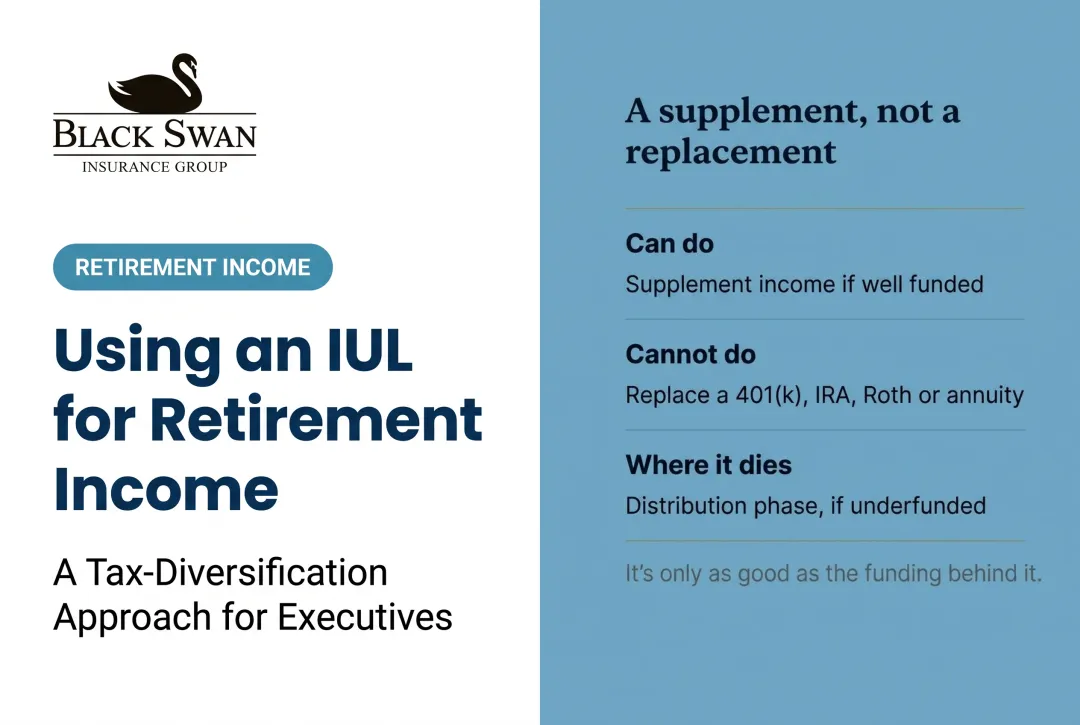
It is permanent life insurance, not an investment account, and the framing matters. It may supplement retirement for some high-income professionals, but fit depends on protection need, funding capacity, horizon and how it compares with the accounts you already hold.
How does an IUL provide retirement income?
Through cash value withdrawals and policy loans. Charges, loan interest, reduced benefits, lapse risk and tax rules all affect how much you can actually draw, and the loan rate is contractual while the crediting that services it is not.
Can an IUL replace a 401(k) or IRA?
Generally no — and certainly not before an employer match is captured. It works as a supplement, evaluated alongside existing retirement accounts rather than against them.
What is the biggest risk?
Underfunding, rising policy costs and changing non-guaranteed assumptions top the list. Excessive loans and lapse risk can erase years of accumulated cash value and create a tax bill at the same time.
Can you lose money in an IUL?
Yes. A 0% index floor prevents a negative index credit, but it does not prevent cash value declining through policy charges, cost of insurance, loans, withdrawals or surrender charges.
What should I review before buying one?
Guaranteed against illustrated values, fees, caps, participation rates, premium requirements, surrender charges, loan terms and MEC limits — then compare the whole thing against your other retirement options.
Sources
- Guardian — Indexed universal life insurance
- IRS — 401(k) limit increases to $24,500 for 2026; IRA limit increases to $7,500
- NAIC — Life Insurance Buyer's Guide
Disclosure: This article is educational and is not personal tax, legal or investment advice. Indexed universal life is life insurance first. Contribution limits and tax rules change annually and must be confirmed against current IRS guidance; carrier caps, participation rates, charges and availability change frequently and must be confirmed against current policy forms. Illustrated values are not guarantees; actual results depend on policy terms, crediting, costs and funding. Any potential tax-advantaged access depends on the policy being properly structured, funded and managed. Actual results depend on policy design, carrier, crediting options, caps, participation rates, expenses, funding and ongoing management. This strategy is not appropriate for everyone. Policy loans and withdrawals reduce cash value and the death benefit, and can create tax consequences if the policy lapses or becomes a modified endowment contract. Consult your own tax, legal and financial professionals for advice specific to your situation.
And remember, it's not what you earn, it's what you keep… enjoy the ride.