By Robert Balgac, Founder, Black Swan Insurance Group | October 5, 2026
There is no best indexed universal life carrier, and any list that declares one is ranking something other than your interests. What varies between companies is caps, participation rates, loan provisions, rider costs, guarantee structures and surrender schedules — and those differences compound across thirty years in a way no single-page comparison captures.
If you earn $150K+, have maxed the obvious accounts, and are now looking at illustrations from three carriers that all show a satisfying number in year twenty, the number is not what you should be reading. The guaranteed column is. So are the loan mechanics, and so is the question of whether the carrier can move the cap after you have committed.
U.S. individual life insurance new premium topped $17.5 billion in 2025, according to LIMRA, with IUL climbing alongside it. More carriers and more product variations mean more homework, not less.
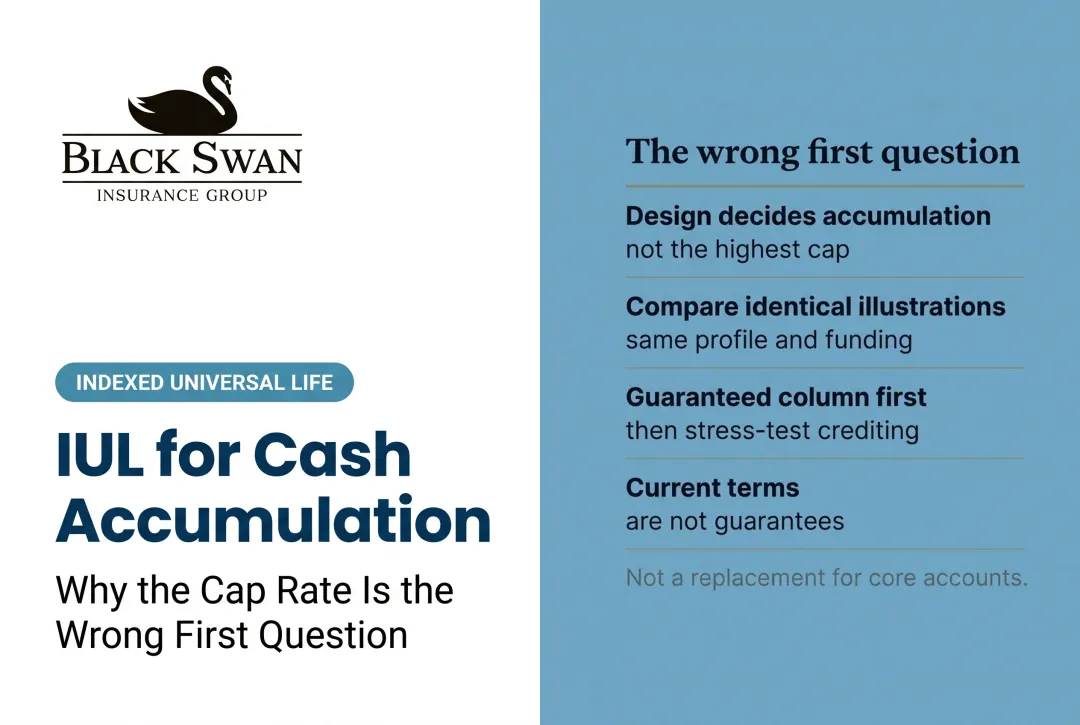
The short answer: Pick the carrier by what it does for your specific job — accumulation, estate liquidity, survivorship, living benefits — not by the illustrated rate. Compare financial strength ratings, caps, participation rates, floors, spreads, cost of insurance, surrender schedules, rider pricing and loan provisions on state-approved illustrations, guaranteed column first. A 0% floor addresses index performance only; charges, loans and underfunding can still reduce value in a flat year. And confirm the product is currently open for new applications, because lineups change.
Key Takeaways
- Choose a carrier on goals, funding capacity, protection need and risk tolerance — not the highest illustrated rate
- Compare caps, participation rates, floors, spreads, fees, surrender charges and riders side by side, on current terms
- The 0% floor stops a negative index credit only, not declines caused by fees, loans or underfunding
- Weigh an IUL against term, whole life, retirement accounts and brokerage assets before committing
- Ratings are an agency's opinion of claims-paying ability, not a forecast of how your policy will perform
How Index Crediting Actually Works
An IUL is permanent life insurance first. It pays a death benefit for as long as the contract stays in force, and it allows flexible premiums within limits. Cash value can earn interest tied partly to an external index such as the S&P 500, but the money is never invested in that index.
The moving parts:
- Floor — the minimum crediting rate for a segment, often 0%, protecting against negative index performance for that segment only
- Cap — the maximum credited interest, however well the index does
- Participation rate — how much of the index-linked gain the policy can credit
- Spread — a deduction some uncapped strategies apply instead of a cap
- Fixed account — an alternative crediting a stated rate unrelated to any index
A policy with a 100% participation rate, a 9% cap and a 0% floor would credit 9% in a year the index gains 12%, and 0% in a year the index falls. Illustrative only.

As Guardian Life explains, a 0% floor generally addresses index performance only. It does not shield cash value from cost-of-insurance charges, administrative fees, policy loans or withdrawals, each of which can reduce the balance even in a flat or positive index year.
Zero is your hero in a down year — but the floor applies to the credit, not to the charges. Most of the disappointment in this product traces back to people who were told otherwise.
Any potential tax-advantaged access through loans and withdrawals is conditional on the policy being properly structured, funded and managed, and on it staying in force and outside MEC status.
Carriers, by the Job They Are Built For
Financial strength, flexibility, crediting options, guarantees, living benefits and service, weighed against common buyer profiles. Ratings and features change; verify current data before applying.
| Carrier | AM Best | S&P Global | Moody's |
|---|---|---|---|
| Pacific Life | A+ | AA- | Aa3 |
| Penn Mutual | A+ | A+ | Aa3 |
| Nationwide | A+ | A+ | A1 |
| Lincoln Financial | A | Not stated in public excerpt | A2 |
| Protective | A+ | AA- | Aa3 |
Ratings reflect the most recent affirmations each carrier reported at the time of writing and are subject to change. AM Best rates A+ as Superior and A/A− as Excellent.
Pacific Life — Flexible Design for Affluent and Business Planning
Policies issued through Pacific Life Insurance Company and Pacific Life & Annuity Company. The lineup includes Pacific Horizon ECV IUL, Pacific Horizon IUL 2, Pacific Horizon Survivorship IUL 2 and Pacific Trident IUL.
- Early cash-value design — Horizon ECV IUL is built around early-year cash surrender value
- Index-account variety — Horizon IUL 2 offers eight indexed accounts including one-year, multi-year and volatility-control strategies, plus a fixed account
- No-lapse protection — eligible policies can include guarantees to age 90, extendable under specified conditions
- Survivorship coverage — Horizon Survivorship IUL 2 insures two lives and pays after the second death, a common estate-liquidity tool
- Loan provisions — Horizon IUL 2 documents a guaranteed indexed loan-interest charge rate of 4.5%
Ask about: current cap and participation rates, what the no-lapse guarantee costs, and how the loan provisions read on your state's approved policy form.
Penn Mutual — Mutual Structure and Early Liquidity
A mutual company owned by policyholders rather than outside shareholders. Current lineup includes Accumulation Builder Select IUL, Survivorship IUL and Protection IUL.
- Chronic-illness benefit available at no charge at issue on Accumulation Builder Select, though using it reduces the death benefit and cash value
- Guaranteed increase options adding coverage at specified ages or life events without new medical underwriting, subject to limits
- Surrender Benefit Enhancement Rider on survivorship products, waiving surrender charges for nine years with return-of-premium guarantees for six
- Accelerated underwriting lets many applicants skip exams and fluid tests, though eligibility varies
Ask about: premium flexibility and the current surrender-charge schedule, and test every illustration under conservative assumptions.
Nationwide — Living Benefits and Care Planning
Lineup includes Indexed UL Accumulator III, Indexed UL Protector II 2020 and Survivorship Indexed UL 2020. Accumulator III's Guaranteed Interest Accumulated Value endorsement guarantees a 2% minimum cash-value growth rate at surrender or death, though that value is not available for loans or withdrawals.
Living-benefit riders include chronic, critical and terminal illness coverage, long-term care riders for qualifying needs, Overloan Lapse Protection II to help keep heavily loaned policies in force, and waiver of premium or monthly deductions.
The chronic-illness rider caps the annual benefit at the lesser of 20% of the specified amount or the HIPAA daily rate times 365, with a $250 administrative fee reducing each payment.
Ask about: how invoking a benefit affects the remaining death benefit and cash value. These riders supplement comprehensive care planning; they do not replace it.
Lincoln Financial — Estate, Legacy and Survivorship
Portfolio spans WealthProtector IUL, WealthAccelerate IUL, WealthBuilder IUL, WealthBuilder ECV IUL and the survivorship-focused WealthPreserve 2 SIUL. WealthAccelerate includes a 10-year no-lapse guarantee period.
Product choice follows intent. A legacy or estate-liquidity design normally trades cash-value growth and premium flexibility for stronger guarantees. An accumulation design does the reverse.
Ask about: state availability — several Lincoln products are not offered in New York — and how much of any illustrated value is guaranteed rather than tied to non-guaranteed index performance.
Protective — Verify Before You Research Further
Ratings are strong, but the flagship Protective Indexed Choice UL stopped taking new sales as of March 9, 2026, per the carrier's transition notice. Public materials reviewed for this article did not describe a successor in enough detail to report specifics.
Ask first: is a current IUL product open for new applications, what are the cost-of-insurance charges, administrative fees and surrender schedule, and can cap or participation rates change and how often? Treat older illustrations and archived product sheets as outdated until the carrier confirms otherwise.

What the Critics Get Right
The skepticism aimed at carrier comparisons in this category is well earned.
Critics are right that illustrated rates are close to meaningless as a comparison tool, because the carrier chooses the assumption and can change the cap afterwards. They are right that "best IUL company" content is frequently commission-driven, ranking whoever pays. And they are right that a buyer who picks on the projection rather than the guaranteed column has not actually compared anything.
Where the criticism runs out is in concluding the carrier choice does not matter. It matters enormously — just not in the dimension the marketing emphasises. Loan provisions, no-lapse structures, rider pricing and financial strength are the differences that survive thirty years. The illustrated rate is the one that does not.
How to Compare Properly
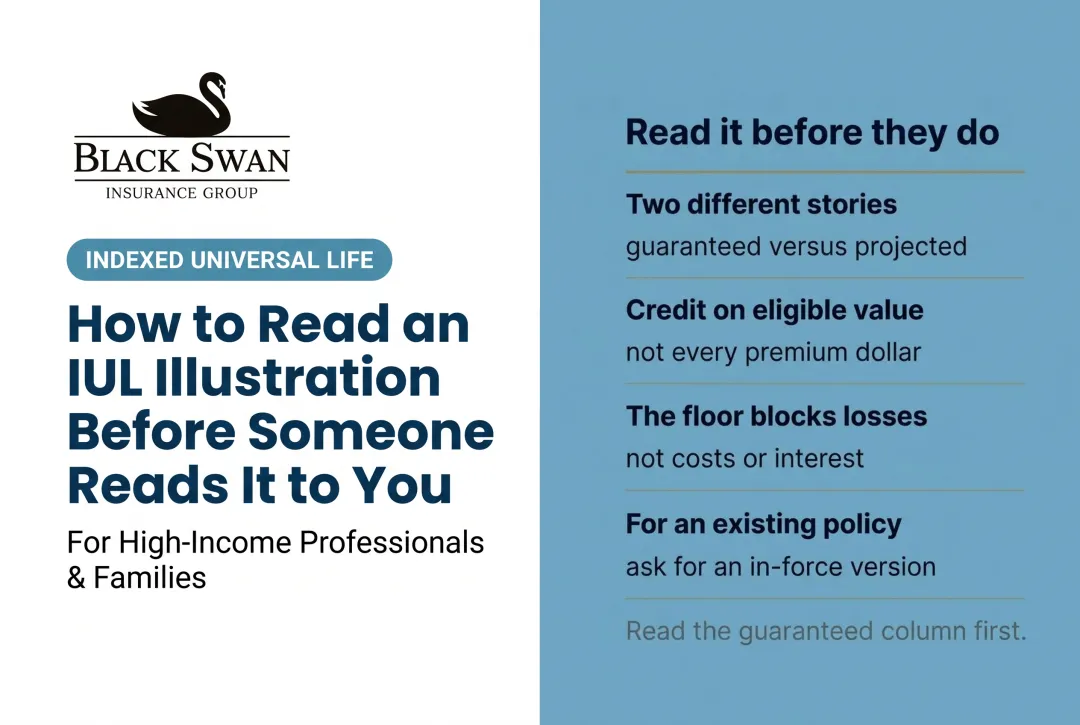
Separate guaranteed values from illustrated ones. The NAIC life insurance illustration model regulation requires a basic illustration to show both side by side. Treat the guaranteed column as your planning floor.
Then compare:
- Caps, participation rates, spreads and floors — and whether the carrier can change them
- Premium requirements, cost of insurance, administrative fees, surrender charges and rider costs
- Loan interest rates, direct versus non-direct recognition, and overloan protection
- Lapse risk, and the tax consequences of surrendering a policy still carrying loan debt
Six Mistakes That Recur
- Buying on an illustration without reading the guaranteed column
- Treating a policy as a substitute for an employer 401(k) match
- Underfunding in the early years
- Ignoring near-term liquidity needs
- Overlooking MEC rules, which change how loans and withdrawals are taxed
- Skipping reviews as caps, costs or personal circumstances change
Request two or three comparable illustrations, run conservative and adverse scenarios, and confirm the plan still works if caps decline or income starts earlier than planned.

The Ultimate IUL Blueprint
If you are comparing carriers now, the Blueprint covers what to demand from each of them: the guaranteed column, the loan provisions, the seven-pay limit, and what the design has to survive.
Who This Product Actually Fits
Stronger Fit
- Household income of $150K+ with stable or growing cash flow
- A genuine need for permanent rather than temporary death benefit protection
- Funding capacity of roughly $500–$2,500 a month that does not disturb emergency reserves
- Already funding retirement accounts, and looking for a second tax-advantaged bucket
- A long horizon and willingness to review the contract annually
- Insurable, and clear this is not a market replacement
Different buyers need different things. High-income W-2 professionals usually want tax diversification alongside protection. Business owners often need liquidity held outside the company. Affluent families prioritise legacy and survivorship. Late-start high earners face a shorter runway and need conservative projections rather than optimistic ones.
Weaker Fit
Not everyone should buy an IUL. The best carrier in the market is still the wrong purchase if the underlying need is temporary.
- The need is low-cost temporary coverage, where term insurance is the better answer and usually by a wide margin
- Stronger guarantees with less complexity are the priority — whole life may suit better
- Retirement goals are already met through a 401(k), IRA or brokerage account
- Unstable income, thin reserves, or high-interest debt needing triage
- Unwillingness to monitor funding and crediting year to year
Risks to Understand Before You Choose a Carrier
- Caps and participation rates are not fixed and may be adjusted within contract limits after you have committed
- Cost of insurance rises with age and is charged in flat crediting years
- Surrender charges run for years and vary substantially between carriers
- Rider benefits reduce the death benefit and cash value when invoked, including chronic-illness and long-term care riders
- Loan interest compounds, and an outstanding loan at lapse or surrender with gain in the contract can create taxable income with no cash received to pay it
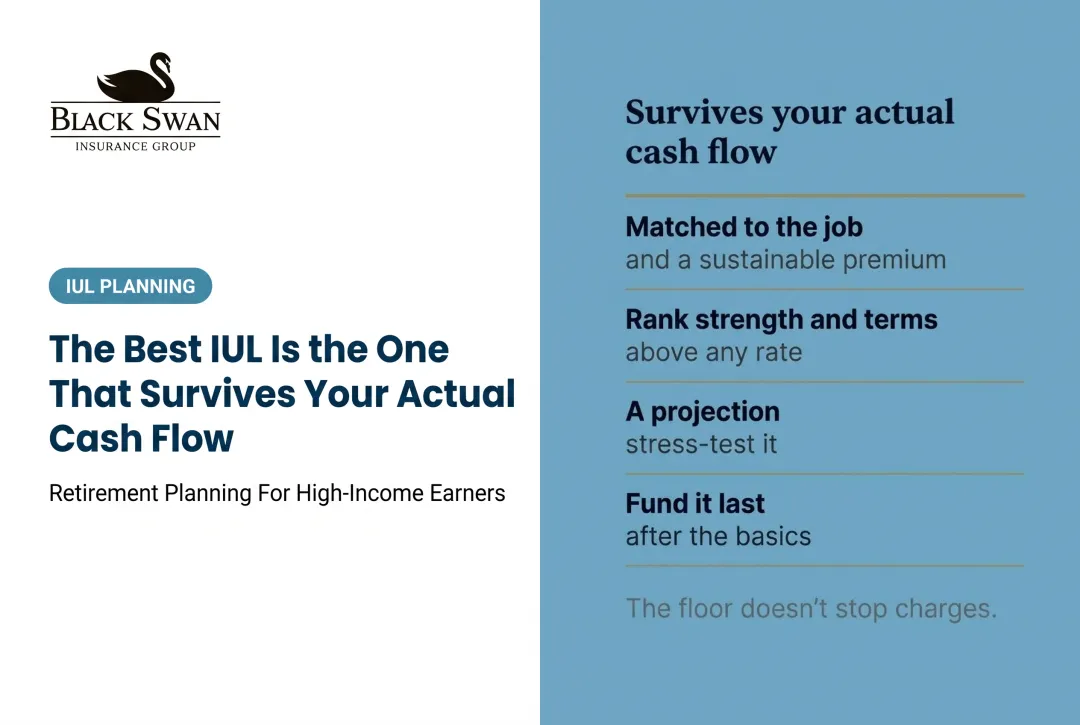
- Underfunding is the most common failure mode, regardless of which carrier issued the policy
- Crossing the seven-pay limit makes the contract a MEC under I.R.C. § 7702A and changes distribution taxation
- Product lineups change. A product quoted last year may no longer be open for new applications
- Ratings reflect claims-paying ability, not policy performance, and they can be revised
Find Out Where You Actually Stand
This starts with the Tax-Free Wealth Blueprint Fit Review. If you earn $150K+ and are holding illustrations from more than one carrier, we compare them on the guaranteed columns, the loan provisions and the real fee load, stress-test each design against lower crediting and imperfect funding, and price the alternatives including term. If it does not fit, we will tell you that too.
Frequently Asked Questions
How much does an IUL cost?
Premiums depend on age, health, tobacco status, coverage amount, underwriting class, policy design, funding level, riders and carrier charges. A personalised illustration is the only useful answer; broad averages are not.
What is the average rate of return on an IUL?
There is no reliable single figure. Credited interest depends on index performance, caps, participation rates, floors, spreads, fees, funding level and outstanding loans. Illustrations are projections, not forecasts.
Where can I buy one?
Through a licensed agent, an independent brokerage or a carrier-affiliated channel. Confirm who issues the policy, compare multiple carriers, and verify the agent's licence and product availability in your state.
Is an IUL worth it?
It can be, for someone with a genuine permanent coverage need who can fund and monitor the contract long term and has already handled the other savings priorities. For different goals, term insurance, whole life or direct retirement investing may suit better.
Is an IUL better than a 401(k)?
They serve different purposes — one is a retirement account, the other is life insurance with a cash-value feature. Capture any employer match first, then compare taxes, fees, liquidity, guarantees and your actual protection need.
Should I just buy term instead?
If the need is temporary and the goal is maximum death benefit for the lowest premium, term is usually the cleaner answer and worth saying outright. Permanent coverage earns its place when the protection need genuinely outlasts a term.
Sources
- LIMRA — U.S. individual life insurance new premium tops $17.5 billion in 2025
- Guardian Life — Indexed universal life insurance
- NAIC — Life Insurance Illustrations
- NAIC — Life Insurance
- I.R.C. § 7702A and Rev. Proc. 2008-39 (modified endowment contracts and the seven-pay test)
Disclosure: This article is educational and is not personal tax, legal or investment advice. Indexed universal life is life insurance first. Carrier products, ratings, caps and participation rates change; confirm current terms directly. Actual results depend on policy design, carrier, crediting options, caps, participation rates, expenses, funding and ongoing management. Policy loans and withdrawals may reduce cash value and death benefit and can create tax consequences if the policy lapses or becomes a modified endowment contract. This strategy is not appropriate for everyone. Illustrated values are not guarantees; actual results depend on policy terms, crediting, costs and funding. Consult your own tax, legal and financial professionals for advice specific to your situation.
And remember, it's not what you earn, it's what you keep… enjoy the ride.