By Robert Balgac, Founder, Black Swan Insurance Group | October 7, 2026
Confusing a LIRP with an IUL is like confusing a workout plan with a gym membership. One is a strategy. The other is a piece of equipment you might use to run it.
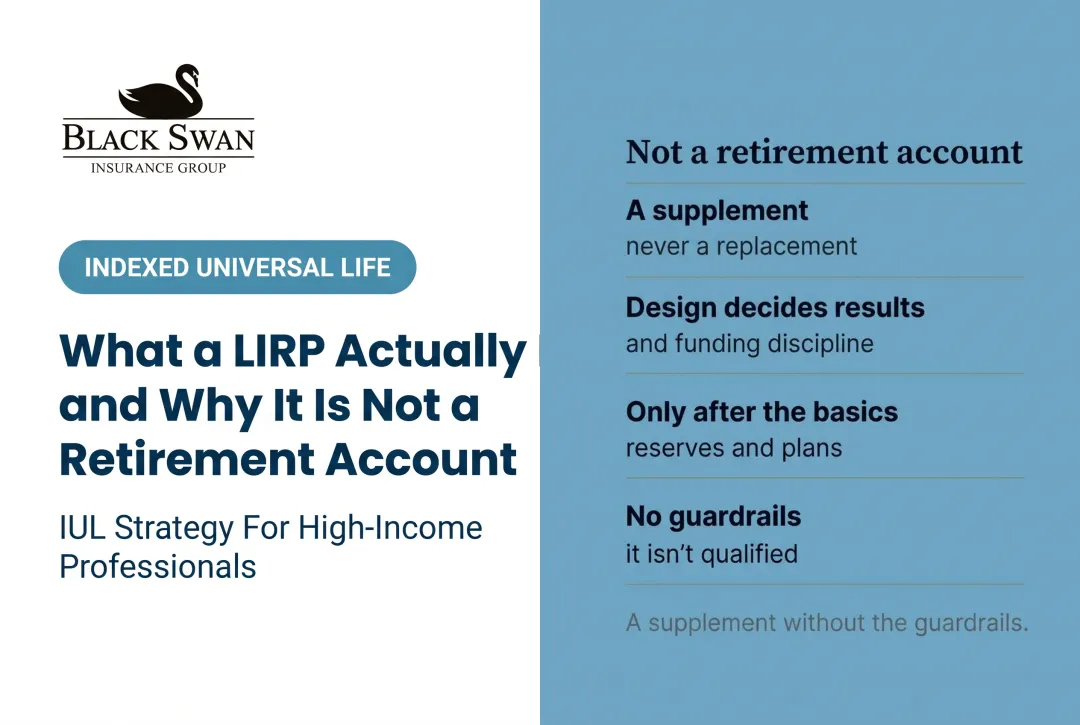
High-income professionals and business owners hear the two terms used interchangeably by agents, podcasts and forums, and the mix-up produces bad comparisons and worse decisions. A Life Insurance Retirement Plan (LIRP) describes how you use permanent life insurance to generate retirement income. An Indexed Universal Life (IUL) policy is one product that can be structured to do that job — and most IULs sold are not.
The short answer: A LIRP is a funding and access strategy, not an IRS account type and not a product you can buy. An IUL is a permanent life insurance contract. An IUL can be designed as the chassis for a LIRP, but only if it is built and funded that way from day one. Buying an IUL for coverage does not give you a LIRP, and nothing about either arrangement makes access automatically tax-free.
This matters most to the $150K+ household that has captured the match, maxed the 401(k) and run into the Roth phase-outs, and is now being told life insurance is the next bucket. Get the distinction right and you can actually evaluate the thing. Get it wrong and you are comparing a projection to a product category.
Key Takeaways
- A LIRP is a strategy using permanent life insurance; an IUL is one policy type that can fund it
- IUL cash value references an index for crediting only — you never own the index
- Both require a genuine insurance need, sustainable funding and ongoing monitoring
- Neither replaces employer plans, Roth accounts or brokerage investing; they sit alongside them
- Suitability turns on horizon, health, liquidity, risk tolerance and tax position — not on an illustration
LIRP vs. IUL: The Distinction That Matters
| Factor | LIRP | IUL |
|---|---|---|
| What it is | A retirement-income strategy using permanent life insurance cash value | A permanent life insurance policy with index-linked crediting |
| Primary purpose | Retirement income, tax diversification, cash-value efficiency | Lifelong coverage, flexible premiums, potential cash-value growth |
| Tax treatment | Depends on structure, MEC status and whether the policy stays in force | Same rules — withdrawals and loans are not automatically tax-free |
| Market exposure | Indirect, through whichever policy funds it | Credited by reference to an index, subject to caps, floors and charges |
| Best fit | High earners with long horizons, surplus cash flow and a real insurance need | Buyers needing permanent coverage who will monitor non-guaranteed assumptions |
The tax ground is shared. The IRS generally does not tax increases in a policy's cash value unless you take a distribution, per an IRS letter ruling released in 2024. That advantage is real and it is conditional — it depends on the contract avoiding Modified Endowment Contract status and staying in force.
Growth works differently in an IUL. You do not receive the index return. Credits pass through a floor, a cap and a participation rate set by the carrier: down years are buffered, and upside above the cap is simply not yours.
What a LIRP Actually Is
It is not an IRS account category and not a guaranteed product. It is a funding pattern: you pay substantially more than the minimum into a permanent policy, let the charges carry the death benefit, and let the surplus build cash value you intend to draw on later.
Premiums cover cost of insurance and fees first. Excess funding above that builds accessible value. The design is tilted toward accumulation relative to death benefit, within the limits of Section 7702, and the value grows tax-deferred while the contract remains in force.
Kimberly Lankford describes the approach in The Wall Street Journal's guide to using life insurance for retirement income, noting that policyholders deliberately overpay in order to build value for later withdrawals and loans.
Access generally happens two ways: withdrawals up to basis, which are generally untaxed because you are taking back your own premium first; and policy loans against cash value, which accrue interest and reduce the death benefit until repaid.
And one risk sits underneath both. If the contract lapses or is surrendered with a loan outstanding, the IRS can treat the loan balance as taxable income — a tax bill with no cash attached.
Tax-free income is not magic. It is policy management.
A LIRP makes sense only for someone who has already built an emergency fund, cleared high-priority debt, captured the employer match, funded qualified plans appropriately, and confirmed they genuinely need permanent life insurance. That is five gates, and most people asking about LIRPs have not cleared all five.
The Ultimate IUL Blueprint
If you are weighing whether to run this strategy, the Blueprint covers what the design has to survive: funding levels, the MEC line, loan timing and what to demand from an illustration before you commit cash flow for twenty years.
Who Should Be Cautious
Pause if you have a short runway to retirement, because the early years carry the heaviest charges and there is less time to recover them. Pause if income is uncertain, because sustained funding is the whole mechanism. Pause if you may need the money soon, because surrender charges will take a bite. And pause if your protection need is temporary — if term would do the job, a LIRP is an expensive way to solve a cheap problem.
Funding speed carries its own hazard. Overfund too fast and the contract becomes a modified endowment contract under Section 7702A, which flips withdrawals and loans to gain-first taxation and can add a 10% penalty before 59½. The strategy that was supposed to produce flexible access produces a tax bill instead.

A LIRP belongs beside your 401(k), Roth options, taxable brokerage and other coverage. Not instead of them.
What an IUL Actually Is
Permanent coverage with a death benefit and a cash value account credited by reference to an external index, often the S&P 500. You do not own index shares. You receive a credit calculated from index movement under your contract's rules.
Three mechanics do the filtering. The floor is the minimum credit, often 0%, protecting against negative index years. The cap is the maximum credit, limiting upside in a strong year. The participation rate is the share of index gain actually credited.
The NAIC's illustration guideline, AG 49-A, uses a 0% floor and 100% participation as a testing benchmark. That is context for reading an illustration, not a description of your contract. Carriers set their own terms and can revise them.
Guaranteed values and illustrated values are different things. The contract guarantees a minimum. The illustration typically shows current, non-guaranteed assumptions that can move with market conditions or carrier decisions.
The flexibility is genuine: adjustable premium within limits, death benefit options that can change, the ability to reduce or skip payments — with consequences.
And it cuts both ways. Cost of insurance rises with age. Caps and participation rates can be lowered. Surrender charges bite in early years. Underfunding accelerates lapse risk. Loan interest compounds against cash value. And lapsing with a loan outstanding can trigger tax.
Buying an IUL for coverage alone does not make it a LIRP. It becomes a retirement strategy only when designed and funded as one.

What the Critics Get Right
The sceptics are right that this product gets sold on its best-case illustration and that the phrase "tax-free retirement" does an enormous amount of unearned work in those conversations.
A published dispute involving Pacific Life, reported by Wealth Management in 2025, alleged an IUL was marketed as a "tax-free retirement plan" on misleading projections, with plaintiffs claiming over $10 million in premiums paid and millions in losses. Those are allegations, not findings. They are still a useful reminder that the illustration is a model and the contract is the contract.
What the criticism gets wrong is the conclusion that the product is therefore worthless. A properly funded policy with conservative assumptions and an annual review is a different object from the one in that complaint. The difference is design and maintenance, which is unglamorous and does not sell podcasts.

Deciding Between Them
The real question is rarely LIRP versus IUL, because an IUL is usually the chassis a LIRP runs on. The question is whether you need permanent insurance at all, and if so, how to fund it.
Weigh five things: your objective (retirement income and tax diversification, or protection with flexible access); your horizon (enough years for early charges to be absorbed); your cash flow (can the premium survive a career change or a slow business year); your tolerance for complexity; and whether the protection need is genuinely permanent.
Then the honest conclusions: an IUL-based LIRP only after matches, qualified plans, Roth options and reserves are handled. Whole life where guaranteed premiums matter more than index upside. Term plus separate investing where the need is temporary and your retirement vehicles are already efficient. And walking away where funding is not sustainable, you need near-term access, or permanent coverage simply is not required.
Stronger Fit
A LIRP deserves evaluation if you:
- Earn $150K+ with surplus cash flow after reserves, debt and retirement contributions
- Have a genuine permanent protection or legacy need
- Have fifteen-plus years before you want income to begin
- Will sustain the premium through an interruption and review the policy annually
Weaker Fit
This is not your strategy right now if you:
- Lack an emergency fund or carry high-interest debt
- Have an uncertain income that cannot support consistent funding
- Need liquidity inside five to ten years
- Only need a death benefit for a defined period — buy term and invest the difference, genuinely
- Have not yet maxed the lower-cost accounts available to you
Risks to Understand Before You Fund One
- Underfunding is the primary failure mode. The strategy depends on surplus above charges; without it the policy slowly eats itself.
- Caps and participation rates can be lowered going forward, subject to contract minimums.
- Charges rise with age. A design that works at 45 can strain at 70 if funding never changed.
- MEC status is generally permanent and removes the access advantage the whole strategy was built on.
- Lapsing with a loan outstanding can produce taxable income with no cash received.
- Surrender charges can consume much of the cash value if you exit in the early years.
Find Out Where You Actually Stand
This starts with the Tax-Free Wealth Blueprint Fit Review. If you earn $150K+ and someone has proposed a LIRP, we compare the policy against your existing coverage, retirement accounts and cash-flow priorities, model the funding against the MEC limit, stress-test it through lower-crediting and zero-credit years, and show the loan assumptions and charges in plain numbers. If the honest answer is term plus a brokerage account, we will say that. If IUL does not fit, we will tell you that too.
Frequently Asked Questions
Is a LIRP the same as an IUL?
No. A LIRP is a strategy; an IUL is a policy type. An IUL can be designed and funded as a LIRP, but most IULs sold for coverage are not built for retirement income.
Is a LIRP worth it?
It can be, for a high earner with surplus cash flow, a long horizon, a genuine permanent insurance need, and retirement priorities already funded. Costs, risks and alternatives still need a side-by-side comparison first.
What is better than an IUL?
It depends entirely on the goal. Term suits temporary protection. Whole life suits stronger guarantees. Retirement accounts and brokerage assets usually suit pure accumulation better. There is no universal winner, and anyone claiming one is selling.
Are LIRP distributions taxable?
Withdrawals and loans can receive favourable treatment while the contract stays in force and avoids MEC status. Surrendering, or lapsing with a loan outstanding, can change that sharply.
What does Dave Ramsey say about IUL?
Ramsey Solutions has publicly criticised IUL for complexity, fees and rising costs, generally favouring term plus separate investing. That is one firm's stated position, and on the question of badly designed policies they are not wrong. It is still not a substitute for evaluating your own numbers.
What are the main risks of using an IUL as a LIRP?
Underfunding, falling caps or participation rates, rising charges, surrender penalties and compounding loan interest. MEC status and lapsing with a loan outstanding are the two most likely to produce an unexpected tax bill.
Sources
- IRS letter ruling on life insurance cash value (2024)
- NAIC — Actuarial Guideline 49-A
- The Wall Street Journal — Using life insurance for retirement income
- Wealth Management — What the Kyle Busch case reveals about IUL policies
- NAIC — Life Insurance Illustrations
Disclosure: This article is educational and is not personal tax, legal or investment advice. Indexed universal life is life insurance first. A LIRP is a planning approach, not a regulated account type, and its tax treatment depends on contract status under IRC Sections 7702 and 7702A. Actual results depend on policy design, carrier, crediting options, caps, participation rates, expenses, funding and ongoing management. This strategy is not appropriate for everyone. Policy loans and withdrawals reduce cash value and the death benefit, and can create tax consequences if the policy lapses or becomes a modified endowment contract. Illustrated values are not guarantees; actual results depend on policy terms, crediting, costs and funding. Consult your own tax, legal and financial professionals for advice specific to your situation.
And remember, it's not what you earn, it's what you keep… enjoy the ride.