By Robert Balgac, Founder, Black Swan Insurance Group | October 9, 2026
Term life and indexed universal life both exist to do one thing: pay a death benefit when you die. Everything after that is a different conversation, and the pros-and-cons framing is only useful if the cons are written as honestly as the pros.
So here is the con that matters most and rarely appears on these lists: a term policy that fails simply ends, and you know the date in advance. A permanent policy that fails ends without warning, decades in, often when you are uninsurable — and sometimes with a tax bill attached. That asymmetry should shape how a $150K+ earner reads every other line below.
Interest in both products is rising. IUL new premium rose 17% in 2025 while term grew 3%, according to LIMRA's 2025 sales data. Growing sales are not evidence of suitability. They are evidence of distribution.
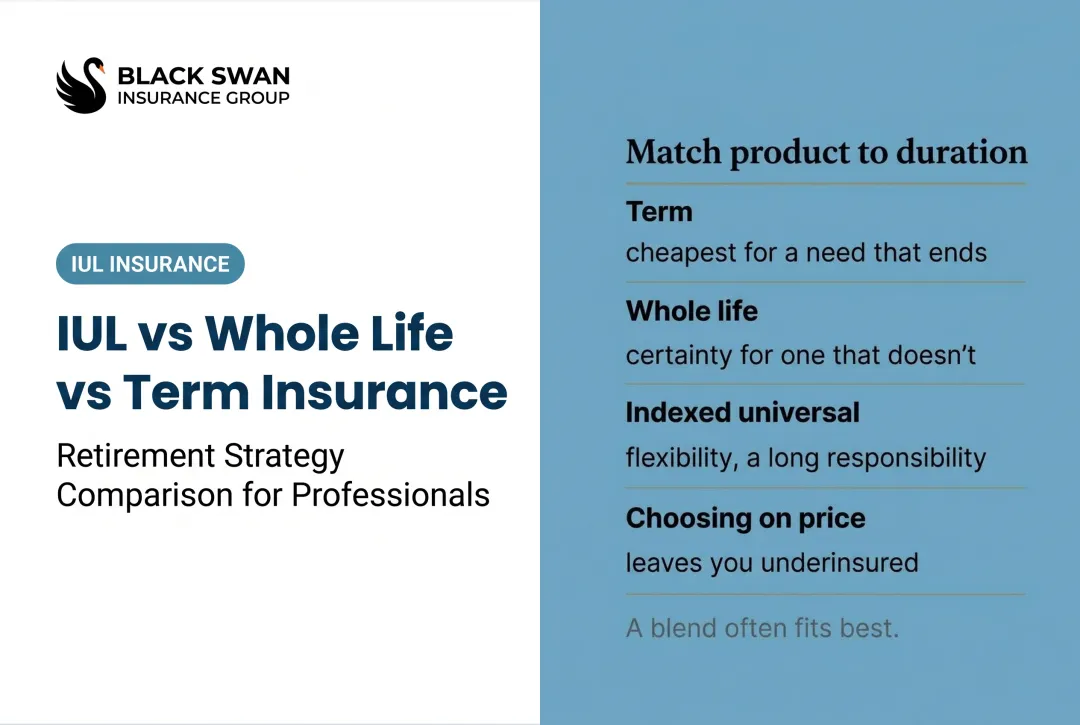
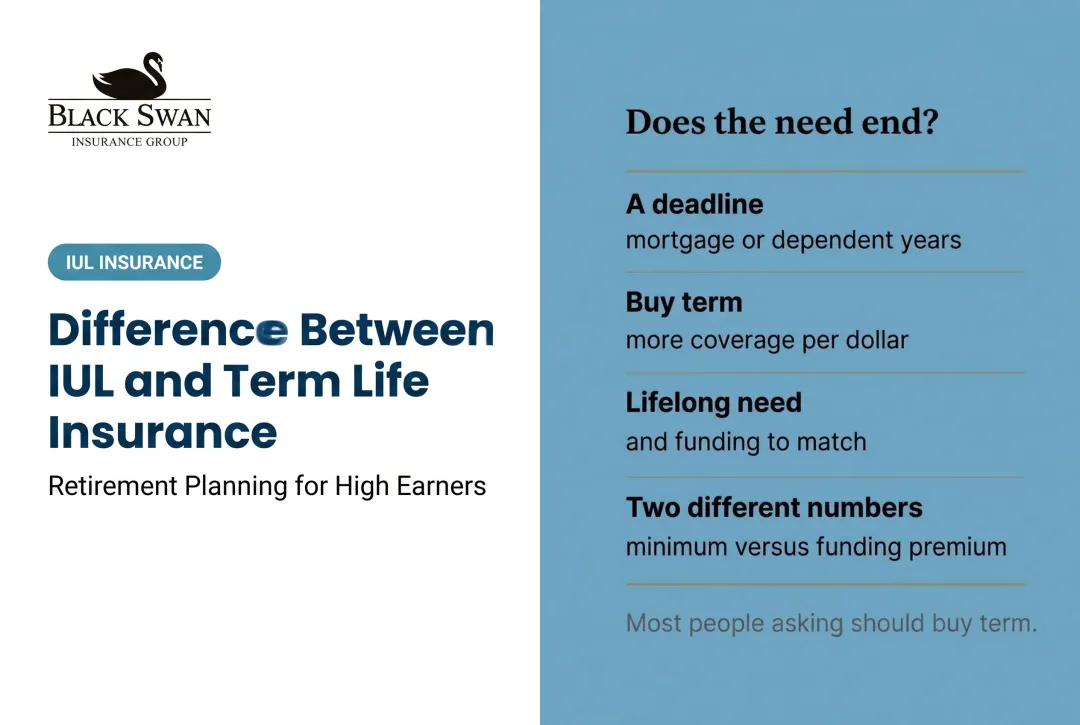
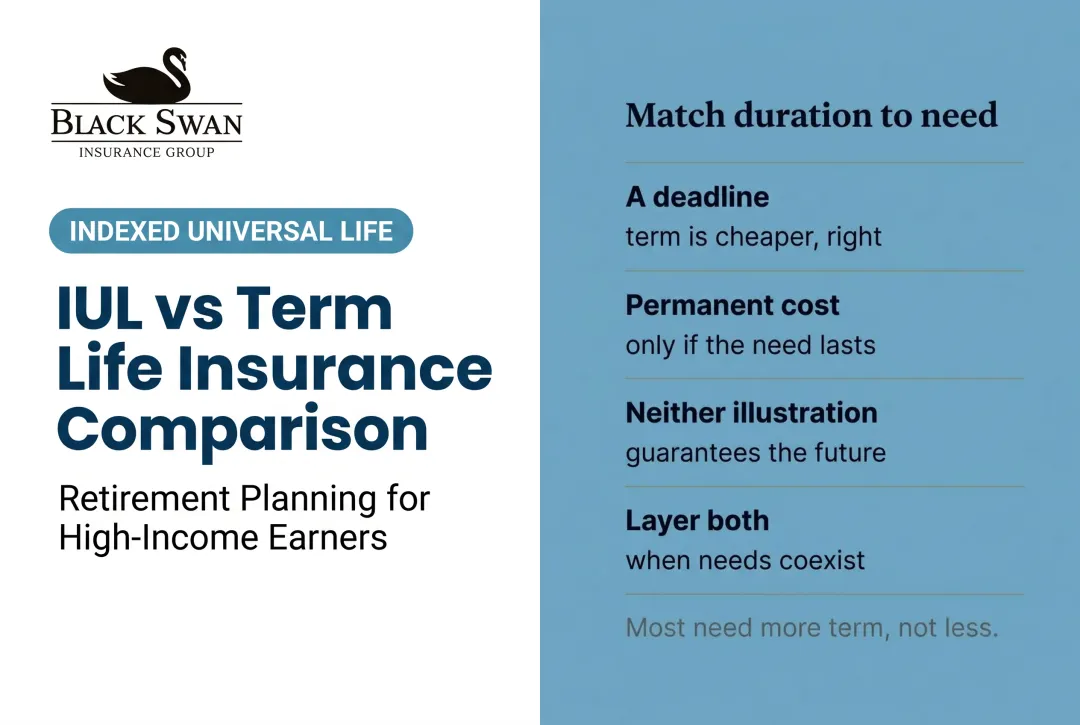
The short answer: Term wins on cost, simplicity and predictability, and it is the right answer for the large majority of protection needs. An IUL buys permanence and a cash-value feature, at a much higher price and with a real obligation to fund and monitor it for decades. The question is not which list is longer. It is whether your need outlives any term you could buy, and whether you will genuinely do the maintenance.
This is not set-it-and-forget-it. It is design-it, fund-it, review-it.
Key Takeaways
- Term offers straightforward, lower-cost protection for a defined period
- IUL provides permanent coverage with index-linked cash value, subject to caps, charges and funding discipline
- Match term to obligations with an end date; reserve a permanent policy for a lifelong need you can fund sustainably
- Neither policy replaces emergency savings, retirement accounts or professional tax advice
- Choose on coverage duration, budget, health and liquidity — not on an illustration
Side by Side
| Factor | IUL | Term Life |
|---|---|---|
| Coverage duration | Lifelong, if adequately funded | Fixed period (10, 20 or 30 years) |
| Premiums | Higher; flexible but requires minimum funding | Lower; level during the term, rises at renewal |
| Cash value | Tax-deferred, index-linked, subject to caps and fees | Generally none, unless a return-of-premium rider is added |
| Flexibility | Adjustable premiums and death benefit, within limits | Simple, fixed benefit and term length |
| Best for | Permanent protection, legacy planning, supplemental access | Mortgages, income replacement, child-rearing years |
Three nuances the table cannot carry. "Flexible premiums" still require enough funding to cover ongoing insurance costs and charges — skipping payments indefinitely erodes or lapses the contract. Term's level premium applies only to the initial term; renewal is re-priced at your current age and usually costs considerably more. And cash-value growth depends on caps, participation rates and floors set by the carrier, not on direct market ownership.
The IUL Ledger
Permanent life insurance pairing a death benefit with a cash-value account. Interest credited to that cash value is linked to an external index such as the S&P 500, but you are not invested in the index itself.

The mechanics:
- Premiums split between the cost of insurance, administrative charges and the cash-value account
- Indexed crediting typically has a floor (minimum rate, often 0%), a cap (maximum credited rate) and a participation rate (the percentage of index gains you actually receive)
- These figures are carrier-specific and can change over time
Pros:
- Lifelong protection potential, not tied to a term
- Flexibility to adjust premiums and death benefit as needs shift
- Tax-deferred cash-value growth
- Access to cash value through loans or withdrawals, subject to policy terms
Cons:
- Higher cost than term for comparable coverage
- Internal charges, surrender fees and genuine complexity
- Capped upside compared with direct market investing
- Lapse risk if funding falls short over time
Important: a 0% floor usually applies only to indexed interest crediting, not to your total cash value. Cost of insurance, loans and withdrawals can still reduce your balance in a year when the index performs poorly.
The Term Ledger
Term pays a death benefit if you die during the coverage period you selected. Standard policies build no cash value.
Pros:
- Lower cost for a large death benefit
- A simple structure that is easy to understand and compare
- Predictable premiums during the level-term period
- Coverage matched to a specific obligation, such as a mortgage
Cons:
- Coverage ends when the term ends
- Renewal premiums climb, because they are based on your age at renewal rather than your original issue age
- No cash value in standard policies
- Replacing a lapsed term policy usually requires new underwriting
The Texas Department of Insurance notes that term coverage ends at the expiration date unless you pay to extend it, and renewal pricing reflects your age at that later point, not when you first bought.
Before buying term, check for level term (premium flat for the stated period), renewable term (extendable without new underwriting, usually at a higher rate), convertible term (switchable to permanent coverage, often with a deadline), and any riders or exclusions specific to the carrier. The conversion provision is worth more than most buyers realise — it is an option on your own future insurability.
Life-Stage Use Cases

- Young families with a mortgage usually need term: a large death benefit that matters less as the mortgage shrinks and the children become self-sufficient.
- Established households with permanent needs may consider a policy if they have sustainable surplus cash flow, a long horizon and the discipline to review performance annually.
- Business owners may use personal coverage for protection outside the company; succession and buy-sell needs are usually separate business coverage.
- Late-start high earners, often 45 to 55, should weigh insurability, funding runway and liquidity against term, retirement accounts and other permanent options before committing.
The Ultimate IUL Blueprint
If the permanent column is genuinely where you land, the Blueprint covers what the design has to survive: funding levels, charges, the MEC line, loan timing and what to demand from an illustration.
What the Critics Get Right
Underfunding is not a hypothetical risk invented by sceptics. It is documented.
In 2019, New York's Department of Financial Services issued a consumer alert warning that universal life policyholders saw coverage lapse with little remaining value, or needed large additional premiums to stay in force, when crediting lagged the original illustrations. That alert covered universal life broadly rather than IUL specifically. The lesson transfers intact: illustrated numbers are not guarantees, and a design that depends on them is a design with a fault line running through it.

The critics are also right that permanent coverage is frequently sold to people whose need is plainly temporary, by someone compensated on the premium, and that "buy term and invest the difference" beats a mediocre permanent policy on almost every measure. Both points stand.
What they do not resolve is the household whose obligation has no end date — estate liquidity, a dependent who will always need support, a business that will owe money whenever the owner dies. Buying twenty years of coverage for a forty-year problem is not thrift. It is a gap with a date on it. That is the narrow case, and it is narrow.
Stronger Fit
- Lean toward term if you need maximum death benefit for a defined period, your budget is tight, or you are still building reserves and retirement savings.
- Consider a permanent policy only if the coverage need is genuinely lifelong, you can sustain planned premiums through income changes, and you understand the non-guaranteed elements.
- A combination can work: a permanent base for a lasting need plus term for temporary high protection, when design and affordability are coordinated.
Weaker Fit
Not everyone should buy permanent coverage. Walk away, at least for now, if:
- The obligation you are insuring has a clear end date
- An employer match is unclaimed, or high-interest debt is outstanding
- You cannot fund the premium through a job loss or a weak business year
- You want to buy a policy and never look at it again
- The illustration is doing the persuading
Questions to Ask Before You Sign
Request these from any agent:
- Guaranteed and non-guaranteed illustrations, side by side
- Current and guaranteed charges, including cost of insurance
- Cap and participation-rate assumptions
- Surrender charge schedule and loan provisions
- Stress-tested scenarios showing what happens if crediting underperforms
Then ask how much planned funding is actually required, what happens if you reduce premiums, and how a loan affects the death benefit. Loop in a tax or legal professional before relying on policy loans or estate-planning assumptions — this is not a do-it-yourself decision.
Three Educational Scenarios
Not personalised advice:
- A young family with a mortgage and two children, needing maximum coverage on a tight budget — term fits, clearly.
- An established professional with a genuine lifelong legacy goal and years of surplus cash flow — a permanent policy might warrant a closer look.
- A business owner with succession obligations — usually needs separate business-focused planning alongside personal coverage.
An illustration is a model, not a guarantee.
Risks to Understand Before You Buy Either
- Buying permanent coverage for a temporary need is the costliest error in this category and the most common.
- Buying term for a permanent need is the mirror error: coverage expires exactly when replacing it is hardest and most expensive.
- Missing a conversion deadline can close off permanent coverage if your health changes.
- Underfunding causes lapse, and a lapse with an outstanding loan can create taxable income with no cash received.
- Caps and participation rates can be reduced going forward, subject to contract minimums.
- Cost of insurance rises with age, straining a structure built decades earlier.
- Surrender charges can run a decade or more.
- MEC status from overfunding is generally permanent and changes the tax treatment of every future distribution.
Find Out Where You Actually Stand
This starts with the Tax-Free Wealth Blueprint Fit Review. If you earn $150K+ and you are weighing term against permanent coverage, we pressure-test the three things that actually decide it — funding capacity, insurability and whether a permanent need genuinely exists — before any product is named. We compare a properly sized term policy plus retirement and brokerage investing against any permanent design, stress-test crediting and funding, and put the charges in plain numbers. If IUL does not fit, we will tell you that too.
Frequently Asked Questions
At what age should you stop paying for term life insurance?
It depends on when your obligations end: mortgage paid off, children independent, income replacement no longer needed. Review coverage before the term expires, and consider conversion or replacement only after comparing costs and current insurability.
Is IUL more expensive than term life insurance?
Generally yes. A policy funds permanent insurance plus a cash-value feature, while term is priced for temporary protection only. Compare the same death benefit, term length and health rating before drawing conclusions.
Does term life insurance build cash value?
Standard term generally does not. Its job is paying a death benefit during the term. Return-of-premium riders exist but cost more and work differently.
Can an IUL policy lose money?
Indexed crediting often has a floor, but charges, cost of insurance, loans, withdrawals and inadequate funding can still reduce cash value or cause a lapse.
Can you have both term life insurance and an IUL?
Yes. Layering term for temporary high coverage with a permanent base is common. Total premiums, coordination and long-term affordability should be reviewed together.
Is IUL a good replacement for a 401(k) or IRA?
No. It is life insurance first and should not automatically replace qualified retirement accounts. The 401(k) is not the villain — a one-bucket retirement plan is. Capture the match, fund the core, then weigh anything else.
Sources
- LIMRA — 2025 individual life insurance new premium sales data
- Texas Department of Insurance — Life insurance consumer guide
- New York Department of Financial Services — 2019 universal life consumer alert
- NAIC — Life Insurance Illustrations
Disclosure: This article is educational and is not personal tax, legal or investment advice. Indexed universal life is life insurance first. Any potential tax-advantaged access depends on the policy being properly structured, funded and managed. Actual results depend on policy design, carrier, crediting options, caps, participation rates, expenses, funding and ongoing management. Illustrated values are not guarantees; actual results depend on policy terms, crediting, costs and funding. This strategy is not appropriate for everyone. Policy loans and withdrawals reduce cash value and the death benefit, and can create tax consequences if the policy lapses or becomes a modified endowment contract. Consult your own tax, legal and financial professionals for advice specific to your situation.
And remember, it's not what you earn, it's what you keep… enjoy the ride.