By Robert Balgac, Founder, Black Swan Insurance Group | October 9, 2026
You searched for companies that offer IUL insurance expecting a list. The list is the easy part, and it is also the part least likely to determine whether your policy works. If you earn $150K+, have maxed the 401(k), and are looking for a second bucket, the carrier name is maybe the fourth most important variable in the outcome.
What ranks above it: how the policy is designed, how much you actually fund it, and whether anyone looks at it again after year one. A well-designed contract from a middling carrier beats a badly designed contract from a famous one, every time.
The short answer: Carriers issue policies; brokers shop them. Compare financial strength, contract guarantees, crediting mechanics, loan provisions and service with equal weight — and treat any carrier list, including the one below, as a research starting point rather than a recommendation. Ratings and product terms change, and the policy you are shown is a design, not a product off a shelf.
IUL sales hit $4.5 billion in new premium in 2025, up 17% year over year, according to LIMRA's 2025 sales data. More buyers means more glossy illustrations handed to people who were never told which column is guaranteed.
Key Takeaways
- Carriers issue IUL policies; brokers compare products across carriers on your behalf
- Weigh financial strength, guarantees, fees, crediting methods, loan terms and ongoing service equally
- A 0% floor protects the index credit — it does not protect the policy from charges or lapse
- Ratings and rider terms change; verify every figure with the carrier before you apply
- IUL is not automatically right for anyone. Compare it against term, whole life and tax-advantaged accounts first
What You Are Buying Before You Compare Who Sells It
Indexed universal life is permanent life insurance built around two pieces: a death benefit and a cash value account. The cash value earns interest based on the performance of a market index, often the S&P 500. Your money is not invested in that index. The policy uses it as a formula for calculating credited interest.
This is life insurance first. Everything else follows from that, including why the charges exist.
Where Your Premium Actually Goes
No dollar you pay goes straight into cash value. It is split among:
- Cost of insurance charges, which typically rise as you age
- Administrative fees charged by the carrier
- Rider costs, if you added living benefits or other features
- Cash value, whatever remains after the above
Premiums and death benefits are flexible. That flexibility cuts both ways: underfund the policy and it can lapse, usually decades after the decision that doomed it.
Caps, Floors and Participation Rates
Three terms appear in nearly every illustration:
- Cap rate — the maximum interest credited in a period, however well the index performs
- Participation rate — the share of index gains you actually receive
- Spread — a deduction the carrier takes from index growth before crediting
A 0% floor means a bad index year does not produce a negative credit. It does not mean your account balance cannot shrink. John Hancock's own consumer guide notes that a 0% annual indexed-interest floor still allows charges to continue, and that weak crediting years can force additional premium simply to keep the policy alive, per John Hancock's IUL consumer guide.
Zero is your hero in a down year — but the floor applies to the credit, not to the charges.
That gap confuses more buyers than any other detail in the product, and a carrier admitting it in its own marketing literature should tell you how real it is.

Loans and Withdrawals Are Not Free Money
Policy loans let you reach cash value without surrendering the policy. They are still real debt. Loans accrue interest, reduce the death benefit, and raise lapse odds if the balance compounds faster than the cash value.
If the policy lapses or you surrender with a loan outstanding, the loan can become taxable income — tax owed on money you already spent. Tax treatment also depends on avoiding modified endowment contract status under the seven-pay test, so confirm the funding design with a tax advisor before contributing aggressively.
Companies That Offer IUL Insurance
Not every company selling IUL designed and issued the policy. Carriers underwrite, issue and pay claims. Brokers shop across carriers and compare the fine print. Know which you are talking to before you sign.
A snapshot of major carriers and products worth researching, grouped by use case rather than a single "best" pick:
| Best For | Carrier & Product | Notable Feature | Rating (verify before applying) |
|---|---|---|---|
| Survivorship/estate planning | Pacific Life – Pacific Horizon Survivorship IUL 2 | Last-survivor coverage with a conditional no-lapse guarantee | Fitch AA- |
| Living benefits | Nationwide – Indexed UL Accumulator III | Chronic-, critical-, and terminal-illness riders | S&P A+ |
| Overloan protection | Penn Mutual – Accumulation IUL | Overloan protection rider, conditions apply by age and duration | AM Best A+ |
| Crediting control | Allianz Life – Life Accumulator IUL | Index Lock and Auto Lock features | AM Best A+ |
| Chronic-illness acceleration | John Hancock – Accumulation IUL | Built-in chronic-illness death-benefit acceleration | Fitch AA |
| Flexible no-lapse add-on | Lincoln Financial – WealthProtector IUL | Optional extended no-lapse rider to age 100 | AM Best A |
Ratings and product terms change, so confirm current figures with the carrier before applying. Penn Mutual's overloan feature, for instance, has historically required the insured to reach age 75 and the policy to run at least 15 years. A rider existing on paper does not mean it protects you on day one, and that distinction is where most "but the brochure said" conversations start.
Black Swan is a brokerage, not a carrier. We shop multiple carriers so clients can compare real designs side by side, including F&G Annuities and Life, Corebridge, Transamerica, John Hancock, National Life Group, Mutual of Omaha, Ameritas and Americo.
Our focus is fit-or-no-fit: whether IUL supports your retirement, tax, protection or legacy goals, plus annual reviews rather than a one-time sale.
The Ultimate IUL Blueprint
Before you shortlist carriers, the Blueprint covers what any design has to survive: funding levels, caps and charges, the MEC line, loan timing, and what to demand from an illustration.
How to Compare IUL Companies Before Applying
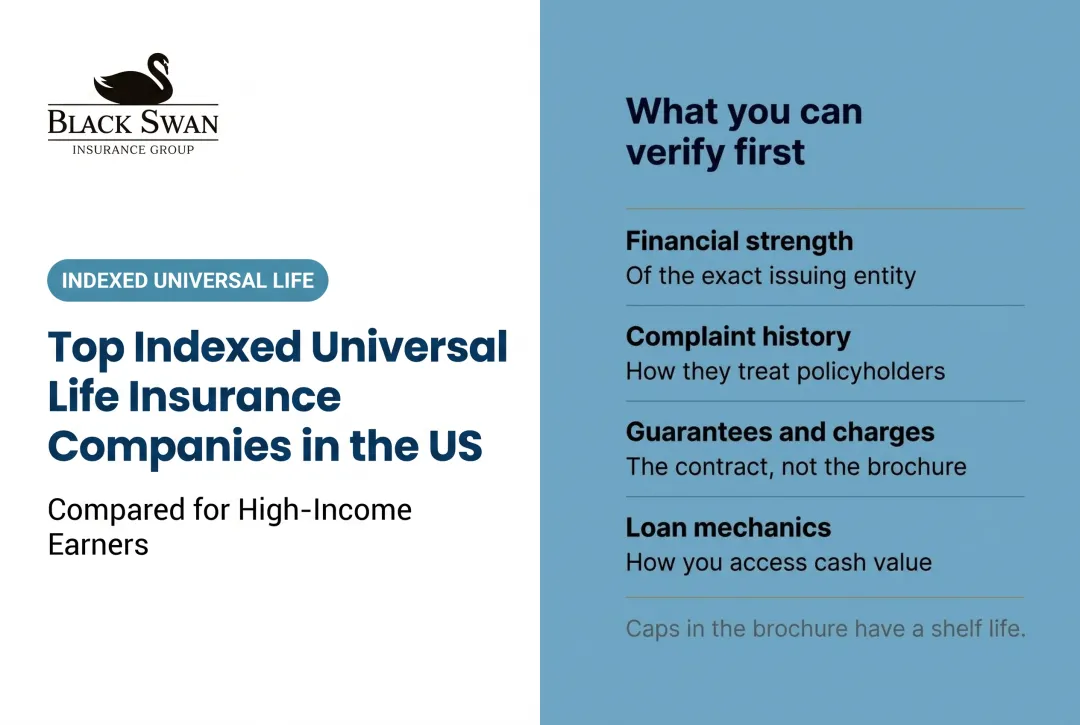
Financial Strength and Claims-Paying Ability
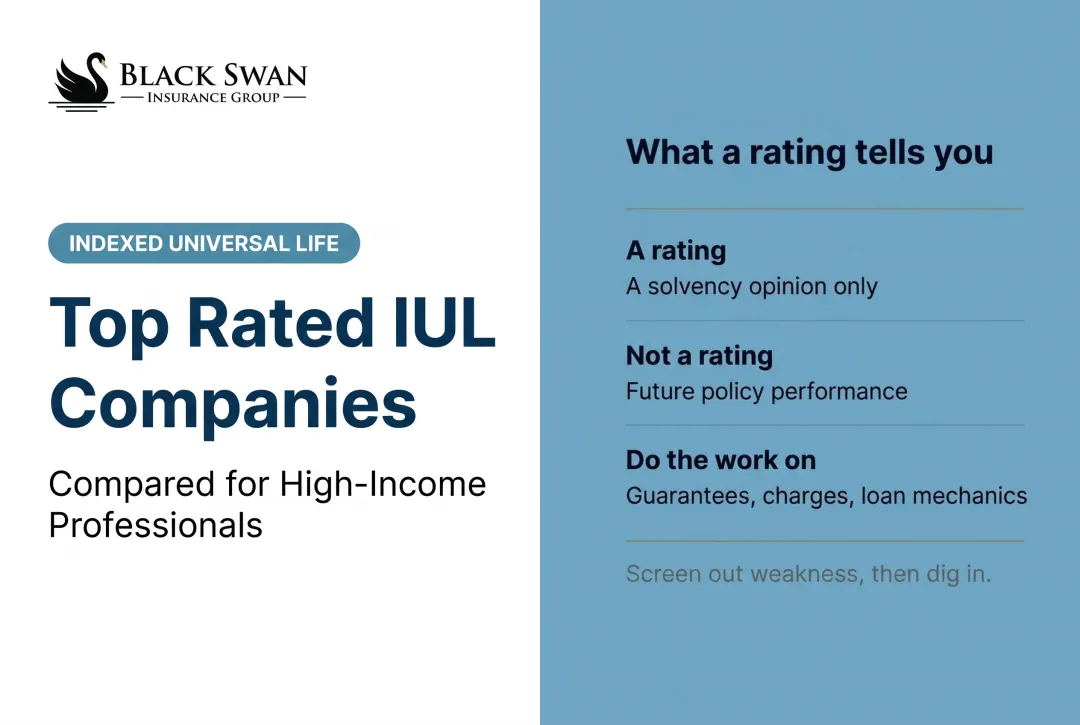
An IUL is a decades-long contract. Check ratings from AM Best, Fitch, S&P and Moody's before assuming a carrier will be present to pay a claim in thirty years. One agency's rating is part of the story, not the story. And ratings speak to claims-paying ability — they say nothing about how your policy will perform.
Guarantees, Illustrations and Loan Terms
Request illustrations showing guaranteed and non-guaranteed values side by side. Ask what happens to the no-lapse guarantee if you reduce premiums, and whether loan rates are fixed or participating. Then line carriers up on the contract details that drive long-term cost and flexibility:
- Index choices, caps, participation rates and spreads
- Cost-of-insurance charges and administrative fees
- Surrender charge schedules and how long they run
- Overloan protection, chronic-illness riders and survivorship options
Stress-Testing the Illustration
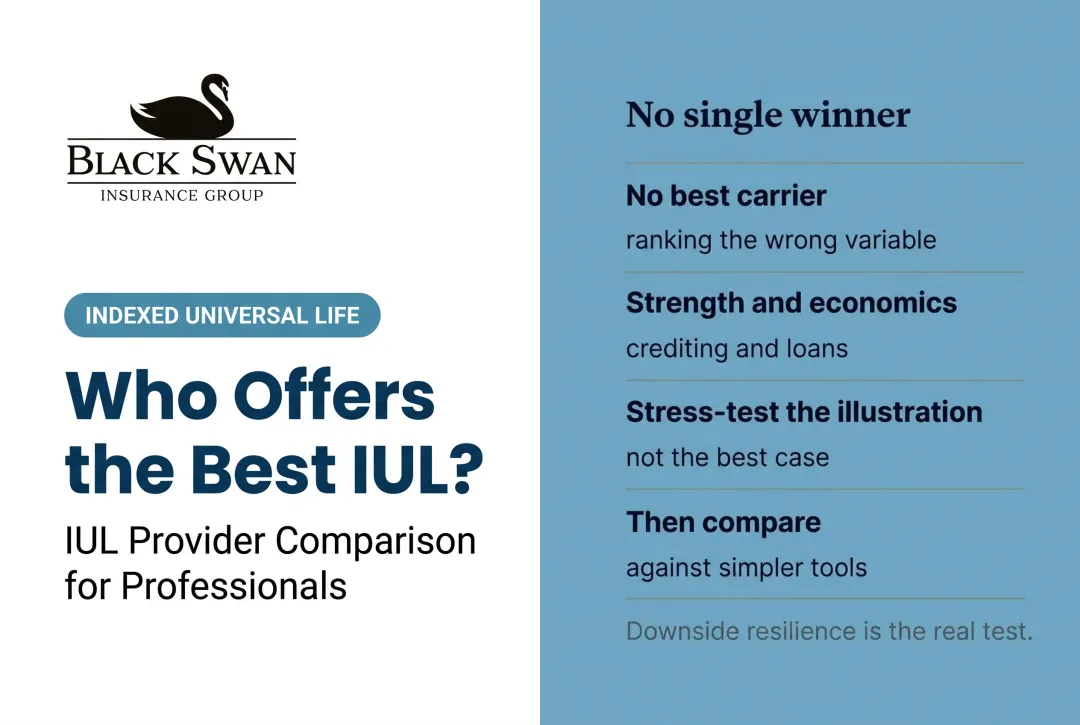
Feature lists leave funding risk untested. Ask for a version using conservative crediting assumptions: lower caps, reduced funding and an unfavourable index sequence. Review cash value and death benefit at years 10, 20 and 30, not only the final year of the brightest ledger. If the policy holds up only under the most optimistic numbers, that is your answer.
An illustration is a model, not a guarantee.

Then press on incentives and service:
- How is your compensation structured on this sale?
- What alternatives did you consider before IUL?
- Which values in this illustration are guaranteed?
- How will this policy be monitored after I buy it?
- What happens if my income or funding capacity changes?
A professional who flinches at question one is telling you something useful.
What the Critics Get Right
The strongest fair criticism of carrier-shopping content is that most of it is marketing in a comparison-table costume. The tables are produced by people paid when you buy, the "best for" labels are soft, and the ratings are presented as though they predict policy performance, which they do not.
That criticism lands. It is why the table above carries a verify-before-applying column and no overall winner.
What the criticism misses is the alternative. Going direct to one carrier does not remove the conflict — it removes the comparison and keeps the conflict. The defence is not avoiding brokers. It is asking every one of them the five questions above, in writing, and reading the guaranteed column yourself.
A great IUL is engineered. A bad IUL is sold.
Who Should Consider an IUL
Stronger Fit
- A genuine permanent coverage need, not temporary protection
- Stable surplus cash flow beyond retirement account contributions — typically $150K+ earners who have maxed the 401(k) and hit Roth phase-out
- Adequate emergency reserves already in place
- Willingness to review the policy annually
- Interest in tax diversification after the cheaper buckets are full
That profile often covers high-income professionals, executives, business and practice owners, and affluent families with mortgages, dependents or succession concerns. It can also fit late-start high earners in their late 40s and 50s weighing permanent protection against sustainable funding and insurability on a compressed runway.
Weaker Fit
Not everyone should buy this. Step back if you:
- Only need low-cost, temporary coverage — term is cheaper, simpler and the right answer
- Have unstable income or thin emergency savings
- Cannot commit to consistent, long-term funding
- Have poor insurability or significant health concerns
- Would need optimistic assumptions just to make the numbers work
IUL should be compared against, never substituted for, employer retirement plans, IRAs, Roth strategies, brokerage accounts and term or whole life coverage. Contribution limits change annually — for 2026 the 401(k) limit is $24,500 and the IRA limit is $7,500, with the Roth phase-out beginning at $153,000 single and $242,000 joint, per the IRS. Fill those first.
A gut check: what is the primary goal — death-benefit protection, estate liquidity, business continuity, or supplemental retirement income? Then confirm the policy still works under conservative assumptions.
How to Buy IUL Insurance Properly
- Define the need. Estimate the required death benefit, identify beneficiaries, decide whether the need is temporary or permanent.
- Gather financial and health information. Income, debts, existing coverage, medical history and tobacco use all drive underwriting and premium.
- Compare multiple proposals. Request comparable illustrations, confirm the actual issuing carrier, and demand conservative stress tests.
- Review tax and legal implications. Talk to your own advisors about ownership, beneficiaries, trusts and MEC rules before funding.
- Plan for ongoing management. Schedule annual reviews comparing actual performance against the original illustration.
This is not set-it-and-forget-it. It is design-it, fund-it, review-it.

Risks to Understand Before You Choose a Carrier
- Ratings are not performance. A strong insurer can still issue a policy that underperforms its illustration.
- Caps and participation rates can be lowered after issue, subject to contract minimums.
- Cost of insurance rises with age, which is the mechanism behind most late-life lapses.
- Rider conditions bind. Age and duration requirements can make a headline feature unavailable when you need it.
- Surrender charges run for years; an early exit returns less than you paid in.
- MEC status is generally permanent and removes the tax-advantaged access you may be buying for.
- The loan is not the problem. The unmanaged loan is the problem.
Find Out Where You Actually Stand
This starts with the Tax-Free Wealth Blueprint Fit Review. If you earn $150K+ and are comparing carriers, we define the job the coverage has to do, then shop designs across carriers, read guaranteed against illustrated values, compare loan and rider mechanics, and stress-test the funding through lower-crediting and reduced-income years. If term solves your problem, we will say so. If IUL does not fit, we will tell you that too.
Frequently Asked Questions
How much does IUL insurance cost?
Premiums depend on age, health, tobacco use, coverage amount, riders, funding strategy and the carrier's underwriting. There is no universal price. Ask for a personalised, comparable illustration.
Which companies offer the best IUL insurance?
There is no single best carrier for every buyer. Compare financial strength, guarantees, fees, crediting methods, loan terms and riders using current, verified information for your specific situation.
Who should buy an IUL?
Buyers with a genuine permanent coverage need, stable long-term funding capacity, and the willingness to monitor the policy annually. Get a suitability review before applying, not after.
Where can I buy IUL insurance?
Through a licensed agent, an independent brokerage, or a carrier's own distribution channel. The carrier issues and backs the policy; a broker helps you compare across carriers.
What should I compare when choosing an IUL company?
Financial strength ratings, guarantees, caps and participation rates, fees, loan provisions, riders, underwriting requirements and ongoing service — together, not in isolation.
Can an IUL policy lapse if the cash value falls?
Yes. If cash value cannot cover ongoing charges, the policy can lapse. Loans, withdrawals, low index credits and underfunding all raise that risk and can create tax consequences.
Sources
- LIMRA — 2025 individual life insurance new premium record
- John Hancock — IUL consumer guide
- IRS — 401(k) limit increases to $24,500 for 2026
Disclosure: This article is educational and is not personal tax, legal or investment advice. Indexed universal life is life insurance first. Carrier names, products, ratings and rider terms are listed for research purposes only and are not recommendations; verify all figures directly with the carrier, and note that all guarantees are subject to the issuing insurer's claims-paying ability. Illustrated values are not guarantees; actual results depend on policy design, carrier, crediting options, caps, participation rates, expenses, funding and ongoing management. This strategy is not appropriate for everyone. Policy loans and withdrawals reduce cash value and the death benefit, and can create tax consequences if the policy lapses or becomes a modified endowment contract. Consult your own tax, legal and financial professionals for advice specific to your situation. Any potential tax-advantaged access depends on the policy being properly structured, funded and managed.
And remember, it's not what you earn, it's what you keep… enjoy the ride.