By Robert Balgac, Founder, Black Swan Insurance Group | October 9, 2026
For 2026 the IRS caps employee 401(k) contributions at $24,500, with the IRA limit at $7,500 and the Roth phase-out beginning at $153,000 single and $242,000 married filing jointly. Hit those ceilings and the search for another tax-advantaged bucket begins. Indexed universal life enters the conversation at exactly that point, usually introduced by someone paid on the premium.
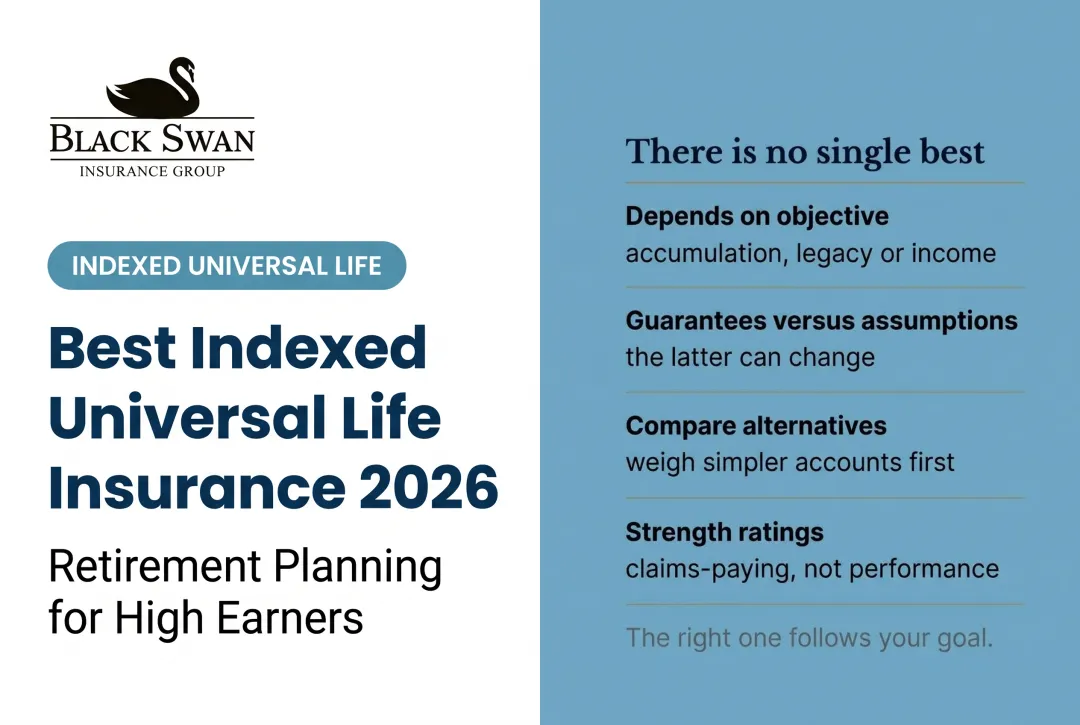
Finding the "best" IUL for retirement income is not about the highest cap, the richest bonus, or the largest projected account value. Those are models.
The short answer: The question is narrower and harder — can this specific policy, funded the way you can realistically sustain it, generate dependable supplemental income while protecting the death benefit, and does it still hold up under assumptions weaker than the illustration? If the design only works at the illustrated rate, it is not an income plan.
Key Takeaways
- IUL offers permanent coverage and cash-value growth, but it is a long-term insurance strategy, not a market investment
- Evaluate carriers on loan terms, internal costs and lapse protection — not illustrated returns
- Fund the 401(k), IRA and emergency reserves before committing surplus cash
- The right carrier depends on your goal: accumulation, lifetime income, or legacy protection
- An outstanding loan at lapse can convert the whole strategy into a tax bill
How Income Actually Comes Out
Permanent life insurance paired with a cash-value account, credited by reference to an index under four limits: the cap (upside limit), the participation rate (share of gain counted), the spread (deduction before crediting) and the floor (typically 0%).
The floor limits losses from a down market. It does not eliminate cost of insurance, administrative fees, rider costs or surrender charges. Cash value can still fall when charges outpace credited interest.
Zero is your hero in a down year — but the floor applies to the credit, not to the charges.
Retirees draw two ways. Withdrawals take cash value directly, usually basis first. Policy loans borrow against cash value under fixed, variable, participating or indexed structures, each with different interest arrangements. Loans accrue interest and reduce the death benefit until repaid, and an outstanding loan at lapse or surrender can trigger a taxable event — the detail most often skipped in a sales conversation.
The loan is not the problem. The unmanaged loan is the problem.
The NAIC requires insurers to separate guaranteed from non-guaranteed values under standards including Actuarial Guideline 49-A. For retirement planning that distinction is the whole exercise.

Before relying on any projection, have it re-run with lower crediting than the current cap, reduced or interrupted funding, rising cost of insurance, a longer-than-expected distribution period, and accumulated loan interest across 20 to 30 years.
The Ultimate IUL Blueprint
If retirement income is the objective, the Blueprint covers what the design has to survive: funding levels, charges, the MEC line, loan timing, and what to demand from an illustration.
| Vehicle | Strength | Trade-off |
|---|---|---|
| 401(k) / IRA | Employer match, tax deferral | Contribution limits, RMDs |
| Roth IRA / 401(k) | Tax-free qualified withdrawals | Income limits, contribution caps |
| Brokerage | Full liquidity, no caps | Fully taxable, no death benefit |
| Fixed/indexed annuity | Guaranteed income stream | Less flexibility, surrender periods |
| Whole life | Guaranteed cash value | Lower growth ceiling |
| IUL | Death benefit + indexed growth, loan flexibility | Variable costs, lapse risk, complexity |
Carriers, By Income Approach
Not a ranking. Rates, caps and rider availability change by state and by month — verify current illustrations, state approval and rating standing directly before buying. Compare the same levers every time: index options and caps, loan type and timing, income or overloan riders, internal charges, financial strength.
Allianz Life. The Accumulator (2024) pairs index options such as S&P 500 Futures ER and Bloomberg US Dynamic Balance III ER with an Index Lock securing a crediting value mid-period, plus guaranteed loan rates and an optional rider to reduce loan-driven lapse risk. Best for accumulation with predictable borrowing terms. Ask whether bonus-bearing allocations carry lower caps. No dedicated income rider identified in current materials. AM Best A+, S&P AA, Moody's Aa3.
F&G. Everlast and Pathsetter use S&P 500 and specialty indices such as Barclays Trailblazer Sectors 5. Pathsetter holds fixed loans for ten years, then preferred (wash) loans from year 11. Best where loan predictability after the early years matters. Ask about maximum guaranteed variable-loan rates — 5.5% Everlast, 5% Pathsetter. Living-benefit and overloan terms differ between them. AM Best A, S&P A−, Moody's A3.
Corebridge Financial. Max Accumulator+ III added Nasdaq-100 and S&P 500 High Bonus strategies in 2026, five crediting options total (two in New York). Its Income for Life Rider can convert policy value into income potentially continuing to age 121. Best where a structured lifetime-income rider outranks flexibility. Ask about activation conditions, fees, and whether distributions reduce the death benefit — rider payments are not automatically tax-free. AM Best A, placed under review with developing implications in March 2026 pending the Corebridge-Equitable combination.
North American. Builder Plus IUL 4 allows participating loans from year 3 and guaranteed net-zero-cost loans from year 6, with a Protected Death Benefit Endorsement; Protection Builder IUL 2 adds a death-benefit guarantee to age 120. Best where a legacy floor sits alongside income. Ask about funding requirements tied to the protected death benefit, since protection reduces available income. The Protected Death Benefit and Overloan Protection Benefit cannot both be active. AM Best A+, S&P A+.
Nationwide. Indexed UL Accumulator III targets accumulation buyers around ages 30–55 and publishes costs up front: a $10 monthly policy charge, first-year premium charges up to 8%, a 10-year surrender schedule, a 0% guaranteed floor. Ask about declared-rate loan (3.90% current charged interest) versus indexed loan (5% current, 8% guaranteed maximum). Lower costs alone do not prove better income — compare identical illustrations. AM Best A+, Moody's A1; third in J.D. Power's 2025 individual life study.

Loan timing, rider fees and funding discipline matter more than any carrier brand.
What the Critics Get Right
The promise of retirement income that is both tax-free and guaranteed does almost all the selling in this category, and it does not survive contact with the contract.
Loans are tax-advantaged only while the policy stays in force and outside modified endowment status. Let it lapse with a loan outstanding and the previously untaxed gain becomes income — a bill arriving in the year you can least absorb it, from an asset you were told was tax-free. The critics who hammer this point are right to.
What they miss is that a conservatively funded policy, reviewed annually, with loan balances monitored, is a materially different object from the one in those cautionary tales. The difference is maintenance, which no illustration shows.
How These Were Assessed
Hold everything else constant — same age, health class, death benefit, premium, funding schedule and distribution assumptions — then compare.
Financial strength and service history from rating agencies and verifiable public complaint data, not brochures. Loan mechanics: fixed against variable, participating loan treatment, overloan-protection triggers. Crediting terms over time: caps, participation rates, spreads and floors, separated into guaranteed terms and rates the carrier can revise. Stress-tested outcomes: lower crediting, interrupted funding, early withdrawals, longer distributions, rising charges.
Stronger Fit
- Earning $150K+ with stable surplus cash flow and separate liquidity reserves
- A genuine permanent-insurance need, not only an income objective
- Good insurability and ideally 15+ years before income begins
- Discipline to review the policy annually
Weaker Fit
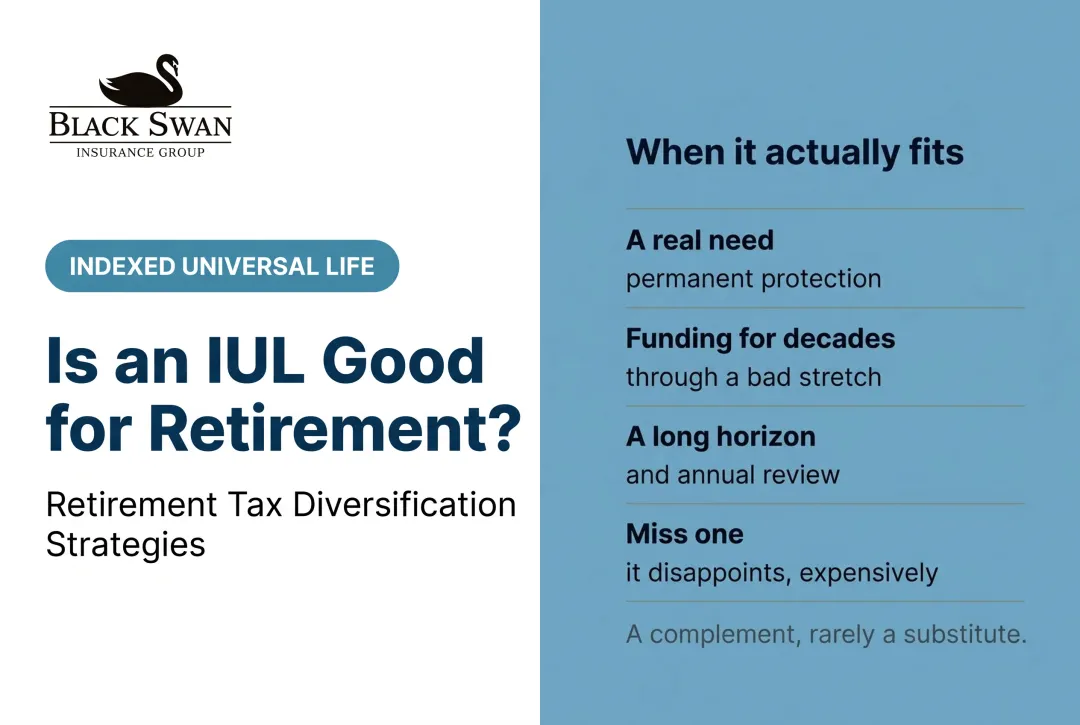
Not everyone should fund one. Work through this first: have you captured any employer match; maxed the tax-advantaged accounts suited to you; set aside three to six months of emergency liquidity; confirmed a genuine ongoing need for permanent coverage; and discussed it with a tax or legal professional? If most answers are no, this is not your next move.
Risks to Understand Before You Fund
- Underfunding is the leading failure mode, and it surfaces exactly when you want income.
- Caps and participation rates can be lowered after issue, within contract limits.
- Cost of insurance rises with age and accelerates through the distribution years.
- MEC status is generally permanent and removes the access advantage entirely.
- A loan outstanding at lapse or surrender creates taxable income with no cash received.
- Rider conflicts exist — some protections cannot run simultaneously, as North American's two benefits show.
This is not set-it-and-forget-it. It is design-it, fund-it, review-it.
Caps, charges and personal circumstances change. A policy funded correctly at 45 may need adjusting at 55, and the annual review is where that gets caught.

Find Out Where You Actually Stand
This starts with the Tax-Free Wealth Blueprint Fit Review. If you earn $150K+ and are weighing a policy as a retirement income source, we hold the variables constant across carriers, read guaranteed values against illustrated ones, model the distribution phase with accumulated loan interest over 20 to 30 years, and test the design under lower crediting and interrupted funding. If your 401(k), Roth and a brokerage account serve you better, we will say so. If IUL does not fit, we will tell you that too.
Frequently Asked Questions
Is an IUL good for retirement?
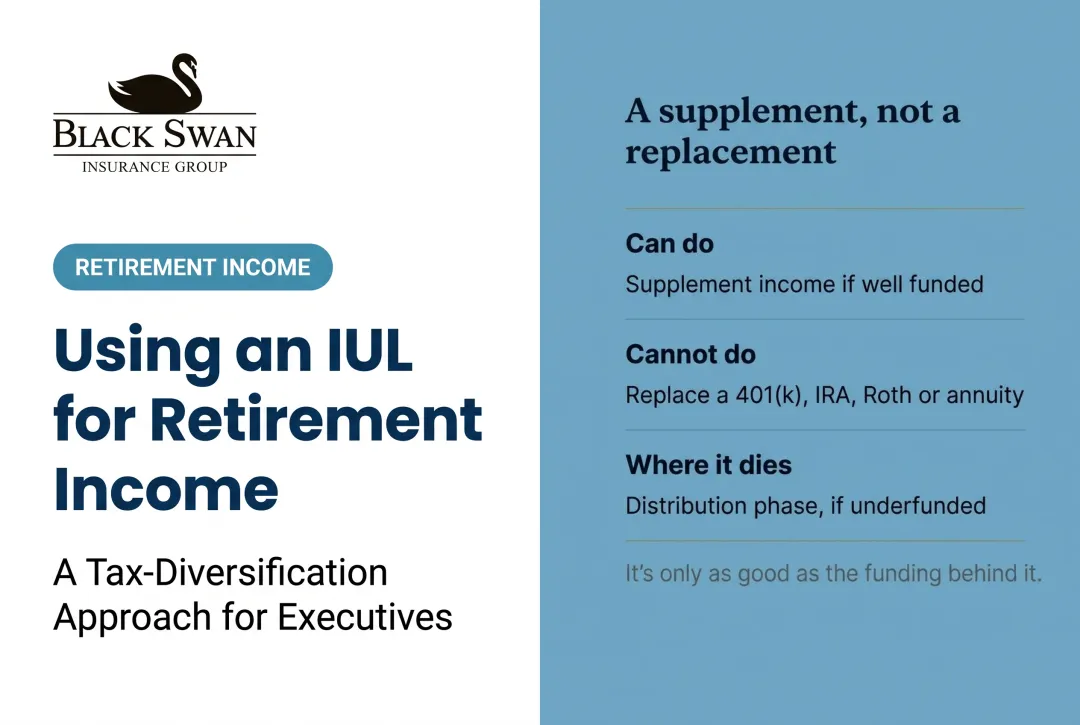
It can supplement income for high earners who need permanent coverage, can fund consistently, and understand loan and lapse risk. It is not automatic, and it does not replace qualified retirement saving.
Which company is best for retirement income?
It depends on age, health, funding capacity, desired death benefit and income method. Compare current illustrations and contractual guarantees across several carriers.
Can the income come out untaxed?
Loans and withdrawals may receive favourable treatment while the policy stays properly funded, non-MEC and in force. IRS rules on modified endowment contracts can change that, and lapsing with a loan outstanding can trigger taxable income. "Potentially tax-advantaged" is accurate; "tax-free" is not.
Should I fund one before maxing my 401(k) or IRA?
Generally no. Evaluate the employer match and tax-advantaged accounts first. Individual circumstances and a genuine permanent-insurance need can shift the order, but not the match.
What if the policy performs worse than illustrated?
Lower crediting, higher charges or reduced premiums can shrink cash value, require extra funding, reduce the death benefit or cause a lapse. Always request conservative and guaranteed projections alongside the illustrated ones.
Is an IUL or an annuity better for income?
They insure different risks. An annuity offers contractual income guarantees; an IUL combines a death benefit with flexible access and growth potential. Which is better depends on whether protection, flexibility or guaranteed income matters most.
Sources
- IRS — COLA increases for dollar limitations on benefits and contributions
- IRS Revenue Ruling 2007-38 — modified endowment contracts
- NAIC — Life Insurance Illustrations
Disclosure: This article is educational and is not personal tax, legal or investment advice. Indexed universal life is life insurance first. Carrier products, riders, loan rates, index options and state availability change frequently and must be confirmed against current policy forms before applying; ratings reflect an insurer's claims-paying ability, not the suitability of any contract. Contribution limits change annually and should be confirmed with the IRS. Illustrated values are not guarantees; actual results depend on policy terms, crediting, costs and funding. Actual results depend on policy design, carrier, crediting options, caps, participation rates, expenses, funding and ongoing management. This strategy is not appropriate for everyone. Policy loans and withdrawals reduce cash value and the death benefit, and can create tax consequences if the policy lapses or becomes a modified endowment contract. Consult your own tax, legal and financial professionals for advice specific to your situation.
And remember, it's not what you earn, it's what you keep… enjoy the ride.