By Robert Balgac, Founder, Black Swan Insurance Group | October 5, 2026
Four words decide what an indexed universal life policy actually credits, and three of them are usually mentioned only in passing. The floor gets the airtime, because it is the comfortable one. The cap, the participation rate and the spread are where the return you were shown quietly becomes the return you receive.
If you earn $150K+ and someone has put an illustration in front of you, these four levers are the assumptions underneath every number on the page. They are also, in most contracts, adjustable by the carrier within written limits. That combination is worth understanding before you fund anything.
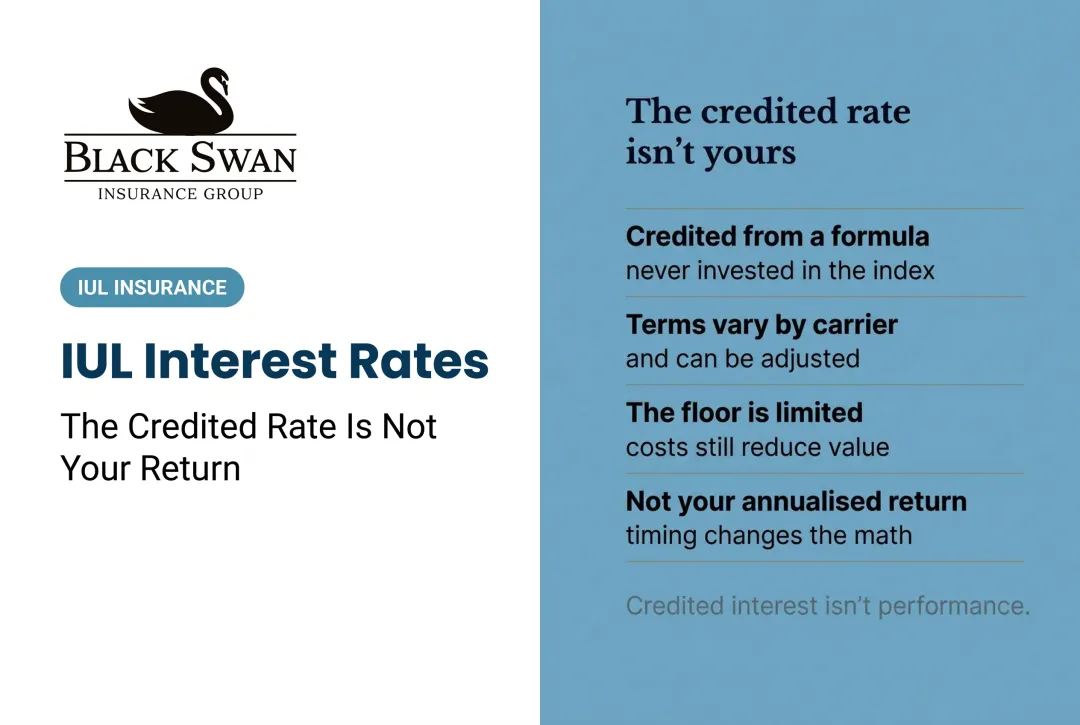
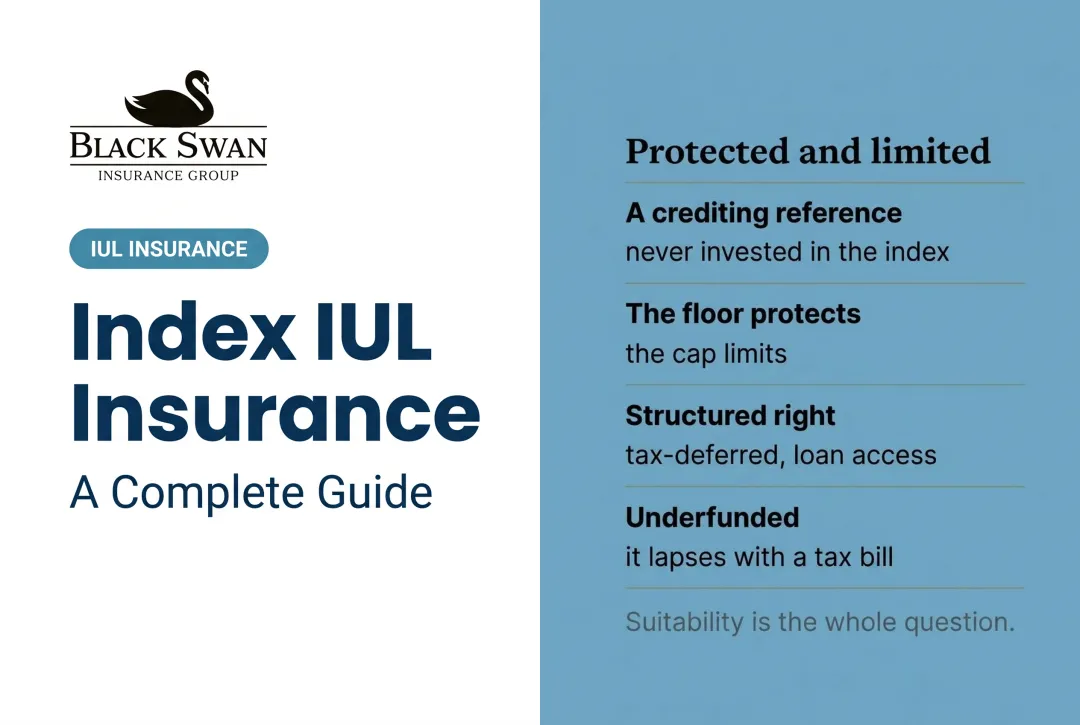
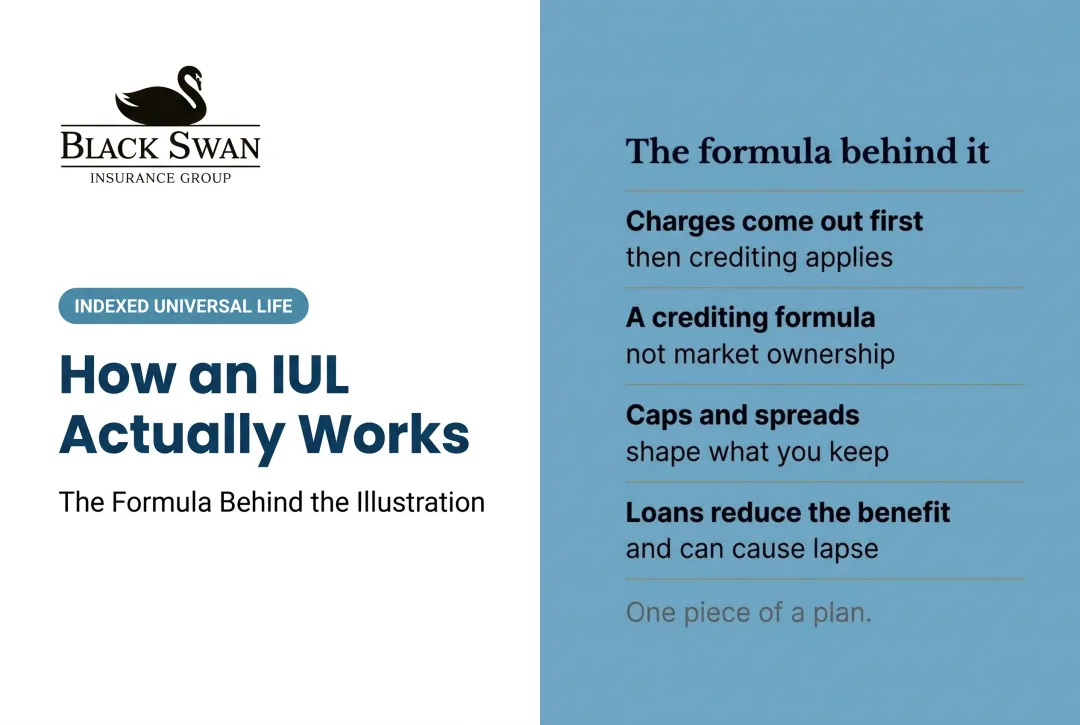
The short answer: The floor sets the minimum credited rate on indexed interest, commonly 0%. The cap sets the maximum. The participation rate sets what share of index movement counts. The spread subtracts a fixed amount from index movement before crediting. Only the floor helps you, it applies to the credit and not to policy charges, and caps, participation rates and spreads are generally non-guaranteed within contract limits.
Key Takeaways
- The credited rate is not the index return; three separate levers reduce it before anything reaches your account
- A 0% floor prevents a negative credit, not a negative year — monthly charges continue regardless
- Caps, participation rates and spreads are typically non-guaranteed and can be adjusted within contract limits
- A policy modelled at a 10% cap behaves very differently at 7%, and the shortfall compounds across the contract
- Ask for the guaranteed minimum cap and maximum spread, not just today's declared rates
What Each Lever Actually Does
An IUL is permanent life insurance first. The cash value is credited through an index-linked formula rather than invested directly in the market, and any potential tax-advantaged access later depends on the policy being properly structured, funded and managed.
The Floor
A minimum crediting rate for indexed interest, most commonly 0%. If the index falls 18%, the indexed credit is 0% rather than negative 18%. This is the feature that sells the product, and it is described inaccurately more often than any other. Your indexed crediting may have a floor, but policy charges still apply — so in that same year, cost of insurance and administrative fees come out and cash value falls.
The Cap
The maximum credited rate for the crediting period. If the cap is 9% and the index moves 22%, you are credited 9%. Caps exist because the carrier is buying options to hedge the crediting promise, and the option budget is finite.
The Participation Rate
The share of index movement the policy credits. At 70% participation, a 10% index move credits 7% before any cap is applied. Some products advertise no cap and use a participation rate below 100% instead. That is not generosity; it is the same constraint expressed differently.
The Spread
An amount subtracted from index movement before crediting. With a 3% spread, a 10% index move credits 7%. Spreads are often paired with uncapped strategies.

Same premium. Different design. Completely different outcome. The levers are where most of that difference lives.
How the Levers Interact
A single crediting strategy may apply more than one lever. A policy might offer an uncapped strategy with a 4% spread and 100% participation, alongside a capped strategy at 9% with no spread. Neither is automatically better. Which one performs depends on the size of the index move, and nobody knows that in advance.
The practical test is to model both under three scenarios: a strong year, a modest year and a flat year. In a modest year the capped strategy often wins, because the spread consumes most of a small move. In a strong year the uncapped strategy usually wins. In a flat year both credit nothing and the charges still run.
Why These Numbers Change
Carriers set declared rates against their hedging costs and portfolio yields. When option costs rise or yields fall, caps tend to come down. This is not misconduct; it is the economics of the guarantee. What matters for you is that the contract specifies a guaranteed minimum cap and a guaranteed maximum spread, and those figures — not today's declared rates — are the worst case you have agreed to.
The Segment and the Crediting Method
Two more details change the arithmetic and are rarely explained:
- Segment term. Most crediting is annual point-to-point, comparing the index on two dates a year apart. Monthly methods and multi-year terms behave very differently.
- Index selection. Price-return indices exclude dividends. That exclusion is a structural reduction relative to a total-return comparison, and it is the reason side-by-side charts against "the market" are usually unfair in one direction or the other.

What the Critics Get Right
Critics are right that headline caps are a marketing surface, and that a policy sold on a 12% cap can be renewed at 8% without breaching the contract. They are right that price-return indices understate what a market investor would have earned. And they are right that the floor is routinely described as though it protects the policy rather than the credit.
Where the criticism overreaches is in treating the levers as deception rather than as the price of the floor. You trade some upside for downside crediting protection and policy flexibility. Whether that trade is worth its cost is a design and suitability question, not a moral one.
Compare It Against the Alternatives
- A taxable brokerage account — full participation including dividends, full downside, favourable long-term capital gains treatment
- A 401(k) — lower cost and an employer match, fully taxable withdrawals later
- A fixed indexed annuity — similar crediting mechanics, built for income rather than a death benefit
- Term insurance plus investing the difference — cheapest protection, no crediting constraints on the invested portion
What to Ask Before You Accept a Crediting Strategy
The levers are only useful if you know which numbers in your contract are promises and which are current declarations. Four questions separate those.
What is the guaranteed minimum cap, and the guaranteed maximum spread? These are contractual. Today's declared rates are not. Model the projection at the guaranteed figures and see whether the policy still does the job.
How often has the carrier changed declared rates on this product? History is not a guarantee, but a product whose caps have moved repeatedly tells you something about how tightly the pricing was set.
Is the index price-return or total-return? Most are price-return, which excludes dividends. That exclusion is structural and permanent.
What is the segment term and crediting method? Annual point-to-point behaves differently from monthly averaging or a monthly cap design, and monthly cap structures in particular can credit nothing in a volatile year that finished up.
Do not buy the highlight reel. Watch the game film.
The Ultimate IUL Blueprint
A plain-English walkthrough of crediting mechanics, guaranteed minimums and what to ask before you accept an illustration.
Who This Structure May Fit
Stronger Fit
- $150K+ stable income with sustainable funding capacity of $500–$2,500 a month
- A genuine permanent protection or legacy need alongside the cash value goal
- Comfort with capped, formula-based crediting rather than direct market participation
- A twenty-year-plus horizon and willingness to review declared rates annually
- Already funding available retirement accounts and capturing the employer match
Weaker Fit
Not everyone should buy an IUL. If you came here hoping the caps were high enough to make this a market substitute, that is the wrong frame and the answer is no.
- An expectation of index-like returns including dividends
- Short horizon, or liquidity needed inside the surrender period
- No emergency reserve, or high-interest debt outstanding
- A purely temporary protection need — term insurance solves that directly and cheaply

Risks to Understand Before You Fund
- The floor protects the credit, not the account. In a zero-credit year, charges still reduce cash value.
- Caps, participation rates and spreads are generally non-guaranteed and can be adjusted within contract limits.
- Guaranteed minimums are far less attractive than declared rates, and they are what you have actually contracted for.
- Price-return indices exclude dividends, a structural drag relative to total-return comparisons.
- Underfunding remains the dominant failure mode, independent of crediting.
- Policy loans and withdrawals reduce cash value and the death benefit and can create tax consequences on lapse or MEC classification.
Find Out Where You Actually Stand
Start with the Tax-Free Wealth Blueprint Fit Review. If you earn $150K+ and want to see what your contract's guaranteed minimum cap does to the projection you were shown, we model it alongside a flat decade and the funding required to hold the policy through it. If IUL does not fit, we will tell you that too.
Frequently Asked Questions
What is a typical IUL cap rate?
Caps vary by carrier, product, crediting strategy and current economic conditions, and they change over time. Any single figure quoted as typical is a snapshot, not a standard. Ask for your contract's guaranteed minimum.
Can the insurance company lower my cap?
Generally yes, within the limits written into the contract. That is why the guaranteed minimum cap matters more than the declared rate on the illustration.
Is a higher participation rate better than a higher cap?
Not necessarily. Which performs better depends on the size of the index movement. Model both under strong, modest and flat scenarios rather than choosing on the headline.
Does the floor protect my account value?
No. The floor applies to indexed interest. Policy charges continue to be deducted, and surrender charges apply on early exit, so cash value can fall.
Why is my credited rate lower than the index return?
Because caps, participation rates and spreads reduce it, and most indexed strategies use price-return indices that exclude dividends.
What should I ask before choosing a crediting strategy?
The guaranteed minimum cap, the guaranteed maximum spread, the segment term, the crediting method, whether the index is price-return, and how often declared rates have been changed historically.
Sources
- NAIC — Life Insurance — indexed universal life crediting and guaranteed minimum interest
- NAIC, Life Insurance Illustrations Model Regulation (Model #582) — non-guaranteed element disclosure
- FINRA — Indexed products investor guidance — index crediting mechanics and caps
- I.R.C. § 7702A — Modified Endowment Contract and the seven-pay test
- I.R.C. § 72 — additional tax on early distributions
Disclosure: The information on this page is educational in nature and does not constitute personalized financial, tax, or legal advice. Actual results depend on policy design, carrier, crediting options, caps, participation rates, expenses, funding, loans, and ongoing management. Policy loans and withdrawals reduce cash value and the death benefit, and can create tax consequences if the policy lapses or becomes a modified endowment contract. Consult a licensed insurance professional and, where appropriate, a tax or financial advisor before making any insurance or financial decision. Indexed universal life is life insurance first. Illustrated values are not guarantees; actual results depend on policy terms, crediting, costs and funding. This strategy is not appropriate for everyone.
And remember, it's not what you earn, it's what you keep… enjoy the ride.