By Robert Balgac, Founder, Black Swan Insurance Group | October 5, 2026
California has some of the most detailed life insurance illustration rules in the country. Most buyers never hear about them, which is unfortunate, because those rules are the closest thing you have to a referee in this transaction.
Indexed universal life draws serious interest from California professionals, practice owners and executives — often physicians, attorneys and founders already maxing a 401(k) and a Roth, feeling the state income tax pressure, and looking for another lever.
The part the pitch skips: an IUL is life insurance first. Not a market position, not a guaranteed retirement account. Results depend on how the policy is funded, what it charges, how interest is credited, and whether anyone reviews it over the next thirty years.
The short answer: An IUL provides a permanent death benefit plus cash value credited on an external index formula — never direct market investment. Caps, participation rates, spreads, charges, loans and withdrawals all shape the outcome, and caps can be reduced after issue. California requires guaranteed and non-guaranteed values to be clearly separated, a signed illustration receipt, a free-look period of 10 to 30 days (at least 30 for buyers 60+), a grace period of at least 60 days, and 30 days' advance lapse notice. Use those protections; they exist because people needed them.
Key Takeaways
- A permanent death benefit plus cash value credited by an index formula — not direct market investment
- Caps, participation rates, spreads, charges, loans and withdrawals all shape the actual result
- California law separates guaranteed from non-guaranteed values and requires a signed illustration receipt
- Best fit: a long-term protection need with sustainable funding capacity, not a short-term goal
- Compare guaranteed values against illustrated ones; a strong illustration is not a promise
How the Policy Works
Two moving parts: a death benefit paid to beneficiaries, and a cash-value account accessible while you are alive. The death benefit is straightforward. The cash-value side is where the confusion lives.
Your cash value is not invested in the S&P 500 or any index. The carrier credits interest based on how a chosen index performed, subject to policy-specific rules. California carriers such as Pacific Life market products like Pacific Horizon IUL 2, which the company's own California client guide states does not directly participate in stock or equity investments.
Four Terms Decide What You Earn
- Floor — the minimum credited rate, often 0%, preventing negative index performance from reducing credited interest, though charges can still reduce value
- Cap — the maximum credited rate in a period, however well the index performed
- Participation rate — the percentage of index gains actually credited
- Spread — a deduction some carriers subtract from index performance before crediting
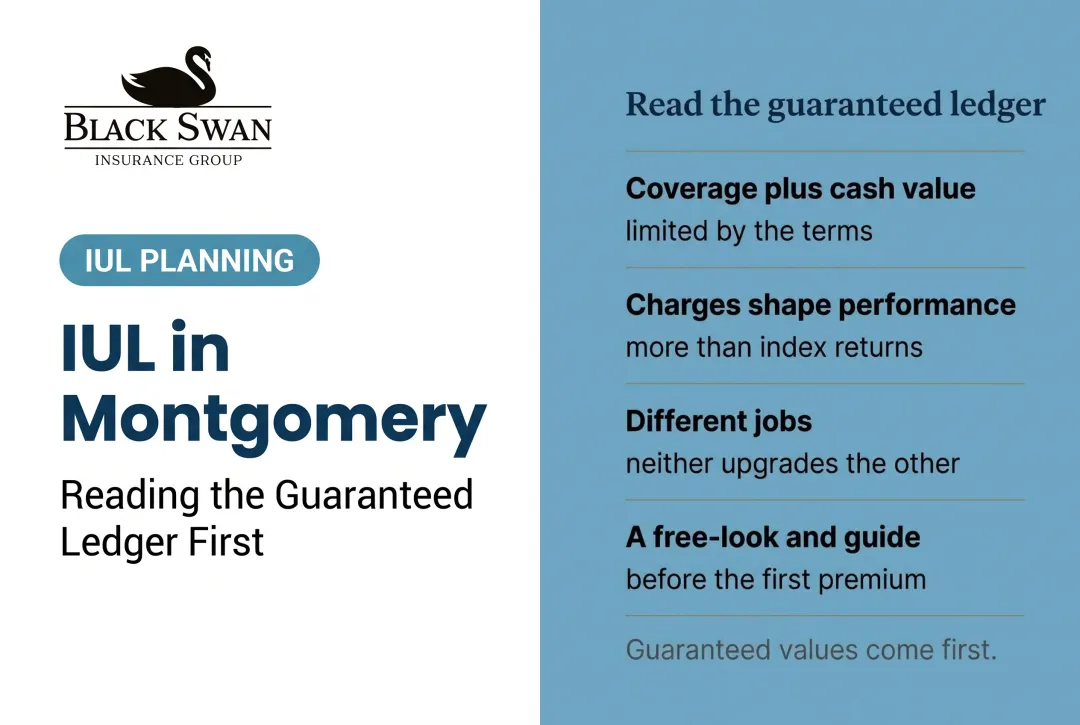
None of these is fixed forever. Carriers can adjust caps and participation rates going forward, which is exactly why an illustration projecting today's rates across thirty years is a model rather than a forecast.

Where the Premium Goes
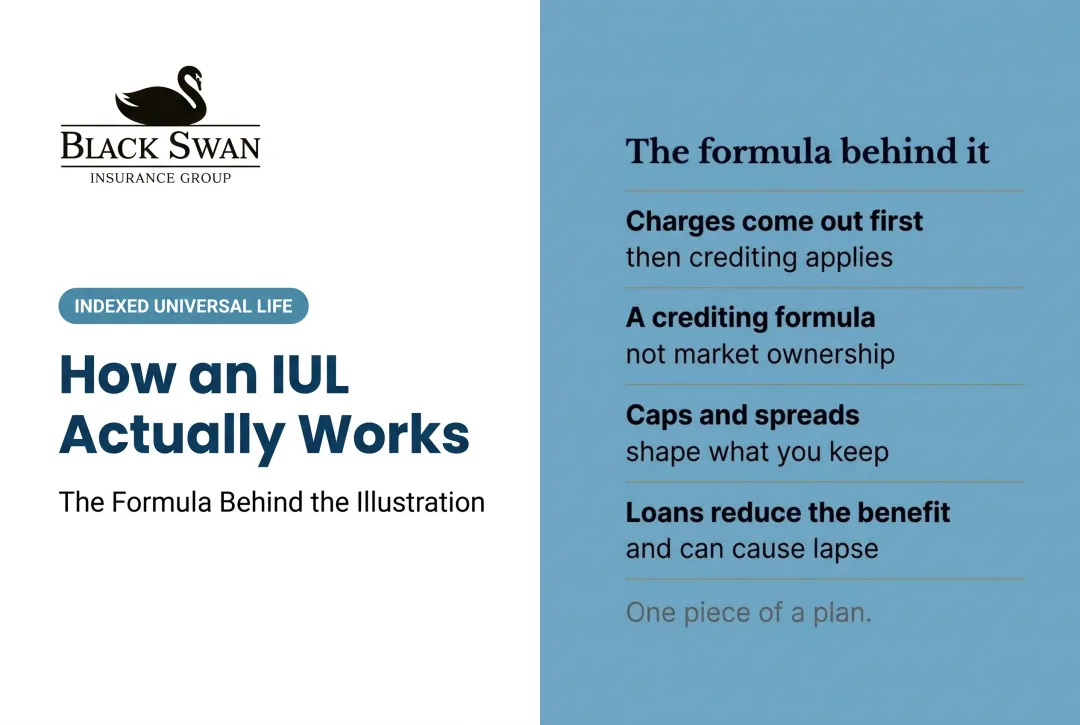
Flexible premiums are appealing, and flexible does not mean optional. Your payment covers cost of insurance charges that rise with age, administrative and premium load fees, any riders elected, and then whatever remains goes to cash value.
Stop paying, or underfund, and the charges keep coming out of existing cash value. Do that long enough and the policy lapses.
Zero is your hero in a down year — but the floor applies to the credit, not to the charges.
Loans, Withdrawals and Tax
Loans accrue interest and reduce the death benefit until repaid. Withdrawals permanently reduce cash value.
Death benefits and certain loans may be received income-tax-free while the policy stays in force and is not classified as a modified endowment contract — potential tax-advantaged access, conditional on the contract being properly structured, funded and managed. Surrender or lapse with an outstanding loan and gain in the contract and you face a tax bill with no cash received to pay it.
Your California Buyer Protections
Knowing these helps you recognise a compliant, transparent sales process — and spot one that is not.
Illustration Disclosure
Under California Insurance Code sections 10509.950–10509.965, illustrations must clearly separate guaranteed from non-guaranteed values. Section 10509.956 requires that guaranteed death benefits and surrender values be shown as guaranteed; that non-guaranteed elements not be illustrated more favourably than the insurer's own scale; that the illustration state actual results may be less favourable; and that both you and the producer sign an illustration receipt.
If an agent hands you a single illustration with no clearly marked guaranteed column, that is the finding. Ask why before you ask anything else.
Free-Look, Grace Periods and Lapse Notices
- Free-look — 10 to 30 days to cancel after receiving the policy, with a full refund
- Senior free-look — buyers aged 60+ get at least 30 days
- Grace period — at least 60 days from a missed premium due date before lapse, per California Insurance Code Section 10113.71
- Lapse notice — mailed at least 30 days before termination, and you may name a second person to receive it. Use that. Naming a spouse or adult child as the second recipient has saved more policies than any rider
Contestability and Replacement
A California life policy generally cannot be contested after two years from issue. And on a replacement, your agent must give you a written comparison of premiums, cash values, death benefits and any debt on both policies — a requirement worth invoking if anyone suggests swapping coverage you already own.
State rules, carrier availability and licensing change. Confirm your producer's current California licence through the California Department of Insurance licence lookup.
What the Critics Get Right
Scepticism about this product in a high-tax state is warranted, and it is worth engaging rather than waving off.
Critics are right that state income tax pressure gets used as an emotional lever to sell permanent insurance to people who needed a brokerage account. They are right that caps and participation rates are carrier-controlled and can be cut after you have committed a decade of premiums. And they are right that California's illustration rules exist because the industry demonstrated, repeatedly, that it would not separate projections from promises voluntarily.
Where the criticism runs out is the protection question. California professionals with concentrated business assets, estate exposure or genuine permanent coverage needs are not solving a tax problem — they are solving a liquidity problem. The regulations are there to make the transaction honest, not to suggest nobody should enter it.
Costs, Benefits and Risks
What drives your premium: age and health at underwriting; the underwriting class you qualify for; face amount and death-benefit option; policy design and riders; and how much you plan to fund it. Two people the same age can pay very different premiums on underwriting alone.
The benefits, with the fine print attached:
- Lifelong protection — while the policy stays funded and in force
- Flexible funding — within limits; skip too much and lapse risk rises
- Tax-deferred growth — cash value grows without annual taxation
- Index-linked potential — bounded by a floor and a cap, not unlimited
- Potential tax-advantaged access — loans and withdrawals, conditional on non-MEC status and the policy remaining active
The real risks: more complexity than term or whole life; ongoing charges even when crediting is flat; caps and participation rates the carrier can change after issue; underfunding that accelerates lapse; surrender charges in the early years; loan balances that reduce the death benefit. And MEC treatment — overfunding past IRS limits means Revenue Ruling 2007-38 treats distributions as income-first, with a possible 10% additional tax.
| Product | Guarantees | Market exposure | Best for |
|---|---|---|---|
| Term insurance | Death benefit only, for a fixed term | None | Lowest-cost temporary protection |
| Whole life | Guaranteed cash value and death benefit | None | Predictable, guaranteed growth |
| Guaranteed UL | Death benefit guarantee, minimal cash value | None | Permanent protection at lower cost |
| IUL | Floor on crediting; charges not guaranteed | Indirect, capped index-linked | Flexible protection with growth potential |
| Variable UL | None on cash value | Direct, uncapped | Owners comfortable carrying market risk |
| 401(k) / Roth | Depends on plan | Direct | Primary retirement savings |

The Ultimate IUL Blueprint
If a permanent need genuinely exists, the Blueprint covers the design decisions that follow: funding levels, the MEC line, index-strategy selection and loan timing.
Who It Fits in California
Stronger Fit
- A genuine, ongoing need for permanent death benefit protection
- Household income of $150K+ with surplus cash flow sustainable for years, not just this year
- Insurability supporting reasonable underwriting terms
- A long enough horizon for cash value to build past the early charges
- Willingness to review the policy annually
High-income California professionals who have already funded the 401(k), IRA and Roth often look here for tax diversification, particularly given state income tax exposure. It supplements those accounts; it does not replace them.
Business and practice owners often need liquidity and protection outside a concentrated business asset. Ownership structures and beneficiary designations get complicated quickly, so involve tax and legal advisors before anything is finalised.
Late-start high earners face a compressed runway. Underwriting matters more, and fewer years remain for cash value to build. Stress-test realistic premium capacity against simpler alternatives first.
Weaker Fit
Not everyone should buy an IUL. California's buyer protections are strong, but no regulation makes an unsuitable purchase suitable.
- The lowest-cost temporary coverage is what you need — term insurance does that job better and cheaper
- Short-term returns or quick liquidity
- Guaranteed accumulation with no variability
- A completely hands-off policy nobody reviews
- Premiums you are not confident you can sustain
Comparing and Buying
The Comparison Checklist
Carrier financial strength ratings. California product approval and current availability. Cost of insurance assumptions and administrative charges. Cap, participation rate and spread on each index option. Loan provisions and interest rates. Available riders and their cost. The surrender charge schedule. And guaranteed values, not just illustrated ones.
Six Questions Before You Sign
- What values in this illustration are actually guaranteed?
- Who can change caps or participation rates, and how often has this carrier done so?
- What happens if I reduce or pause premiums for a year or two?
- What specifically triggers a lapse on this policy?
- How are outstanding loans managed, and what happens if I do not repay them?
- How often will someone review this policy with me?

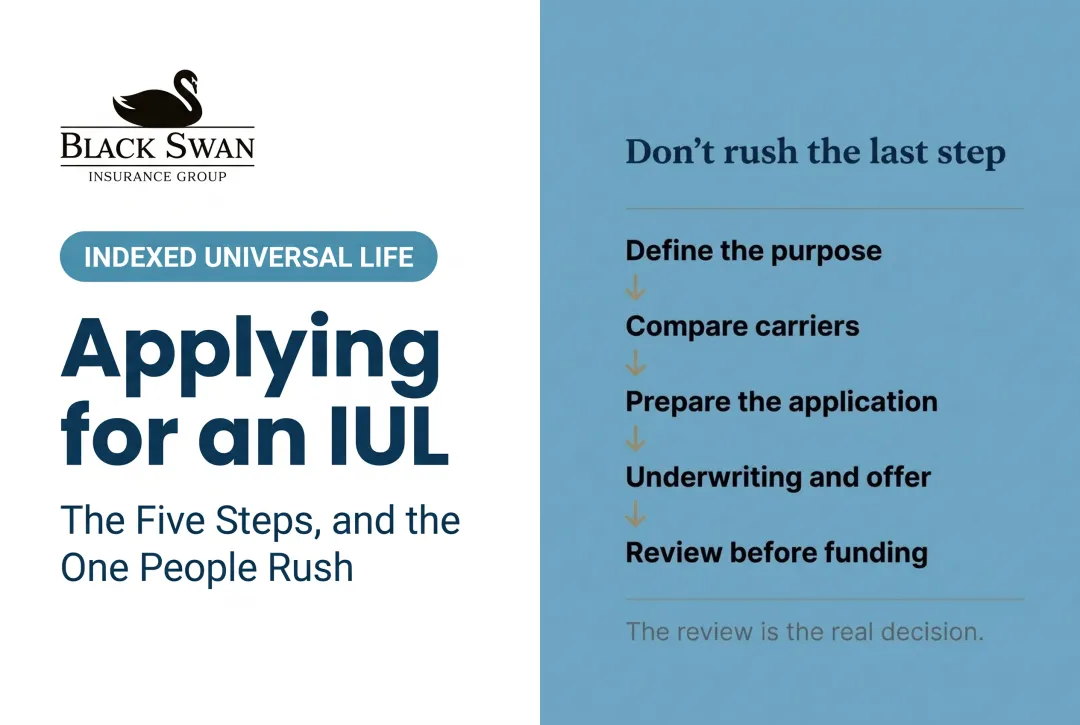
Apply only after confirming a genuine permanent insurance need, a realistic and sustainable funding plan, a comparison against term, whole life and your existing retirement accounts, an understanding of what is guaranteed and what is not, and a commitment to periodic review.
Do not buy the highlight reel. Watch the game film. In California you have a statutory right to see both.
Risks to Understand Before You Apply
- Charges continue in a 0% crediting year, so cash value can fall with the floor intact
- Cost of insurance rises with age and is deducted regardless of index performance
- Caps, participation rates and spreads can be reduced by the carrier after issue
- Underfunding accelerates lapse, and the 60-day grace period only buys you time to fix it
- Surrender charges apply in the early years
- Loans reduce the death benefit, and a lapse or surrender with a loan outstanding and gain in the contract creates taxable income with no cash received
- Crossing the seven-pay limit makes the contract a MEC and changes distribution taxation permanently
- Illustrated values are projections — California law requires them to say so, and that statement is the important sentence on the page
- Product availability and producer licensing vary by state and change over time
Find Out Where You Actually Stand
This starts with the Tax-Free Wealth Blueprint Fit Review. If you earn $150K+ in California, we read the guaranteed column against the illustrated one, stress-test the funding through a bad year, check the MEC line and loan assumptions, and price term plus your existing accounts on identical terms. If it does not fit, we will tell you that too.
Frequently Asked Questions
How much does an IUL cost per month in California?
There is no fixed figure. It depends on age, health, coverage amount, underwriting class, design and funding level. Ask for an individualised illustration rather than an estimate.
Is IUL legal in California?
Yes. It is a regulated life insurance product sold subject to state insurance law, carrier product approval and producer licensing. Availability varies by carrier.
Can a policy lapse here?
Yes. Insufficient funding, charges, loans or withdrawals can all cause it. California requires at least a 60-day grace period and 30 days' advance notice, and you remain responsible for monitoring the funding.
What does the free-look period give me?
10 to 30 days to cancel after delivery with a full refund, and at least 30 days if you are 60 or older. Use it to have the contract read by someone who is not selling it to you.
Is an IUL a good retirement plan?
It is life insurance with cash-value potential, not a replacement for retirement accounts. Whether it fits depends on your permanent protection need, funding capacity, tax position and existing accounts.
Should I buy term instead?
If the protection need has an end date, yes — term insurance is cheaper and cleaner, and that answer deserves stating before anyone designs a permanent policy.
Sources
- California Insurance Code § 10509.956 — illustration requirements
- California Insurance Code § 10113.71 — grace period and lapse notice
- California Department of Insurance — licence lookup
- IRS Revenue Ruling 2007-38
- NAIC — Life Insurance Illustrations
Disclosure: This article is educational and is not personal tax, legal or investment advice. Indexed universal life is life insurance first. State rules, carrier product availability and licensing requirements change; confirm current details before applying. Actual results depend on policy design, carrier, crediting options, caps, participation rates, expenses, funding and ongoing management. Policy loans and withdrawals may reduce cash value and death benefit and can create tax consequences if the policy lapses or becomes a modified endowment contract. This strategy is not appropriate for everyone. Illustrated values are not guarantees; actual results depend on policy terms, crediting, costs and funding. Consult your own tax, legal and financial professionals for advice specific to your situation.
And remember, it's not what you earn, it's what you keep… enjoy the ride.