By Robert Balgac, Founder, Black Swan Insurance Group | October 5, 2026
Think of your cash value like equity in a financial house. If the house goes up in value, you do not have to sell it to access some of that equity. You can borrow against it, and the house still exists, still potentially appreciates, still does its job.
That analogy holds right up to the point most people stop listening. Just like a home equity loan, this only works if you manage the debt. Borrow too much, ignore the interest, never check the structure, and you create a problem — because in life insurance, the policy has to stay healthy for the whole arrangement to hold.
The loan is not the problem. The unmanaged loan is the problem.
The short answer: Policy loans require permanent coverage with enough cash value; term insurance generally does not qualify. No bank-style credit check is needed, and interest still accrues and needs active monitoring. Unpaid balances cut the death benefit, raise lapse risk, and can create taxable income if the policy lapses — with no cash received to pay it. Borrow only after checking contract terms, the purpose, your repayment capacity and how it fits the wider plan.
Key Takeaways
- Loans require permanent coverage with sufficient cash value; term insurance usually does not qualify
- No credit check is required, but interest accrues and the balance needs active monitoring
- Unpaid balances reduce the death benefit, raise lapse risk, and can create taxable income on lapse
- Borrow only after checking contract terms, purpose, repayment capacity and fit with the wider plan
- A policy loan is borrowing from the insurer against your cash value — not a withdrawal from savings
Which Policies Allow It
Term insurance is pure protection with no cash value, so there is nothing to borrow against. Guardian confirms that term policies do not permit policy loans. That is a design feature, not a shortcoming — term does one job cheaply.
Permanent policies are different. Whole life, universal life and indexed universal life all build cash value usable as collateral. Owning one still does not guarantee access straight away.

Confirm available value before assuming anything. Insurers set their own minimums and rules. Check how much cash value has actually accumulated — early years often leave little to borrow — the insurer's loan minimums and any waiting periods, and whether existing loans or fees already reduce what is available.
Why an IUL Needs Extra Scrutiny
Indexed universal life adds complexity whole life does not have. Cash-value growth depends on index crediting formulas, cap rates, participation rates and floors rather than a fixed guaranteed rate. An illustrated projection is not a promise.
Cost of insurance, administrative charges and rider fees reduce performance regardless of how the index behaves.
Before borrowing against one, review the actual contract and a current in-force illustration — not the sales illustration from years ago. Any potential tax-advantaged access depends on the policy being properly structured, funded and managed, and a loan changes that calculation.
Loan, Withdrawal or Surrender
| Option | What happens | Key risk |
|---|---|---|
| Policy loan | Borrow against cash value; interest accrues | Reduces the death benefit if left unpaid |
| Withdrawal | Removes value directly from the policy | Can permanently lower cash value and death benefit |
| Surrender | Ends the policy entirely | Surrender charges and potential taxable gain |
Your latest statement or annual report shows your current loan value, interest method and any restrictions. Do not rely on memory or a projection from the year the policy was issued.
How the Loan Actually Works
Here is where people go wrong: a policy loan is not a withdrawal from your own savings account. It is a loan from the insurer, using your cash value as collateral. Your cash value keeps earning interest or index credits under the contract, while you separately owe the insurer principal and interest.
The Process
- Review your policy for loan provisions and current cash value
- Confirm the amount available and the interest terms with your insurer
- Submit the request through your carrier's process
- Receive funds — timing varies, so verify with your carrier rather than assuming a standard turnaround
- Monitor premiums, loan balance and policy performance afterwards

What determines how much you can borrow: current cash value available as collateral; any existing loan balance; accumulated unpaid interest added to what you owe; policy charges and fees reducing net access; and insurer rules plus the required cushion against lapse. Limits vary by carrier and contract — confirm the actual figure rather than assuming a percentage.
Why people borrow: emergencies, education costs, major purchases, business liquidity gaps, or supplemental retirement cash flow. Convenient is not automatically cheapest or safest. Compare it against the alternatives first.
Repayment Is Flexible, Not Free
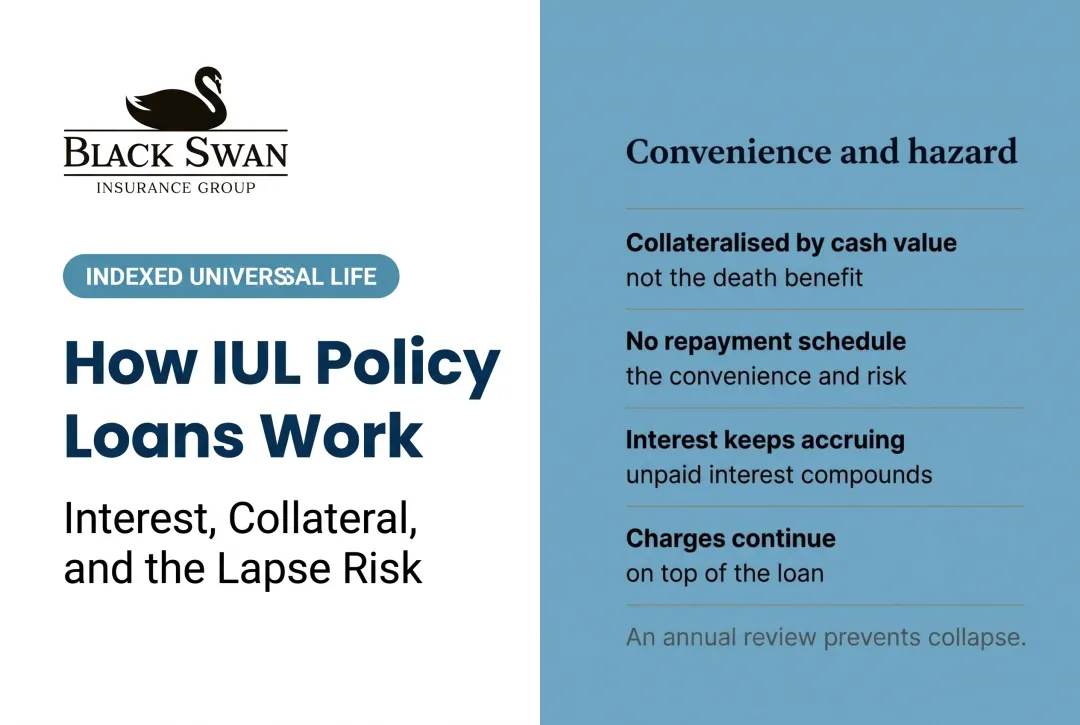
Most permanent policies do not impose a monthly amortisation schedule the way a mortgage does. That flexibility is genuinely useful and it is also the trap:
- Unpaid interest compounds and increases the balance
- A rising loan shrinks the net death benefit
- Ignoring the balance raises lapse risk as cash value thins
Monitor: loan principal and accrued interest; total outstanding balance; current cash value and surrender value; remaining death benefit; premium payment status; and any lapse-warning notices from the insurer.
Tax-free income is not magic. It is policy management. Borrowing against cash value can be powerful, but you still have to keep the policy breathing.
What the Critics Get Right
The criticism of policy loans is largely fair, and meeting it improves the analysis.
Critics are right that borrowing against a policy gets presented as though nothing were owed, when it is debt with compounding interest secured against your family's protection. They are right that the absence of a required repayment schedule is what lets a balance quietly grow past the point of recovery. And they are right that the worst outcome — a lapse producing a tax bill with no cash attached — is rarely disclosed with the same energy as the benefit.
Where the criticism runs out is the alternative. For someone with a genuine liquidity need and a well-funded policy, the comparison is not against nothing. It is against selling investments at a bad time, taking a bank loan at a worse rate, or disrupting a business. A managed policy loan can be the better option. An unmanaged one never is.
The Risks, Plainly
The death benefit impact. Die with an outstanding loan and the insurer deducts the balance plus accrued interest from what beneficiaries receive. No separate bill arrives at your estate — it simply comes off the top.
Interest compounds while you do nothing. This is where owners get caught. Interest accrues whether or not you are drawing more, and paying your regular premiums does not address a growing loan balance sitting alongside.
Lapse risk is real. If the loan and accrued interest grow large enough relative to available value, the policy lapses or is forced into surrender. You lose the coverage you bought, usually at the age when replacing it is hardest and most expensive.
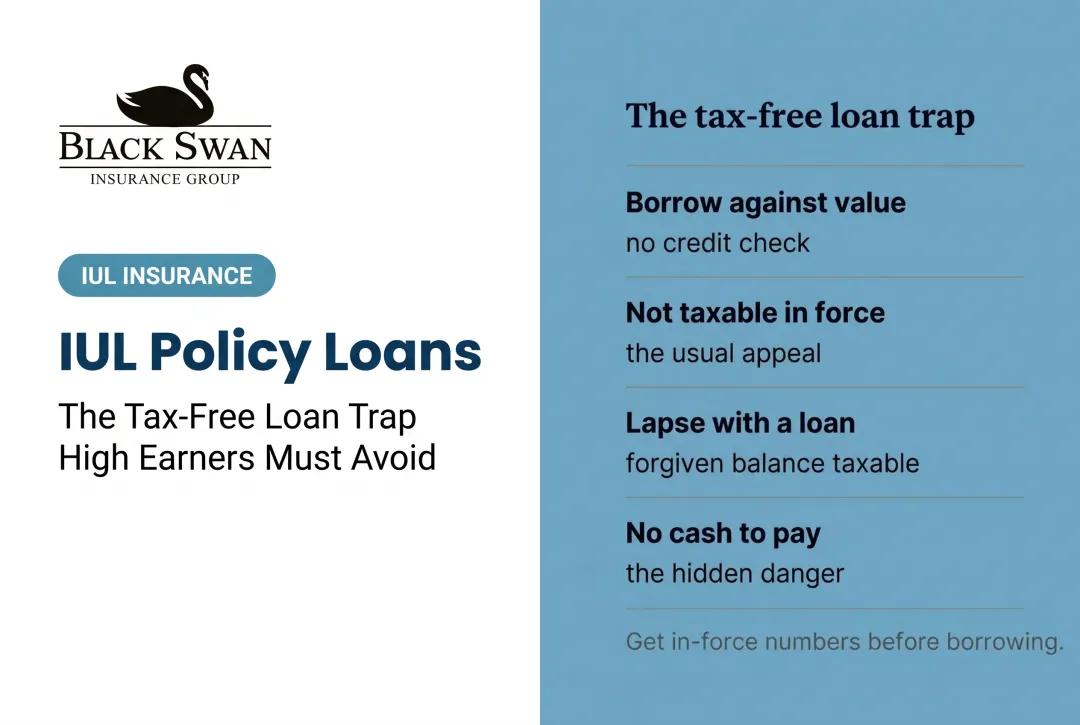
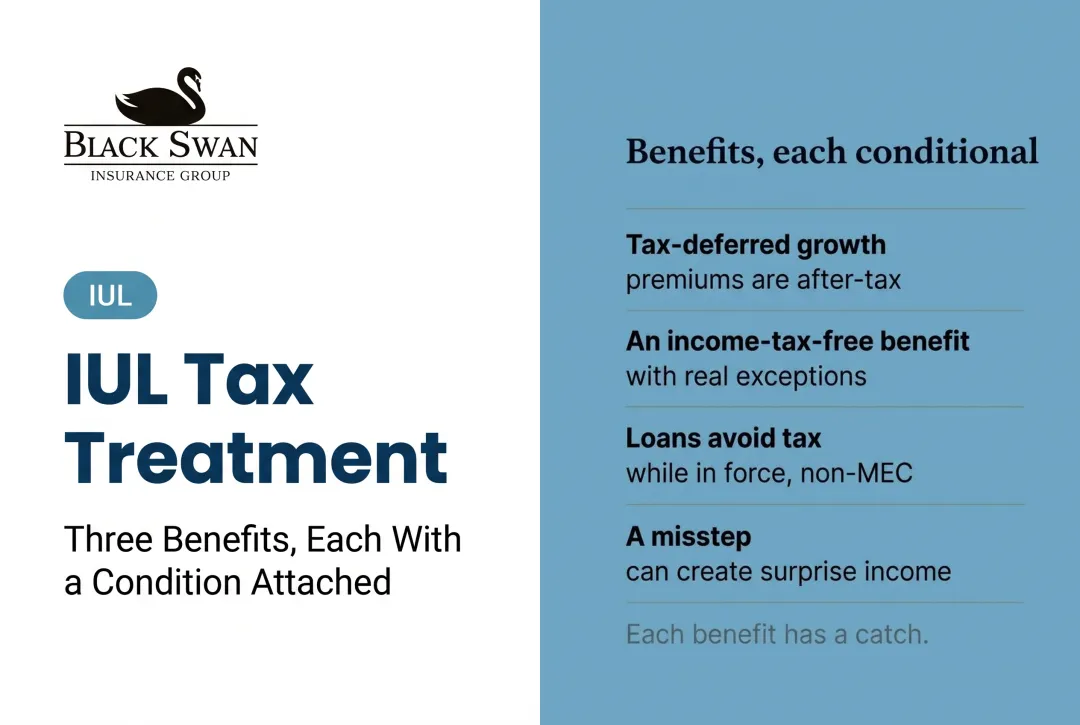
Tax when it goes wrong. A loan itself generally is not taxable income while the policy stays in force. If the policy lapses or is surrendered with a loan outstanding, the IRS treats proceeds above your cost basis as taxable income. That cost is typically premiums paid, reduced by amounts such as unrepaid loans not previously taxed.
Modified endowment contract status changes everything. Withdrawals, exchanges and certain contract provisions shift the tax treatment entirely. That is a conversation for a qualified tax professional, not an assumption.

The Ultimate IUL Blueprint
If the policy you are borrowing against is an indexed design, the Blueprint covers how loan timing interacts with crediting, funding and the MEC line — the three things that decide whether the loan strategy survives.
Who Should Borrow, and Who Should Not
Stronger Fit for a Policy Loan
- A well-funded policy with cash value comfortably above the amount needed, plus a cushion
- Household income of $150K+ with a clear, documented repayment plan alongside ongoing premiums
- A specific purpose and amount, not an open-ended draw
- A current in-force illustration showing the policy survives the loan under conservative crediting
- Acceptance of what a reduced death benefit means for beneficiaries
Weaker Fit
Not everyone should buy an IUL. If you do not intend to monitor a loan balance annually for decades, do not create one.
- A thinly funded policy, or one still inside its surrender period
- No realistic repayment capacity beyond the premium
- A recurring liquidity problem, where a loan treats the symptom
- The policy is a MEC, or close to becoming one
- Cheaper credit is available elsewhere and the protection is better left alone
- Only term insurance is held, in which case this does not apply at all
Before You Request Anything
- Identify the exact purpose and dollar amount
- Confirm the current loan interest rate, and whether it is fixed or variable
- Request an in-force illustration showing loan versus no-loan scenarios
- Determine how much repayment your household or business can genuinely sustain alongside premiums
- Consider what a reduced legacy means for your beneficiaries
Do not buy the highlight reel. Watch the game film. Ask for the in-force illustration with the loan modelled, not the one without it.
Risks to Understand Before You Borrow
- It is debt, not a withdrawal, and interest compounds whether or not you engage with it
- An unpaid balance reduces the death benefit dollar for dollar plus accrued interest
- Lapse risk rises as the balance grows relative to available cash value
- A lapse or surrender with a loan outstanding and gain in the contract creates ordinary income with no cash received
- MEC status changes the tax treatment of loans entirely and permanently
- Cost of insurance continues and rises with age, working alongside the loan against your cushion
- Early-year cash value is thin, so borrowing early leaves the smallest margin
- Replacing lapsed coverage may be impossible or unaffordable if your health has changed
- Illustrated crediting is not guaranteed, and a loan strategy built on optimistic assumptions is fragile
Find Out Where You Actually Stand
This starts with the Tax-Free Wealth Blueprint Fit Review. If you are considering borrowing against a policy, we pull the in-force illustration with and without the loan, model the balance forward under conservative crediting, check MEC status, and compare the cost against the alternatives you actually have. If it does not fit, we will tell you that too — and sometimes the honest answer is that the policy cannot support the loan you want.
Frequently Asked Questions
Can I borrow against a term policy?
No. Term insurance builds no cash value, so there is nothing to lend against. That is by design and it is part of why term costs so much less.
Is a policy loan taxable?
Generally not while the policy stays in force and is not a MEC. If the policy lapses or is surrendered with a loan outstanding, gain above your cost basis becomes taxable income.
Do I have to repay it?
Most permanent policies impose no fixed schedule. Interest still accrues and compounds, and an unpaid balance reduces the death benefit and raises lapse risk, so "no requirement" is not the same as "no consequence."
How much can I borrow?
It depends on current cash value, any existing balance, accrued interest, policy charges and the insurer's required cushion. Confirm the figure with your carrier rather than assuming a percentage.
What happens if I die with a loan outstanding?
The insurer deducts the balance plus accrued interest from the death benefit before paying beneficiaries. Nothing is billed to the estate; it simply reduces what the family receives.
Is borrowing better than surrendering?
Usually, yes, because surrender ends the coverage permanently and can trigger tax. But a loan the policy cannot support is how people end up surrendering anyway, with a tax bill attached.
Sources
- Guardian Life — Borrowing and withdrawals from life insurance
- IRS Publication 525 — Taxable and Nontaxable Income
- NAIC — Life Insurance
- NAIC — Life Insurance Illustrations
- I.R.C. § 7702A and Rev. Proc. 2008-39 (modified endowment contracts and the seven-pay test)
Disclosure: This article is educational and is not personal tax, legal or investment advice. Indexed universal life is life insurance first. Loan provisions, interest methods and borrowing limits vary by contract and carrier. Actual results depend on policy design, carrier, crediting options, caps, participation rates, expenses, funding and ongoing management. Policy loans and withdrawals may reduce cash value and death benefit and can create tax consequences if the policy lapses or becomes a modified endowment contract. Consult a qualified tax professional before borrowing. Illustrated values are not guarantees; actual results depend on policy terms, crediting, costs and funding. This strategy is not appropriate for everyone.
And remember, it's not what you earn, it's what you keep… enjoy the ride.