By Robert Balgac, Founder, Black Swan Insurance Group | October 5, 2026
Houston has no shortage of physicians, attorneys, energy executives and practice owners who have outgrown a simple term policy. Once you are carrying business debt, funding a practice, or thinking hard about what happens to your family without you, "buy cheap coverage and move on" stops being a complete answer.
That is where indexed universal life enters the conversation, and where the quality of the advice tends to collapse. An IUL pairs a permanent death benefit with a cash-value account credited on an index-linked formula. It is not investing in stocks, and it will not outperform a broad index fund on accumulation alone.
If you earn $150K+ and someone has put an application in front of you, the useful thing is not another explanation of what the product is. It is the list of documents to demand before you sign, and what to look for in each one.
The short answer: An IUL is permanent life insurance first; cash-value growth depends on caps, charges and ongoing funding rather than on markets alone. Floors, caps, participation rates and fees decide what a policy credits versus what an illustration projects. Loans and withdrawals unlock cash value and can trigger lapse or taxes if mismanaged. Weigh it against term insurance, whole life, retirement accounts and brokerage investing first — and use the Texas free-look period to read the actual contract, not the illustration.
Key Takeaways
- It is permanent life insurance first; cash-value growth hinges on caps, charges and funding, not markets alone
- Floors, caps, participation rates and fees decide what a policy credits versus what an illustration projects
- Loans and withdrawals unlock cash value but can trigger lapse or taxes if mismanaged
- Weigh it against term, whole life, retirement accounts and brokerage investing before committing
- Use the Texas free-look period to read the contract, which is the document that binds
How the Policy Works
Three moving parts: a death benefit, a cash-value account, and a premium funding both. Not every premium dollar earns interest. A portion covers the cost of insurance, administrative charges and any riders before the remainder credits to cash value, per Guardian Life's explanation of how IUL works.
The Crediting Mechanics
The insurer does not invest your cash value in the S&P 500 or any index. It uses the index's performance over a crediting period, often one year, to calculate an interest credit subject to several limits:
| Term | What it means |
|---|---|
| Floor | Minimum crediting rate for that segment, sometimes 0% |
| Cap | Maximum rate the strategy can credit |
| Participation rate | Percentage of index growth counted toward the credit |
| Spread | Amount subtracted from index growth before crediting |
None of these is fixed for the life of the policy. Insurers can adjust caps and participation rates by segment.
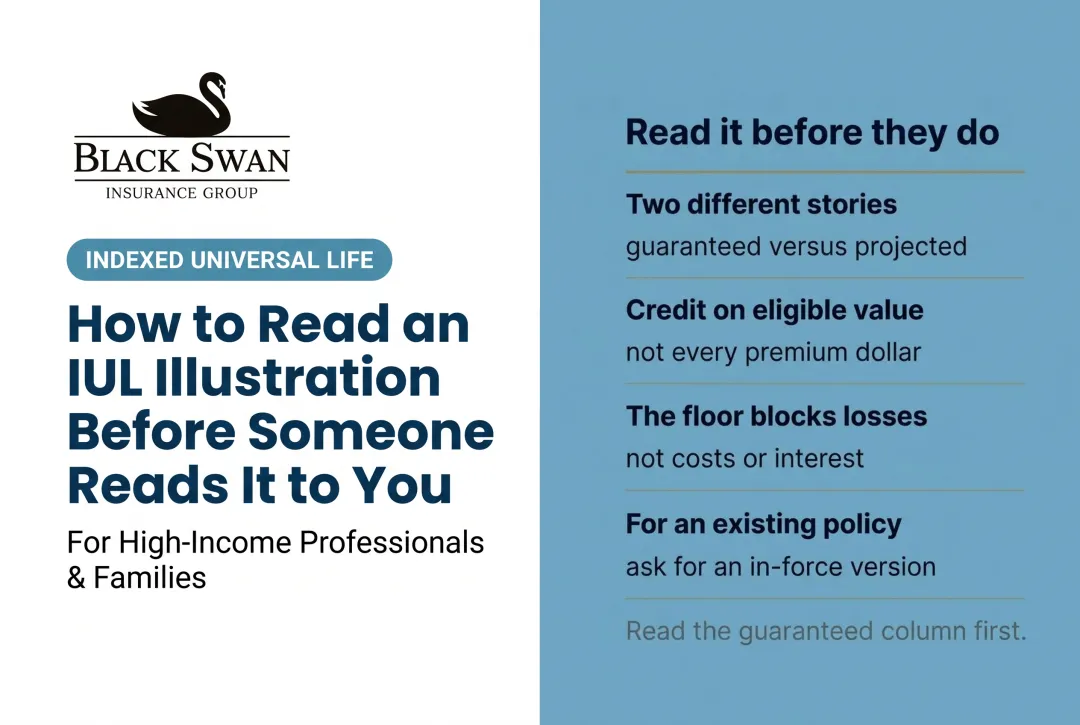
Illustrations always separate guaranteed contractual minimums from non-guaranteed projections. Ask for both columns, and read the actual Texas-approved contract rather than the sales illustration.

Flexibility Has Limits
Premiums and death benefits can typically be adjusted within the policy's structure, and that flexibility is bounded:
- Minimum funding levels may be required to keep the policy active
- Rising cost of insurance with age increases what is needed to sustain coverage
- Premium cuts that run too deep accelerate lapse risk
How you access cash value matters as much as how you fund it. A withdrawal reduces cash value directly. A loan leaves cash value in place and may still receive credits, while interest accrues and the unpaid balance reduces the net death benefit until repaid.
What It Costs
Texas's own universal life insurance checklist requires insurers to disclose cost-of-insurance rates, administrative charges, surrender-charge schedules and net amount at risk. Ask specifically about premium loads and cost-of-insurance charges, monthly administrative fees, rider charges, loan interest rates, and surrender charges — which are often steep in the early years.
The Floor-Versus-Cap Trade
A floor protects against negative index-linked crediting. Caps, participation rates, spreads and ongoing charges limit how much upside you keep. A 0% floor does not mean 0% loss — policy charges deduct from cash value regardless of index performance.

Cash value erodes faster than expected when premiums fall short of what is needed, when cost of insurance rises, when policy loans stay outstanding, and when crediting runs below illustrated rates for several years. Each of those raises lapse risk.
The Texas Department of Insurance's consumer guide to life insurance notes that permanent coverage generally costs more than term because it is built to last longer and include a savings component. Underfunding it defeats the purpose you bought it for.
Premium is the fuel. Cash value is the tank. The charges are the engine burn. Underfund it and you are not getting anywhere.
Tax, Stated Conditionally
Death benefits are generally received income-tax-free. Cash value grows tax-deferred while the policy stays in force, and loans from a properly structured, funded and managed non-MEC policy may offer potential tax-advantaged access.
Surrendering or lapsing with an outstanding loan can create taxable income above your basis, per the IRS guidance for life insurance policyholders.
Overfunding can push a contract into modified endowment contract status, changing how loans and withdrawals are taxed permanently. Not a do-it-yourself calculation — involve a tax professional before treating any distribution as tax-free.
What the Critics Get Right
Houston professionals see aggressive financial marketing from several directions, and scepticism here is well-founded.
Critics are right that the phrase "0% floor" does more selling than any other three characters in this industry, and that it describes something narrower than buyers understand. They are right that caps and participation rates are carrier-controlled and can be reduced after you have committed. And they are right that an illustration is a marketing document while the contract is the binding one, and that most buyers never read the second.
Where the criticism stops is the need itself. A practice owner with a partnership buyout obligation, or a family with an estate liquidity problem, has a permanent need that term insurance stops solving at some point. The right response to the criticism is to demand better documents, not to assume the entire category is fraudulent.
Who It Fits
Stronger Fit
- A genuine need for permanent death-benefit coverage, not temporary protection
- Household income of $150K+ with stable surplus cash flow beyond emergency reserves
- A long enough horizon for cash value to build meaningfully past the early charges
- Willingness to review the policy annually and adjust
This often describes physicians, attorneys, executives, practice owners and business owners building assets outside a concentrated business. Occupation alone does not make a fit — need and funding capacity matter more than the job title.
Weaker Fit
Not everyone should buy an IUL. If you cannot get straight answers to the questions above, that is your answer.
- Low-cost temporary coverage is the real requirement — term insurance answers it directly and far more cheaply
- Income is unstable or inconsistent
- High-interest debt should be cleared first
- Lower-cost tax-advantaged accounts such as a 401(k) or Roth IRA are not yet maxed
- Short-term liquidity matters more than a long-term commitment
An honest evaluation stacks this against term insurance, whole life, guaranteed universal life, annuities, employer retirement plans and brokerage investing — not as competitors to eliminate, but as pieces that may work better alone or alongside a policy.
The Ultimate IUL Blueprint
If a permanent need genuinely exists, the Blueprint covers the design decisions that follow: funding levels, the MEC line, index-strategy selection and loan timing.
What to Demand Before You Sign
Start with the numbers: your desired death benefit, funding timeline, premium budget, and what you actually want the cash value to do — supplemental income, liquidity or legacy.
Comparable Illustrations
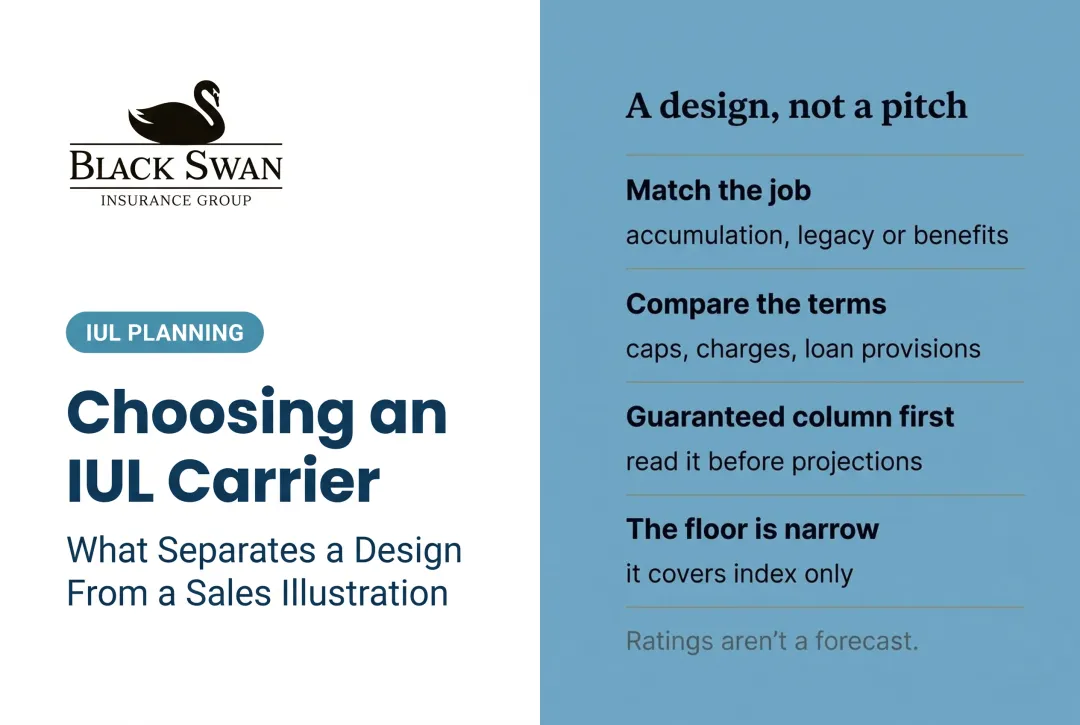
- Guaranteed and non-guaranteed columns side by side, never blended
- Conservative crediting assumptions, not just current or historical best cases
- Full charge disclosure — caps, participation rates, loan provisions and surrender schedules
- Lapse projections showing what happens if funding stops early
Vet the Insurer and the Advisor
- Financial-strength ratings from at least two agencies: AM Best, S&P or Moody's
- The producer's Texas licensing status through the Texas Department of Insurance
- Complaint history via the NAIC Consumer Information Source
- How the advisor is compensated, and whether they have reviewed policies long term or only sold them
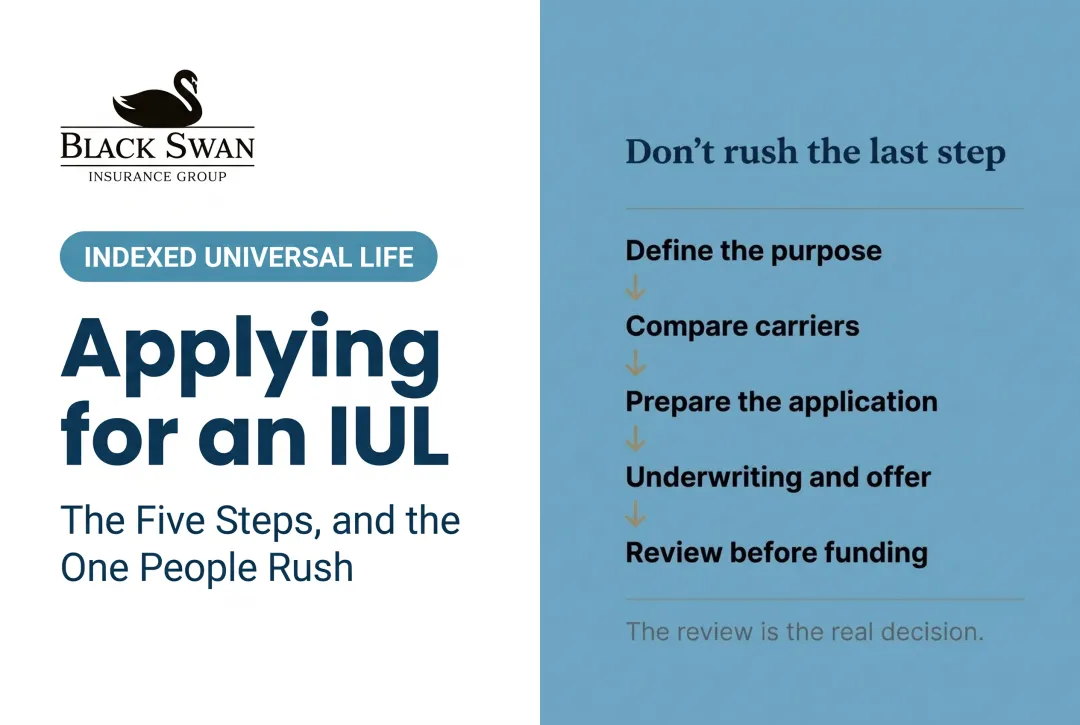
Underwriting and the Free-Look
Expect health and lifestyle questionnaires, possible medical exams, financial justification for the coverage amount, and beneficiary designations.
Once issued, use the free-look period — Texas policies generally allow at least 10 to 20 days to cancel for a full refund — to read the actual contract. Not the illustration. The contract.

Do not buy the highlight reel. Watch the game film. You have a statutory window to do exactly that, and almost nobody uses it.
Managing It After Purchase
Review annually: credited interest against the illustrated assumption, current cash value, funding status, any cap or participation-rate changes, loan balances, and whether life circumstances have shifted the protection need. A policy nobody monitors is a policy drifting toward a letter from the carrier.
Risks to Understand Before You Apply
- Charges continue in a 0% crediting year, so cash value can fall with the floor intact
- Cost of insurance rises with age and is deducted regardless of index performance
- Caps and participation rates can be reduced by segment after you commit
- Underfunding is the leading cause of lapse, and deep premium cuts accelerate it
- Surrender charges are steep in the early years
- Loans reduce the net death benefit and accrue interest, and a lapse or surrender with a loan outstanding and gain in the contract creates taxable income with no cash received
- Crossing the seven-pay limit makes the contract a MEC and changes distribution taxation permanently
- Illustrated values are projections — the contract is the binding document
- Producer licensing and carrier availability vary by state and change over time
Find Out Where You Actually Stand
This starts with the Tax-Free Wealth Blueprint Fit Review. If you earn $150K+ in the Houston area, we read the guaranteed column against the illustrated one, model reduced funding and an unrepaid loan, check where your funding sits against the MEC line, and price term plus your existing accounts on identical terms. If it does not fit, we will tell you that too. Confirm Texas licensing, carrier availability and compensation for any producer — including ours — before applying.
Frequently Asked Questions
How much does an IUL cost in Houston?
There is no local average worth quoting. Cost depends on age, health, tobacco use, underwriting class, coverage amount, design, riders and funding level. Ask for a personalised illustration with its assumptions labelled.
What is the free-look period in Texas?
Texas policies generally allow at least 10 to 20 days after delivery to cancel for a full refund. Use it to read the contract rather than the illustration.
Does a 0% floor protect my policy value?
No. It prevents a negative index credit. Cost of insurance, administrative charges and loan interest continue regardless, so cash value can still fall.
What causes these policies to lapse?
Underfunding, most often — compounded by rising cost of insurance, reduced caps and outstanding loans. A single weak index year rarely does it alone.
How do I check a carrier or agent here?
Financial-strength ratings from at least two agencies, the producer's licence through the Texas Department of Insurance, and complaint history via the NAIC Consumer Information Source.
Should I buy term insurance instead?
If the protection need has an end date, yes — term is cheaper and simpler and deserves pricing before anyone designs a permanent policy for you.
Sources
- Guardian Life — How indexed universal life works
- Texas Department of Insurance — consumer guide to life insurance
- IRS — For senior taxpayers: life insurance questions
- NAIC — Life Insurance Illustrations
- I.R.C. § 7702A and Rev. Proc. 2008-39 (modified endowment contracts and the seven-pay test)
Disclosure: This article is educational and is not personal tax, legal or investment advice. Indexed universal life is life insurance first. State rules, carrier product availability and licensing requirements change; confirm current details before applying. Actual results depend on policy design, carrier, crediting options, caps, participation rates, expenses, funding and ongoing management. Policy loans and withdrawals may reduce cash value and death benefit and can create tax consequences if the policy lapses or becomes a modified endowment contract. This strategy is not appropriate for everyone. Illustrated values are not guarantees; actual results depend on policy terms, crediting, costs and funding. Consult your own tax, legal and financial professionals for advice specific to your situation.
And remember, it's not what you earn, it's what you keep… enjoy the ride.