By Robert Balgac, Founder, Black Swan Insurance Group | October 5, 2026
An irrevocable life insurance trust owns a life insurance policy on your behalf so that the death benefit does not land inside your taxable estate. That is the whole idea, and it works.
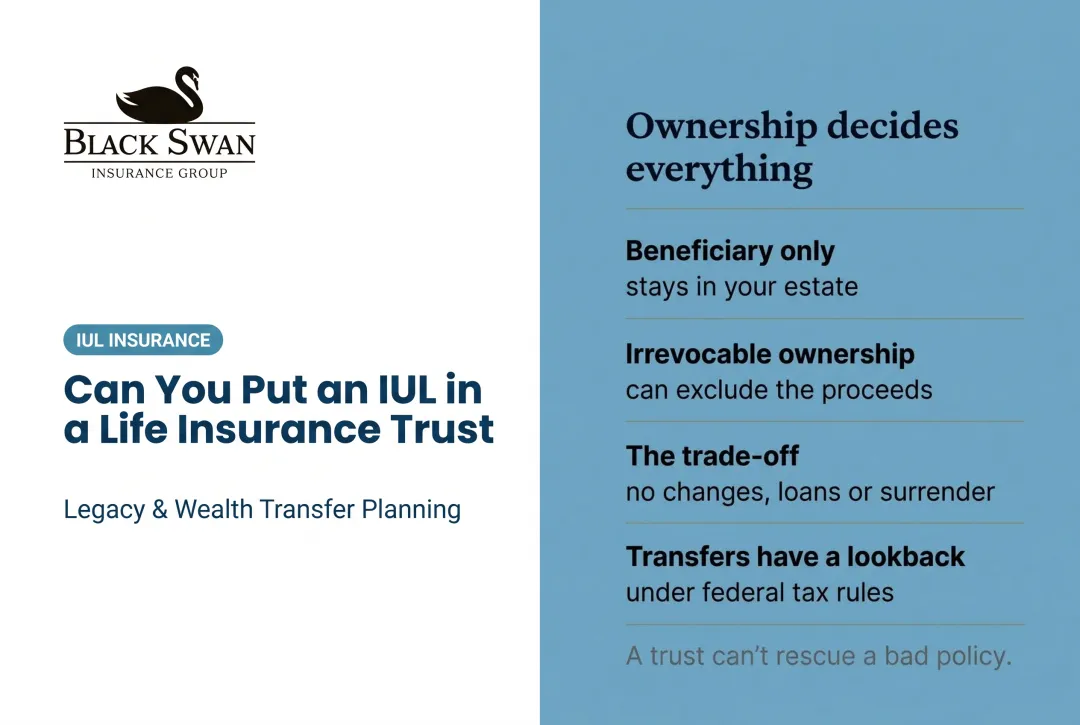
What people underestimate is the price. Once the trust owns the policy, you cannot borrow against the cash value, change the beneficiary, or treat it as a personal asset. Irrevocable means irrevocable. The control you give up is not a formality — it is the mechanism.
Plenty of families also assume that naming a trust as beneficiary achieves the same thing. It does not. If you still hold what the IRS calls an incident of ownership, the proceeds can be pulled back into your estate regardless of whose name is on the beneficiary line.
The short answer: An ILIT is an irrevocable trust that owns and is beneficiary of one or more policies. Structured correctly, proceeds may stay outside your taxable estate — but only if you retain no incidents of ownership and the trust is administered properly. Transferring an existing policy triggers a three-year lookback under IRC § 2035, which is why attorneys often recommend the trust buy a new policy from inception. You permanently give up cash-value access, policy loans and the ability to change anything. This needs an estate attorney and a tax professional, not an article.
Key Takeaways
- An ILIT is an irrevocable trust that typically owns and is the beneficiary of one or more life insurance policies
- Proper structuring may keep proceeds outside your taxable estate, subject to current federal and state law
- The trust can fund estate expenses, business succession or inheritance equalisation under defined terms
- You give up direct control permanently — cash-value access, policy loans and the ability to change the policy
- Coordinate with an estate attorney, tax professional, trustee and insurance professional before creating or funding one
Why the Trust Has to Own It
Irrevocable means the trust generally cannot be changed or cancelled once created. Life insurance is the asset it holds. Trust is the legal arrangement — a separate entity owning property for named beneficiaries.
The reason the trust and not you owns the policy comes down to control. Under IRS rules, retaining an incident of ownership pulls proceeds back into your taxable estate even when a trust is named as beneficiary.
Incidents of ownership include the power to change a beneficiary, borrow against the policy, or cancel it. The IRS regulation governing life insurance proceeds makes clear that estate inclusion turns on retained control, not on the paperwork.
Three Roles
- Grantor — creates the trust and contributes funds, usually as gifts, to cover premiums
- Trustee — administers the trust: pays premiums, handles contributions, communicates with beneficiaries, and follows the document exactly
- Beneficiaries — receive trust benefits according to its terms, usually after the insured's death
The insured is typically the grantor. The trustee owns the policy on paper. The beneficiaries receive what the trust terms direct.
When the insured dies, the death benefit is generally paid to the ILIT rather than the estate. The trustee then distributes or holds those funds according to the trust document — not according to a will, and outside probate.
How It Runs
Route One: A New Policy
- An estate-planning attorney drafts the trust document
- An independent trustee accepts the appointment, rarely the insured
- The trustee applies for and owns the policy from day one
- The grantor contributes funds, and the trustee pays premiums from those contributions

Route Two: Transferring an Existing Policy
This is where people get tripped up. Naming a trust as beneficiary on a policy you still personally own is not a transfer. A real transfer makes the ILIT the legal owner, and you relinquish every incident of ownership.
The three-year rule. Transfer an existing policy and die within three years and the proceeds may still be pulled into your taxable estate. That comes from IRC Section 2035, covering transfers of property or retained powers within three years of death.
A newly purchased policy owned by the trust from inception avoids this entirely, which is why attorneys frequently recommend starting fresh rather than moving an old contract.
Annual Contributions
- The grantor gifts funds to the trust
- The trustee notifies beneficiaries of any withdrawal rights
- After the required waiting period, the trustee pays the premium from trust funds — never directly from grantor to insurer
After death, the trustee collects the death benefit, follows the distribution terms, and may lend money to the estate or purchase illiquid assets from it, such as a family business interest, depending on the drafting.
A worked situation: a business owner whose company is most of their net worth. Selling shares quickly to cover estate costs could gut the business. An ILIT holding a policy on the owner's life gives the trustee cash to lend to the estate or buy business assets, keeping the company intact for the next generation.
The unthinkable is only unthinkable until it happens. Estate liquidity is a fire drill you run on paper, once, so nobody has to sell a company in a hurry.
What the Critics Get Right
Scepticism about ILITs — and about permanent insurance inside them — is worth meeting directly.
Critics are right that the estate-tax exemption is high enough that most households will never need one, and that the strategy gets recommended to people whose estates are nowhere near the threshold. They are right that the ongoing costs are real: attorney fees, trustee fees, annual notices, tax filings, and a premium that has to be funded reliably for decades. And they are right that irrevocability is frequently glossed over at the sale and discovered later, at the worst moment.
Where the criticism stops short is the liquidity problem. A family whose wealth sits in a company, a farm or real estate has an estate-cost problem regardless of exemption levels, because the assets cannot be sold quickly without destroying their value. For them the ILIT is not a tax dodge. It is the thing that prevents a forced sale.
Where It Helps, and Where It Does Not
Genuine uses:
- Estate liquidity — covering estate taxes, debts, administration costs or equalisation without a rushed sale
- Distribution control — setting when and how beneficiaries receive funds, useful for minors or anyone needing structured support
- Creditor and divorce limits — trust language, timing and state law may shield assets from a beneficiary's creditors or a divorcing spouse, though never guaranteed
- Inheritance equalisation — balancing outcomes when one heir receives a business or farm and another does not
For a special-needs beneficiary, a supplemental-needs structure inside or alongside the ILIT may help protect means-tested benefit eligibility. The Social Security Administration's guidance on trusts notes an irrevocable trust that can pay a beneficiary may still count as an SSI resource unless a specific exception applies. That is specialist work, not an add-on.
An ILIT is not the only option. Personally owned insurance, a revocable trust or spousal ownership each serve different objectives. The structure should follow the plan rather than habit.

What Kind of Policy Goes Inside
Where the need genuinely ends — a mortgage, a term of years until a business sells — term insurance inside the trust is cheaper and entirely legitimate. Where the need is permanent, which is the usual reason an ILIT exists at all, permanent coverage such as indexed universal life is common. That is life insurance first, and any potential tax-advantaged features are conditional on the policy being properly structured, funded and managed for the whole life of the trust. A policy that lapses in year fourteen defeats the entire arrangement.
The Ultimate IUL Blueprint
If permanent coverage is going inside the trust, the Blueprint covers the design decisions that determine whether it survives long enough to do its job: funding levels, the MEC line, loan provisions and what to demand from an illustration.
What You Are Giving Up
Once the trust is funded you generally lose the ability to revoke the trust, change beneficiaries, access cash value or take a policy loan, or alter policy terms as if you still owned it.
That loss of control is the single most underestimated part of this decision.
The ongoing costs: attorney fees for drafting and continuing guidance; trustee fees; premiums funded reliably over decades; and recordkeeping, beneficiary notices and tax filings where applicable.
Underfunding is a real risk. Illustrations are not guarantees, and a lapsed policy defeats the strategy entirely. Review premium requirements and guarantees regularly, not just at setup.
Who This Fits
Stronger Fit
- An estate large enough, or growing fast enough, that liquidity at death is a genuine problem
- Household income of $150K+ with the cash flow to fund premiums reliably for decades
- Wealth concentrated in illiquid assets — a company, a practice, a farm, real estate
- A clear estate-planning objective the trust actually solves
- Comfort with giving up control permanently, understood rather than glossed over
- Willingness to administer it properly, every year
Weaker Fit
Not everyone should buy an IUL, and fewer still need an ILIT. Below the federal exemption, the trust adds cost and irrevocability for no tax benefit.
- Insufficient cash flow to fund premiums reliably over time
- Uncertain insurability or health changes affecting coverage
- A genuine need for personal access to policy cash value — an ILIT removes that permanently
- No clear estate-planning objective the trust would solve
- Discomfort with irrevocability, which is not a problem to be talked out of
- An estate comfortably below the exemption with no liquidity concentration
An ILIT is not automatically right because someone owns life insurance or earns well. Estate size, projected growth, state law, liquidity needs, insurability and family dynamics all decide it.
Setting It Up and Keeping It Alive
The team: an estate-planning attorney to draft and structure; a tax professional for gift- and estate-tax implications; a trustee to administer, usually not the insured since that reintroduces retained control; and an insurance professional to design and review the policy over time.
Funding and Crummey Notices
Premium contributions are generally treated as gifts to the beneficiaries. The federal annual gift-tax exclusion is $19,000 per donee for both 2025 and 2026. The basic estate-tax exclusion is $13,990,000 for 2025, rising to $15,000,000 in 2026. These change, so confirm current thresholds before relying on them.
To qualify contributions for the annual exclusion, trustees commonly send a Crummey notice — a letter describing a temporary right to withdraw the contributed funds, typically over 30 to 60 days. It does not automatically guarantee exclusion treatment; it is a documentation practice that supports it when done correctly and consistently.

Annual administration: confirm premiums were paid and the policy remains in force; document each contribution and send the required notices; maintain records of trustee actions and beneficiary acknowledgments; file any required returns; review trustee performance and policy statements.
Review the whole arrangement whenever tax law shifts, family circumstances change, or policy performance drifts. What worked at setup may need adjusting a decade later.
Bring to the first meeting: policy documents, current ownership and beneficiary details, a rough estate inventory, your premium budget, family objectives, and questions about exactly what you are giving up.
Risks to Understand Before You Create One
- Irrevocability is permanent. No cash-value access, no policy loans, no beneficiary changes
- The three-year rule under IRC § 2035 can pull a transferred policy back into the estate
- Retained incidents of ownership defeat the whole structure, and they are easy to create accidentally
- Underfunding causes lapse, and a lapsed policy inside an ILIT wastes the trust, the fees and the premiums
- Crummey notices must be sent consistently and documented, or the annual exclusion treatment may not hold
- Naming yourself trustee can reintroduce control and undo the planning
- Cost of insurance rises with age inside permanent policies and is charged in flat crediting years
- Exemption amounts and tax law change, and a structure built for this year's rules may need revisiting
- Creditor and divorce protection is never guaranteed — it depends on drafting, timing and state law
Find Out Where You Actually Stand
This starts with the Tax-Free Wealth Blueprint Fit Review. If you earn $150K+ and your wealth is concentrated in something illiquid, we size the actual liquidity gap, model what the premium has to be and whether it is sustainable for decades, and compare term against permanent coverage for the job. If it does not fit, we will tell you that too. Your attorney drafts the trust and your tax professional confirms the treatment; we make sure the policy inside it survives.
Frequently Asked Questions
Can I put an existing policy into an ILIT?
Yes, but the transfer triggers the three-year lookback under IRC § 2035, and you must relinquish every incident of ownership. Many attorneys prefer the trust to buy a new policy from inception for exactly that reason.
Is there a five-year rule?
No. The federal rule for transferring an existing policy into an ILIT is the three-year rule under IRC § 2035. A five-year rule generally relates to different contexts such as Medicaid planning. Confirm which applies with an attorney.
Who pays the premiums?
The trustee, using funds the grantor contributes or gifts to the trust. Beneficiary withdrawal notices and gift-tax coordination are handled alongside each contribution. The grantor should never pay the insurer directly.
What are the disadvantages?
Permanent loss of control and cash-value access, real setup and administration costs, largely fixed terms, and an ongoing obligation to monitor funding and policy performance for decades.
Is an ILIT right for everyone?
No, and most households do not need one. Suitability depends on estate size and growth, tax exposure, liquidity concentration, family goals, insurability and premium affordability — plus genuine willingness to give up control.
Could term insurance go in the trust instead?
Yes, and where the need has a defined end date it is often the better answer. Permanent coverage belongs inside an ILIT when the liquidity need is genuinely permanent.
Sources
- 26 CFR § 20.2042-1 — Proceeds of life insurance
- 26 U.S.C. § 2035 — Adjustments for certain gifts made within 3 years of death
- IRS — What's new: estate and gift tax
- Social Security Administration — Trusts and SSI
- NAIC — Life Insurance
Disclosure: This article is educational and is not personal tax, legal or investment advice. Trusts are legal instruments requiring an estate-planning attorney, and gift- and estate-tax treatment requires a qualified tax professional. Indexed universal life is life insurance first. Actual results depend on policy design, carrier, crediting options, caps, participation rates, expenses, funding and ongoing management. Exemption amounts and tax rules change. This strategy is not appropriate for everyone. Policy loans and withdrawals reduce cash value and the death benefit, and can create tax consequences if the policy lapses or becomes a modified endowment contract. Illustrated values are not guarantees; actual results depend on policy terms, crediting, costs and funding. Consult your own tax, legal and financial professionals for advice specific to your situation.
And remember, it's not what you earn, it's what you keep… enjoy the ride.