By Robert Balgac, Founder, Black Swan Insurance Group | October 9, 2026
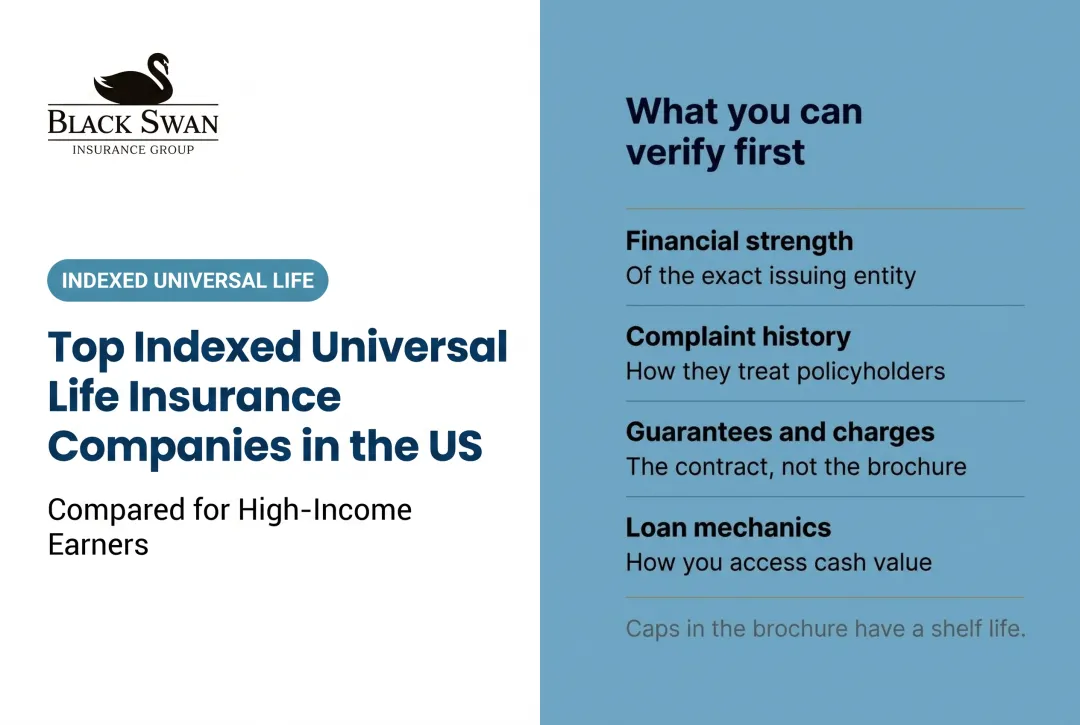
"Top rated" sounds like it settles the question. It does not, and understanding why is the most valuable thing you can take from this page. A financial-strength rating answers exactly one question: how likely is this insurer to be able to pay claims decades from now? It says nothing about whether the policy design in front of you is funded sustainably, priced fairly, or matched to what you actually need.
That distinction matters most for the reader this is written for: a $150K+ earner who has maxed the 401(k), hit the Roth phase-out, and is now being shown an A+ carrier as though the letter grade were the analysis. It is not. Ratings matter. So do caps, participation rates, loan provisions, underwriting and your own cash-flow reality. Get any of those wrong and even a top-rated carrier produces a disappointing outcome.
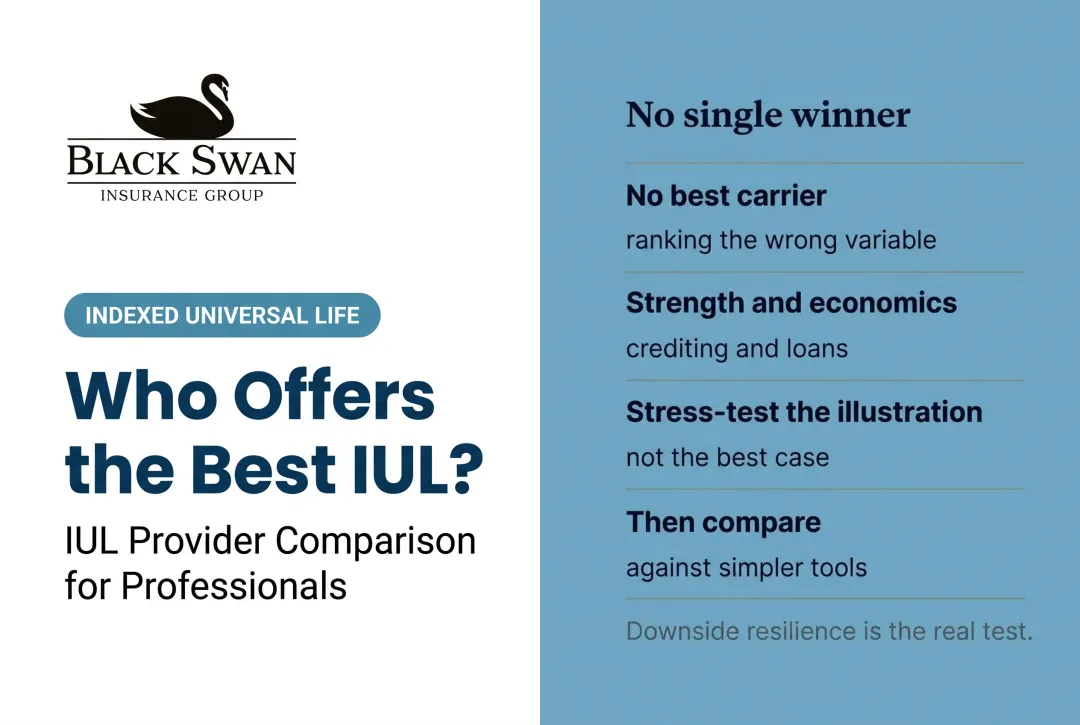
The short answer: A rating is a solvency opinion, not a suitability opinion, and the two get deliberately conflated in marketing. No one can rank IUL companies by future policy performance, because caps, participation rates and cost of insurance are mostly non-guaranteed and set by the carrier after you buy. Use ratings to screen out weakness, then do the actual work on guarantees, charges and loan mechanics.
Key Takeaways
- "Top rated" should combine financial-strength ratings, complaint data, product features, cost and underwriting — not marketing claims
- IUL cash value is credited based on an index, not invested in it; floors, caps and fees drive the real result
- Current caps and illustrated values are not guaranteed for the life of the policy
- Pacific Life, Nationwide, Allianz, Protective and Lincoln Financial each suit different goals; research all five
- Compare multiple illustrations with a licensed professional before funding anything
What a Rating Actually Measures
Indexed universal life is permanent coverage. It pays a death benefit for as long as the policy stays in force, with flexible premiums and a cash-value account that can earn interest tied partly to an external index such as the S&P 500.
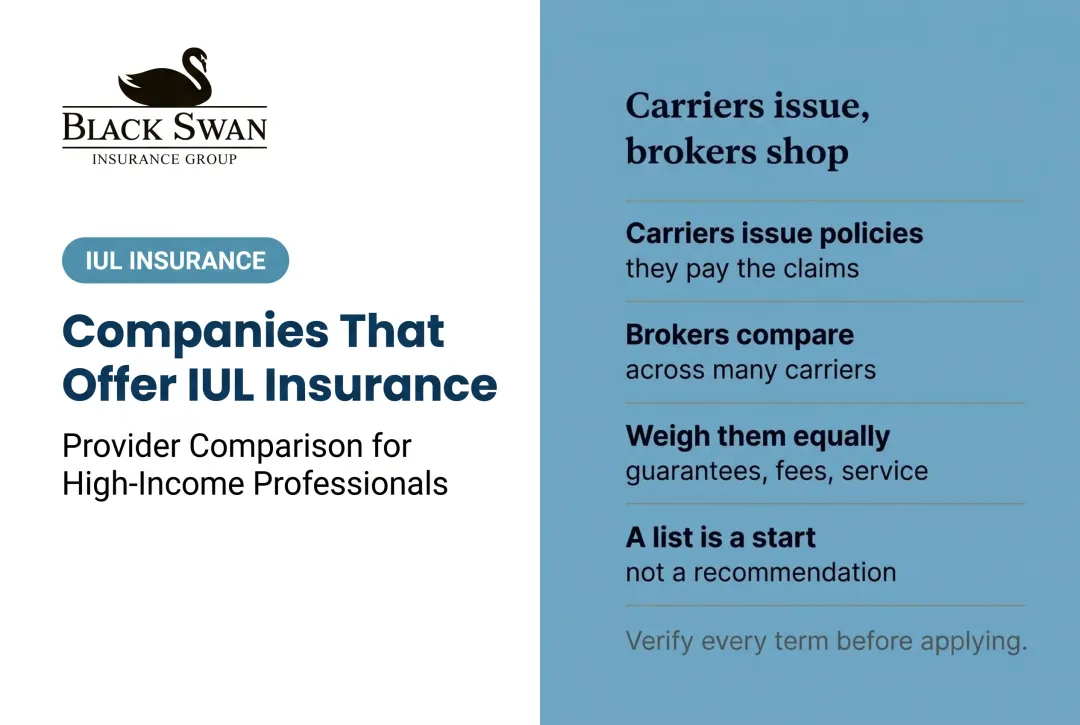
The carrier issues the contract, sets its costs and pays claims. A broker or agent shops multiple carriers and helps structure the policy. Black Swan Insurance Group works in that second role — screening carrier options against each client's funding capacity and goals. We do not issue policies and we cannot guarantee anything a carrier does.
Core mechanics worth understanding before you compare anyone:
- Floor — the minimum index credit, often 0%, protecting against negative index years
- Cap — the maximum rate the policy will credit in a strong index year
- Participation rate — the percentage of index gain used in the crediting formula
- Cost of insurance, admin charges and rider costs — ongoing deductions that reduce cash value regardless of index performance
- Surrender charges — fees for early withdrawal or cancellation, typically declining over 10–19 years
The National Association of Insurance Commissioners requires every basic life illustration to separate guaranteed values from non-guaranteed, illustrated ones. That requirement exists because the two columns routinely tell different stories, and only one of them binds the carrier.
Zero is your hero in a down year — but the floor applies to the credit, not to the charges.
IUL draws interest from high-income professionals, business owners and families wanting permanent protection plus tax-diversified retirement planning or an estate tool. It is a poor fit for anyone with tight cash flow, a short horizon, no ongoing need for permanent coverage, or a preference for simpler guaranteed products.

The Ultimate IUL Blueprint
Before you let a letter grade stand in for analysis, the Blueprint covers what the design itself has to survive: funding levels, caps and charges, the MEC line, loan timing, and what to demand from an illustration.
Five Carriers, Compared by Objective
Compared on financial strength, product breadth, underwriting flexibility, living benefits, loan provisions, cost and fit for specific goals. The ordering is editorial and goal-based, not an official industry ranking.
| Carrier | AM Best Rating | Best Potential Fit |
|---|---|---|
| Pacific Life | A+ | Early cash value, high coverage, multiple index strategies |
| Nationwide | A+ | Multi-index strategies, mutual-affiliated structure, overloan protection |
| Allianz Life | A+ | Active accumulation, index-lock management |
| Protective | A+ | Historical cost efficiency (confirm current product availability) |
| Lincoln Financial | A | Estate planning, survivorship, legacy protection |
Pacific Life
Pacific Life Insurance Company carries A+ (AM Best), AA− (S&P), Aa3 (Moody's) and AA− (Fitch).
Flagship Horizon IUL 2 offers eight indexed-account choices — one-year, multiyear and volatility-control strategies — plus a fixed account. Issue ages run 0 to 90, and a survivorship version covers two lives.
Strengths: wide range of indexed-account options; optional chronic-illness and long-term-care riders; an age-90 no-lapse guarantee rider (a death-benefit guarantee, not a cash-value guarantee).
Trade-offs: the no-lapse rider requires specified premium funding — skip a payment and the guarantee can terminate. Alternative loan provisions carry more volatile net costs than standard loans. Full underwriting is typically agent-assisted and takes several weeks.
Request in the illustration: guaranteed values alongside current assumptions, the specific no-lapse funding requirement, and a loan-cost comparison between standard and alternative loans.
Nationwide
Nationwide Life Insurance Company holds A+ (AM Best), A+ (S&P) and A1 (Moody's). The broader enterprise operates under a mutual structure.
Indexed UL Accumulator III offers S&P 500, Nasdaq-100, Multi-Index and BNPP Global H-Factor crediting strategies, with issue ages reaching into the mid-80s depending on class.
Strengths: four distinct crediting strategies; Overloan Lapse Protection Rider II; LTC Rider II plus chronic-, critical- and terminal-illness benefits.
Trade-offs: the initial base death-benefit guarantee shrinks sharply with issue age — 20 years for ages 0–55, down to 5 years for ages 70+. Rider costs and policy charges reduce cash value independent of index performance. Current crediting rates are not guaranteed at renewal.

Ask directly: how long does the guaranteed death-benefit period actually last at your issue age? For a 70-year-old, five years is a materially different product than the brochure implies.
Allianz Life
Allianz Life Insurance Company of North America holds A+ (AM Best), AA (S&P) and Aa3 (Moody's) — among the stronger marks here.
The Allianz Life Accumulator IUL, issue ages 0–80, centres on crediting flexibility. Index Lock lets you lock a positive index gain mid-crediting-period, and Auto Lock can trigger at a preset target.
Strengths: Index Lock and Auto Lock; multiple allocation choices including bonus-multiplier accounts; an indexed loan option where borrowed value can still receive index credits.
Trade-offs: bonus multipliers often carry an added annual asset charge — for example, a 1% charge on the Select allocation. Indexed-loan credits are not guaranteed to exceed the loan charge, which is the scenario that quietly breaks retirement-income plans. Buyers who cannot sustain planned premiums, or who do not understand loan mechanics, face real lapse risk.
Protective
Protective Life Insurance Company carries A+ (AM Best), AA− (S&P), Aa3 (Moody's) and AA− (Fitch).
Protective's transition notice confirms Indexed Choice UL stopped accepting new applications effective March 9, 2026. Older marketing pages still circulate; they do not override the closure. If you are researching Protective for a new purchase, confirm directly which indexed product, if any, is currently open for new business.
This is the single best illustration of why a rating is not an answer. Protective's financial strength is excellent and entirely unchanged. The product you would have bought no longer exists. Those two facts sit comfortably together, and a list that ranks only on ratings cannot tell you the second one.
Historical Indexed Choice UL terms remain useful context: juvenile issue ages 0–17, adult maximum issue ages of 75 or 80, a 0% crediting floor, and a surrender schedule declining over 19 years.
Strengths (prior product generation): competitive administrative charge structure; flexible death-benefit options; guarantee provisions on qualifying designs.
Trade-offs: product availability is actively changing — do not assume last year's research still applies. Stress-test any live illustration at lower crediting, reduced premiums, added loans and extended distributions.
Lincoln Financial
The Lincoln National Life Insurance Company holds A (AM Best), A+ (S&P), A2 (Moody's) and A+ (Fitch).
The lineup includes WealthProtector IUL, WealthAccelerate IUL, WealthBuilder IUL, WealthBuilder ECV IUL and WealthPreserve 2 Survivorship IUL. WealthProtector launched in 2026 with an optional Extended No-Lapse Rider II customisable up to age 100; it is not currently available in New York or California.
Strengths: a survivorship option built for two-life legacy planning; an extended no-lapse guarantee customisable to age 100 on WealthProtector; enhanced chronic- and terminal-illness riders.
Trade-offs: a policy built for legacy protection is not designed like one built for cash accumulation — do not compare them head to head. Rider and product availability vary by state. Issue-age limits are not uniformly published across the lineup, so confirm for your age and health class. Ask your estate-planning attorney how survivorship coverage interacts with the rest of your plan.
What the Critics Get Right
The fairest criticism of a "top rated" roundup is that the rating is doing rhetorical work it cannot support. A+ means the agency believes the company will be solvent. It does not mean the contract is good value, the caps are competitive, the charges are reasonable, or the premium you were quoted is one you can sustain. Pairing an A+ insurer with a design wrong for your funding capacity is a complete loss on both counts, and it happens constantly.
The second fair criticism: these lists are written by parties compensated when you buy. We are a brokerage. We are paid when a policy is placed, and we will tell you how much before anything is funded.
The third: agency scales are not interchangeable. Lincoln's "A" from AM Best and "A+" from S&P are not contradictory readings — they are different scales, and reading them as a single ranking is a category error.
A great IUL is engineered. A bad IUL is sold.
How These Were Assessed
Not from sales volume, and not from a single attractive cap rate.
- Financial strength and claims-paying ability. Current ratings from AM Best, S&P, Moody's and Fitch for each legal entity issuing the policy, not the parent holding company — a distinction that matters, because several of these products are issued through subsidiaries. AM Best's rating guide defines A+/A++ as "Superior" and A/A− as "Excellent"; grades are not interchangeable across agencies.
- Product design and guarantees. Guaranteed premiums, guaranteed death benefits, no-lapse provisions and contractual loan rates, separated from anything labelled "current" or "illustrated."
- Crediting and cost structure. Caps, participation rates, spreads, floors, cost of insurance, admin charges, rider costs and surrender schedules — all of which shape how much cash value actually builds, and most of which can change.
- Suitability and stress testing. Identical assumptions across carriers: same age, health class, death benefit, premium and funding period. Then test lower credited rates, reduced funding, added loans and early withdrawals.
- Customer and service evidence. NAIC complaint indexes, underwriting experience and the quality of in-force policy reviews. Ratings do not capture service.
An illustration is a model, not a guarantee.

Stronger Fit
- Earning $150K+ with surplus cash flow after reserves, debt and maxed retirement contributions
- A genuine permanent protection, business or estate-transfer need
- Insurable at a rate class that makes the design economic
- A long funding horizon and willingness to review annually
Weaker Fit
Not everyone should buy one. Step back if cash flow is tight, the horizon is short, there is no ongoing need for permanent coverage, or you would simply prefer guaranteed products — term insurance or whole life may serve you better and more cheaply.
Risks to Understand Before You Rely on a Rating
- A rating is a solvency opinion, not a statement about caps, charges or suitability
- Ratings apply to a specific legal entity — confirm it is the one issuing your contract
- Products get withdrawn, as Protective's March 2026 closure shows, regardless of carrier strength
- No-lapse guarantees are conditional on a funding schedule you must actually maintain
- Caps and participation rates are non-guaranteed and can be reduced after issue
- MEC status is generally permanent and changes how loans and withdrawals are taxed
- Lapsing with a loan outstanding can create taxable income with no cash received
A reputable, highly rated carrier can still produce a disappointing policy if it is overfunded, underfunded, priced too high, borrowed against aggressively, or mismatched to your horizon. Carrier strength is necessary. Design and funding decide the outcome.
This is not set-it-and-forget-it. It is design-it, fund-it, review-it.
Find Out Where You Actually Stand
This starts with the Tax-Free Wealth Blueprint Fit Review. If you earn $150K+ and are comparing top-rated carriers, we verify the rating of the exact issuing entity, compare at least two or three carriers under identical assumptions, read guaranteed and non-guaranteed values separately, check loan provisions, MEC headroom and lapse risk under conservative scenarios, and weigh the result against term insurance, qualified plans, Roth strategies and brokerage accounts. As a brokerage rather than a carrier, we issue none of the policies above. We explain compensation before anything is funded, and we will tell you to loop in your CPA or attorney when the plan warrants it. If IUL does not fit, we will tell you that too.
Frequently Asked Questions
What are the top rated life insurance companies?
"Top rated" for IUL depends on your goal, not a marketing list. Compare independent financial-strength ratings from AM Best, S&P, Moody's and Fitch, alongside NAIC complaint data, product features, costs and underwriting — and check the ratings for the entity actually issuing the contract.
Does a high rating mean the policy is a good deal?
No. A rating is an opinion on the insurer's ability to pay claims. It says nothing about caps, cost of insurance, surrender charges or whether the premium suits your cash flow. Those are separate questions and they decide your outcome.
What will life insurance not pay out for?
Common exclusions include suicide during the contestability period, typically the first two years; material misrepresentation on the application; causes specifically excluded in the contract; and policy lapse from insufficient premium. Review your own policy language.
How much does a $100,000 life insurance policy cost a month?
It depends on age, health, tobacco use, policy type, term length, underwriting class, riders and state. A $100,000 death benefit alone does not set the price. Term coverage is typically far cheaper than permanent coverage like IUL, which needs an individualised underwriting quote.
Why do agencies give the same company different grades?
Because the scales differ. An "A" from one agency and an "A+" from another can describe similar views of the same insurer. Read each grade against that agency's own definitions rather than lining the letters up side by side.
How often should ratings be rechecked?
At each annual policy review, and before any new application. Affirmations and downgrades happen, and a rating cited in a brochure may be several years old.
Sources
- NAIC — Life insurance illustrations
- Protective — Indexed Choice UL transition notice
- AM Best — Guide to best's credit ratings
Disclosure: This article is educational and is not personal tax, legal or investment advice. Indexed universal life is life insurance first. Black Swan Insurance Group is an insurance brokerage and does not issue or guarantee any policy. Carrier products, riders, caps, participation rates, ratings and state availability change frequently — products may be withdrawn from sale — and must be confirmed against current carrier materials before applying; ratings reflect an insurer's claims-paying ability, not the suitability of any contract. Illustrated values are not guarantees; actual results depend on policy terms, crediting, costs and funding. Any potential tax-advantaged access depends on the policy being properly structured, funded and managed. Actual results depend on policy design, carrier, crediting options, caps, participation rates, expenses, funding and ongoing management. This strategy is not appropriate for everyone. Policy loans and withdrawals reduce cash value and the death benefit, and can create tax consequences if the policy lapses or becomes a modified endowment contract. Consult your own tax, legal and financial professionals for advice specific to your situation.
And remember, it's not what you earn, it's what you keep… enjoy the ride.