By Robert Balgac, Founder, Black Swan Insurance Group | October 5, 2026
There is a specific moment that sends high earners looking at indexed universal life, and it is almost always the same one: you go to fund the Roth IRA and discover your income has phased you out of it.
That is a real problem, and the frustration is legitimate. You are paying the most tax you have ever paid, and the one account that would have given you a tax-free bucket in retirement just closed. So the search begins, and an IUL turns up wearing the words "tax-free retirement."
Slow down. A Roth IRA and an IUL are not two versions of the same product. One is a retirement investment account funded with after-tax dollars. The other is permanent life insurance with a cash-value component. Only one of them charges you a cost of insurance every month.
The short answer: For anyone eligible, the Roth IRA is the more direct, cheaper and simpler path — and if you can still contribute, contribute. An IUL is life insurance first and only earns consideration when a genuine permanent death-benefit need exists, core accounts are funded, and surplus cash flow is stable enough to sustain premiums for 15 years or more. Being phased out of a Roth is a reason to look at the alternatives, including a backdoor Roth and a taxable brokerage account. It is not, by itself, a reason to buy a policy.
Key Takeaways
- A Roth IRA is for retirement investing; an IUL is life insurance first, and should only be evaluated with a real permanent coverage need
- An IUL trades some market upside for crediting protection, insurance costs and lapse risk; a Roth keeps full upside and far simpler administration
- IRS limits, phase-outs and withdrawal rules change annually — verify against irs.gov before deciding anything
- A policy deserves a look only after core retirement accounts are funded and surplus cash flow is stable
- Neither wins by default. Compare net costs, funding sustainability and beneficiary goals side by side
Where They Actually Differ
| Feature | Indexed universal life | Roth IRA |
|---|---|---|
| Primary purpose | Permanent life insurance with cash value | Tax-advantaged retirement investing |
| Funding limit | No IRS cap; limited by underwriting and MEC rules | $7,500 for 2026 ($8,600 if 50+) |
| Income restrictions | None | Phases out at $153,000–$168,000 single, $242,000–$252,000 married filing jointly for 2026 |
| Growth mechanism | Index-linked crediting with floors and caps | Direct market investment performance |
| Downside protection | A floor, typically 0%, on the credit | None; market losses are real |
| Access to funds | Loans and withdrawals against cash value | Contributions any time; earnings have rules |
| Costs | Cost of insurance, admin fees, surrender charges | Fund expenses, possible advisory fees |
| Death benefit | Yes, generally income-tax-free | None |
Contributions and Eligibility
An IUL has no IRS contribution ceiling. Funding is shaped instead by underwriting approval and health classification, the premium you can sustain long term, and modified endowment contract limits capping how much you can overfund before the favourable tax treatment goes away.
A Roth works the opposite way. For 2026 the IRS set the annual contribution limit at $7,500 with a $1,100 catch-up at 50 and over. High earners above the MAGI phase-out cannot contribute directly at all — which is precisely why they start looking elsewhere.
Before looking at insurance, look at the backdoor Roth. A non-deductible traditional IRA contribution converted to a Roth is a well-established route for high earners, and the pro-rata rule is the thing to discuss with your CPA. It costs nothing in insurance charges.
Growth, Risk and Access
IUL crediting depends on floors, caps, participation rates and spreads. The index's performance is not what lands in your cash value. A 0% floor means index losses do not directly reduce the account — the charges still apply regardless of market direction.
Roth growth is straightforward. Whatever your investments do, your account does. No caps, no floors, full exposure both ways.
IUL policy loans are generally not taxed while the policy stays in force. Unpaid loans plus interest reduce the death benefit, and a lapse with a loan outstanding and gain in the contract can create a tax bill with no cash received to pay it.
Roth contributions, though not earnings, can be withdrawn any time tax- and penalty-free. Earnings need to clear the five-year rule and generally require age 59½, per IRS Publication 590-B.

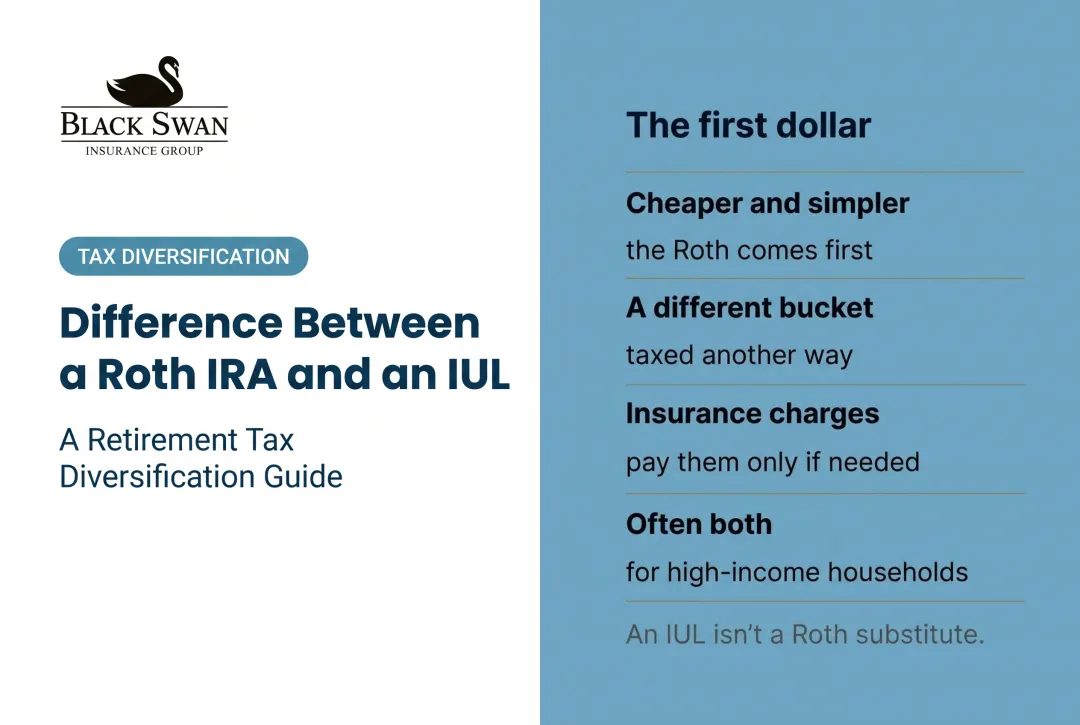
Tax-deferred is not tax-free, and neither is potentially tax-advantaged. The Roth actually is tax-free on qualified withdrawals, which is why it should be exhausted first wherever it is available.
What an IUL Actually Is
Permanent life insurance combining lifelong death-benefit coverage with a cash-value account credited on an index-linked formula, often referencing the S&P 500. Your money is not invested in that index; the insurer applies a formula.
Premium splits among the cost of insurance, policy expenses and the cash-value bucket. Index performance is not your policy's return. A strong index year does not automatically produce a strong crediting year once caps and spreads apply.
- Floor — usually 0%, so a losing index year does not reduce cash value from index performance directly
- Cap — the maximum credited rate for a segment, however high the index climbs
- Participation rate — the percentage of index gain used in the formula
- Spread — a portion of index growth subtracted before crediting
Request the insurer's current illustration and read the contract. Caps, participation rates and spreads vary by carrier and can change over the life of the policy.
What it offers: permanent protection when properly structured, funded and managed; crediting with a floor against direct index losses; premium and death-benefit flexibility within contract limits; access to cash value through loans or withdrawals.
What it costs: higher charges in the early years; surrender schedules that can run a decade or more; non-guaranteed assumptions that shift; underwriting requirements; lapse risk if funding falls short.
Nationwide's current IUL products, for example, list premium charges around 8–12% in year one and surrender schedules running 10 to 15 years.

What a Roth IRA Actually Is
A retirement account funded with after-tax dollars. Because the tax is already paid, qualified withdrawals in retirement come out tax-free under current rules.
- 2026 limit: $7,500 ($8,600 with catch-up at 50+)
- Income phase-outs by filing status and MAGI
- Earned income required
- High earners shut out of direct contributions may use a backdoor Roth — talk to a tax professional about the pro-rata rule first
Investment flexibility is broad: stocks, bonds, mutual funds, ETFs, depending on custodian. Gains and losses track what you chose, with no insurance formula in between.
Advantages: simple structure, transparent costs, no cap on performance, contributions withdrawable any time, and no required minimum distributions during your lifetime under current law.
Limitations: contribution ceilings and income limits, full market exposure including the downside, no death benefit, and early earnings withdrawals that can trigger tax and penalty before the five-year rule and 59½, with limited exceptions.
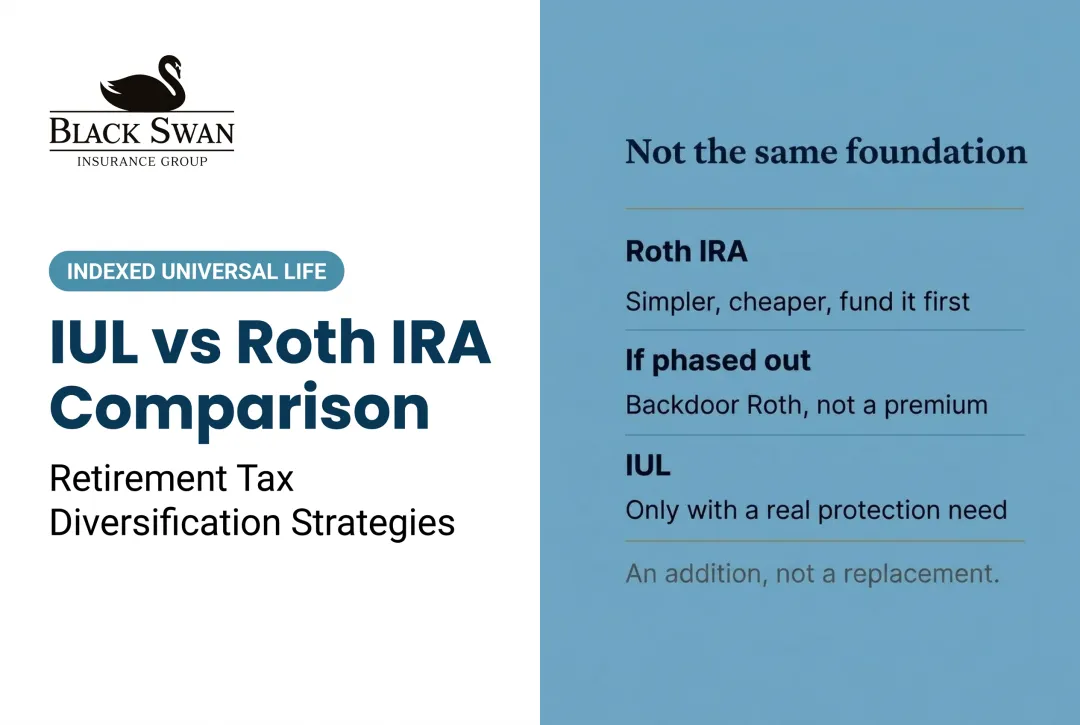
A Roth is not a substitute for life insurance you actually need. An IUL is not a substitute for a Roth you are still eligible to fund.
What the Critics Get Right
The objection to putting these two side by side at all is a fair one.
Critics are right that comparing an insurance contract to a retirement account invites a category error, and that most content doing this comparison exists to sell the policy. They are right that a Roth's transparent, uncapped, low-cost structure beats a capped and charge-laden alternative on pure accumulation, and that it is not close. And they are right that "too much income for Roth" is usually best answered by a backdoor Roth and a brokerage account, not by underwriting.
Where the comparison earns its place is for the household that has already done all of that — backdoor Roth funded, 401(k) maxed, brokerage account running — and also has a permanent protection need sitting unaddressed. At that point the question is no longer which is better. It is what the remaining dollars should do, and whether the protection need gets solved with term or with something permanent.
Which One Comes First for You
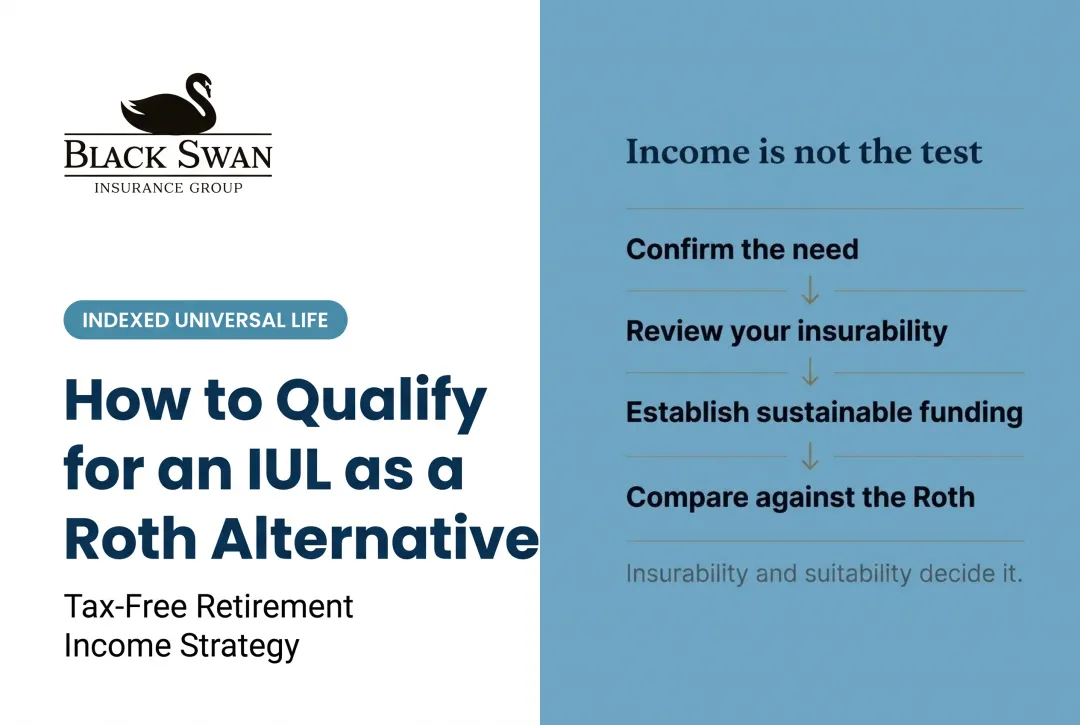
Start with purpose, not projected returns. Is the core need retirement investing, permanent life insurance, tax diversification, or a combination?
Stronger Fit for Prioritising the Roth
- You are eligible to contribute and have not maxed the limit
- You want a simple, low-cost account with full market participation
- No documented permanent life insurance need
- Surplus cash flow is limited, or the money may be needed sooner
- You have not yet explored a backdoor Roth
Stronger Fit for Evaluating an IUL
- A genuine, documented permanent death-benefit need, and you are medically insurable
- Household income of $150K+ and premiums sustainable through a job change, downturn or business slowdown
- Employer matching and core accounts already maxed
- Legacy planning and crediting protection matter more than uncapped upside
- Willingness to review the contract annually for decades
Weaker Fit for an IUL Right Now
Not everyone should buy an IUL. If a backdoor Roth is still available to you, use it first — it is cheaper and simpler.
- Low-cost retirement investing is the actual goal
- Money may be needed within the next several years
- Income is unstable, or reserves are thin
- The real need is cheap temporary coverage — term insurance is the direct answer and there is no reason to dress it up
- Nobody has documented the permanent need in writing
A June 2026 Morningstar analysis notes advisers generally see IUL as suitable for a fairly narrow group: high-income households with a permanent insurance need, maxed retirement accounts and the ability to fund aggressively for 15 years or more. The death benefit should be the reason to buy, with tax treatment secondary — not the reverse.
The Ultimate IUL Blueprint
If you have exhausted the Roth routes and a permanent need genuinely exists, the Blueprint covers what a defensible design requires: funding levels, the MEC line, loan timing and what to demand from an illustration.
Three Households, Three Answers
- Eligible saver, modest cash flow. No permanent insurance need, limited surplus. A Roth IRA plus separate term coverage beats a policy, comfortably.
- Business owner, strong cash flow. Permanent protection need, long horizon, retirement accounts already maxed. Evaluate an IUL alongside the other assets, never instead of them.
- Late-start earner. Short runway, uncertain funding capacity. Scrutinise underwriting, surrender charges and time horizon hard before a policy makes sense — and be willing to conclude it does not.
Due Diligence Before Either
- Request full illustrations — guaranteed and current-assumption, including charges and break-even timing
- Model multiple scenarios, not one optimistic projection
- Stress-test funding against job loss, health changes and a long low-crediting stretch
- Loop in a tax professional or estate attorney before anything affecting taxes or ownership

Risks to Understand Before You Choose
- Buying a policy while a Roth route remains open is the most common sequencing error in this comparison
- Premium charges around 8–12% in year one and surrender schedules of 10 to 15 years are typical, and they make early exit expensive
- Caps, participation rates and spreads are non-guaranteed and can be reset by the carrier after you commit
- Cost of insurance rises with age and is charged in flat crediting years
- Underfunding causes lapse, and premium flexibility makes underfunding easy
- A loan outstanding at lapse or surrender with gain in the contract can create taxable income with no cash received
- Crossing the seven-pay limit makes the contract a MEC under I.R.C. § 7702A and changes distribution taxation permanently
- On the Roth side: full market exposure, and early earnings withdrawals can trigger tax and penalty
- IRS limits and phase-outs change annually, so last year's plan may not be this year's
Find Out Where You Actually Stand
This starts with the Tax-Free Wealth Blueprint Fit Review. If you earn $150K+ and have been phased out of direct Roth contributions, we map what tax-advantaged capacity you still have — including routes you may not have used — before any insurance conversation happens. If it does not fit, we will tell you that too, and "fund the backdoor Roth and buy term" is a conclusion we reach often.
Frequently Asked Questions
Which is better for retirement?
Neither universally. A Roth is simpler and cheaper for anyone eligible. An IUL adds permanent insurance and crediting protection for buyers who genuinely need the coverage. If you are eligible for the Roth and have no permanent need, the Roth wins.
I am over the income limit. What now?
Look at a backdoor Roth, the 401(k) including any after-tax and in-plan conversion options, an HSA if eligible, and a taxable brokerage account. Exhaust those before insurance enters the conversation.
Why do wealthy households use IUL?
Usually for permanent death-benefit planning, estate liquidity and tax diversification on money already allocated elsewhere. Being wealthy does not make it a good fit; the costs and risks apply identically.
Can I cash out an IUL?
Yes — surrender, withdrawal or policy loan. Each carries trade-offs: surrender charges, a reduced death benefit, loan interest, and potential taxable income if the policy lapses with a loan outstanding.
How much will $10,000 in a Roth be worth in 20 years?
It depends on your investments, fees and further contributions. Any specific figure is a projection, not a promise.
Should I just buy term instead?
If the protection need is temporary, yes, and pairing term with a Roth or brokerage account is a perfectly strong plan. Permanent coverage earns its place when the need genuinely outlasts a term.
Sources
- IRS Notice 2025-67 — 2026 retirement plan limits
- IRS Publication 590-B — Distributions from IRAs
- Morningstar / MarketWatch — who should and should not buy these policies
- NAIC — Life Insurance Illustrations
- I.R.C. § 7702A and Rev. Proc. 2008-39 (modified endowment contracts and the seven-pay test)
Disclosure: This article is educational and is not personal tax, legal or investment advice. Indexed universal life is life insurance first. Contribution limits, phase-outs and withdrawal rules change; verify current figures with the IRS. Actual results depend on policy design, carrier, crediting options, caps, participation rates, expenses, funding and ongoing management. Policy loans and withdrawals may reduce cash value and death benefit and can create tax consequences if the policy lapses or becomes a modified endowment contract. This strategy is not appropriate for everyone. Illustrated values are not guarantees; actual results depend on policy terms, crediting, costs and funding. Consult your own tax, legal and financial professionals for advice specific to your situation.
And remember, it's not what you earn, it's what you keep… enjoy the ride.