By Robert Balgac, Founder, Black Swan Insurance Group | October 9, 2026
The phrase "max funded" implies there is a maximum you can look up. There is not. Under IRC Section 7702A the IRS compares your cumulative premiums against a contract-specific seven-pay allowance calculated across the first seven policy years — a number that only exists once a particular insured, at a particular age and health class, is matched to a particular death benefit at a particular carrier.
Push past that line and the contract becomes a Modified Endowment Contract, a status the IRS defines in Rev. Rul. 2005-6, which permanently changes how withdrawals and loans are taxed.
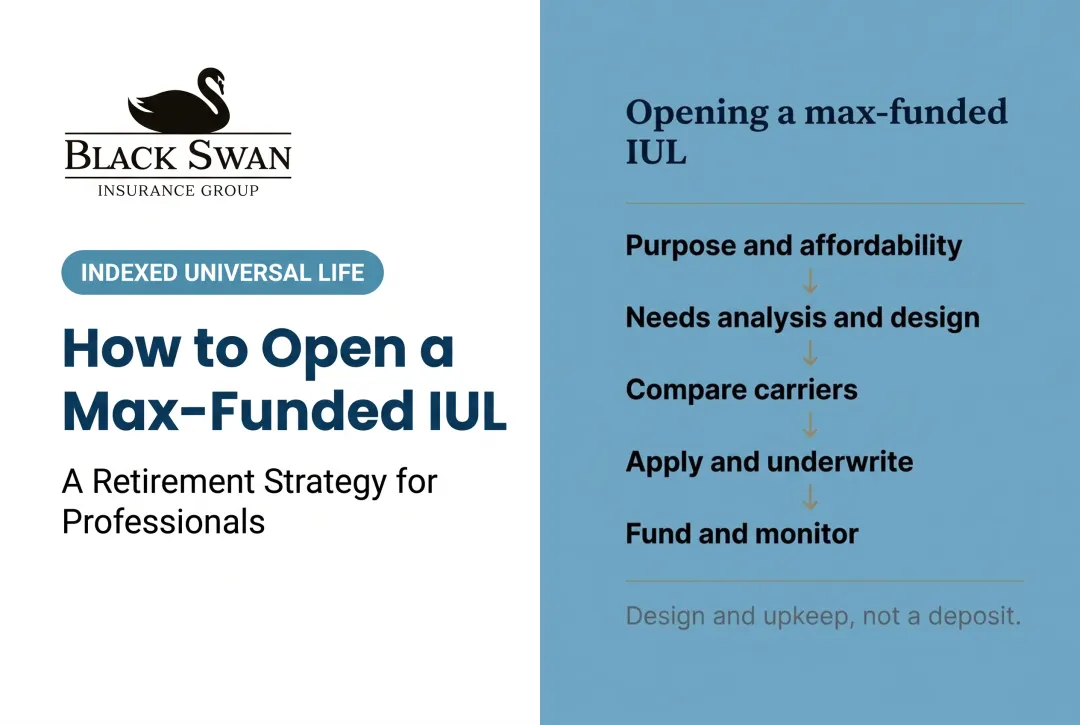
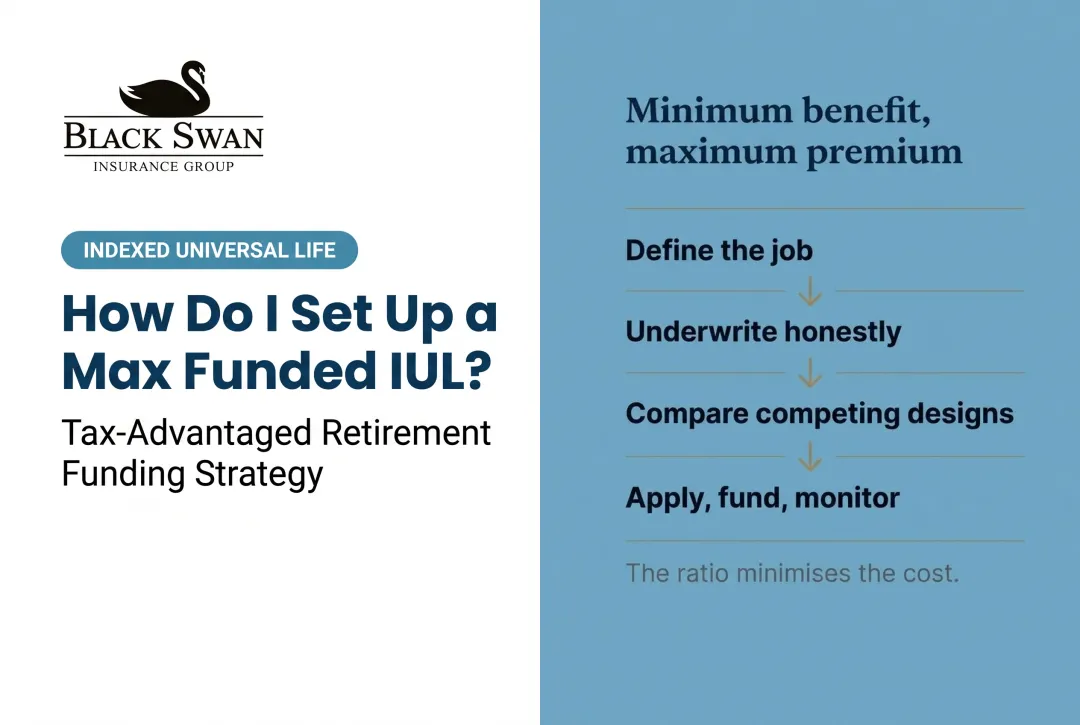
The short answer: You do not open a max-funded IUL; you apply for permanent life insurance and then design the funding to sit just under a ceiling the contract itself sets. The sequence is define the purpose and a sustainable premium, prepare for underwriting, compare carrier designs, stress-test the illustration, then apply, fund and review annually. The number you can pay is an output of that process, never an input.
If you earn $150K+, have captured the employer match, maxed the 401(k) and hit the Roth phase-outs, you are the buyer this design was actually built for — and the buyer most likely to be handed a premium figure before anyone has established whether you need permanent insurance at all.
Key Takeaways
- Fund this only against a genuine permanent life insurance need, never as a retirement shortcut
- Maximum premium is set by policy structure, carrier rules and IRS seven-pay testing, not by a fixed dollar amount
- Cost of insurance, caps and lapse risk persist even with a 0% crediting floor
- Compare against 401(k)s, IRAs, Roth accounts, brokerage investing and other insurance before committing
- A design built on an unrealistic funding timeline rarely performs the way the first illustration suggested
Step 1: Purpose, Timeline, Sustainable Premium
Name the job first. Permanent death-benefit protection, supplemental retirement flexibility, tax diversification, estate planning, business continuity, or some mix.
Then set the premium budget from stable surplus cash flow — not a one-off bonus, not an optimistic market return, and not money earmarked for emergency reserves, debt payoff or education savings.
Cover emergency reserves and high-interest debt first. Map the funding period and the earliest point you might need liquidity. Avoid committing to a long-horizon design if there is any real chance you surrender or scale back premiums soon after issue.
This is the step that decides whether the policy works. Everything after it is execution.
Step 2: Prepare for Underwriting
Carriers and advisers need a complete picture before anything can be designed: household income, net worth, dependents and existing coverage; retirement accounts, debts and business obligations; health history, medications, tobacco use and occupation; intended beneficiaries.
Age, health, income and insurability directly set the available death benefit, premium structure, underwriting class and projected cash value. Answer accurately — misstatements create problems at claim time, which your family inherits rather than you. Read the privacy, replacement and policy-delivery disclosures before signing.
Step 3: Compare Carriers and Design the Contract
Request illustrations from several carriers that fit your profile and compare them side by side.
| What to compare | Why it matters |
|---|---|
| Guaranteed against non-guaranteed values | Shows the worst case next to the projection |
| Insurance and administrative charges | Directly reduces net cash value |
| Surrender schedules | Determines early liquidity |
| Loan provisions | Determines the cost of access later |
| Caps, participation rates, floors | Shapes how much index growth you actually capture |
A licensed professional can identify the death-benefit option that supports your intended premium while staying inside non-MEC limits. If income is variable or business distributions fluctuate, a design with extra funding headroom usually beats one built tight against the minimum death benefit.
A great IUL is engineered. A bad IUL is sold.
The Ultimate IUL Blueprint
Before the design is locked, the Blueprint covers what it has to survive: funding levels, caps and charges, the MEC line, loan timing, and exactly what to demand from an illustration.
Step 4: Stress-Test the Illustration
This is where most policies go wrong, and it happens before anyone signs anything.
Verify the planned premium, premium duration, death benefit, crediting assumptions, loan assumptions, charges, surrender values and lapse sensitivity. The NAIC Life Insurance Illustrations Model Regulation requires guaranteed and non-guaranteed elements to be separated, with a disclosure that assumptions can change and actual results may come in better or worse than shown.
Then ask for the scenarios nobody volunteers: lower crediting rates, reduced premiums, a missed payment year, shifting caps, loan activity and earlier withdrawals.
An illustration is a model, not a guarantee.
Black Swan works through carrier-approved illustrations with clients rather than invented performance figures, comparing designs side by side so the numbers reflect realistic outcomes instead of only the best-case column.
Step 5: Apply, Fund, Review
Once the illustration matches the intended design, complete the application, medical underwriting, beneficiary designations and delivery requirements.
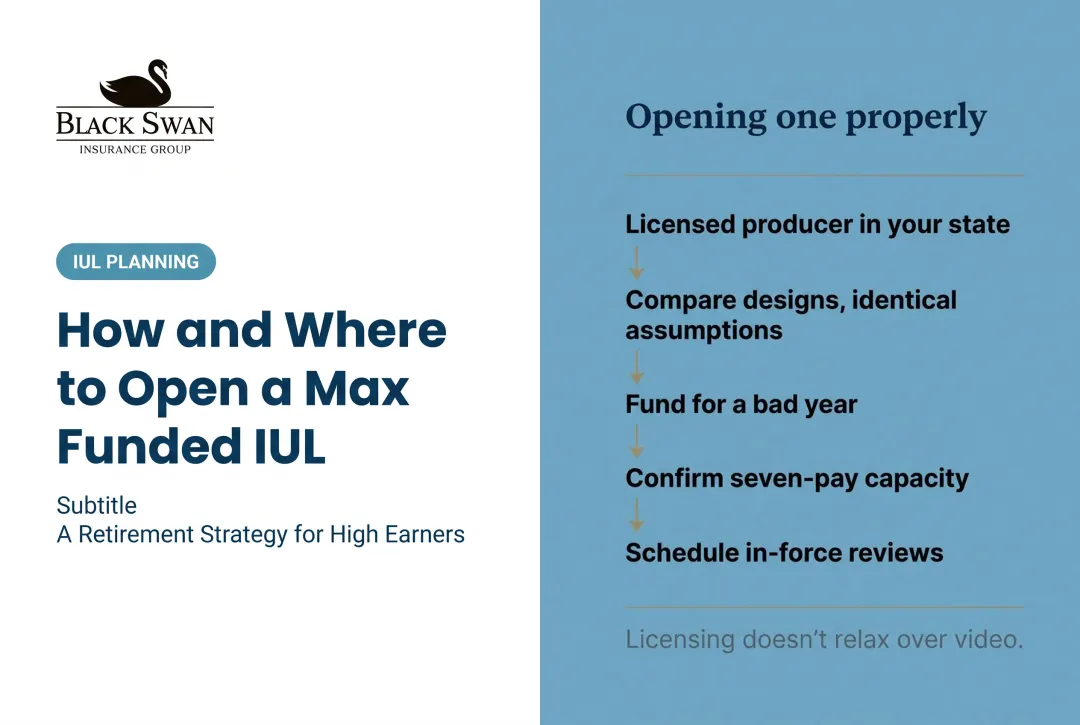
Set up a payment method you can sustain for years rather than the first one. Confirm how additional premiums, unscheduled payments or missed payments could affect MEC status — the seven-pay test is not a one-time check. Schedule an annual review covering cash value, charges, crediting assumptions, loan balances and premium sufficiency.
This is not set-it-and-forget-it. It is design-it, fund-it, review-it.

What the Critics Get Right
The fairest criticism of max funding is that it inverts the purpose of the product.
A contract deliberately designed with the smallest death benefit the IRS will allow for a given premium is being bought for its tax treatment, not its protection. Critics are right to ask why someone with no permanent protection need would accept mortality charges at all, right that the design only works if funding holds for decades, and right that the person presenting it is usually paid on premium.
The defensible version is narrow: you have a genuine permanent need, you have already filled the cheaper buckets, and you can fund consistently through a bad decade. Outside that, the criticism lands.
Who This Fits
Stronger Fit
- High-income professionals, executives, business owners and affluent families
- A genuine permanent protection need alongside the accumulation goal
- Stable surplus cash flow and adequate liquidity elsewhere
- A long time horizon and willingness to review annually
Late-start high earners face a different calculation. With fewer years before retirement the priorities shift to insurability, funding consistency, time remaining and policy costs — not the attractive income figure on page twelve of an illustration.
Weaker Fit
Not everyone should buy this. It is usually a poor fit if you have no genuine permanent insurance need, thin emergency savings, high-interest debt, unstable income, a need for the money back within a few years, or a preference for keeping things simple with low-cost investments.
Qualified retirement plans and employer matches deserve attention first in almost every case.

The Variables That Actually Move the Outcome
Policy variables are interconnected. Change the premium, death benefit, funding duration or loan activity and the maximum allowable funding moves with it.
Underwriting, premium and death benefit. Younger age, better health and a favourable class lower cost of insurance and improve premium efficiency. Tobacco use and certain medical histories raise costs and can limit available terms. Premium size, timing and duration all affect accumulation, expenses and seven-pay testing. There is no universal minimum or maximum; carriers calculate limits per contract. Minimising the death benefit prioritises cash value growth — weigh that against real protection needs for dependents, debts, estate goals or business obligations.
Index crediting. The cap limits credited interest, the participation rate sets the share of index growth applied, the spread is subtracted before crediting, and the floor sets the minimum, often 0%. According to Pacific Life's client guide to Indexed Universal Life, a 0% floor applies only to indexed interest. Monthly insurance and administrative charges continue regardless.
Zero is your hero in a down year — but the floor applies to the credit, not to the charges.
Loans and withdrawals reduce cash value and death benefit, accrue interest, and can trigger a tax bill if the policy lapses or is surrendered with a balance outstanding. Review any loan strategy with a licensed professional and a tax adviser before acting.

| Mistake | What happens | Fix |
|---|---|---|
| Skipping the needs analysis | Premium chosen before confirming coverage need or cash flow | Run the needs analysis first, every time |
| Treating illustrations as guarantees | Floors, caps and loan strategies mistaken for promises | Demand guaranteed columns and stress-tested scenarios |
| Over- or underfunding, then ignoring it | Falling cash value, excessive loans, MEC or lapse risk | Schedule annual reviews without fail |
The Alternatives, Honestly
Term life gives a larger death benefit at lower cost with no cash value. Whole life gives guaranteed cash value growth with less index-linked upside. A standard IUL carries a lower funding commitment and slower build-up. A 401(k) or IRA delivers tax-advantaged retirement saving without insurance costs. A Roth IRA offers tax-free qualified withdrawals, subject to income limits. A taxable brokerage account offers direct market participation and full liquidity. An annuity or business retirement plan offers other income or deferral structures.
An alternative usually wins when you need lower complexity, guaranteed cash value, short-term liquidity, a larger death benefit, or retirement saving without insurance charges.
Risks to Understand Before You Fund
- The MEC line is contract-specific and crossing it is generally permanent, changing the tax treatment of every loan and withdrawal that follows.
- Caps and participation rates can be lowered after issue, within contract minimums.
- Cost of insurance rises with age, so a design that works at 45 can strain at 70 if funding never changed.
- Underfunding is the leading cause of failure. Flexible premiums are flexible right up until the contract needs them.
- Minimising the death benefit to maximise cash value leaves less protection in place for the people who were supposed to be the point.
- Lapsing with a loan outstanding can create taxable income with no cash received.
Find Out Where You Actually Stand
This starts with the Tax-Free Wealth Blueprint Fit Review. If you earn $150K+ and want to know what your real funding ceiling is, we establish the protection need first, then model the premium against your contract's MEC limit, stress-test it through lower-crediting and zero-credit years, and compare designs across carriers with charges and loan assumptions shown in plain numbers. If maxing a Roth and buying term serves you better, we will say so. If IUL does not fit, we will tell you that too.
Frequently Asked Questions
How do I open a max-funded IUL?
Define the goal and funding capacity, submit financial and health details for underwriting, compare carrier illustrations, design a non-MEC policy, stress-test the numbers, apply, fund it, and review it annually.
How much do I need to start?
There is no universal figure. The premium depends on age, health, desired death benefit, carrier, policy design, funding period and budget — and the contract's own seven-pay allowance sets the upper bound.
Is a max-funded IUL a good idea?
It can work for someone with a genuine permanent insurance need, stable surplus cash flow, adequate liquidity elsewhere and a long horizon. It is not right for everyone and should be compared against other strategies first.
Can I have more than one IUL?
Yes. Before adding another, review combined premiums, actual insurance need, underwriting requirements, MEC testing on each contract, total policy costs and how the whole thing fits your plan.
What happens if I accidentally overfund?
Carriers normally monitor the seven-pay limit and will refund or refuse excess premium, but do not rely on that alone. Confirm the handling in writing before making unscheduled payments.
Sources
- IRS — Revenue Ruling 2005-6
- NAIC — Life Insurance Illustrations Model Regulation
- Pacific Life — Client guide to Indexed Universal Life
Disclosure: This article is educational and is not personal tax, legal or investment advice. Indexed universal life is life insurance first. Illustrated values are not guarantees; actual results depend on policy design, carrier, crediting options, caps, participation rates, expenses, funding and ongoing management. Seven-pay limits and modified endowment contract testing are contract-specific and must be confirmed with the issuing carrier. This strategy is not appropriate for everyone. Policy loans and withdrawals reduce cash value and the death benefit, and can create tax consequences if the policy lapses or becomes a modified endowment contract. Consult your own tax, legal and financial professionals for advice specific to your situation. Any potential tax-advantaged access depends on the policy being properly structured, funded and managed.
And remember, it's not what you earn, it's what you keep… enjoy the ride.