By Robert Balgac, Founder, Black Swan Insurance Group | October 9, 2026
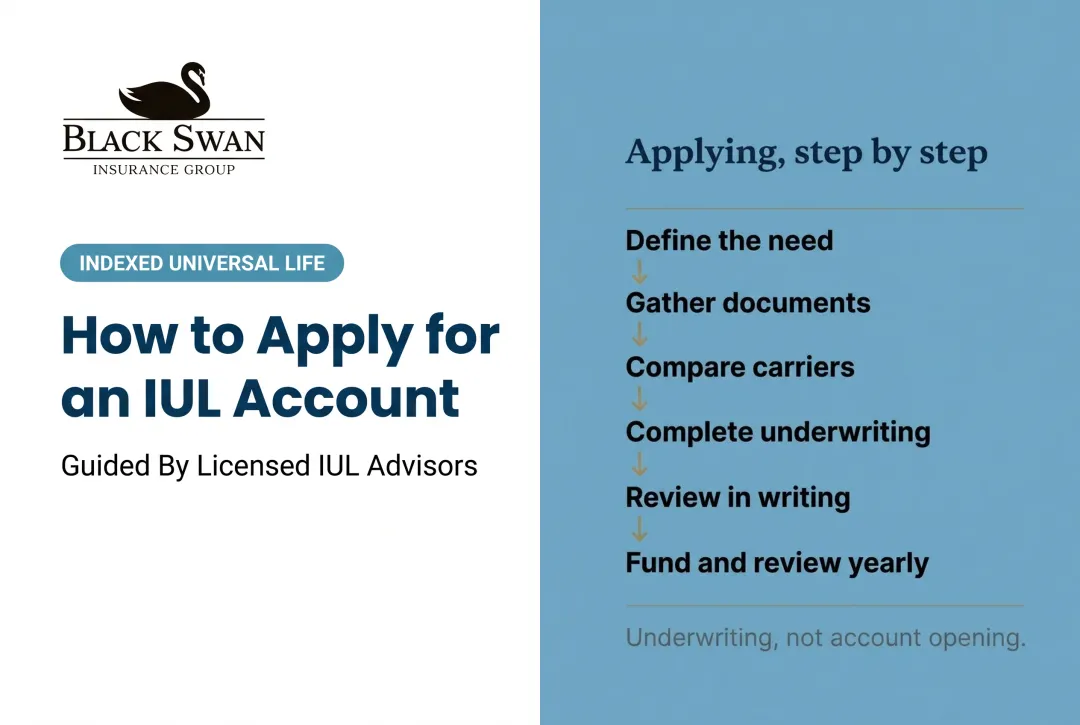
Applying for indexed universal life is not opening an account. An insurer reviews your health, your finances and your actual need for protection, then decides whether — and on what terms — to insure you.
Most applicants assume the hard part is choosing an index strategy. It is not. Approval and long-term outcome depend on accurate disclosure, realistic funding, sound design and underwriting that matches your real risk profile.
The short answer: The best application starts before the application. Define what the policy must do, confirm the premium survives a bad year rather than a peak one, work with someone who compares carriers and will tell you when IUL does not fit, disclose everything accurately, and read the guaranteed column before you accept. Approval is not proof of suitability.
Key Takeaways
- Work with a licensed professional who compares suitable policies across carriers
- Gather personal, medical, financial and beneficiary details before applying
- Separate guaranteed illustration values from non-guaranteed projections before accepting
- Treat it as a complement to term, retirement accounts and emergency savings — never a replacement
- Affordability is a hard constraint, not a design variable
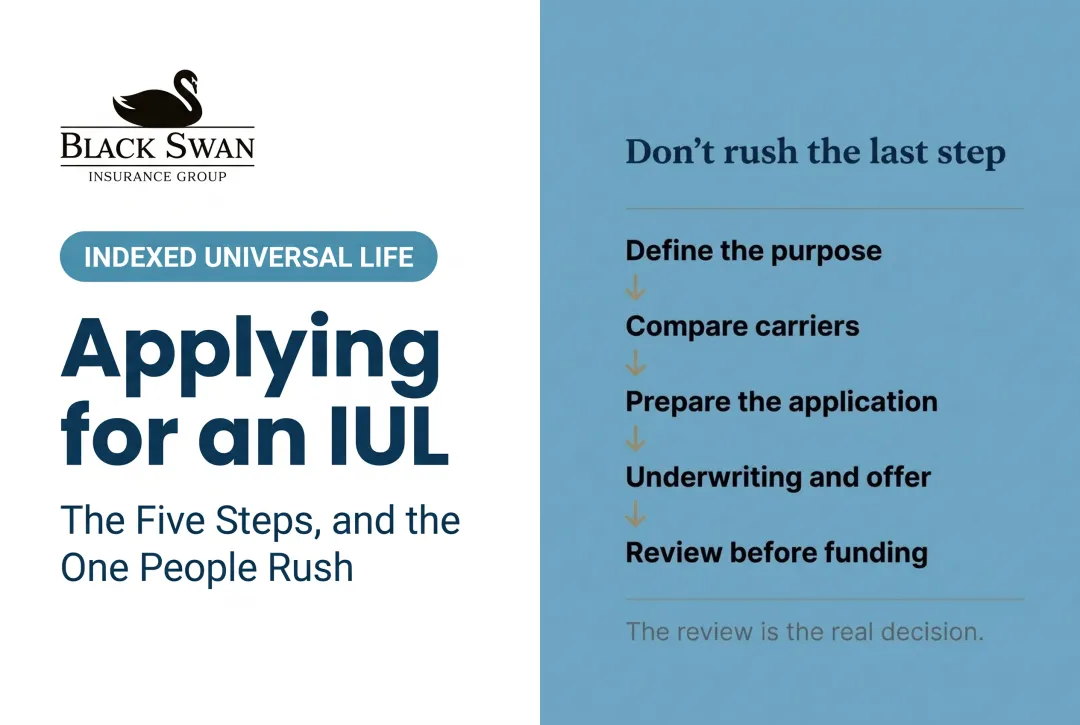
Step 1: Decide What the Policy Is For
Before discussing coverage amounts, settle the purpose: permanent family protection, business or succession planning, legacy and estate liquidity, supplemental retirement income, or a combination.
Then estimate the death benefit from income replacement, debts, mortgage, education costs, dependants and any business obligations tied to you.
And one check before anything else — confirm the premium will not compromise your emergency fund, debt repayment or retirement contributions. An IUL only works if you can sustain it. Treat affordability as a budget constraint before you design anything, not a number you back into afterwards.
Step 2: Choose Who You Work With
A licensed agent or broker assesses suitability, requests illustrations, coordinates underwriting and submits the application. Before proceeding with anyone, verify their state licensing and carrier access, how they are compensated and whether that is disclosed upfront, their product knowledge beyond IUL, and whether they will explain alternatives rather than sell you on one answer.
At Black Swan Insurance Group this begins with a needs assessment reviewing goals, income and existing coverage before any design work. If you are unsure whether IUL fits at all, that review is the right first step rather than an application.
The Ultimate IUL Blueprint
Before you apply, the Blueprint covers what the design has to survive: funding levels, caps and charges, the MEC line, loan timing, and exactly what to demand from an illustration.
Step 3: Prepare the File
Carriers request identity, financial and medical information. Having it ready speeds underwriting considerably.
Expect to provide government ID; address, occupation and employer; income and net worth, with tax or financial records for larger amounts; existing policies; beneficiary designations and ownership structure; and the source of premium funding.
Medical disclosure matters just as much. Be accurate and consistent about history, current medications, diagnoses, tobacco or nicotine use, family history, hazardous hobbies and recent travel. Inconsistent answers raise flags and can delay or jeopardise approval — and a discrepancy discovered at claim time is a problem your family inherits, not you.
Business owners applying for larger amounts should expect questions about ownership structure, key-person exposure, buy-sell agreements and the financial justification for the death benefit.
Step 4: Underwriting
Two tracks, often running in parallel. Financial underwriting confirms the coverage is justified by income, net worth and insurable interest. Medical underwriting may involve questionnaires, prescription history, a paramedical exam, labs or an attending-physician statement depending on age, health and amount.
Some carriers offer exam-free accelerated underwriting for qualifying applicants. A 2025 LIMRA consumer survey found 52% of people are somewhat or very likely to buy a policy issued through accelerated underwriting — consumer interest, not a guarantee you qualify. An exam-free offer is also not automatically cheaper or better suited to your case.
Answer follow-up questions quickly and completely. If you receive a rating, exclusion or postponement, ask how it affects your alternatives before assuming the worst.
Step 5: Read the Offer Properly
Approval is not the finish line. Before funding anything, compare the approved coverage against what you requested; the premium schedule and underwriting class assigned; charges, death benefit option and index strategy details; surrender values and illustrated cash value; and planned premium against minimum premium, with what happens if you reduce or skip.
Per Guardian's 2026 buying guide, underwriting can take as little as 24 hours but more often runs four to six weeks — build that into your planning.
Only accept and fund after reviewing the actual contract, the illustration, all disclosures and your state's free-look rights.

What the Critics Get Right
The criticism worth taking seriously is that the application process is designed to carry momentum.
Once an illustration has been produced and underwriting has started, declining feels like wasted effort — for you and for the person who ran it. That momentum is precisely why the affordability and suitability work belongs before the paperwork, not after an approval lands with a number attached.
The other fair point: nobody in the process is paid to tell you no. Which is exactly why the question "what would make this the wrong policy for me?" should be asked out loud, early, and of someone who will answer it.
Reading the Illustration Critically
An illustration is a projection. Separate the guaranteed column from the non-guaranteed assumptions, and ask about crediting assumptions, index methodology, floor, cap, participation rate, spread — and whether the illustrated values depend on you paying the planned premium indefinitely.
Under NAIC's AG 49-A standard, illustrated indexed-credit rates are constrained by a prescribed formula, and from 1 April 2026 basic illustrations must show an Alternate Scale ledger alongside the illustrated scale with equal prominence. A real transparency improvement that still predicts nothing about future index performance.
An illustration is a model, not a guarantee. The rate on the cover is the least binding number in the document.

Test sustainability against your actual cash flow, not a peak-income year. Ask to see the policy under lower long-term crediting, reduced or irregular payments, a full missed-payment year, rising cost of insurance, and an outstanding loan against cash value.
| Alternative | How it compares |
|---|---|
| Term life | Lower cost, no cash value, fits a defined period |
| Whole life | More guaranteed, less funding flexibility |
| Guaranteed UL | Death benefit guarantee without cash-value growth potential |
| 401(k) / Roth | Retirement savings vehicles, not insurance protection |
Check the issuing insurer's financial-strength rating and complaint history through your state insurance department. Ask your adviser how they are paid, whether they compare carriers, and what ongoing service comes with the relationship.
Ownership structure, beneficiary designations and trust arrangements carry real legal and tax consequences — work with qualified legal and tax professionals on those specifically.
Stronger Fit
- Earning $150K+ with stable surplus cash flow beyond existing savings and retirement contributions
- A genuine, ongoing need for permanent coverage
- Sufficient liquidity outside the policy and a long horizon
- Willingness to monitor and adjust over time
Weaker Fit
Do not apply yet if you have a short-term coverage need, uncertain or unstable income, insufficient emergency reserves, no capacity to sustain premiums long term, a need for near-term liquidity, reluctance to go through underwriting, or an expectation that this behaves like a guaranteed investment account. It does not.
Risks to Understand Before You Apply
The mistakes that cause most problems:
- Applying before confirming purpose and budget — complete a written needs and affordability review first
- Treating illustrated projections as results — request guaranteed and stress-tested comparisons
- Omitting medical, lifestyle or financial information, which causes delays, rescission risk or a poor-fit offer
- Choosing the minimum premium without understanding sustainability
- MEC status, which is generally permanent and changes loan and withdrawal taxation
- Lapsing with a loan outstanding, which can create taxable income with no cash received
If the decision disappoints, you have options: ask exactly what triggered it; provide additional records where a rating rested on incomplete information; appeal with new evidence where permitted; try another insurer with different guidelines; reduce or redesign the coverage; or consider term, whole life or guaranteed UL instead. No adviser can promise approval before underwriting completes, and a decline often means a different structure fits better — not that you should reapply with the same numbers.

Find Out Where You Actually Stand
This starts with the Tax-Free Wealth Blueprint Fit Review. If you earn $150K+ and are preparing to apply, we document the protection objective first, pressure-test the premium against a weak year rather than a strong one, compare designs across carriers, and read the guaranteed column alongside the illustrated one. Approval and an attractive illustration are not proof a policy is right for you. If IUL does not fit, we will tell you that too — before anyone completes an application.
Frequently Asked Questions
How do I get approved?
Approval depends on the insurer's medical and financial underwriting, accurate disclosure, insurable interest and your ability to support the premium. No agent or carrier can guarantee it in advance.
What documents do I need?
Identification, financial and income information, beneficiary details, existing coverage and medical or prescription history. Exact requirements vary by insurer and coverage amount.
Do I need a medical exam?
It depends on age, health history and the amount requested. Some applicants qualify for exam-free underwriting, though that path is not automatically cheaper or more appropriate.
How long does it take?
It depends on file completeness, medical records, exam requirements and how quickly you respond. Guardian's 2026 guide cites a general range of 24 hours to four to six weeks.
What should I compare before accepting?
Guaranteed and non-guaranteed values, premiums, charges, caps, participation rates, surrender values, death benefit options, loan provisions and lapse risk — plus alternatives like term or whole life.
What if I am declined?
Ask what triggered it, supply additional records if the decision rested on incomplete information, and consider another carrier or a different structure. A decline is information about fit, not a verdict on you.
Sources
- LIMRA — 2025 facts about life insurance
- Guardian — how to buy life insurance
- NAIC — Actuarial Guideline 49-A
Disclosure: This article is educational and is not personal tax, legal or investment advice. Indexed universal life is life insurance first. Underwriting requirements, timelines, product terms and state availability vary by carrier and applicant and must be confirmed before applying; no approval outcome can be guaranteed in advance. Illustrated values are not guarantees; actual results depend on policy terms, crediting, costs and funding. Any potential tax-advantaged access depends on the policy being properly structured, funded and managed. Actual results depend on policy design, carrier, crediting options, caps, participation rates, expenses, funding and ongoing management. This strategy is not appropriate for everyone. Policy loans and withdrawals reduce cash value and the death benefit, and can create tax consequences if the policy lapses or becomes a modified endowment contract. Consult your own tax, legal and financial professionals for advice specific to your situation.
And remember, it's not what you earn, it's what you keep… enjoy the ride.