By Robert Balgac, Founder, Black Swan Insurance Group | October 5, 2026
Nobody knows what tax brackets, Social Security rules or Medicare surcharges will look like in twenty years. Yet most people build an entire retirement around one account type — usually a traditional 401(k) — and hope the rules hold.
That is not a plan. It is a bet on Congress, placed decades in advance, with no way to hedge it later.
Retirement income arrives from several sources at once: Social Security, required minimum distributions, pensions, part-time work, rental income. Each is taxed differently, and the interactions between them are where the real money is won or lost. Tax diversification means spreading savings across accounts with different tax treatments so you have choices later. It does not eliminate tax. It gives you control over when and how much.
The short answer: Combining taxable, tax-deferred and tax-free accounts creates withdrawal choices in retirement that a single-bucket plan cannot. No universal ratio fits everyone — the right mix depends on your current bracket against your plausible future one. Coordinate Roth conversions, RMDs, Social Security timing and legacy goals with a tax professional. And permanent life insurance and annuities require a suitability review; they are not automatic substitutes for diversified savings.
Key Takeaways
- Combining taxable, tax-deferred and tax-free accounts creates more withdrawal choices in retirement
- No universal bucket ratio fits everyone; it depends on your current versus projected future tax situation
- Coordinate Roth conversions, RMDs, Social Security timing and legacy goals with a tax professional
- Permanent life insurance and annuities need a suitability review, not automatic inclusion
- Capture the employer match before any of this — it is the highest-certainty money in the plan
Three Concepts People Conflate
- Investment diversification spreads money across asset classes to manage market risk
- Tax diversification spreads money across account types to manage how withdrawals are taxed
- Asset location decides which investments sit in which account for tax efficiency
All three matter and they solve different problems. A portfolio can be perfectly diversified by asset class and still leave you fully exposed to one tax outcome, because every dollar sits in a traditional IRA.
Bucket One: Tax-Deferred
Traditional 401(k)s, 403(b)s, traditional IRAs, SEP IRAs and SIMPLE IRAs. Contributions may be deductible now, growth is deferred, and withdrawals are taxed as ordinary income later. Early withdrawals often trigger penalties.
Large balances create a future problem. The IRS generally requires RMDs to begin at age 73, using the prior year-end balance divided by an IRS life-expectancy factor. Missing one can trigger an excise tax of up to 25% on the shortfall.
Bigger RMDs also push more of your Social Security into taxable territory. Provisional income — half your benefit plus other income including RMDs — starts to matter above $25,000 single or $32,000 married filing jointly. Cross that and up to 50% of benefits can become taxable; higher income pushes it to 85%, per IRS Publication 915.

Tax-deferred is not tax-free. The IRS is waiting, not gone — and a million-dollar 401(k) is a retirement plan with a partner who has not yet sent an invoice.
Before anything more advanced, fill this bucket with the full employer match. Nothing else in your financial life pays you back that reliably for that little effort.
Bucket Two: Tax-Free and Potentially Tax-Advantaged
Roth IRAs and Roth workplace accounts accept after-tax contributions, and qualified withdrawals — the account open five years and you 59½ or older — come out completely tax-free. Roth contribution rules differ from Roth conversion rules.
Health Savings Accounts belong here for anyone on an eligible high-deductible plan. Withdrawals for qualified medical expenses are tax-free at any age; non-qualified withdrawals are taxed as income and may face a penalty before 65.
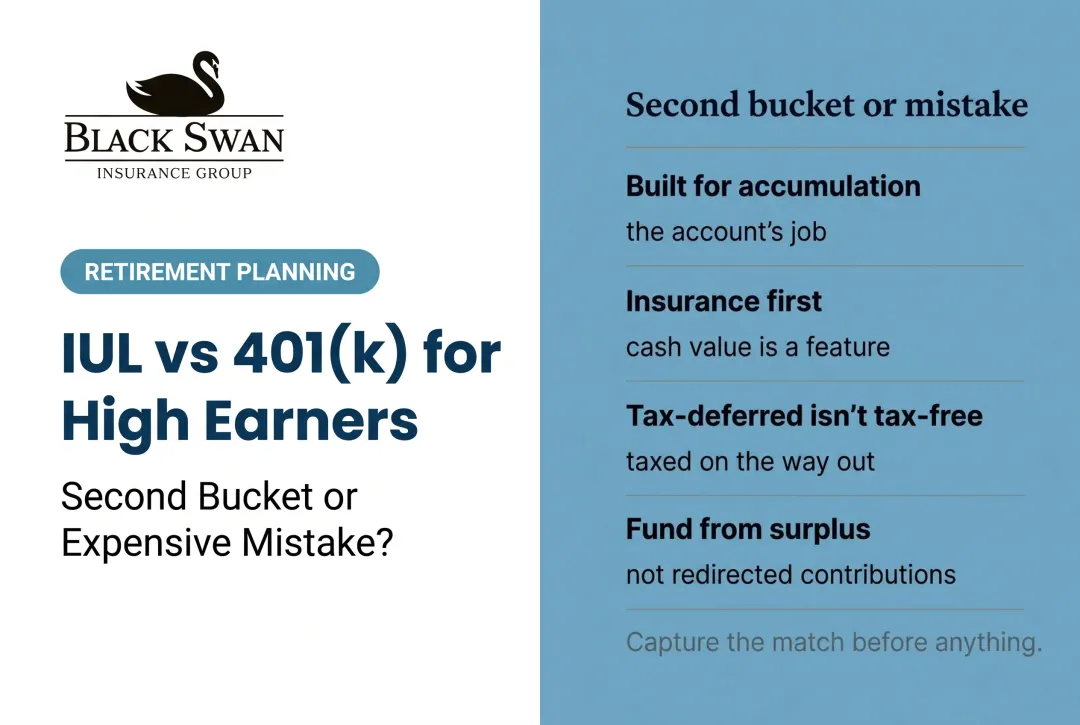
Cash-value life insurance can also sit in this bucket — with considerably more conditions than the other two, and it is worth being precise about them.
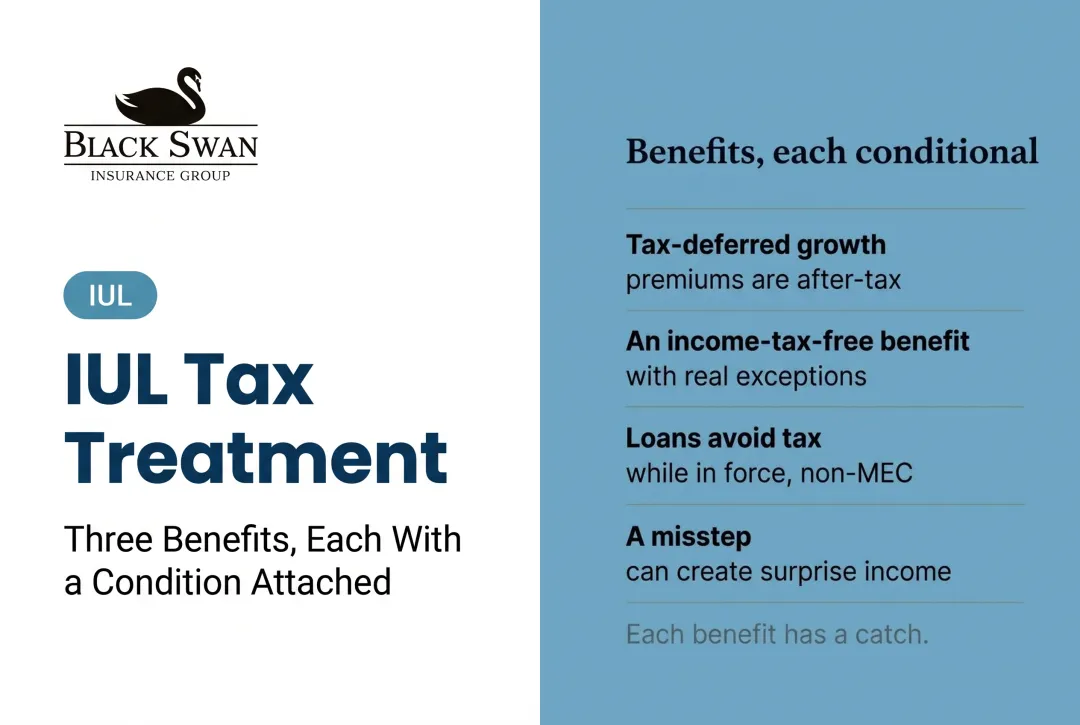
Cash value grows tax-deferred. Policy loans may be accessed without current tax under current rules only if the policy stays in force and avoids modified endowment contract status. That outcome depends on policy design and death-benefit option; funding level relative to insurance costs; how loans and withdrawals are managed; and surrender terms if the policy lapses early.
The Roth is unconditionally tax-free on qualified withdrawals. A policy offers potential tax-advantaged access conditional on being properly structured, funded and managed for decades. Those are not the same thing, and describing them in the same words is how people end up disappointed. If Roth space remains available to you, use it first.
Bucket Three: Taxable
Brokerage accounts, bank accounts and CDs, funded with after-tax dollars, where interest, dividends and realised gains face treatment varying by type and holding period.
These offer what the other two do not: liquidity without penalty. No age restrictions, no early-withdrawal rules. The homework is tracking cost basis, managing holding periods and using tax-loss harvesting where sensible.
For 2025, long-term capital gains can be taxed at 0% for single filers with taxable income up to $48,350, or $96,700 for joint filers, then 15% and 20% at higher levels, per IRS capital gains guidance. Municipal bond interest is generally exempt from federal tax but still reportable, and some bonds can trigger the alternative minimum tax.
Why It Matters in Practice
Access to multiple account types lets you choose where a withdrawal comes from based on what is happening that year.
A simplified example. A retiree needs $60,000. Pulling all of it from a traditional IRA adds $60,000 to taxable income. Splitting it changes the result:
- $30,000 from the IRA, as ordinary income
- $20,000 from a taxable brokerage account, much of it capital gains
- $10,000 from a Roth, tax-free
That mix could produce meaningfully less taxable income. Illustrative only — actual results depend on your full picture.
That flexibility matters because retirement income has to interact with RMDs from 73, Social Security taxation thresholds, pension or annuity payments, rental or business income, and any part-time work.
Roughly 54% of U.S. households hold a defined-contribution account or IRA, with a median balance of $87,000 and an average of $334,000, per the Congressional Research Service. For many of those households the balance sits almost entirely in tax-deferred form, which is precisely the problem.
Tax diversification builds resilience against changing brackets and changing circumstances. It does not guarantee lower lifetime taxes or better returns, and never choose an investment for tax reasons alone.
What the Critics Get Right
Anyone suspicious of a tax-diversification article that mentions life insurance is reading it correctly, and the suspicion deserves a direct answer.
Critics are right that the third bucket is overwhelmingly best filled with a Roth, an HSA and a taxable brokerage account, all of which cost a fraction of what a policy costs. They are right that "tax-free" gets applied to policy loans when the accurate word is conditional. And they are right that a household with unused Roth capacity being shown an insurance policy is being sold to.
Where the criticism runs out is the household that has genuinely exhausted those routes — maxed the plan, used the backdoor Roth, funded the HSA, and still has surplus alongside a real permanent protection need. That group exists, and it is much smaller than the marketing implies.
Building the Strategy
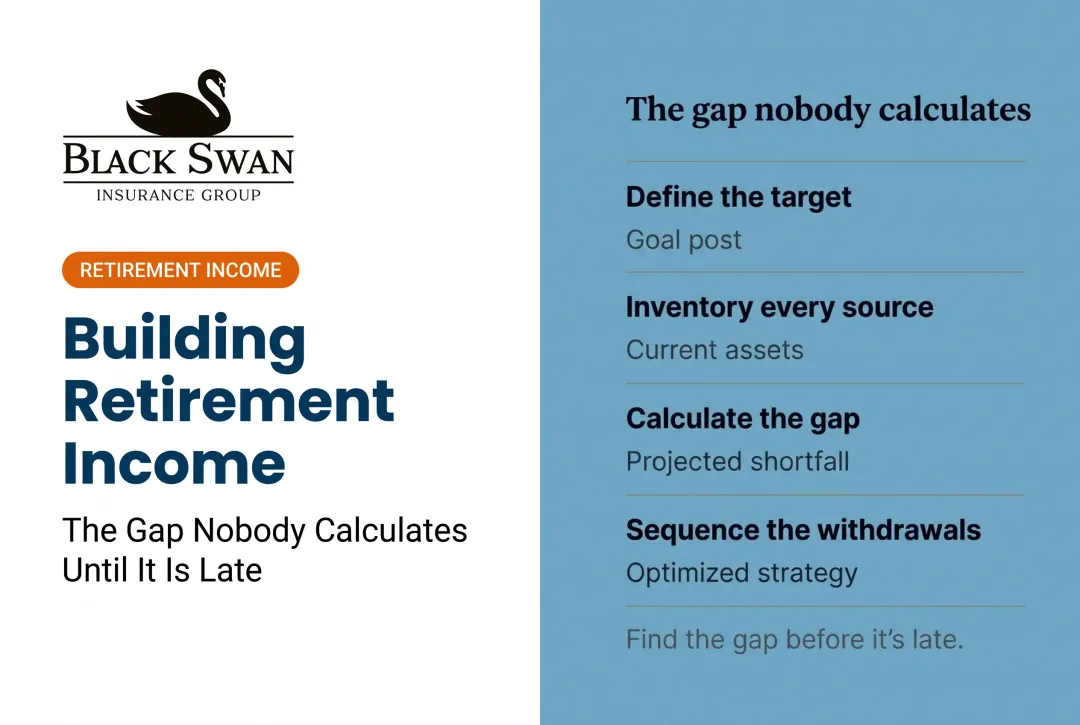
Start with an inventory: current and expected income sources; account balances across all three buckets plus contribution limits and employer benefits; insurance needs, debt and emergency reserves; and your timeline, intended spending and legacy goals.
Then compare your current marginal rate against plausible future scenarios, factoring changes to income, filing status, state residency and retirement timing. Verify current brackets — do not rely on figures from a few years ago.
Contribution Priorities
- Capture the full employer match
- Keep adequate liquidity in cash or taxable accounts
- Max eligible tax-advantaged accounts — 401(k), IRA, HSA
- Then evaluate Roth contributions, conversions and other tools
That order is not negotiable, and step four is where any insurance conversation belongs.
Roth Conversions
A conversion moves money from a tax-deferred account into a Roth, and the converted amount generally counts as taxable income that year.

- Fund the tax bill separately. Paying conversion taxes out of the converted amount defeats the purpose
- Watch the pro-rata rules. Holding both deductible and non-deductible IRA funds brings Form 8606 into play
- Model multiple amounts and years. One large conversion can push you into a higher bracket than several smaller ones
- No recharacterisation after 2017. Once done, there is no reversal
High Earners and Business Owners
Practice owners and executives face a different version: concentrated wealth inside the business, plus a compressed timeline if saving started late. Priorities are qualified-plan design — SEP, SIMPLE or solo 401(k) — planning around eventual business-sale income, and preserving operating liquidity before any long-term product commitment.
The Ultimate IUL Blueprint
If you have genuinely exhausted the Roth and HSA routes and a permanent protection need exists, the Blueprint covers what the policy has to survive to contribute anything to bucket two: funding levels, the MEC line and loan timing.
Withdrawals Across Life Stages
Working years: balance current deductions against future flexibility; consider Roth contributions or conversions if you are in a lower bracket now than you expect later; fund an HSA if eligible; and keep liquidity outside retirement accounts.
The years before retirement: project what your RMDs will look like at 73 or 75 depending on birth year; test whether income needs actually match planned withdrawals; review beneficiary designations, which are frequently outdated; and consider staged Roth conversions with a CPA.
Early retirement: the years between stopping work and Social Security or RMDs are often the lowest-income years of your life, which makes them ideal for conversions or strategic withdrawals. Weigh that against health insurance costs before Medicare, early-withdrawal penalties on certain accounts, and cash reserves for unexpected expenses.

Who This Applies To
Stronger Position
- Household income of $150K+ with meaningful balances in at least two of the three buckets
- The employer match fully captured and qualified accounts maxed
- Roth capacity used, including a backdoor Roth where eligible
- A projection of RMDs at 73 already run, with the Social Security interaction modelled
- A CPA involved in conversion planning
Weaker Position
- Nearly everything in tax-deferred accounts with no conversion plan
- The employer match not fully captured
- Roth or HSA capacity still unused while permanent insurance is being considered
- No projection of what RMDs will do to your bracket
- Insurance being evaluated as a Roth substitute rather than after one
Where a protection need exists but is temporary, term insurance handles it cheaply and leaves the tax planning to the accounts built for it. Not everyone needs permanent coverage, and buying it for tax diversification alone inverts the analysis.
Risks to Understand
Not everyone should buy an IUL. Tax diversification is a goal, not a product, and the qualified accounts plus a taxable brokerage account already give you two of the three buckets.
- A single-bucket plan has no hedge against bracket or rule changes you cannot predict
- RMDs at 73 can push more Social Security into taxable territory and cross IRMAA thresholds
- Missing an RMD can trigger an excise tax of up to 25% on the shortfall
- A large single Roth conversion can push you into a higher bracket than staged ones
- Conversions cannot be reversed since recharacterisation ended in 2017
- Pro-rata rules complicate conversions where non-deductible IRA funds exist
- Policy loan access is conditional on the contract staying in force and outside MEC status — unlike a Roth, which is not
- Cost of insurance, surrender charges and lapse risk apply to any policy used for this purpose
- Tax law changes, which is the entire argument for diversifying and also a reason not to over-engineer around today's rules
Find Out Where You Actually Stand
This starts with the Tax-Free Wealth Blueprint Fit Review. If you earn $150K+, we map what capacity remains in each of the three buckets, project your RMDs and their interaction with Social Security and IRMAA, model staged conversions, and only then look at whether anything else is needed. If it does not fit, we will tell you that too — and "use the Roth capacity you still have" is a frequent answer.
Frequently Asked Questions
What is tax diversification?
Spreading retirement savings across taxable, tax-deferred and tax-free accounts so you can choose which to draw from each year. It manages tax exposure rather than market risk.
What is the right mix?
There is no universal ratio. It depends on your current marginal rate against your plausible future one, your expected income sources, and your legacy goals. It should be revisited as circumstances change.
When should I do a Roth conversion?
Often in low-income years — between stopping work and Social Security or RMDs starting. Model multiple amounts across several years, fund the tax bill from outside the conversion, and involve a CPA.
Does life insurance belong in the tax-free bucket?
Only conditionally, and only after Roth and HSA capacity is used. A Roth is unconditionally tax-free on qualified withdrawals; a policy offers potential tax-advantaged access dependent on design, funding and staying in force.
What happens if I ignore RMDs?
They begin at 73 and can push more Social Security into taxable territory and cross Medicare surcharge thresholds. Missing one can trigger an excise tax of up to 25% of the shortfall.
Should I buy term insurance instead?
If your protection need has an end date, yes — term covers it cheaply, and your tax diversification should be built with accounts designed for that purpose.
Sources
- IRS Publication 915 — Social Security and equivalent railroad retirement benefits
- IRS Topic 409 — Capital gains and losses
- Congressional Research Service — Retirement account ownership and balances
- NAIC — Life Insurance
- I.R.C. § 7702A and Rev. Proc. 2008-39 (modified endowment contracts and the seven-pay test)
Disclosure: This article is educational and is not personal tax, legal or investment advice. Indexed universal life is life insurance first. Tax brackets, thresholds, contribution limits and RMD ages change; verify current figures with the IRS or a qualified professional before acting. Actual results depend on policy design, carrier, crediting options, caps, participation rates, expenses, funding and ongoing management. Policy loans and withdrawals may reduce cash value and death benefit and can create tax consequences if the policy lapses or becomes a modified endowment contract. This strategy is not appropriate for everyone. Illustrated values are not guarantees; actual results depend on policy terms, crediting, costs and funding. Consult your own tax, legal and financial professionals for advice specific to your situation.
And remember, it's not what you earn, it's what you keep… enjoy the ride.