By Robert Balgac, Founder, Black Swan Insurance Group | October 9, 2026
"Is an IUL good for retirement?" is a question with no general answer, and anyone who gives you one is guessing. The product does not have a quality score. It has a set of conditions, and the honest work is finding out whether those conditions describe you.
Here is where most $150K+ earners are standing when they ask. The 401(k) is maxed. The match is captured. Income has pushed past the Roth phase-out. There is surplus cash flow with nowhere tax-advantaged left to go. And somebody has described a policy that sounds like it solves the whole thing.
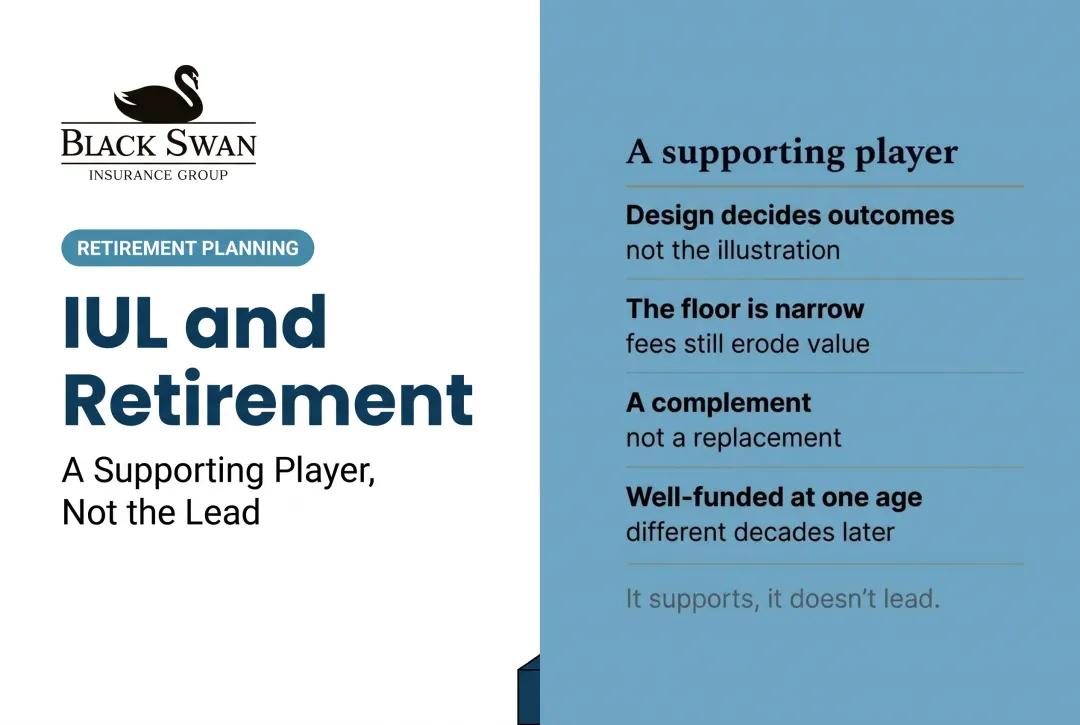
The short answer: An IUL is good for retirement only when four things are simultaneously true — a genuine permanent insurance need, funding capacity to sustain premiums for decades, a long time horizon, and the willingness to monitor a contract more complex than a brokerage account. Miss one and the product tends to disappoint, sometimes expensively. It is a complement to qualified accounts, rarely a substitute.
A great IUL is engineered. A bad IUL is sold.
Key Takeaways
- An IUL pairs permanent life insurance with index-linked cash value — it is not a direct stock market investment
- It fits as a retirement complement only with a real protection need, strong cash flow and a long horizon
- Caps, participation rates, spreads and charges all pull real results below illustrated projections
- A 0% crediting floor still allows total cash value to fall when charges exceed credits
- Compare it against 401(k)s, IRAs, Roth accounts, brokerage assets, annuities and term insurance before deciding
The Mechanics You Are Actually Buying
An IUL provides two things: a death benefit and a cash-value account. The cash value earns credited interest based on a selected index, such as the S&P 500, filtered through the insurer's contract terms.
That filter is the whole story. You do not own the index. You do not receive its dividends. And the insurer deducts the cost of insurance and administration before anything is credited.
Floors, Caps and Participation Rates
Three mechanisms determine what you actually earn:
- Floor — the minimum credited interest, commonly 0%, protecting against a negative index credit
- Cap — the maximum credited interest, regardless of how high the index climbs
- Participation rate — the share of index gains the insurer credits to your cash value
According to Guardian Life, typical gain caps run roughly 8% to 12%, with participation rates often from 50% to above 100% depending on the contract. Those are illustrative ranges, not guarantees — ask for current, carrier-specific figures in writing.
A simplified example: if the index gains 15% and the policy caps at 10%, you are credited 10%. A different design might use a spread, subtracting a flat percentage — say 3% — from the index gain instead of capping it. Either way, net cash-value growth lands below the raw index return.

Premiums are flexible within policy limits, which sounds purely like a benefit until underfunding catches up with you. Pay too little for too long and cash value shrinks or the policy lapses. Access runs two ways: withdrawals, which reduce cash value and may reduce the death benefit, and policy loans, which accrue interest and can trigger taxes if the policy lapses or is surrendered with a balance owed.
What Has to Be True for the Answer to Be Yes
An IUL can support retirement in three ways: index-linked cash-value growth with a downside floor, potential tax-advantaged access to that value when properly structured, funded and managed, and permanent death-benefit protection. None of those hold if the policy is underfunded or lapses.
Condition One: The Growth Case Survives Inspection
Index-linked crediting offers growth potential above a fixed-rate account, with the floor limiting damage from a negative index year. That part of the pitch is accurate. What it leaves out matters more: caps, participation rates, spreads and terms the insurer can change all constrain the upside. Never equate net cash value with the index's gross return.
When evaluating a policy, look past the headline crediting rate and check:
- Guaranteed cash value — what is contractually promised
- Illustrated cash value — non-guaranteed, current assumptions
- Net internal rate of return after all charges
- Surrender value at various policy years
- Death-benefit performance under stress-tested scenarios
Condition Two: The Tax Case Clears a Real Bar
Cash-value growth generally is not taxed until distributed, and loans on a properly structured contract are typically designed to avoid current income tax. That is a genuine difference from a traditional 401(k) withdrawal taxed as ordinary income.
But "generally" is carrying weight. Under IRC Section 72(e)(5), withdrawals from a non-MEC life contract are tax-free only up to your basis — total premiums paid minus prior withdrawals. Amounts above basis are taxable. If the policy becomes a Modified Endowment Contract through overfunding, distributions are taxed earnings-first, often with a 10% additional tax before age 59½.
| Access Method | Tax Treatment | Key Condition |
|---|---|---|
| IUL loan | Generally not currently taxable | Policy must stay in force and non-MEC |
| 401(k) withdrawal | Taxed as ordinary income | RMDs generally begin at 73 |
| Roth IRA qualified withdrawal | Tax-free | Five-year rule and age 59½ |
| Taxable brokerage sale | Capital gains tax | Depends on holding period |
Tax diversification can genuinely help a household that has already maxed qualified accounts. It is not automatically more tax-efficient than a Roth, and it has to clear the bar on fees and funding discipline first.
Condition Three: The Protection Need Is Real
The death benefit is the point of an IUL, not an add-on. Death proceeds are generally excluded from a beneficiary's federal gross income under IRC Section 101(a), though interest on delayed proceeds is taxable.
Income-tax-free is not estate-tax-free. Policies owned by the insured — or where the insured retained rights to change beneficiaries or borrow — can land in the taxable estate. Ownership structure belongs with an estate attorney, not an agent.
And loans or withdrawals taken during life reduce the death benefit in most designs, so a policy leaned on hard for income can leave far less for beneficiaries than the original illustration showed.

The Ultimate IUL Blueprint
If you are testing whether those conditions describe you, the Blueprint walks through what the design has to survive: funding levels, charges, the MEC line, loan timing and what to demand from an illustration.
What the Critics Get Right
The strongest criticism of IUL as a retirement vehicle is not that the floor is a lie or the caps are unfair. It is that the product fails quietly, years after the sale, for reasons nobody flagged at the time.
Insurance costs and administrative fees do not pause because the index credited 0%. A 0% floor stops a negative index credit; it does nothing to stop charges from drawing down cash value. Over a decade, that interaction — ongoing charges, underfunding and withdrawals compounding together — does more damage than any single bad index year.
A Society of Actuaries Research Institute and LIMRA study found that IUL policies without a secondary guarantee had meaningfully higher lapse rates in 2019 to 2020 than in 2015 to 2018 — the only product type studied with that consistent pattern. IUL represented under 1% of total policy exposure in the research, so treat it as a warning sign rather than a precise industry rate. But treat it as a warning sign.
The fair answer to that criticism is not to dismiss it. It is to design against it, fund against it, and review against it.
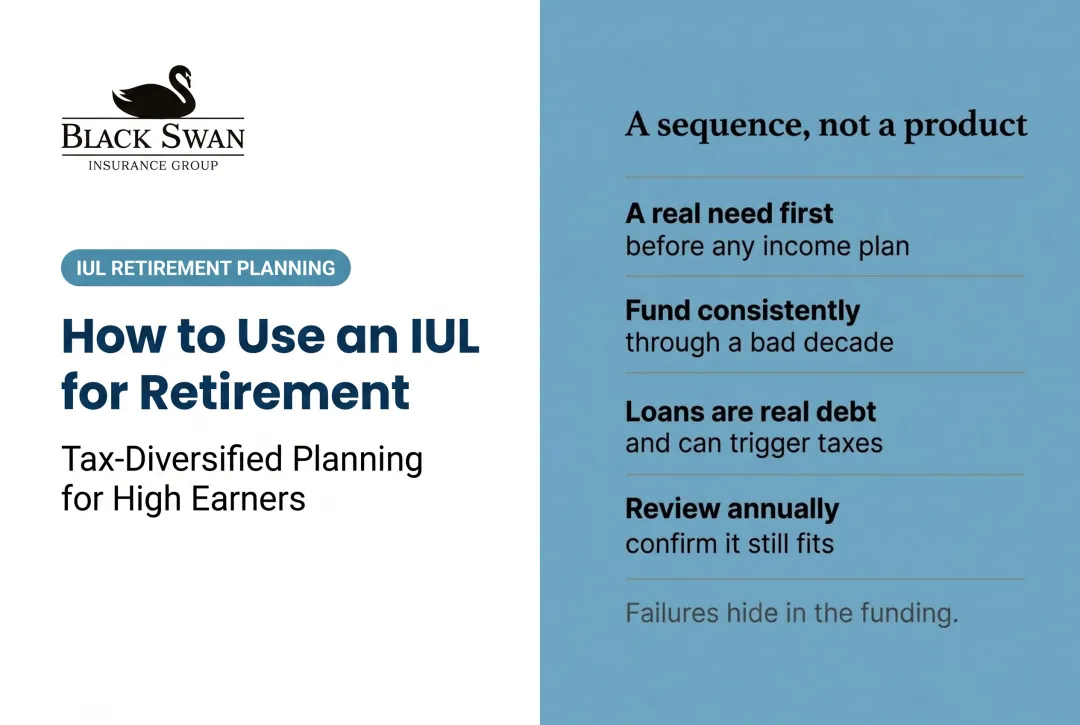
This is not set-it-and-forget-it. It is design-it, fund-it, review-it.
Watch for these red flags in an existing policy:
- Missed or reduced premium payments
- Rising loan balances relative to cash value
- Declining surrender value year over year
- Insurer-reduced caps or participation rates
- An illustration leaning heavily on non-guaranteed assumptions
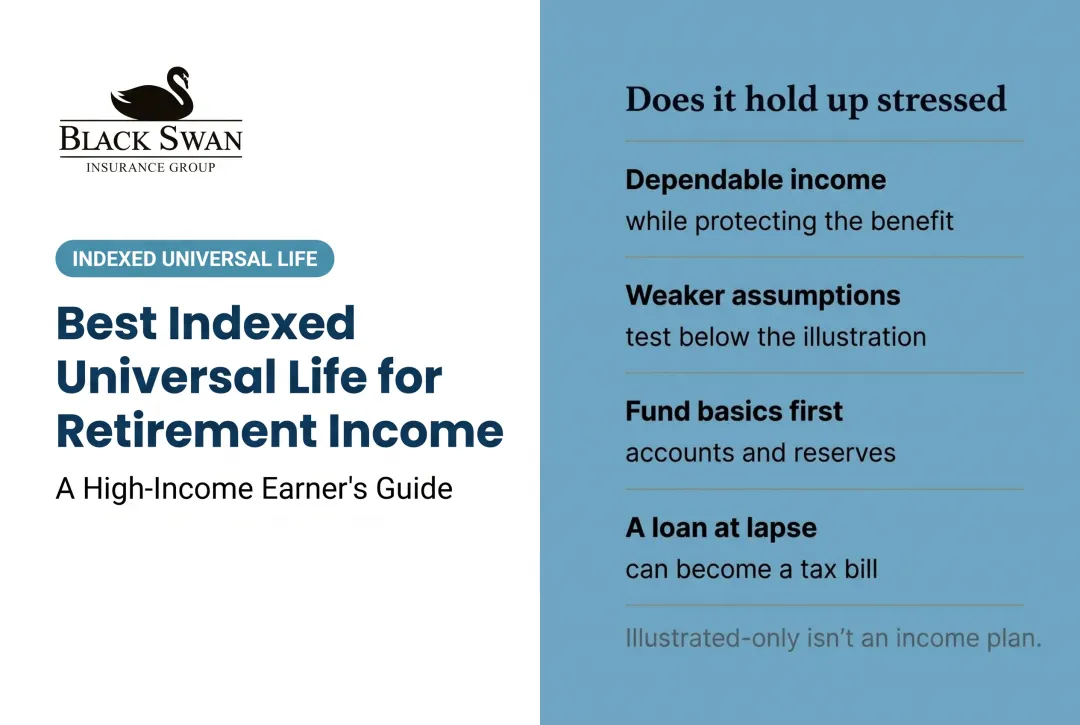
A lapse or surrender with a loan outstanding can create taxable gain even when you receive little or no cash — lost coverage plus an unexpected tax bill, which is the worst version of this product's failure mode.
Stronger Fit
An IUL is worth modelling for retirement if you:
- Earn $150K+, have captured the match and have maxed the 401(k)
- Have a genuine, identifiable permanent insurance need
- Have stable surplus cash flow beyond reserves, debt payments and core contributions
- Have a horizon long enough to absorb early policy charges
- Will request an in-force illustration and review the contract annually
Weaker Fit
An IUL is a poor fit — and not everyone should buy one — if you:
- Have no identifiable permanent insurance need
- Have unpredictable income or limited liquidity
- Doubt you can sustain premiums for 15 years or more
- Prefer simple, low-cost investing
- Have an unclaimed employer match or unresolved high-interest debt
Stress-Test It Before You Buy
Request the full illustration and separate guaranteed values from current, non-guaranteed projections. Then test the design against rougher conditions than the ledger assumes.

- Lower crediting assumptions than the illustrated rate
- Extended periods of 0% crediting, not merely one bad year
- Reduced caps or participation rates over time
- Missed premium payments for a year or two
- Policy loans during retirement and their effect on the death benefit
Then ask directly: what are the guaranteed values, what is the maximum premium I might need to pay, and what happens if I stop funding for a year? Compare the answers against term insurance, whole life, 401(k) contributions, IRAs and annuities before deciding.
Risks to Understand Before You Rely on One
- Underfunding is the leading failure mode, and the damage surfaces decades later when replacing coverage is expensive.
- Cost of insurance rises with age, so a design that works at 45 can strain at 70 if funding never changed.
- Caps and participation rates can be cut going forward, subject to contract minimums.
- Surrender charges can run a decade or more and penalise an early exit.
- MEC status is generally permanent and removes the living-access advantage the strategy was built on.
- Loan interest compounds. The loan is not the problem; the unmanaged loan is the problem.
Find Out Where You Actually Stand
This starts with the Tax-Free Wealth Blueprint Fit Review. If you earn $150K+ and you are wondering whether a policy belongs in your retirement plan at all, we test your insurance need, funding capacity, horizon and existing accounts against the real alternatives — term, Roth, brokerage and doing nothing. We run the funding through lower-crediting and zero-credit years and show the charges in plain numbers. If IUL does not fit, we will tell you that too.
Frequently Asked Questions
Is IUL good for retirement income?
It can supplement retirement income for the right policyholder, but it is not a reliable primary vehicle. Success depends on a genuine permanent insurance need, consistent long-term funding, and managing charges and lapse risk.
What are the biggest risks of using an IUL for retirement?
Underfunding, rising insurance costs, caps that limit upside and loans that accrue interest. Changing insurer assumptions and the possibility of a taxable lapse add further complexity.
Can an IUL replace a 401(k) or IRA?
No. It serves a different purpose and should be compared against — never substituted for — employer matching, 401(k) contributions and IRAs.
How much should I contribute to an IUL for retirement?
There is no universal number. Funding should follow from your death-benefit need, cash flow, tax position and a stress-tested illustration reviewed with a qualified professional.
Are IUL withdrawals and loans tax-free?
Not automatically. Withdrawals are tax-free only up to basis, and loans generally avoid current tax only while the policy stays in force and is not a MEC. A lapse or surrender with a loan outstanding can create taxable income.
Who is an IUL best suited for?
People with a genuine permanent life insurance need, stable surplus cash flow, a long time horizon and the discipline to monitor the policy. Those needing short-term liquidity or simpler investing are usually better served elsewhere.
Sources
- Guardian Life — Indexed universal life insurance
- IRS — Revenue Ruling 2009-14
- IRS — Life insurance and disability insurance proceeds
- Society of Actuaries / LIMRA — 2015–2021 UL lapse rate study
- NAIC — Life Insurance Illustrations
Disclosure: This article is educational and is not personal tax, legal or investment advice. Indexed universal life is life insurance first. Actual results depend on policy design, carrier, crediting options, caps, participation rates, expenses, funding and ongoing management. Illustrated values are not guarantees; actual results depend on policy terms, crediting, costs and funding. This strategy is not appropriate for everyone. Policy loans and withdrawals reduce cash value and the death benefit, and can create tax consequences if the policy lapses or becomes a modified endowment contract. Consult your own tax, legal and financial professionals for advice specific to your situation.
And remember, it's not what you earn, it's what you keep… enjoy the ride.