By Robert Balgac, Founder, Black Swan Insurance Group | October 5, 2026
These three products share a chassis and solve different problems. They all offer permanent coverage with flexible premium and a cash value component. What separates them is who carries the risk of the cash value performing, and how much certainty you are willing to pay for.
Choosing between them on the illustration is how people end up with the wrong one. Choose on the job you need done.
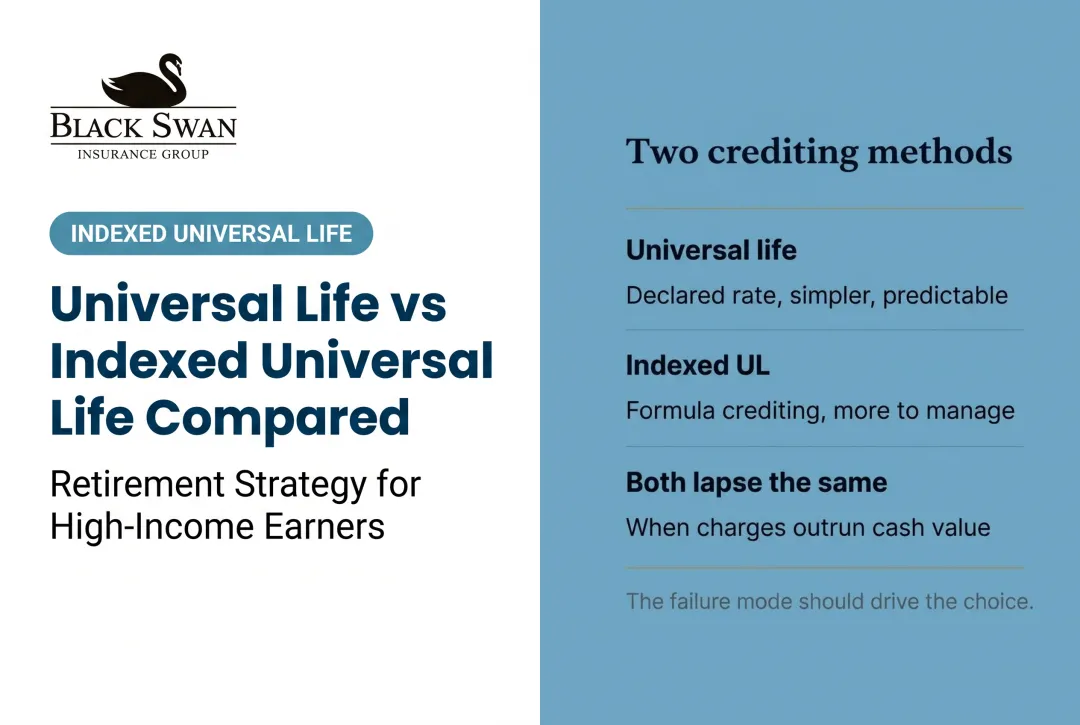
The short answer: Guaranteed UL buys the most certainty and builds the least cash value — it is a death benefit with a premium schedule. Traditional UL credits a declared interest rate set by the carrier, with a guaranteed minimum. IUL credits via an index-linked formula with a floor and a cap, offering more upside potential and more variability. More potential cash value means less guarantee, in every direction.
Key Takeaways
- GUL is for a certain death benefit at the lowest sustainable cost; cash value is incidental
- Traditional UL credits a declared rate with a contractual minimum — simple, predictable, currently modest
- IUL trades a declared rate for a formula with a floor and a cap, adding upside potential and variability
- All three can lapse if underfunded; GUL's guarantee is conditional on paying exactly as scheduled
- Pick on the job to be done, not on which illustration shows the largest number
The Three, Side by Side
| Guaranteed UL | Traditional UL | Indexed UL | |
|---|---|---|---|
| Primary job | Certain death benefit | Permanent coverage with modest accumulation | Coverage plus index-linked cash value potential |
| Cash value | Minimal by design | Declared rate, guaranteed minimum | Index formula, floor and cap |
| Upside | None meaningful | Limited | Capped, index-linked |
| Certainty | Highest | Moderate | Lowest of the three |
| Premium flexibility | Low — the guarantee depends on the schedule | Moderate | High |
| Main risk | Losing the guarantee by paying late | Declared rate falling to the minimum | Flat crediting while charges run |
All three are permanent life insurance first. Any potential tax-advantaged access to cash value depends on the policy being properly structured, funded and managed.

Guaranteed Universal Life
Think of it as term insurance that does not expire. You accept minimal cash value in exchange for a contractual guarantee that the death benefit will be there provided you pay as scheduled.
The trap is in that last clause. A GUL's no-lapse guarantee is conditional. Pay late, pay less, or skip a payment and the guarantee can be forfeited even though the policy continues — leaving you holding an expensive contract without the feature you bought it for.
Traditional Universal Life
The carrier declares an interest rate periodically, subject to a guaranteed minimum written into the contract. Simple and transparent, which is its main virtue. In a low-rate environment the declared rate may sit at or near the minimum for years, which is why many buyers moved to indexed products.
Indexed Universal Life
Crediting is determined by a formula referencing an index, with a floor on the credit and a cap or participation rate limiting it. You are not invested in the index. In exchange for the floor you accept the cap, and caps are generally non-guaranteed within contract limits.
Same premium. Different design. Completely different outcome — and that is true across all three of these, not just within IUL.

What the Critics Get Right
Critics are right that IUL is sold to people whose actual need is a guaranteed death benefit, which GUL provides more cheaply and more reliably. They are right that a GUL guarantee is often described as unconditional when it is not. And they are right that traditional UL's simplicity is undervalued in a market that rewards complicated illustrations.
Where the criticism overreaches is treating the variability of IUL as a defect rather than a trade. You trade some upside for downside crediting protection and flexibility, and for a buyer who genuinely wants accumulation potential alongside coverage, that trade can be reasonable.
How to Choose
- Name the job. Certain death benefit? GUL. Coverage with simple accumulation? UL. Coverage with index-linked growth potential? IUL.
- Test the funding against a bad year, not a good one.
- Read the guaranteed column on all three, not the illustrated one.
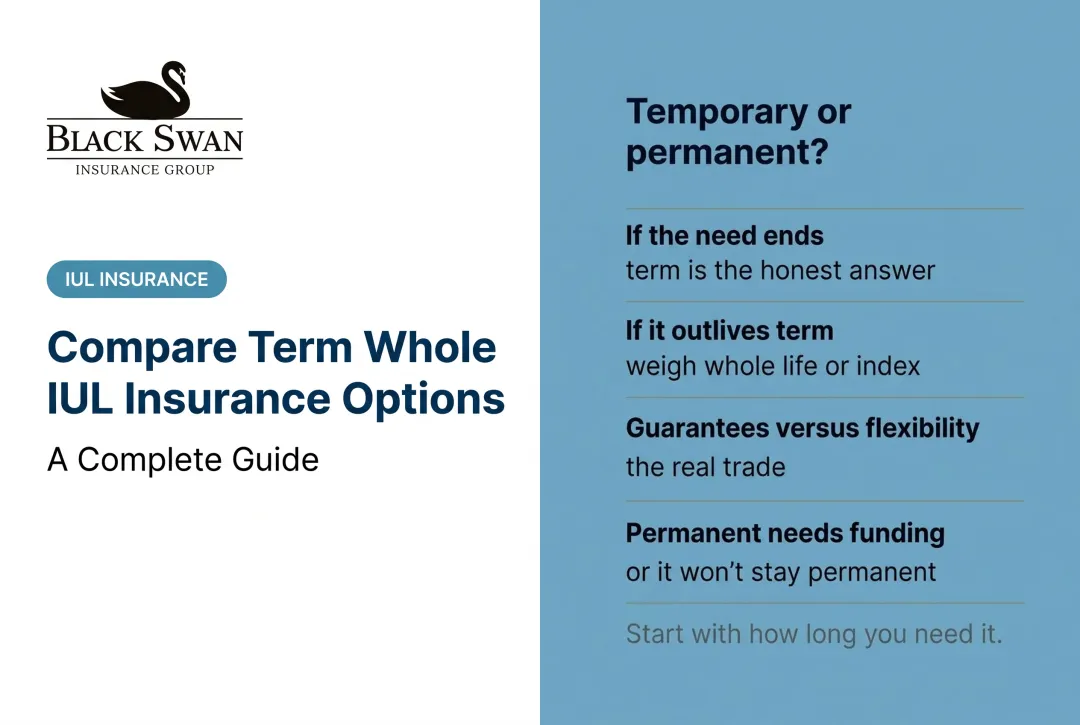
- Price term insurance alongside — if the need is temporary, none of these three is the answer.
- Ask what voids the guarantee on a GUL, specifically and in writing.
The Questions That Separate Them in Practice
Once you have named the job, four questions will usually settle which structure to use.
How much certainty do you want to buy, and what is it worth? Guarantees are not free. GUL's premium buys certainty by giving up accumulation. If certainty is what keeps you comfortable, paying for it is rational — just know that is the trade you are making.
What happens if you pay late? On a GUL, this is the most important question in the contract. Ask specifically what grace and catch-up provisions exist, and whether a missed payment can be cured without losing the guarantee. Get the answer in writing.
What is the guaranteed minimum? On a traditional UL, the guaranteed minimum credited rate. On an IUL, the guaranteed minimum cap. Both are the floor of what you have actually contracted for, and both are considerably less attractive than current declarations.
Who manages it, and how often? GUL is closest to set-and-forget, which is part of its appeal. Traditional UL needs occasional attention. IUL needs an annual review, without exception. If nobody is going to do that review, the IUL is the wrong choice regardless of its other merits.
The best policy is not the biggest illustration. It is the one that survives real life.
The Ultimate IUL Blueprint
A plain-English walkthrough of how these three structures differ, what each guarantees, and how to read what an illustration is assuming.
Who Each May Fit
Stronger Fit
- GUL — an estate liquidity need, a lifetime obligation, a buyer who wants certainty and no management
- UL — someone who wants permanence and simplicity over accumulation potential
- IUL — $150K+ income, sustainable funding of $500–$2,500 a month, a twenty-year-plus horizon, a real protection need, and willingness to review annually
- All three: already capturing the employer match and funding available retirement accounts
Weaker Fit
Not everyone should buy an IUL, or any permanent policy. If the protection need ends when the mortgage does or the children finish school, term insurance is the direct answer and costs a fraction as much.
- A temporary protection need
- Unstable income or no emergency reserve
- Liquidity needed inside the surrender period
- An expectation of market-like returns from any of the three

Risks to Understand Before You Choose
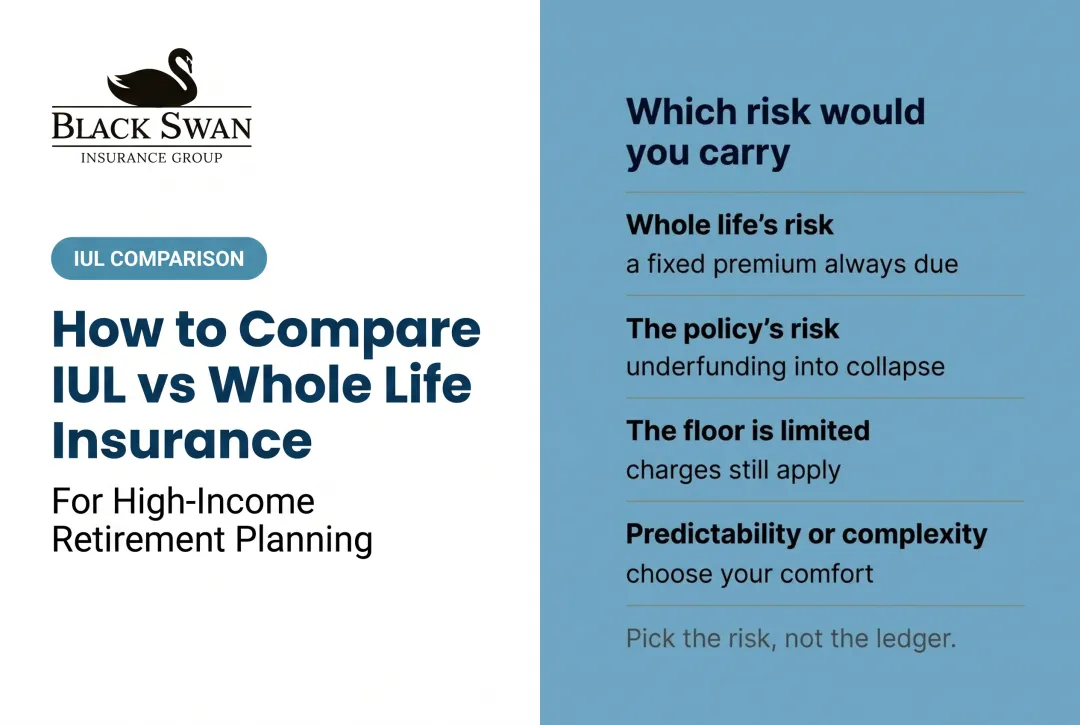
- All three can lapse if funding falls short; permanence is conditional on the premium arriving.
- A GUL no-lapse guarantee is conditional and can be forfeited by late or reduced payments.
- Traditional UL declared rates can fall to the contractual minimum.
- IUL caps, participation rates and current charges are generally non-guaranteed within contract limits.
- Cost of insurance generally rises with age in all three.
- Policy loans and withdrawals reduce cash value and the death benefit, and a lapse with gain and an outstanding loan can create taxable income with no cash received to pay it.
Find Out Where You Actually Stand
Start with the Tax-Free Wealth Blueprint Fit Review. If you earn $150K+ and are choosing between these three, we start from the job you need done rather than the product, model all three on your numbers at guaranteed values, and price term insurance alongside them. If IUL does not fit, we will tell you that too.
Frequently Asked Questions
What is the difference between UL and IUL?
Traditional UL credits a declared interest rate set by the carrier with a guaranteed minimum. IUL credits via a formula referencing a market index, subject to a floor and a cap.
Is GUL better than IUL?
For a certain death benefit at the lowest sustainable cost, generally yes. For accumulation potential alongside coverage, no. They solve different problems.
Can a guaranteed universal life policy still lapse?
Yes. The no-lapse guarantee is conditional on paying as scheduled. Late or reduced payments can forfeit it while the policy itself continues.
Which has the lowest premium?
For a given death benefit, GUL is usually the cheapest permanent option because it is not trying to build cash value.
Which builds the most cash value?
IUL has the highest potential and the least certainty. Actual results depend on design, funding, charges and crediting.
Should I consider term insurance instead?
If the protection need is temporary, yes. Term is not the enemy. Cheap coverage solves a real problem. It just does not solve every problem.
Can I switch from one to another later?
A 1035 exchange can move cash value between policies without triggering tax on the gain, but it restarts the surrender schedule and requires new underwriting. It is not a casual adjustment.
Which is best for estate planning?
Often guaranteed universal life, because the objective is a certain death benefit rather than accumulation. An ILIT may be relevant depending on the size of the estate.
Do all three require annual reviews?
IUL genuinely does. Traditional UL benefits from periodic checks. GUL needs the premium paid exactly as scheduled, which is its own form of ongoing attention.
Sources
- NAIC — Life Insurance — universal life, indexed universal life and guaranteed UL definitions
- NAIC, Life Insurance Illustrations Model Regulation (Model #582) — non-guaranteed element disclosure
- NAIC buyer's guide — affordability and periodic policy review
- I.R.C. § 7702A — Modified Endowment Contract and the seven-pay test
- I.R.C. § 72 — additional tax on early distributions
Disclosure: The information on this page is educational in nature and does not constitute personalized financial, tax, or legal advice. Actual results depend on policy design, carrier, crediting options, caps, participation rates, expenses, funding, loans, and ongoing management. Policy loans and withdrawals reduce cash value and the death benefit, and can create tax consequences if the policy lapses or becomes a modified endowment contract. Consult a licensed insurance professional and, where appropriate, a tax or financial advisor before making any insurance or financial decision. Indexed universal life is life insurance first. Illustrated values are not guarantees; actual results depend on policy terms, crediting, costs and funding. This strategy is not appropriate for everyone.
And remember, it's not what you earn, it's what you keep… enjoy the ride.