By Robert Balgac, Founder, Black Swan Insurance Group | October 5, 2026
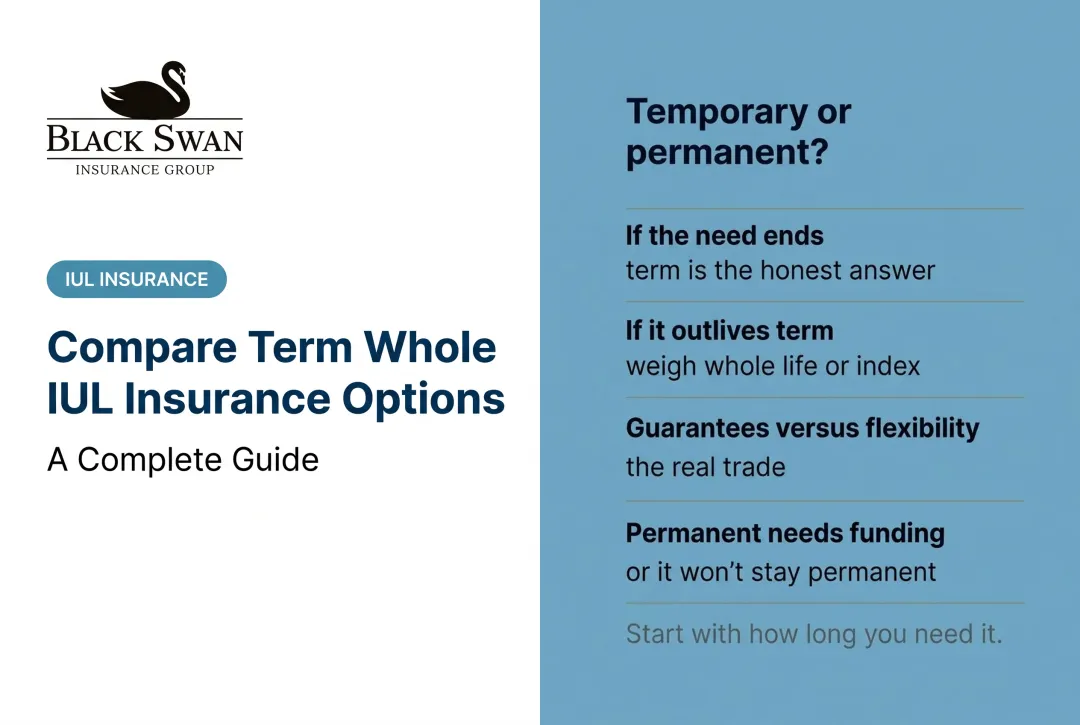
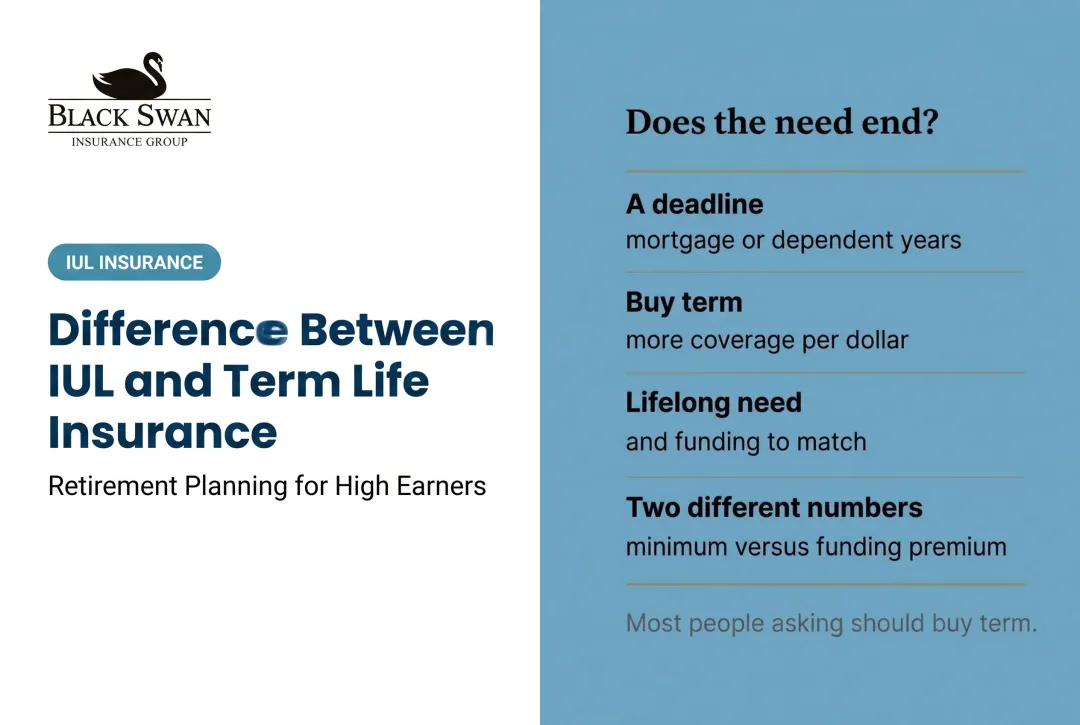
Term insurance and indexed universal life solve two different problems, and the honest starting position is that term solves the more common one.
Term is built for affordable, temporary protection. It delivers the most death benefit per premium dollar of anything in this market, and for a household covering a mortgage or replacing income while children are young, it is usually the whole answer.
An IUL combines permanent coverage with cash value credited on an index-linked formula. It costs more, demands ongoing management, and earns its place only where the protection need genuinely outlasts a term.
If you earn $150K+ and someone has framed this as an upgrade question, it is not. It is a duration question.
The short answer: Term prioritises affordable, temporary death-benefit protection with far lower starting premiums. An IUL offers permanent coverage and cash value, with outcomes depending on charges, caps, floors and funding discipline. Match term to time-bound needs such as a mortgage or dependent children; reserve a permanent policy for a confirmed permanent need with sustainable funding. An illustration is a projection, not a promise. Many households layer both — term for the large temporary need, a smaller permanent policy for the lasting one.
Key Takeaways
- Term insurance prioritises affordable, temporary death-benefit protection at far lower starting premiums
- IUL offers permanent coverage and cash value, with outcomes driven by charges, caps, floors and funding discipline
- Match term to time-bound needs; reserve a permanent policy for a confirmed permanent need with sustainable funding
- An illustration is a projection — review guaranteed and non-guaranteed figures separately
- Many households layer both rather than choosing one
The Core Comparison
Duration
Term covers a set window, usually 10, 20 or 30 years, per NAIC's life insurance overview. When the term ends, coverage stops unless you renew, and renewal premiums climb steeply with age.
An IUL is built as permanent coverage and can stay in force for life while premiums and cash value keep covering policy costs. Miss that requirement and even a permanent policy lapses.
Cost
- Term — lower initial cost and more death benefit per premium dollar during the selected term
- IUL — a higher long-term cost structure with flexible premiums that still have to be funded; underfunding cuts cash value and raises lapse risk
Cash Value
- Term — none, by design. Pure protection for the period
- IUL — part of the premium builds cash value, credited with index-linked interest subject to caps, floors, participation rates and fees
Management
- Term — pay the premium, keep the coverage
- IUL — adjustable premiums and death benefits, with periodic review of charges, crediting assumptions and loan balances
| Factor | Term insurance | IUL |
|---|---|---|
| Best for | Temporary, budget-defined needs | Confirmed permanent needs |
| Cash value | None | Index-linked, capped |
| Management | Minimal | Ongoing reviews required |
| Typical buyer | Growing families with temporary needs | High earners and business owners with lasting obligations |
How an IUL Works
Permanent life insurance built around a death benefit and a cash-value account. Cash value does not buy index shares; interest credits are linked to how an external index, often the S&P 500, performed over a set period.
Each premium splits between policy charges — mortality costs and administrative fees — and the cash-value account. What happens to that cash value depends on your specific crediting formula, not a generic market return.
Three Terms Drive the Result
- Cap — the maximum crediting rate for the period. Insurers can adjust this while the policy is active, per NerdWallet's IUL breakdown
- Floor — the minimum crediting rate, often 0%, and usually guaranteed. It does not erase your insurance costs
- Participation rate — the percentage of index gains credited. 70% participation on a 10% index gain credits 7%, not 10%

Zero is your hero in a down year — but the floor applies to the credit, not to the internal charges deducted every month.
What it offers the right buyer: lifelong coverage while funded; tax-deferred cash-value growth; potential tax-advantaged access through loans or withdrawals when the policy is properly structured, funded and managed; and flexibility to adjust premiums and death benefit over time.
The risks: insurance costs and fees rising with age; illustrated growth rates that are projections rather than guarantees; loans that reduce the death benefit and can trigger tax consequences if the policy lapses; and underfunding that eventually forces a choice between paying more or losing the coverage.
How Term Works
Term pays a death benefit if you die during a stated period. No cash value — protection, not accumulation, and that is the design rather than a shortcoming.
- Level term — fixed premium and death benefit for the full term
- Renewable term — renew without new medical underwriting, at rising premiums
- Convertible term — the option to switch to permanent coverage later
- Decreasing term — a death benefit that shrinks over time, often tied to a declining debt
- Return-of-premium term — refunds premiums if you outlive the term, at a higher cost
The advantage is efficiency. You get substantial coverage for a low premium because you are not also funding a cash-value account. The trade is that coverage can expire, renewal costs more, and nothing is left if you outlive it.

Where term fits: replacing income while children are financially dependent; covering a mortgage balance or other significant debt; protecting a business loan for its repayment period; supporting a spouse through your working years. It is also the practical choice whenever maximising death benefit within a fixed budget matters more than building cash value.
If conversion might matter later, confirm with the insurer: the conversion deadline, which permanent products qualify, the cost difference after conversion, and whether new medical underwriting is required. These vary by carrier and state, and a convertible term policy preserves options a non-convertible one does not.
What the Critics Get Right
The "buy term and invest the difference" position is the strongest argument in personal finance on this topic, and it deserves acknowledging rather than arguing with.
Critics are right that most households comparing these two should buy term, because most protection needs have an end date. They are right that the cost difference is enormous in the early years, and that a permanent policy sold to someone with a temporary need is a poor outcome regardless of how well it is designed. And they are right that the cash-value story takes a decade to become true, which means an early exit loses money.
Where the argument depends on an assumption is the investing half — it works when the difference actually gets invested, every year, through a bad market. And where it stops applying entirely is a need that does not expire: a dependent who will always require support, an estate liquidity problem, a business obligation that outlasts any term you can buy at your age. Those are the cases where permanent coverage is not the expensive option. It is the only option.
Which One Fits
There is no universal winner. The decision runs on why you need coverage, how long you need it, what you can sustainably afford, your health and insurability, how much liquidity you need elsewhere, and whether you will monitor policy performance over time.
Stronger Fit for Term
- The need has a defined end date — a mortgage, children reaching independence, a business loan term
- Maximising death benefit within a fixed budget matters most
- You want straightforward administration and no ongoing management
- Cash flow is variable and a long premium commitment would strain it
- Emergency reserves or retirement contributions are not yet where they should be
Stronger Fit for Evaluating an IUL
- A confirmed, ongoing need for permanent protection rather than temporary coverage
- Household income of $150K+ with stable surplus cash flow after emergency reserves and essential expenses
- A long enough horizon to fund the policy properly past the early charges
- Willingness to review the policy annually rather than filing it away
- Qualified plans, Roth strategies and brokerage accounts already maxed or evaluated
Not everyone should buy an IUL, and most households reading this page should not. Late-start high earners deserve extra caution. Age, health, underwriting outcomes and a shorter funding runway all affect whether a permanent policy makes sense against the alternatives. An optimistic illustration is not a substitute for that analysis.
Layering Both
The most common sensible answer for a $150K+ household with young children is not one or the other. It is a large term policy sized to the temporary need — income replacement, the mortgage, education — plus a smaller permanent policy only where a lasting obligation genuinely exists. That structure costs a fraction of insuring everything permanently and it covers both problems.

The Ultimate IUL Blueprint
If part of your need is genuinely permanent, the Blueprint covers the design decisions for that portion: funding levels, the MEC line, loan timing and what to demand from an illustration.
Stress-Test the Decision First
Before committing to either, compare against emergency savings and employer-provided coverage; 401(k) contributions and Roth strategies; brokerage assets and disability coverage; whole life, guaranteed universal life or annuities; and any business-specific insurance need.
Term is not the enemy. Cheap coverage solves a real problem. It just does not solve every problem.
Risks to Understand Before You Choose
- Buying permanent coverage for a temporary need is the most expensive error available in this comparison
- Term coverage expires, and re-insuring at 60 after a health event may be impossible at any price
- Renewal premiums climb steeply, which is why the conversion option on a convertible policy has real value
- IUL charges continue in a 0% crediting year, so cash value can fall with the floor intact
- Cost of insurance rises with age inside a permanent policy and is deducted regardless of crediting
- Caps and participation rates are non-guaranteed and can be adjusted while the policy is active
- Underfunding forces a choice between paying more or losing coverage, often at a bad moment
- Loans reduce the death benefit, and a lapse with a loan outstanding and gain in the contract creates taxable income
- Crossing the seven-pay limit makes a policy a MEC and changes distribution taxation permanently
Find Out Where You Actually Stand
This starts with the Tax-Free Wealth Blueprint Fit Review. If you earn $150K+, we size the temporary need and the permanent need separately, price term for the first, and test whether the second is real before anyone designs a permanent policy. If it does not fit, we will tell you that too — and "term only" is the conclusion more often than not.
Frequently Asked Questions
Is term always cheaper?
In premium terms, substantially, during the term. It is also temporary, so the comparison is only meaningful once you know how long the need actually lasts.
What happens when my term ends?
Coverage stops unless you renew at a higher premium or converted earlier. If your health has changed, replacing coverage may be expensive or unavailable, which is why conversion deadlines matter.
Can I have both?
Yes, and many households should. A large term policy for the temporary need plus a smaller permanent policy for a genuinely lasting obligation covers both problems at a fraction of the cost of insuring everything permanently.
Does a 0% floor protect an IUL's cash value?
No. The floor applies to the credit. Cost of insurance and administrative charges are deducted every month regardless, so cash value can fall in a flat year.
What is convertible term and should I want it?
The option to convert to permanent coverage later, usually without new underwriting. It preserves flexibility if your health changes or a permanent need emerges, and it is worth asking about.
Which should I buy if I am not sure?
Term, generally — it is cheaper, simpler and reversible in the sense that you can convert or add permanent coverage later. Buying permanent coverage you turn out not to need is the harder mistake to undo.
Sources
- NAIC — Life Insurance
- NerdWallet — Indexed universal life insurance
- NAIC — Life Insurance Illustrations
- NAIC — Life Insurance Buyer's Guide
- I.R.C. § 7702A and Rev. Proc. 2008-39 (modified endowment contracts and the seven-pay test)
Disclosure: This article is educational and is not personal tax, legal or investment advice. Indexed universal life is life insurance first. Conversion terms, renewal provisions and product availability vary by carrier and state. Actual results depend on policy design, carrier, crediting options, caps, participation rates, expenses, funding and ongoing management. Policy loans and withdrawals may reduce cash value and death benefit and can create tax consequences if the policy lapses or becomes a modified endowment contract. This strategy is not appropriate for everyone. Illustrated values are not guarantees; actual results depend on policy terms, crediting, costs and funding. Consult your own tax, legal and financial professionals for advice specific to your situation.
And remember, it's not what you earn, it's what you keep… enjoy the ride.