By Robert Balgac, Founder, Black Swan Insurance Group | October 9, 2026
High earners tend to arrive at the same wall. The saving is going fine. What is unclear is whether the money is organised for the right outcomes — because retirement income, permanent protection, tax diversification and legacy planning are all competing for the same surplus dollars.
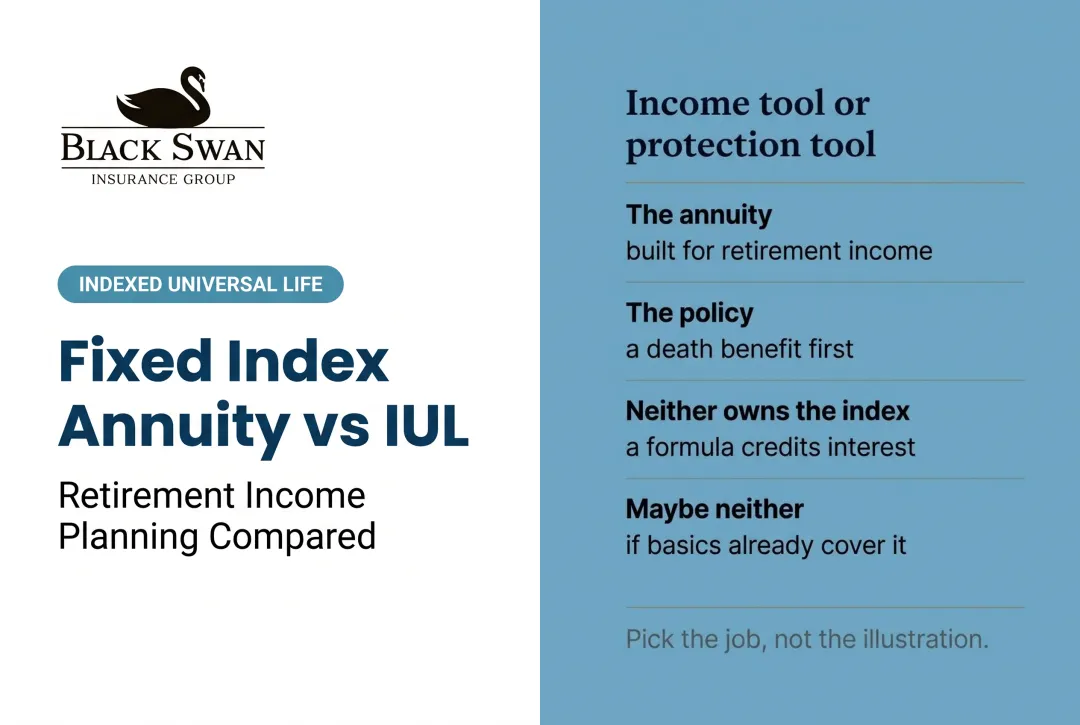
Annuities and IUL get bundled together in that conversation constantly, usually by someone who sells both. They are not variations on a theme. An annuity converts savings into income you cannot outlive. An IUL is permanent life insurance with a cash value account attached. Different problems, different failure modes.
The short answer: Start with the job, not the product. An annuity starts with an income objective and solves longevity risk. An IUL starts with a permanent protection objective and may build accessible cash value as a secondary benefit. If you do not need lifetime income, an annuity is the wrong instrument. If you do not need permanent death-benefit coverage, an IUL is the wrong instrument — and for many people the honest answer is neither.
U.S. retail annuity sales reached $464.1 billion in 2025, up 7% year over year. More households are weighing both against traditional retirement accounts, which makes getting the framing right worth a few minutes.
Key Takeaways
- Annuities convert savings into income and address longevity risk; IUL is life insurance first with cash value second
- An annuity suits someone prioritising guaranteed income over death-benefit protection
- IUL suits someone with a genuine insurance need, a long funding horizon and reliable surplus cash flow
- Neither should displace employer plans, emergency reserves or properly structured term coverage
- Compare the actual contract — fees, caps, surrender schedules, insurer strength — never an illustrated number
The Comparison That Matters
| Factor | Annuity | IUL |
|---|---|---|
| Primary purpose | Accumulation, principal protection, or income payments | Permanent death benefit with cash-value potential |
| Income | Can be structured for immediate or deferred lifetime payments via annuitisation or a rider | Not guaranteed; depends on cash value, loans and the policy staying in force |
| Death benefit | Varies by contract; often requires a specific rider | Central feature; reduced by unpaid loans, withdrawals or lapse |
| Growth exposure | Ranges from fixed, to fixed indexed, to variable | Index-linked crediting with caps, participation rates and floors |
| Liquidity | Surrender periods and withdrawal limits apply | Loans and withdrawals available; surrender charges often apply early |
Two clarifications before anyone leans on that table.
"Annuity" on its own tells you nothing about risk. A fixed annuity, a fixed indexed annuity and a variable annuity behave completely differently — one guarantees a rate, one caps gains against a floor, and one can lose principal outright, per the SEC's investor bulletin on variable annuities.
An IUL floor is not the same as being risk-free. A 0% floor stops negative index crediting. Monthly cost-of-insurance and administrative charges keep deducting regardless.
Zero is your hero in a down year — but the floor applies to the credit, not to the charges.
What an Annuity Actually Is
A contract with an insurance company: you exchange one or more premiums for interest credits, accumulation, or scheduled income — sometimes for life, depending on which contract you sign.
Immediate annuities begin payments soon after funding. Deferred annuities accumulate first. Fixed annuities carry a guaranteed minimum rate for a stated period. Fixed indexed annuities credit interest by reference to an index without investing in it. Variable annuities depend on chosen subaccounts and can lose value.
The NAIC's buyer's guide to fixed deferred annuities sets out how directly those structural differences drive your guarantees, fees and risk. Which is why "I bought an annuity" is not a sentence that conveys information.
The strongest use case is simple and genuinely valuable: a predictable income floor sitting alongside Social Security, a pension and portfolio withdrawals. Those guarantees rest on the issuing insurer's claims-paying ability, so the contract, the riders and the surrender schedule all need individual review.
Tax deferral generally applies to growth, but distributions are taxed under IRS rules in Publications 575 and 939. Verify current guidance rather than assuming any portion arrives untaxed.
Payouts vary enormously with age, premium, payout option and single- versus joint-life. As one illustration, Guardian's April 2026 rate sheet showed approximate monthly income on a $100,000 immediate single-life annuity with no guarantee period: about $571 at 55, about $662 at 65, and about $738 at 70.

Those are figures from one insurer at one moment, not a universal quote.
What an IUL Actually Is
Permanent life insurance built around a death benefit and a cash value account, with policy charges and insurance costs deducted from that cash value under the contract's terms.
Crediting references an external index, but you never own it. The formula uses a cap, a participation rate, a floor (usually 0%) and sometimes a spread.
This is why index performance and policy performance are not the same number. Nationwide's 2024 IUL illustration uses a hypothetical 100% participation rate, a 9% cap and a 0% floor: a 15% index gain credits 9%, a 6% gain credits 6%, and a −12% year credits 0%. None of that is net policy growth — monthly insurance and administrative charges still come off, including in the 0% year.
An illustration is a model, not a guarantee.
For a suitable buyer the benefits are real: permanent protection while the policy stays funded, tax-deferred accumulation potential, and access through withdrawals or loans under the contract's terms.
So are the risks. Premiums are not set-and-forget. Illustrated values are projections. Excessive loans or withdrawals reduce the death benefit or collapse the policy, and a lapse with a loan outstanding can be a taxable event. A contract that fails the seven-pay test under IRC §7702A becomes a modified endowment contract and loses the favourable loan treatment entirely.
The Ultimate IUL Blueprint
If you are comparing these two, the Blueprint covers what an IUL design has to survive: funding levels, caps and charges, the MEC line, loan timing, and what to demand from an illustration before you commit.

What the Critics Get Right
Both products attract heavy criticism, and in both cases the criticism has a defensible core.
Annuities are frequently sold with surrender schedules that outlast the buyer's patience, riders whose cost is poorly explained, and guarantees that depend entirely on one insurer remaining solvent for thirty years. IUL is frequently sold on illustrations nobody stress-tests, to people who did not need permanent coverage, by someone paid on the premium.
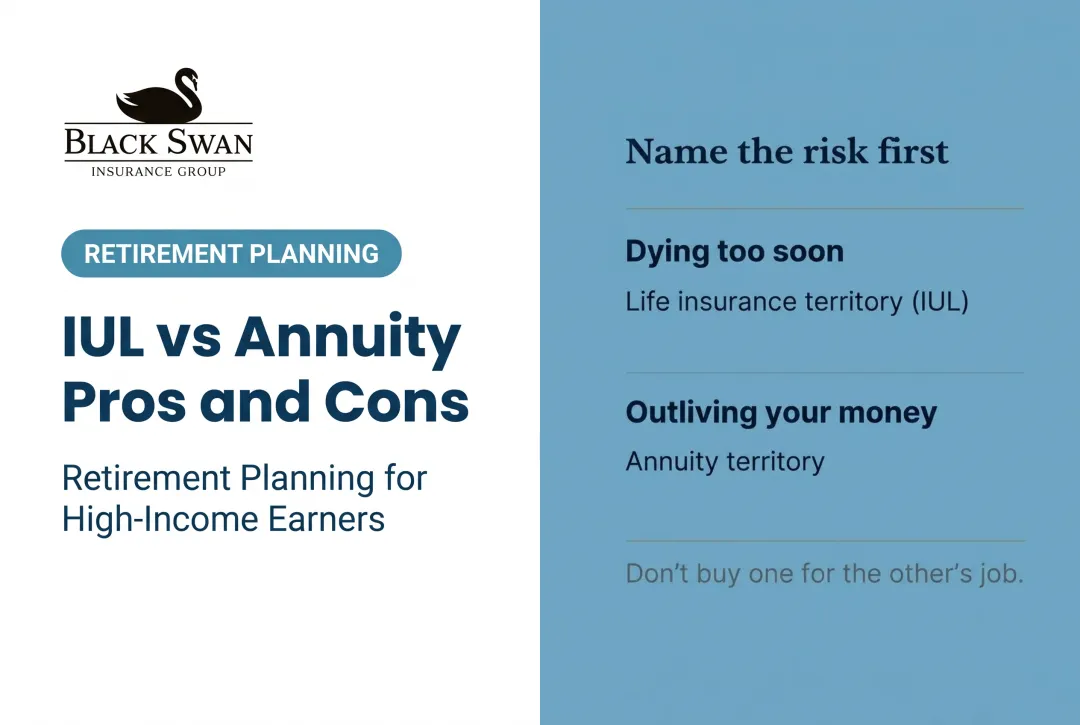
What the critics usually skip is that longevity risk and premature-death risk are both real, and neither a brokerage account nor a 401(k) addresses either one directly. The failure is not that these instruments exist. It is that they get sold as investments rather than as insurance against specific, nameable risks.
Choosing Between Them
An annuity, when you want a predictable income stream or want to reduce longevity risk; when you want to limit market-loss exposure through a suitable fixed or fixed indexed contract and accept the caps, surrender terms and insurer dependence; or when permanent life insurance simply is not a need.
An IUL, when you need permanent death-benefit protection for dependents, a business or an estate plan; when you are building cash value after retirement accounts, reserves and protection are handled; and when you will accept the complexity of monitoring funding, loans and performance.
Before signing either, compare guaranteed against non-guaranteed values, the fees and surrender charges, the caps or participation rates, what the riders actually cost, the insurer's financial strength, and the beneficiary and exit terms.
Some households do run both — one for income, one for protection — but only after confirming the combined premiums are not crowding out reserves, retirement contributions or existing coverage.
And sometimes the honest answer is neither. Term life, a maxed 401(k), a Roth, or a diversified brokerage account may serve the goal better. A clear no-fit still answers the question.
Stronger Fit
An IUL is worth modelling if you:
- Earn $150K+ with surplus cash flow after reserves, debt and maxed retirement contributions
- Have a genuine permanent protection, business or legacy need
- Are insurable at a reasonable rate with a 15-to-20-year funding horizon
- Will review the contract annually rather than file it away
Weaker Fit
Look at an annuity instead — or at neither — if you:
- Need guaranteed lifetime income more than a death benefit
- Have no dependents and no estate liquidity problem
- Cannot fund consistently through a downturn
- Need the money liquid inside five to ten years
- Only need coverage for a defined period, where term is cheaper and entirely sufficient
Two Scenarios
Hypothetical, built from publicly available illustration assumptions. Not client results and not guaranteed outcomes.
The income-focused retiree. 65, no dependents, no permanent insurance need, wanting to supplement Social Security. A single-life immediate annuity funded with $100,000 might generate roughly the $662 a month Guardian illustrated, depending on insurer, state and prevailing rates. The trade-off is blunt: that $100,000 is largely illiquid once annuitised, and no death benefit comes with it by default.
The business owner needing protection. 48, spouse, two children, surplus cash flow after maxing retirement accounts, a genuine permanent death-benefit need and a 20-year funding horizon. An IUL can be structured here — with the guaranteed death benefit evaluated entirely separately from any illustrated cash value, and the loan and lapse risk explained before anything is signed.
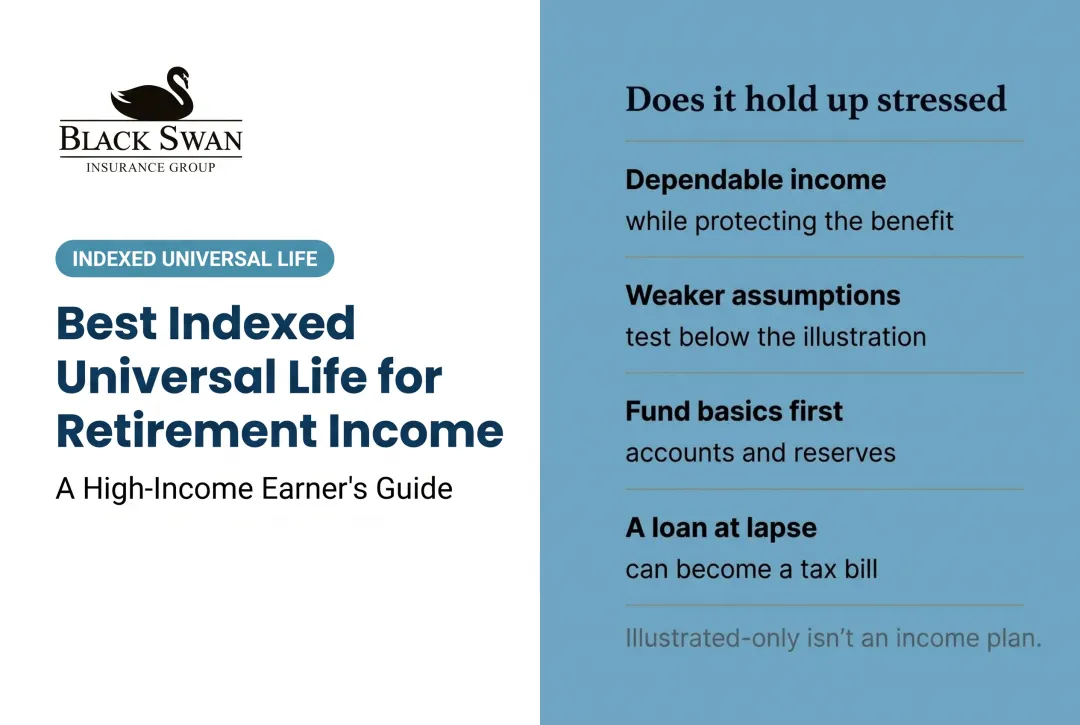
Judge each contract on whether it performs its intended job under conservative assumptions and stays sustainable if income, health or priorities change. The larger illustrated number is not the deciding factor.

Risks to Understand Before You Commit to Either
- Both depend on one insurer's claims-paying ability for decades. Ratings describe the company, not the suitability of your contract.
- Annuitisation is usually irreversible. Liquidity you give up does not come back.
- Surrender schedules bite early on both products and are frequently longer than buyers expect.
- IUL caps and participation rates can be lowered going forward, subject to contract minimums.
- IUL cost of insurance rises with age, and underfunding is the leading cause of policy failure.
- Neither distribution is automatically untaxed. Annuity payments are generally taxable in part or whole; IUL loans carry lapse and tax risk.
Find Out Where You Actually Stand
This starts with the Tax-Free Wealth Blueprint Fit Review. If you earn $150K+ and someone has put an annuity and an IUL in front of you, we work out which risk you are actually trying to insure against — outliving the money, or dying too early with obligations outstanding — then model the funding, stress-test it through lower-crediting and zero-credit years, and show the charges and surrender terms in plain numbers. If the right answer is term plus a brokerage account, we will say so. If IUL does not fit, we will tell you that too.
Frequently Asked Questions
Is an IUL better than an annuity?
Neither is universally better; they insure against opposite risks. An IUL is permanent life insurance with cash value. An annuity is an income or accumulation contract. The right choice follows from your protection need, income goals and liquidity.
What is the main difference?
An IUL pays a death benefit and may build accessible cash value. An annuity is built to accumulate and then distribute income, often for life. Both may offer tax deferral, but the risks and restrictions differ sharply.
How much will a $100,000 annuity pay per month?
It depends on age, type, prevailing rates, payout option and single- versus joint-life. One 2026 illustration showed roughly $571 to $738 a month across ages 55 to 70. Always obtain a current, contract-specific quote.
Can I have both?
Yes, and some households do — one for income, one for protection. Only after confirming cash flow, liquidity and existing coverage can sustain both sets of funding requirements.
Are IUL withdrawals and annuity payments tax-free?
Not automatically. Treatment depends on the contract, your basis, the distribution method and policy status. IUL loans carry lapse and tax risk; annuity distributions are generally taxable in part or in full.
Is term insurance a better answer than either?
If your need is a death benefit for a defined period, very often yes. Term is cheaper, simpler and solves that problem completely. Permanent coverage earns its cost only when the need genuinely outlives a term.
Sources
- LIMRA — U.S. retail annuity sales totalled $464.1 billion in 2025
- SEC — Investor bulletin on variable annuities
- NAIC — Buyer's guide to fixed deferred annuities
- Guardian — Annuity income rates
- Nationwide — IUL illustration
- NAIC — Life Insurance Illustrations
Disclosure: This article is educational and is not personal tax, legal or investment advice. Indexed universal life is life insurance first. Annuity and insurance guarantees are subject to the claims-paying ability of the issuing insurer, and product availability and terms vary by carrier and state. Illustrated values are not guarantees; actual results depend on policy terms, crediting, costs and funding. Actual results depend on policy design, carrier, crediting options, caps, participation rates, expenses, funding and ongoing management. This strategy is not appropriate for everyone. Policy loans and withdrawals reduce cash value and the death benefit, and can create tax consequences if the policy lapses or becomes a modified endowment contract. Consult your own tax, legal and financial professionals for advice specific to your situation.
And remember, it's not what you earn, it's what you keep… enjoy the ride.