By Robert Balgac, Founder, Black Swan Insurance Group | October 9, 2026
Most guides to opening a max-funded IUL stop at the application. That is the easy part. The decisions that determine whether the contract still works in year twenty are made at design, and the problems that destroy it — overfunding into MEC status, quietly missed premiums, an unmanaged loan, caps that drifted lower while nobody looked — all arrive afterwards.
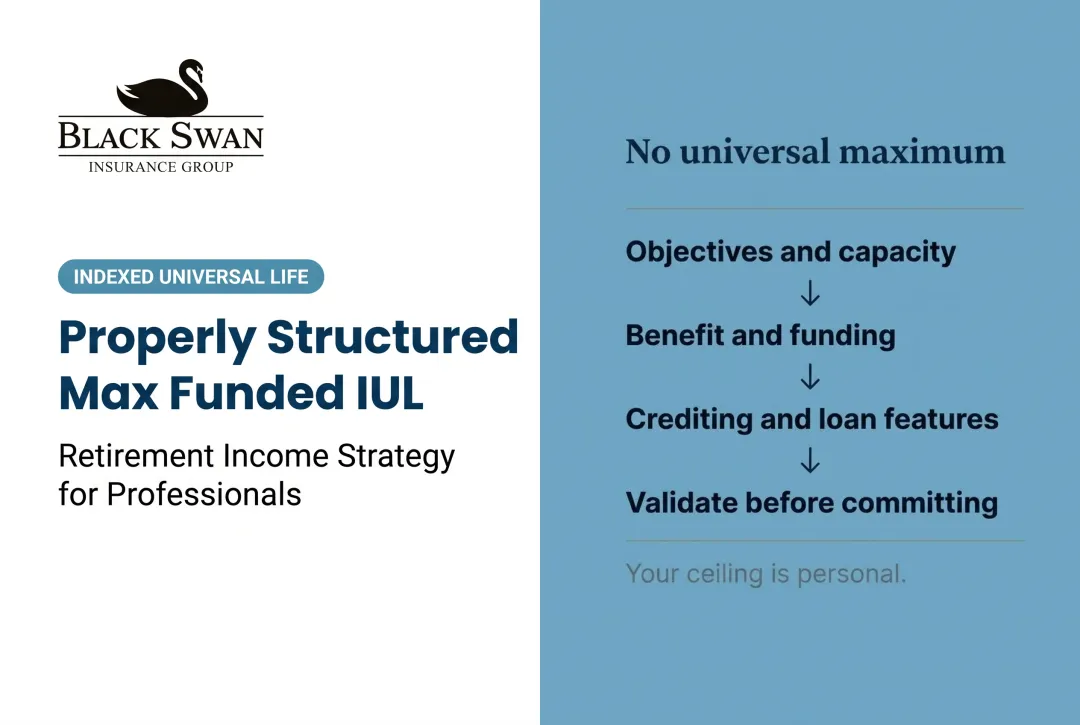
There is also no account here. You are applying for permanent life insurance and structuring the premium to push cash value as high as the contract allows without crossing the Modified Endowment Contract line. Writing the biggest cheque you can afford is not the strategy; it is the most common way the strategy fails.
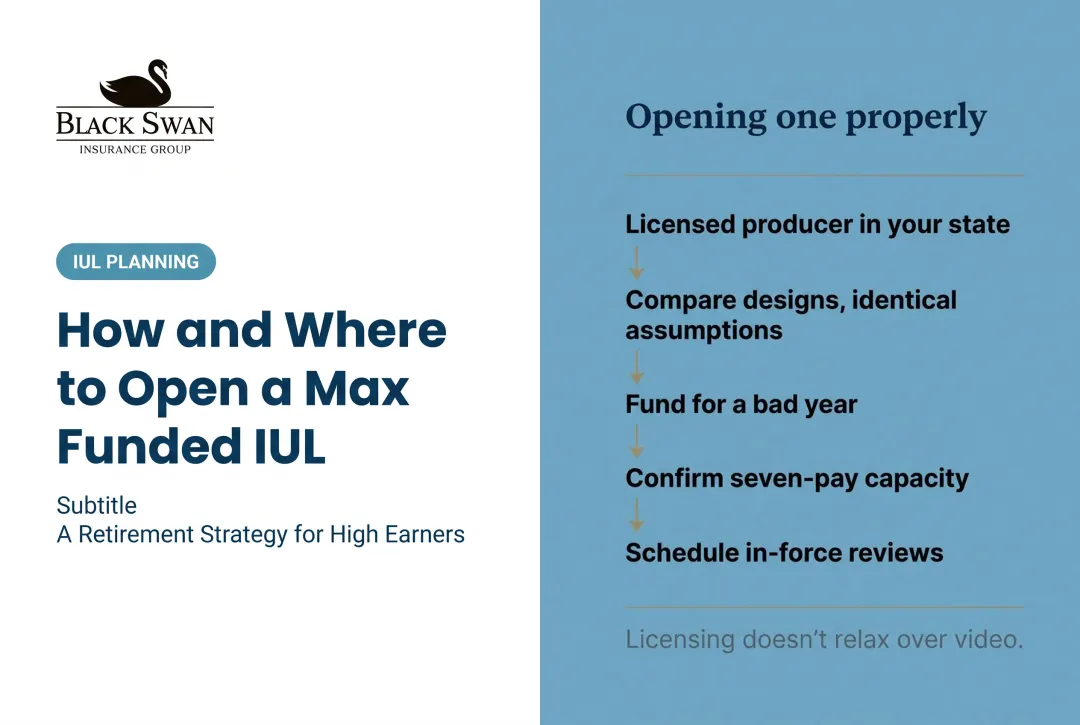
The short answer: Max funding is a design and maintenance discipline, not a deposit. Confirm a genuine permanent protection need, fund only what you can sustain through a bad year, verify remaining seven-pay room with the carrier before every unscheduled payment, and request an in-force illustration annually. When performance slips, fix the process before you change the product.
If you earn $150K+, have maxed the 401(k) and hit the Roth phase-outs, you are the target buyer — and the one most likely to be handed a premium number before anyone asked what the death benefit is for.
Key Takeaways
- Max funding prioritises cash value growth while keeping life insurance tax treatment intact — it is not a market bet or a retirement account
- The seven-pay test sets your funding ceiling, and it is contract-specific, so confirm every extra payment with the carrier first
- Evaluate policies on guaranteed and non-guaranteed figures together, never the illustrated projection alone
- Treat this as a supplement to emergency savings, matched retirement plans and other investments, never a replacement
- Loans, missed premiums and shifting index terms make ongoing monitoring mandatory rather than optional
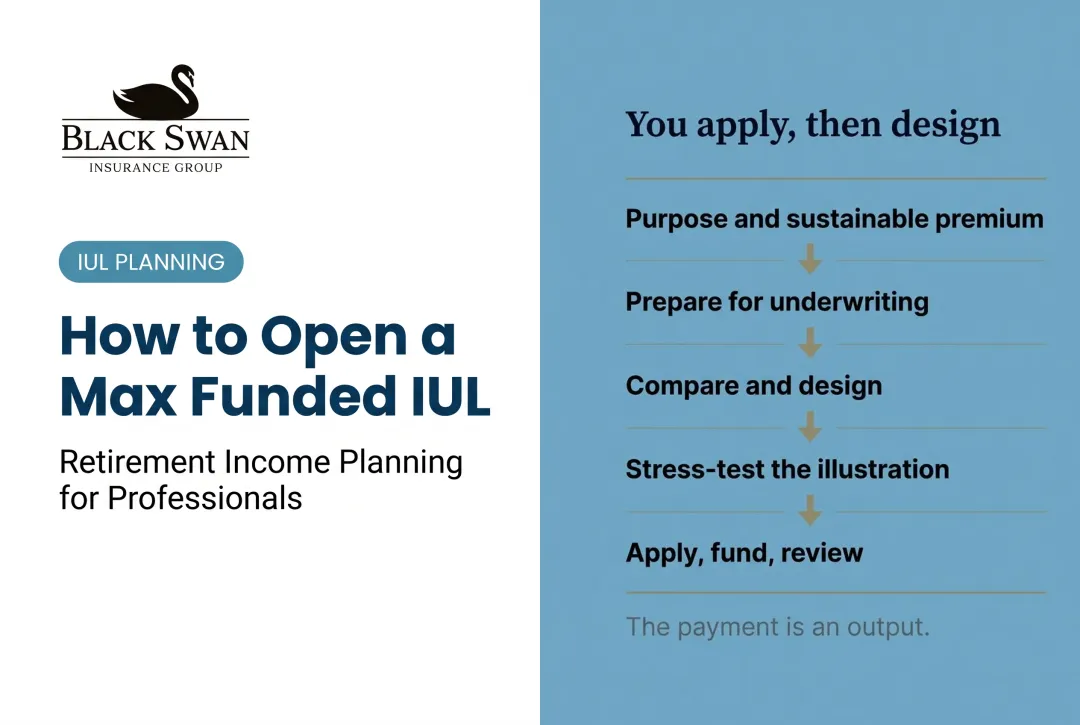
Step 1: Purpose and Affordability
Identify why you want the contract. Permanent protection, supplemental retirement flexibility, tax diversification, liquidity and legacy planning are the common drivers, and they overlap.
Before choosing a premium, review income stability and existing coverage; emergency reserves and outstanding debts; employer retirement-plan matching you already receive; and current qualified contributions and other savings priorities.
Then set a sustainable contribution range. An aggressive premium that looks excellent on paper becomes unmanageable the first time a business slows or a job changes — and the policy, not the spreadsheet, absorbs the consequence.
Step 2: Needs Analysis and Preliminary Design
Separate two questions that get conflated constantly: how much death benefit do you actually need, and how much cash value do you want to build? A minimum-death-benefit design is efficient for accumulation and can leave your family underinsured. Both things are true at once.
Ask for multiple illustrations covering different funding levels, death-benefit options, premium durations and index strategies. Compare a lean accumulation-focused design against one with extra death-benefit headroom for years when income, bonuses or business distributions fluctuate. If the permanent policy's coverage falls short of the real protection need, discuss adding term insurance or a rider rather than stretching the permanent contract to cover it.
Step 3: Compare Carriers, Contracts and Assumptions
No two IUL contracts are built the same. Review each carrier on financial strength and policy charges; surrender schedule and premium flexibility; index-account options, caps, participation rates and spreads; and guaranteed floors and loan provisions.
Insist that current illustrated assumptions are separated from contractual guarantees. Caps, participation rates and spreads are non-guaranteed and can be reset after you own the policy.
The NAIC has tightened illustration limits and consumer disclosures precisely because illustrated non-guaranteed values have historically been mistaken for promises.
An illustration is a model, not a guarantee.
Compare at least one genuine alternative too: additional 401(k) contributions, a Roth IRA if you are eligible, taxable brokerage investing, term insurance paired with investing, or whole life or an annuity.
The Ultimate IUL Blueprint
Before you commit to a design, the Blueprint covers what it has to survive: funding levels, caps and charges, the MEC line, loan timing, and exactly what to demand from an illustration.
Step 4: Apply, Underwrite, Issue
Gather personal, financial and beneficiary information; medical history, prescriptions and tobacco use; occupation details and existing coverage.
Underwriting may involve health records, a paramedical exam and financial justification for the requested amount. Approval, rating class and final premium are never settled until the carrier issues the contract — which is why a design built around an assumed health class deserves a second look when the offer arrives.
Before signing, confirm policy owner, insured and beneficiaries; premium schedule and death-benefit option; riders and index allocations; surrender terms and loan provisions; and how the carrier will run MEC testing on your specific contract.
Step 5: Fund and Monitor
Make planned payments through the carrier's approved process and confirm each one posts correctly.
Do not add extra premium without checking the maths first. Exceeding the seven-pay limit, the guideline premium limits or your policy's available funding room triggers MEC status, and that is generally not reversible.
Schedule annual reviews covering in-force values, charges, crediting assumptions, loan balances, premium sufficiency and beneficiary designations.
This is not set-it-and-forget-it. It is design-it, fund-it, review-it.

The Variables That Decide the Result
Premium amount and funding duration. Planned premium, payment frequency, front-loading and funding period all affect cash value, charges and your exposure to under- or overfunding. Carrier limits vary, and changing the funding duration alters both the death benefit and projected values.
Death-benefit amount and option. A lower death benefit reduces the relative cost of insurance and frees room for accumulation. It also reduces family protection and shrinks how much you are permitted to contribute under IRS rules. Compare level against increasing options, and consider whether a term rider covers the protection gap more cheaply.
MEC and seven-pay limits. The seven-pay test compares cumulative premiums during the first seven years against a legal limit. Exceed it and the contract becomes a MEC, changing how loans and withdrawals are taxed from then on. The test under IRC 7702A is a separate rule from the guideline-premium test under IRC 7702; failing one does not mean failing the other, and both matter. Verify remaining funding room with the carrier before adding payments, and again after any policy change, exchange, loan or death-benefit adjustment.
Index-crediting mechanics. The chosen index, a floor, a cap, a participation rate, a spread and an annual reset. Index-linked interest is not ownership of the underlying market index.
Zero is your hero in a down year — but the floor applies to the credit, not to the charges.

Costs. Premium loads reduce how much of each payment reaches cash value. Cost of insurance typically rises with age. Administrative charges are deducted on a set schedule. Rider costs apply to optional benefits. Surrender charges apply during the surrender period. Loan interest accrues on any outstanding balance.
Outstanding loans reduce the death benefit and can trigger a taxable event if the policy lapses or is surrendered while unpaid. Annual monitoring matters more with a max-funded design than a minimally funded one, simply because more cash value is sitting there to be eroded.
When It Goes Wrong: Troubleshooting
The costliest mistakes fall into four patterns: treating the contract as a guaranteed investment, mistaking an optimistic illustration for a promise, funding beyond verified MEC and guideline limits, and buying coverage that does not match the household's actual protection need.
Skipping the needs analysis, or crowding out an employer match. Go back to the full plan. Confirm the match and other savings priorities are captured first. If the broader plan is not ready, reduce or postpone the premium rather than forcing it.
Overfunding, or missing planned premiums. Overfunding creates a MEC; missed premiums starve cash value and raise lapse risk. Contact the carrier and your licensed professional before changing any payment. Correction procedures, reinstatement rules and tax treatment vary by situation, so there is rarely a universal fix.
Cash value below expectations. Likely causes: lower credited interest, falling caps, policy charges, insufficient premium, outstanding loans or withdrawals, or an illustration that was unrealistic from the start. Request an in-force illustration before changing anything — it shows where the policy stands today rather than where it was projected to be.
The loan is not the problem. The unmanaged loan is the problem.

What the Critics Get Right
The strongest criticism of max funding is that it demands a level of ongoing management most buyers were never told about and most sellers do not provide.
A term policy needs nothing but a premium. This needs annual in-force illustrations, awareness of remaining seven-pay capacity, attention to renewal caps, and loan discipline if you ever borrow. Critics are right that a product requiring active stewardship is routinely sold to people who will never receive it, and right that the illustration shown at the point of sale assumes a maintenance standard nobody commits to in writing.
A great IUL is engineered. A bad IUL is sold.
The honest version is conditional: this works if someone is genuinely minding it. Ask who, and how often, before you sign.
Who This Fits
Stronger Fit
- High-income professionals and executives with stable surplus cash flow
- Business owners building assets outside the company
- Affluent families wanting permanent protection plus tax diversification, after other priorities are addressed
- Buyers willing to engage with an annual review rather than file the contract away
Weaker Fit
Not everyone should buy this. Walk away or wait if you have a short time horizon or unstable income, insufficient emergency savings, premiums that strain the budget, a near-term need for liquidity, or a preference for simple low-cost investing.
| Alternative | Best fit when… |
|---|---|
| Term life plus investing | You need maximum coverage at lowest cost and prefer simple investing |
| Whole life | You want guaranteed cash-value growth and premium stability |
| 401(k) / Roth accounts | You have not maxed the employer match or tax-advantaged limits |
| Taxable brokerage | You want full liquidity and no insurance cost drag |
| Annuities | You want contractual income in retirement, not a death benefit |
Score each on after-tax result, guarantees, fees, liquidity, investment risk and protection value. Then pressure-test the single constraint that decides everything: whether you can sustain the funding long term.
Risks to Understand Before You Fund
- Crossing the MEC line is generally permanent and changes the tax treatment of every loan and withdrawal that follows.
- Caps, participation rates and spreads are non-guaranteed and can be reset within contract minimums after issue.
- Cost of insurance rises with age, and underfunding is the leading cause of policy failure.
- Surrender charges apply for years, so early exit is expensive by design.
- An unpaid loan at lapse or surrender can create taxable income with no cash received.
- Projected loans or income should never be described as automatically tax-free — that depends entirely on the contract staying in force and non-MEC.
Find Out Where You Actually Stand
This starts with the Tax-Free Wealth Blueprint Fit Review. If you earn $150K+ and either want this built properly or suspect an existing policy has drifted, we establish the protection need, model funding against your contract's own MEC limit, pull an in-force illustration where a policy already exists, stress-test through lower-crediting and zero-credit years, and compare carrier designs with charges and loan assumptions in plain numbers. If term plus investing serves you better, we will say so. If IUL does not fit, we will tell you that too.
Frequently Asked Questions
How do I get a max-funded IUL?
Start with a needs analysis and preliminary design, compare carriers and illustrations, complete the application and underwriting, and plan the premium carefully. Confirm MEC limits with the carrier before adding any extra payment.
Is a max-funded IUL a good idea?
It depends on your need for permanent insurance, long-term affordability, liquidity, health and time horizon. It works as one piece of a broader plan, not a replacement for emergency savings or employer-matched contributions.
How much does it cost?
Cost is individualised by age, health, death benefit, policy design, carrier and funding period. There is no universal minimum premium — ask for a personalised illustration rather than assuming a figure applies.
What happens if the policy becomes a MEC?
MEC status changes how distributions are taxed, generally applying an income-first rule and potentially a 10% additional tax on taxable amounts. Check current IRS guidance and speak to a tax professional before it becomes an issue.
Can I lose money in a max-funded IUL?
Yes. A floor on index crediting does not eliminate insurance charges, administrative fees, surrender costs or loan risk. Early surrender, insufficient funding or an unpaid loan at lapse can each produce a real loss.
My cash value is lower than illustrated. What now?
Request an in-force illustration before making any change, then review credited interest, current caps, charges, premium history and loan balances. Correct the funding or the loan before considering a surrender.
Sources
Disclosure: This article is educational and is not personal tax, legal or investment advice. Indexed universal life is life insurance first. Illustrated values are not guarantees; actual results depend on policy design, carrier, crediting options, caps, participation rates, expenses, funding and ongoing management. Seven-pay and guideline premium limits are contract-specific and must be confirmed with the issuing carrier before any additional payment. This strategy is not appropriate for everyone. Policy loans and withdrawals reduce cash value and the death benefit, and can create tax consequences if the policy lapses or becomes a modified endowment contract. Consult your own tax, legal and financial professionals for advice specific to your situation. Any potential tax-advantaged access depends on the policy being properly structured, funded and managed.
And remember, it's not what you earn, it's what you keep… enjoy the ride.