By Robert Balgac, Founder, Black Swan Insurance Group | October 9, 2026
You earn $150K+. You have maxed the 401(k), you are past the Roth phase-out, and somewhere in the last year someone described an indexed universal life policy to you as either a retirement fix-all or a scam. Both descriptions are marketing. Neither survives contact with an actual contract.
The honest question is not "does IUL sound good." It is whether the combination of a permanent death benefit, flexible premiums, index-linked cash value and potential tax treatment justifies the cost and complexity in your situation — and whether you have the cash flow and attention span the product demands.
The short answer: An IUL may fit if you need permanent life insurance, have dependable surplus cash flow, can fund it for decades, and understand that caps, participation rates and illustrated returns are not guarantees. It is not automatically the right move for retirement savings, and it is not a replacement for your 401(k) or your emergency fund. If you are not sure you have a permanent insurance need, you probably do not have one yet.
This is life insurance first. Everything else the product does is downstream of that.
Key Takeaways
- IUL is permanent life insurance with cash value credited from an external index — not a stock market investment
- It can fit high earners and business owners with a real permanent need and the capacity to fund for years
- A 0% crediting floor limits index losses; fees, loans and underfunding can still shrink policy value
- Compare it against term, whole life, 401(k) and Roth before committing
- Always request guaranteed and non-guaranteed illustrations, then stress-test both
- Income alone is never proof of suitability
What You Are Actually Buying
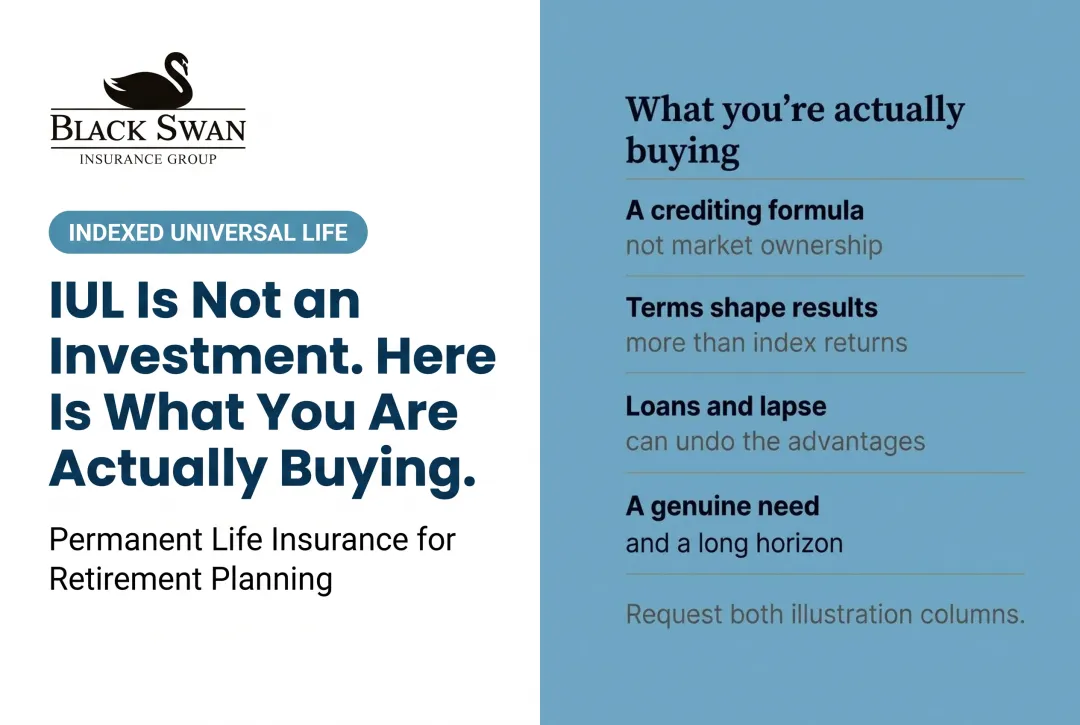
An IUL is a permanent life insurance contract: a death benefit paired with a cash value account, funded through flexible premiums. You are not locked into a fixed schedule as you would be with whole life. You can adjust contributions within policy limits as income changes.
Part of each premium covers cost of insurance and administrative charges. What remains can be allocated to fixed or indexed crediting strategies inside the policy. Your money is never directly invested in the S&P 500 or any other index. The index is a reference point the insurer uses to calculate credited interest.
Four Mechanics That Decide Your Credit
- Floor — the minimum credited interest, commonly 0%, so a down index year will not cut cash value through crediting alone
- Cap — the maximum rate creditable in a period, regardless of how well the index did
- Participation rate — the percentage of index gains counted toward your credit
- Spread — a deduction taken from index growth before the credit is calculated
Insurers apply these using annual point-to-point measurement, monthly averaging or similar methods. Here is what trips people up: caps, participation rates and spreads are frequently non-guaranteed. Carriers can adjust them going forward, subject to contractual minimums.
Why the Floor Is Not What You Were Told
This is the single most misunderstood feature of the product. A 0% floor protects you from negative index crediting. It does not protect your policy's total value.
Cost of insurance, administrative fees, loan interest and withdrawals keep deducting whether the index rises, falls or does nothing. An underfunded policy, or one carrying heavy loan balances, can lose value and eventually lapse in a year the index credited exactly 0%.
Zero is your hero in a down year — but the floor applies to the credit, not to the charges.

You can reach accumulated cash value through withdrawals or policy loans, and both carry trade-offs. Loans accrue interest, can reduce the death benefit and raise lapse risk if unmanaged. Ask directly how an outstanding loan would be treated if the policy terminated.
And before funding aggressively: paying in too much too fast can trigger Modified Endowment Contract status under the IRS seven-pay test, which permanently changes how loans and withdrawals are taxed. A tax professional should review the funding plan before you commit to it.
Who This Actually Suits
Fit starts with fundamentals, not your income bracket. You need a clear, ongoing need for permanent coverage; insurability; stable or reliably surplus cash flow; willingness to fund for the long haul; and comfort reviewing performance year after year. If those are not in place, nothing else matters.
High-Income Professionals and Executives
Physicians, attorneys, executives and sales leaders who have already handled their core priorities sometimes look here next, usually for tax diversification and income flexibility beyond qualified account limits.
For context, the 2026 employee 401(k) deferral limit is $24,500, with an additional $8,000 catch-up at age 50-plus ($11,250 for ages 60 to 63), and the combined traditional and Roth IRA limit is $7,500 (IRS). Roth contributions phase out beginning at $153,000 single and $242,000 joint — which is precisely why this conversation tends to start where it does.

IUL should never displace employer matching, suitable retirement accounts or emergency reserves.
The 401(k) is not the villain. A one-bucket retirement plan is the villain.
Business and Practice Owners
Owners with variable income but reliable average funding capacity sometimes use IUL to build personal wealth outside a concentrated business — retirement assets and liquidity that do not sit on the same balance sheet as operations. That is a distinct conversation from key-person coverage or succession funding. Do not let the two get merged in one meeting.
Affluent Families With a Legacy Objective
Income replacement, estate liquidity and inheritance strategy are legitimate reasons to consider permanent coverage. Protection comes first; cash value flexibility is secondary. Ownership and beneficiary structuring usually needs legal and tax input, especially for larger estates.
Late-Start High Earners
If you are reaching peak earnings in your late 40s or 50s, the runway for funding and insurability is tighter. Time horizon, health, sustainable premium capacity and liquidity needs matter more here than at any other stage.
The Ultimate IUL Blueprint
Before you decide, the Blueprint covers what the design has to survive: funding levels, caps and charges, the MEC line, loan timing, and what to demand from an illustration before you sign it.
What the Critics Get Right
The criticism worth taking seriously is this: IUL is sold with projections, priced with non-guaranteed assumptions, and compensated on premium volume. The three facts are related, and they point in the same direction.
A Maryland Insurance Administration consumer advisory states the core mechanic plainly — when premiums and policy value fall short of covering insurance and administrative costs, you may be forced to raise premiums, reduce the death benefit or risk a lapse (Maryland Insurance Administration). That is not an edge case. It is the mechanism every flexible-premium policy owner lives with.

What the criticism gets wrong is treating the product as the problem. The guaranteed column exists. The charge schedule exists. The surrender schedule exists. If an agent tells you a policy "cannot lose value," that is a red flag about the agent, not a feature of the contract.
A great IUL is engineered. A bad IUL is sold.
Stronger Fit
- A genuine need for permanent coverage, not a term-length need
- Capacity to sustain premiums through a rough year or two
- Adequate liquid reserves held entirely separate from this policy
- Willingness to accept complexity and monitor performance annually
- The policy is still worth owning even if cash value growth lands below the illustration
Weaker Fit
This strategy is not appropriate for everyone, and these are clear no-fits:
- Temporary protection only. Income replacement, mortgage coverage or protection through your children's school years is usually cheaper with term life. Buy term.
- Thin reserves or high-interest debt. Missed funding and weak cash value are the common path to a lapse.
- Short or uncertain horizon. Money you may need for a home, a business cost or a move does not belong here.
- You want simple, guaranteed accumulation. If you will not track charges, crediting assumptions, loans and lapse risk, buy something simpler.
If You Are Thinking of Replacing Existing Coverage
Pause. Replacing an in-force policy can mean new underwriting that costs more or disqualifies you if your health has changed; loss of guarantees built into the existing contract; a fresh contestability period and possible suicide-clause restart; surrender charges on the policy you are leaving; and replacement paperwork requiring a side-by-side comparison. Never replace a policy on the strength of one illustration.
How It Compares
| Option | Best suited for | Key trade-off |
|---|---|---|
| Term life | Temporary needs: income replacement, mortgage, child-raising years | Low cost, coverage ends, no cash value |
| Whole life | Buyers wanting contractual guarantees and simplicity | Less flexible premiums, typically stronger guarantees |
| Guaranteed universal life | Death benefit certainty above all else | Minimal cash value accumulation |
| IUL | Permanent need + flexible funding + index-linked upside | Non-guaranteed elements, funding discipline required |
| 401(k) / IRA / Roth | Tax-advantaged retirement saving | Contribution limits, RMD rules, no death benefit |
| Taxable brokerage | Full investment control and liquidity | No tax deferral, no death benefit, full market exposure |
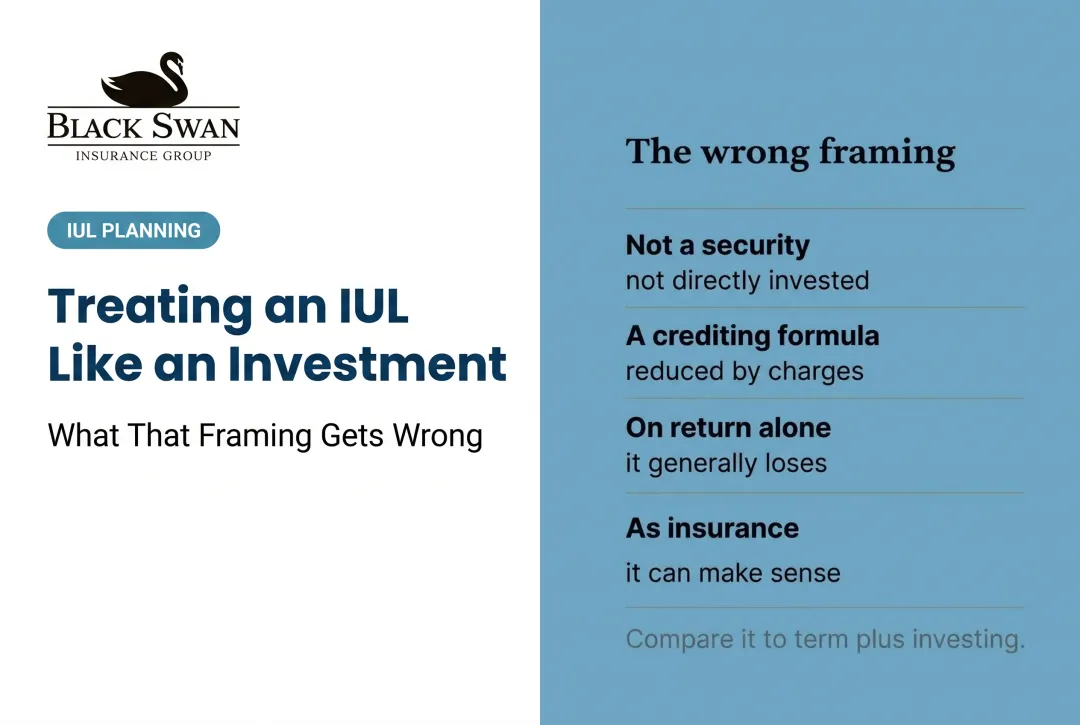
IUL versus term plus investing: term is cheaper upfront, and investing the difference can outperform an IUL if you genuinely invest it every single month. Compare total premiums, liquidity, investment risk and your actual track record — not the theoretical math.
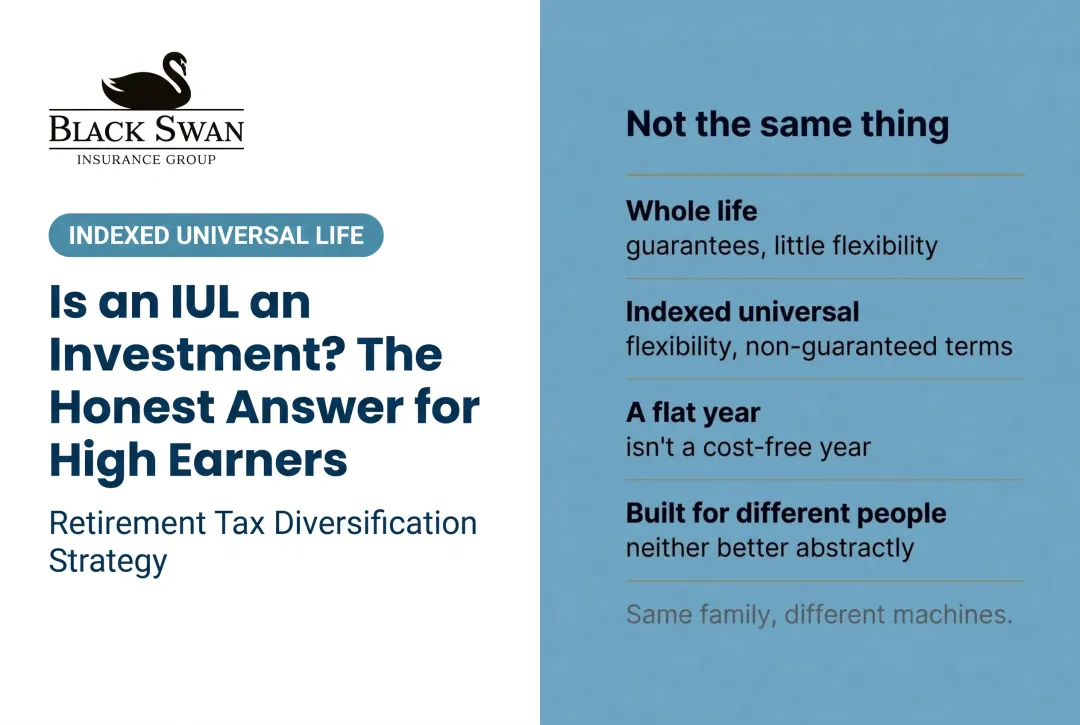
IUL versus whole life: whole life is simpler with stronger contractual guarantees. Prefer it for maximum certainty without needing premium flexibility; prefer IUL when cash flow varies and you want index-linked upside with permanent coverage.
IUL versus guaranteed UL: guaranteed UL locks in death benefit certainty and builds little cash value. Choose it when protection is the only goal.
IUL versus retirement accounts: these are not interchangeable, because IUL is insurance first. 401(k)s and traditional IRAs generally require RMDs from age 73; Roth IRAs have no lifetime owner RMD. Treat IUL as a complement once tax-advantaged space is maxed or a permanent need exists.
Risks to Understand Before You Sign Anything
- Non-guaranteed elements move. Ask what happens if caps or participation rates decline from today's levels. The NAIC draws a hard line between guaranteed and non-guaranteed illustrated values, and you can request an in-force illustration after the first policy anniversary (NAIC).
- Charges continue in flat years, including cost of insurance, premium loads, administrative fees, rider costs, surrender charges, loan interest and index-account charges. Ask for a year-by-year schedule of premiums paid, cash value, surrender value, death benefit and charges.
- Funding interruptions are the main failure mode. Stress-test against a layoff, a business downturn and an illness or disability leave.
- Loans reduce cash value and the death benefit and can create taxable income if the policy lapses with gain outstanding. The loan is not the problem; the unmanaged loan is the problem.
- MEC status is generally permanent. Confirm the funding plan stays within the limit before large premium payments.
- The insurer matters. Verify financial-strength ratings, historical changes to caps and participation rates, and complaint history — and ask how your adviser is compensated.

Find Out Where You Actually Stand
This starts with the Tax-Free Wealth Blueprint Fit Review. If you earn $150K+ and you are trying to decide whether to buy at all, we document the protection objective first, test the premium against a weak year rather than a strong one, compare designs across carriers, and read the guaranteed column next to the illustrated one. Sometimes that process points to an IUL. Sometimes it points to term, to whole life, or to no new policy at all. If IUL does not fit, we will tell you that too.
Frequently Asked Questions
Who should get indexed universal life insurance?
Someone with a real permanent coverage need, a long horizon and sustainable surplus cash flow who will actively manage the policy. Income alone does not prove suitability; funding discipline matters just as much.
Is it good to get universal life insurance?
It can work well when premium flexibility and permanent coverage match your goals. Weigh charges, funding requirements and non-guaranteed elements against simpler alternatives before deciding.
Can I lose money in an IUL?
Yes. The floor can prevent negative crediting from the index, but fees, insurance costs, surrender charges, loans and underfunding can all reduce policy value and even cause a lapse.
How long should I plan to keep an IUL?
Generally decades. Factor in the surrender charge schedule, your break-even timeline and whether you can sustain funding through the lean years.
Should I get an IUL before maxing out my 401(k)?
Generally no. Emergency savings, high-interest debt and employer matching come first — they usually deliver better immediate value. IUL is a supplement after those are handled.
What should I ask for in writing?
Every charge, a year-by-year ledger, guaranteed and non-guaranteed columns, the loan provisions, the surrender schedule and the remaining non-MEC room. If a request for those is met with friction, that is your answer.
Sources
- IRS — 401(k) limit increases to $24,500 for 2026, IRA limit increases to $7,500
- Maryland Insurance Administration — Universal Life Insurance consumer advisory
- NAIC — Life Insurance Illustrations
Disclosure: This article is educational and is not personal tax, legal or investment advice. Indexed universal life is life insurance first. Contribution limits and phase-out thresholds change over time; confirm current figures for your tax year. Illustrated values are not guarantees; actual results depend on policy terms, crediting, costs and funding. Any potential tax-advantaged access depends on the policy being properly structured, funded and managed. Actual results depend on policy design, carrier, crediting options, caps, participation rates, expenses, funding and ongoing management. This strategy is not appropriate for everyone. Policy loans and withdrawals reduce cash value and the death benefit, and can create tax consequences if the policy lapses or becomes a modified endowment contract. Consult your own tax, legal and financial professionals for advice specific to your situation.
And remember, it's not what you earn, it's what you keep… enjoy the ride.