By Robert Balgac, Founder, Black Swan Insurance Group | October 5, 2026
Ask what an IUL costs and you will usually be told a monthly premium. That number is the least useful figure in the conversation. The premium is what you put in. The cost is what the policy takes out before anything is credited, every month, for as long as you own it.
For a household earning $150K+, the decision is not whether the fees exist. They do. It is whether the design leaves enough net value after costs to justify choosing this structure over a taxable brokerage account, a 401(k) or term insurance with the difference invested. That question cannot be answered by a premium quote.
The short answer: An IUL has two cost layers. The premium you choose is a funding decision, not a price. The internal charges — premium load, cost of insurance, administrative fees, rider charges and any surrender schedule — are the actual cost, and they are deducted monthly whether or not interest is credited. Cost of insurance generally rises with age. Ask for the guaranteed column and a schedule of charges, not a monthly figure.
Key Takeaways
- The premium is a funding level you select; the internal charges are the real cost and they run regardless of crediting
- Cost of insurance generally increases with age, so charges are back-loaded even when premiums are level
- A larger death benefit for the same premium means more of your money goes to insurance cost and less to cash value
- Surrender charges can apply for a decade or more, so exiting early usually returns less than was paid in
- Caps and participation rates are an indirect cost: what you are not credited is as material as what you are charged
The Two Cost Layers
An IUL is permanent life insurance first. Any potential tax-advantaged access to cash value later depends on the policy being properly structured, funded and managed — and the charges below are what that funding has to outrun.
Layer One: The Premium You Choose
Most illustrations will show you several premium levels for the same policy, and they are not different prices for the same thing. They are different contracts in practice.
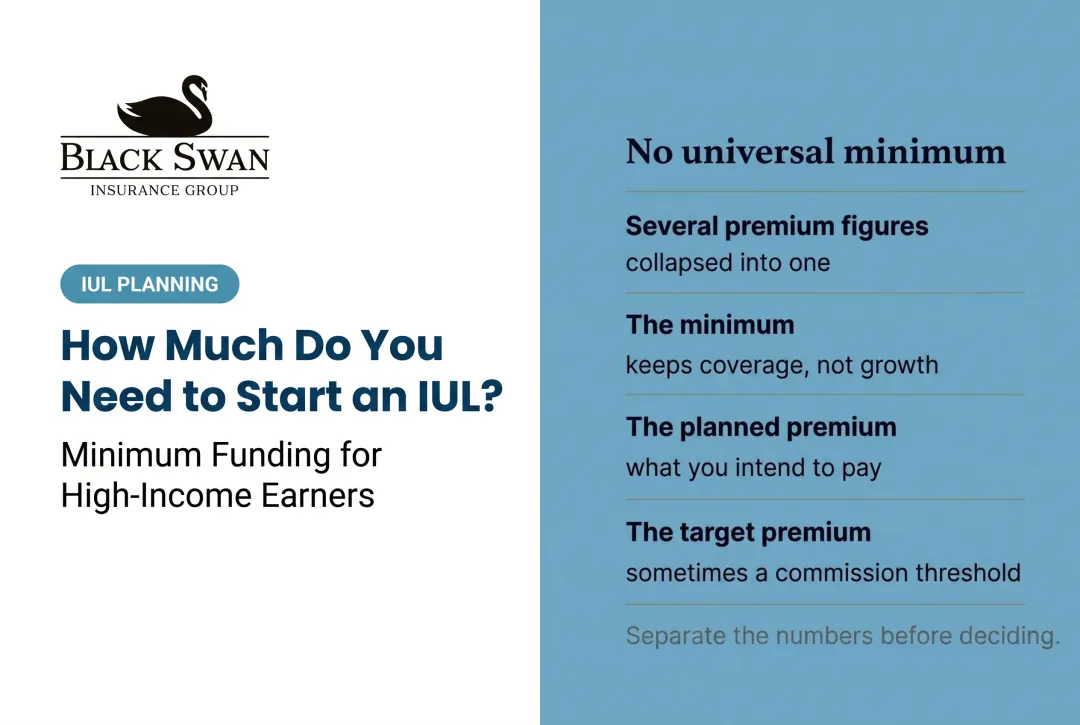
- Minimum premium — the least that keeps the policy in force short term. The most common cause of a policy collapsing decades later.
- Target premium — the carrier's reference level, often tied to commission. Not a recommendation.
- Planned premium — what the illustration assumes you will actually pay.
- Maximum premium — the most you can pay without crossing the seven-pay limit and creating a MEC.
If you were quoted the minimum, you were shown a different policy from the one that was modelled.

Layer Two: The Internal Charges
- Premium load — a percentage taken off each payment before it reaches the account
- Cost of insurance — the monthly charge for the death benefit, generally rising with age
- Administrative and policy fees — flat monthly charges
- Rider charges — for any living benefits, waiver or no-lapse guarantee attached
- Surrender charge — deducted only if you exit early, typically grading down over ten to fifteen years
An IUL illustration without a risk section is like a restaurant menu with no prices. Everything looks delicious until the check shows up.
What Actually Drives Your Number
Pricing is individual. The factors that move it most:
- Age and health classification — the single largest driver of cost of insurance
- Tobacco use — materially changes the rate class
- Death benefit amount — more coverage means more insurance cost
- Death benefit option — a level option versus an increasing one changes the corridor and the charges
- Funding level — how quickly the account builds a base to absorb charges
- Riders selected — each one adds cost
- State and product — availability and pricing vary
The Design Point Most Buyers Miss
For a cash-value goal, the death benefit should generally be the smallest the IRS rules allow for the premium you intend to pay. A clean round face amount — $250,000, $500,000, $1 million — often signals a policy sized for the illustration rather than optimised for cash value. Same premium, different design, completely different outcome.

What the Critics Get Right
Critics are right that IUL fees are higher than an index fund's, and that comparing a 0.03% expense ratio with a policy's total charges is not close. They are right that many policies are sold at minimum funding with an oversized death benefit, which is close to the worst possible configuration for a cash-value buyer. And they are right that non-guaranteed charges can be adjusted within contract limits, so today's numbers are not a promise.
Where the criticism overreaches is treating the fee as the whole analysis. The fee buys a death benefit, a crediting floor and a different tax treatment on access. Whether that bundle is worth its cost depends entirely on whether you need the death benefit — which is why this is a suitability question before it is a pricing question.
Compare It Against the Alternatives
- Term insurance plus a brokerage account — cheaper protection, no insurance drag on the investing, no permanent coverage
- 401(k) — lower cost, employer match, but fully taxable withdrawals later
- Roth IRA — cheapest tax-advantaged access, if your income allows a contribution
- Whole life — higher premium, more guarantees, less flexibility
How to Estimate a Sensible Budget for Yourself
Before you ask a carrier for a quote, do this arithmetic yourself. It changes the conversation.
Start With What You Can Sustain, Not What You Can Afford Today
The premium has to survive a bad year, not just a good one. Take your most recent weak year rather than your best, subtract the reserve you refuse to touch, and work from what is left. A policy funded at a level you can maintain through a slow period is worth more than a larger one you have to interrupt, because interrupting a flexible-premium contract is how underfunding happens quietly.
Then Size the Death Benefit to the Job
Two different jobs produce two different numbers. If the job is protection — replacing income, clearing a mortgage, funding a buy-sell — size the death benefit to that liability and price term insurance alongside it. If the job is cash value, the death benefit should generally be the smallest the tax rules permit for your intended premium, because every extra dollar of face amount is an extra dollar of ongoing insurance cost.
Ask for Four Numbers, Not One
When the illustration arrives, ask for these specifically:
- The guaranteed column, showing what happens at maximum charges and minimum crediting
- A run modelling two or three zero-credit years in the first decade
- The surrender charge schedule year by year
- The premium required to keep the policy in force if crediting underperforms the assumption
If any of the four is unavailable, that is information too.
Watch the Ratio, Not the Premium
The figure worth tracking is how much of each premium dollar reaches the account in the early years after the load and the cost of insurance. A policy where most of the premium is consumed by charges for the first several years needs a long horizon to recover, and a buyer who may not have that horizon should know it before funding rather than after.
The best policy is not the biggest illustration. It is the one that survives real life.
The Ultimate IUL Blueprint
A plain-English walkthrough of premium levels, internal charges, surrender schedules and how to read what a projection is really assuming.
Who the Cost Structure May Suit
Stronger Fit
- $150K+ stable income with $500–$2,500 a month available without touching reserves
- A real permanent protection or legacy need, so the insurance cost buys something you actually want
- Already capturing the full employer match and funding available retirement accounts
- A twenty-year-plus horizon, long enough for the account to outgrow the early charge drag
- Willingness to fund near the maximum rather than the minimum
Weaker Fit
Not everyone should buy an IUL. If the death benefit is not something you need, you are paying an insurance cost to access a crediting formula, and that is a poor trade.
- A premium that would strain the budget in a slow year
- No emergency fund, or high-interest debt outstanding
- Liquidity needed inside the surrender period
- A purely temporary protection need — term insurance is the direct answer at a fraction of the cost

Risks to Understand Before You Fund
- Charges are deducted whether or not interest is credited. A zero-credit year is a net negative year.
- Cost of insurance generally rises with age, so a policy that looks affordable now costs more later.
- Non-guaranteed elements can change within contract limits, including caps, participation rates and current charges.
- Underfunding is the most common failure mode, and the illustration that sold the policy will not have shown that path.
- Surrender charges mean early exit usually returns less than was paid in.
- Policy loans and withdrawals reduce cash value and the death benefit and can create tax consequences on lapse or MEC classification.
Find Out Where You Actually Stand
Start with the Tax-Free Wealth Blueprint Fit Review. If you earn $150K+ and want the cost laid out rather than summarised, we pull the charge schedule, model the guaranteed column alongside the illustrated one, and show what the policy needs to earn to justify its own expenses. If IUL does not fit, we will tell you that too.
Frequently Asked Questions
How much does an IUL cost per month?
There is no standard figure. Premium is a funding choice, and the internal charges depend on age, health, death benefit and design. A meaningful answer requires your underwriting class and intended funding level.
What fees does an IUL have?
Premium loads, cost of insurance, administrative and policy fees, rider charges, and surrender charges if you exit early. Caps and participation rates also limit crediting, which is an indirect cost.
Do IUL fees decrease over time?
Generally the opposite. Cost of insurance is tied to age and tends to rise, though a well-funded account may absorb it more comfortably as the balance grows.
Is an IUL more expensive than term insurance?
Substantially, for the same death benefit. Term buys protection only. If protection is all you need, term is the correct and far cheaper answer.
Can the insurer raise the charges?
Non-guaranteed elements can be adjusted within the limits written into the contract. That is why the guaranteed column matters more than the illustrated one.
What is the cheapest way to structure an IUL?
For a cash-value goal, generally the smallest death benefit the rules allow for your intended premium, funded near the maximum. That minimises insurance cost per dollar of premium.
Sources
- NAIC — Life Insurance — universal life charge structure
- NAIC, Life Insurance Illustrations Model Regulation (Model #582) — non-guaranteed element disclosure
- NAIC buyer guidance — affordability and periodic policy review
- I.R.C. § 7702A — Modified Endowment Contract and the seven-pay test
- I.R.C. § 72 — additional tax on early distributions
Disclosure: The information on this page is educational in nature and does not constitute personalized financial, tax, or legal advice. Actual results depend on policy design, carrier, crediting options, caps, participation rates, expenses, funding, loans, and ongoing management. Policy loans and withdrawals reduce cash value and the death benefit, and can create tax consequences if the policy lapses or becomes a modified endowment contract. Consult a licensed insurance professional and, where appropriate, a tax or financial advisor before making any insurance or financial decision. Indexed universal life is life insurance first. Illustrated values are not guarantees; actual results depend on policy terms, crediting, costs and funding. This strategy is not appropriate for everyone.
And remember, it's not what you earn, it's what you keep… enjoy the ride.