By Robert Balgac, Founder, Black Swan Insurance Group | October 9, 2026
If you earn $150K+ and the Roth IRA door has closed on you, the comparison you are actually running is not "which product is better." It is "what do I do with the dollars that no longer have a tax-advantaged home?" Those are different questions, and the second one is where most of the bad advice lives.
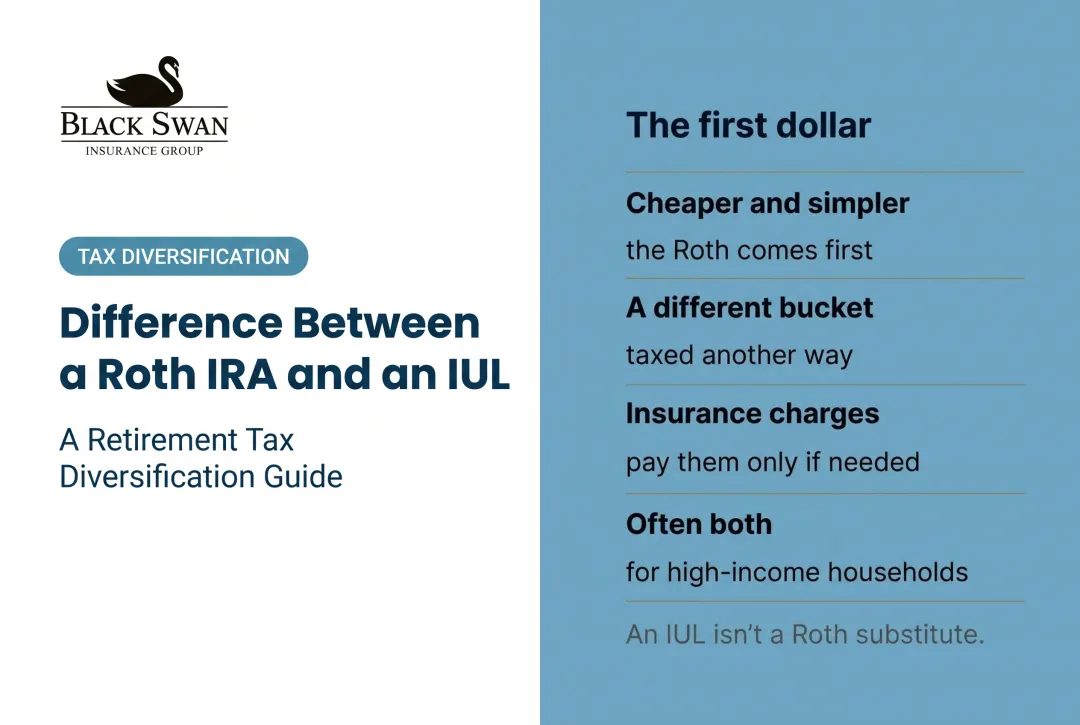
A Roth IRA and an indexed universal life policy both offer tax-advantaged growth. That is where the similarity ends. One is a retirement investment account you open at a brokerage in about ten minutes. The other is permanent life insurance with a death benefit, an underwriting process, and a cash value component that takes years to turn the corner. Treat them as interchangeable and you can give up tax flexibility, permanent protection, or liquidity you actually needed.
This matters most for high-income professionals, business owners, and families balancing retirement savings, permanent protection, liquidity, and legacy planning. Roth IRAs run into income and contribution limits. IULs add insurance costs and only work with steady, long-term funding. Neither product wins automatically.
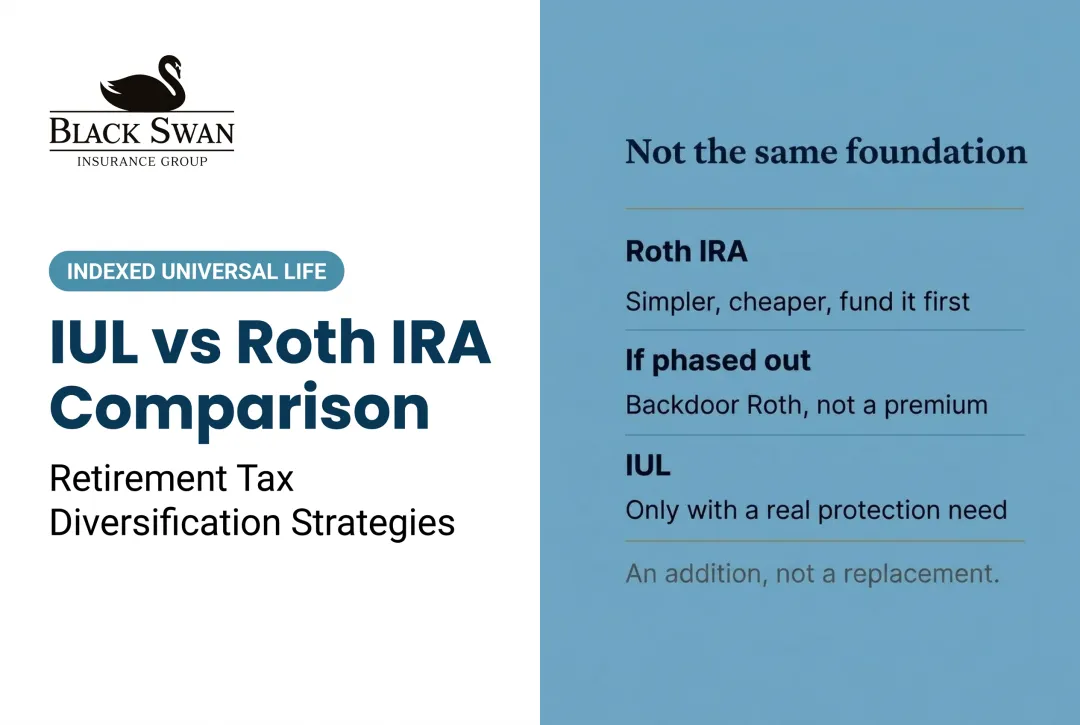
The short answer: For most eligible savers, the Roth IRA is the better first dollar — cheaper, simpler, and uncapped on the upside. IUL enters the conversation when you have a genuine permanent insurance need and surplus cash flow after the Roth, the employer match and the emergency fund are handled. If you are choosing between them because you were phased out of the Roth, the honest first move is to check whether a backdoor Roth still works for you.
Key Takeaways
- A Roth IRA is simpler and lower-cost; an IUL pairs cash value accumulation with a permanent death benefit
- IRS income limits gate Roth contributions; IUL funding is gated by underwriting and modified endowment contract rules instead
- Uncapped Roth upside comes with uncapped downside; IUL crediting limits index losses, caps index gains, and still carries policy charges
- IUL deserves evaluation only with a real permanent insurance need, strong cash flow and a long horizon
- Many households are better served by using both, or by prioritising the employer plan and term insurance first
The Comparison, Without the Sales Framing
| Factor | Roth IRA | IUL |
|---|---|---|
| Purpose | Retirement investment account, no insurance coverage | Permanent life insurance with cash value accumulation |
| Tax treatment | After-tax contributions, tax-free qualified withdrawals | After-tax premiums, tax-deferred growth, potentially income-tax-free loans if structured and maintained correctly |
| Contribution limits | IRS annual limit and income phase-outs apply | No fixed dollar limit; governed by underwriting and MEC testing |
| Growth | Direct market investment, uncapped gains and losses | Index-linked crediting with floors, caps and participation rates |
| Costs | Brokerage and fund fees only | Cost of insurance, admin charges, surrender charges, loan interest |
| Access | Contributions withdrawable anytime; earnings restricted | Policy loans and withdrawals; death benefit paid separately |
Tax Treatment
A Roth IRA is funded with after-tax dollars. Qualified withdrawals — those taken after the five-year holding period and a qualifying event such as reaching age 59½ — come out completely tax-free. That is a statutory outcome, not a design outcome. Nonqualified earnings withdrawals can trigger both income tax and a 10% penalty.
An IUL also uses after-tax premiums. Cash value grows tax-deferred, and policy loans may be income-tax-free when the policy is not a modified endowment contract and stays in force. Read that sentence again: and stays in force. The tax result on an IUL is conditional on your behaviour for the next forty years. The tax result on a Roth is not.
IRS Revenue Ruling 2007-38 confirms that MEC distributions are taxed income-first and may trigger a 10% additional tax on top of ordinary income tax. A policy that lapses with an outstanding loan can create a tax bill with no cash arriving to pay it.
Contributions and Eligibility
Roth IRA contributions follow firm annual rules. For 2026 the IRS set the limit at $7,500, or $8,600 for those 50 and older, including the $1,100 catch-up amount. Contribution eligibility phases out at $153,000–$168,000 for single filers and $242,000–$252,000 for joint filers in 2026. The 401(k) deferral limit is $24,500.
Note where those phase-out numbers land. A single filer at $168,000 is not wealthy by the standards of most coastal markets, and they are already locked out of a direct Roth contribution. That is the structural problem IUL marketing exploits.

IUL funding works differently:
- No standard annual dollar ceiling like an IRA
- Premium capacity depends on underwriting class, health and policy design
- The seven-pay test under Section 7702A determines MEC status
- Overfunding too quickly converts the policy to a MEC, generally permanently
"No contribution limit" is the line that sells IUL. It is true, and it is less useful than it sounds, because the binding constraint is not the IRS. It is whether you can sustain the premium for two decades through a job change, a divorce, a practice buy-in or a recession.
Growth and Market Exposure
Roth IRA owners choose their own investments, from index funds to individual stocks. There is no contractual cap on gains, but the account can fall in a downturn with no floor to soften it.
IUL cash value is not directly invested in the market. The insurer credits interest by reference to an index's performance, subject to:
- Floors that limit index-related losses, often 0%
- Caps that limit how much upside gets credited
- Participation rates determining what share of index gains apply
- Spreads subtracted from gains before crediting
Those features shape credited interest — not net return. A 0% floor still allows insurance and administrative charges to reduce cash value in a year with no credited gain.
Zero is your hero in a down year — but the floor applies to the credit, not to the charges.
Caps and participation rates are also non-guaranteed on most contracts. The carrier can revise them after you buy, within contract limits, and you will find out in an annual statement rather than a phone call.
What Each Product Actually Is
Indexed Universal Life
Permanent life insurance. It pairs a death benefit with a cash value account whose interest crediting ties to an external index such as the S&P 500, under rules specific to each contract. The policy does not own index investments. Crediting is a formula.
Where it earns its place:
- Permanent protection that does not expire the way term does
- Potential tax-advantaged access through policy loans when properly structured, funded and managed
- No Roth-style income phase-out restricting who can fund it
- Accumulation capacity beyond standard retirement account limits
- Possible cushioning against sequence-of-returns risk in down markets, when properly structured
Where it costs you:
- Higher charges in the early policy years
- Surrender charge periods that penalise early cancellation
- Underwriting based on health and age
- Funding commitments that require sustained cash flow
- Non-guaranteed caps and participation rates that can change
- Lapse risk if premiums stop or loans grow too large
A September 2025 Forbes Advisor review flagged IUL complexity, administrative fees, commissions and shifting caps and participation rates as the main drawbacks, along with reliance on overly optimistic illustrations. That criticism is fair and we are not going to argue with it.
The Roth IRA
An individual retirement account funded with after-tax contributions, invested through a brokerage of your choosing.
Advantages:
- Qualified withdrawals are completely tax-free, by statute
- Broad investment flexibility across stocks, bonds and funds
- Transparent, easy-to-track account values
- Contribution basis is withdrawable anytime without penalty
- No lifetime required minimum distributions for the original owner
Limitations:
- Annual contribution caps restrict how much you can save
- Income-based eligibility excludes high earners from direct contributions
- Early withdrawals of earnings can trigger taxes and penalties
- Direct market exposure means account values can drop
- No built-in life insurance protection
The Ultimate IUL Blueprint
Before you compare either option on a projected balance, the Blueprint covers what an IUL design has to survive: funding levels, caps and charges, the MEC line, loan timing, and what to demand from an illustration.
What the Critics Get Right
The strongest criticism of IUL-versus-Roth content is that it is almost always produced by someone paid when you choose the insurance. We are not exempt from that. So here is the fair version.
A Roth IRA's tax-free treatment is written into the Internal Revenue Code. An IUL's tax-advantaged access is written into your own ability to manage a contract for decades without letting a loan compound past what the cash value supports. Those are not equivalent risks, and any comparison table that lists them in the same row as "tax-free" is flattering the insurance.
The Roth also costs a few basis points. The IUL costs cost of insurance that rises every year with your age, plus admin charges, plus rider costs, plus a surrender schedule. Those charges are real and they front-load.
What the critics usually miss is the eligibility cliff. At $242,000 joint the Roth stops being an option, and "just use a brokerage account" means accepting annual tax drag on dividends and realised gains for thirty years. That gap is real. It does not automatically mean IUL — a backdoor Roth, a taxable brokerage account, or simply more in the 401(k) may serve better. But the gap is why the conversation exists at all.
A great IUL is engineered. A bad IUL is sold.
Which Fits Your Situation
Name your primary goal first. Retirement investing, permanent protection, tax diversification, estate planning and early-retirement liquidity each point toward a different answer.
Stronger Fit
An IUL deserves evaluation when you:
- Have a genuine, lasting need for a death benefit
- Are medically and financially insurable at a reasonable rate
- Can sustain premiums through career changes and income dips
- Have a horizon long enough — typically 15–20 years or more — for cash value to build past early charges
- Understand which policy values are guaranteed and which are not
- Earn $150K+ with surplus cash flow after reserves, debt and maxed retirement contributions
Weaker Fit
Not everyone should buy one. The Roth IRA is usually the right starting point when you qualify under current income limits, have not yet captured the full employer match, want low complexity, value broad investment choice, or can tolerate volatility over decades.
Step back from IUL entirely if funding is unstable, reserves are thin, liquidity is needed within a few years, or your protection need is temporary — term insurance is cheaper and does that job completely.
High earners and business owners should clear the basics first: employer retirement plans and any match, backdoor Roth if relevant, emergency reserves and high-interest debt, business liquidity needs, and whether term already closes the protection gap.

Comparing Retirement-Income Risk
Roth assets stay exposed to market swings right through retirement withdrawals. A downturn in your first few retirement years can meaningfully dent a balance you are actively drawing from.
How you pull income matters as much as how you grow it. IUL policy loans are a different access path, not free money. Loans accrue interest, reduce cash value and death benefit, and create tax exposure if the policy lapses with a loan outstanding.
The loan is not the problem. The unmanaged loan is the problem.
Risks to Understand Before You Choose
Picture a policyholder who funds an IUL aggressively for three years, then hits a cash-flow disruption. Premiums stop while surrender charges still apply. Caps drop at a later renewal. A large policy loan covers an emergency during a market downturn.
Each choice compounds the next:
- Reduced funding slows cash value growth
- Lower caps shrink future credited gains
- The loan balance accrues interest and reduces the death benefit
- If the policy lapses with the loan outstanding, the loan amount can become taxable income
The design errors behind most failed policies:
- Buying on the illustrated column rather than the guaranteed one
- Overfunding into MEC status, which is generally permanent
- Underfunding after year three, which is the single most common cause of failure
- Substituting IUL for an employer match, a Roth, diversified investments or adequate term coverage
- Ignoring the surrender schedule in the early years
Fund conservatively, read the guaranteed column, and review every year. A design that looks strong at a 7% assumed crediting rate means little if you cannot sustain premiums through a job change.

Find Out Where You Actually Stand
This starts with the Tax-Free Wealth Blueprint Fit Review. If you earn $150K+ and are weighing a Roth against an IUL, we check backdoor Roth capacity first, confirm whether a permanent insurance need actually exists, then run identical assumptions across designs, read guaranteed values against illustrated ones, and stress-test through lower crediting, paused funding and extended loans. We explain compensation before anyone funds anything. If the answer is "max the Roth and buy term," we will say that. If IUL does not fit, we will tell you that too.
Frequently Asked Questions
Is an IUL better than a Roth IRA?
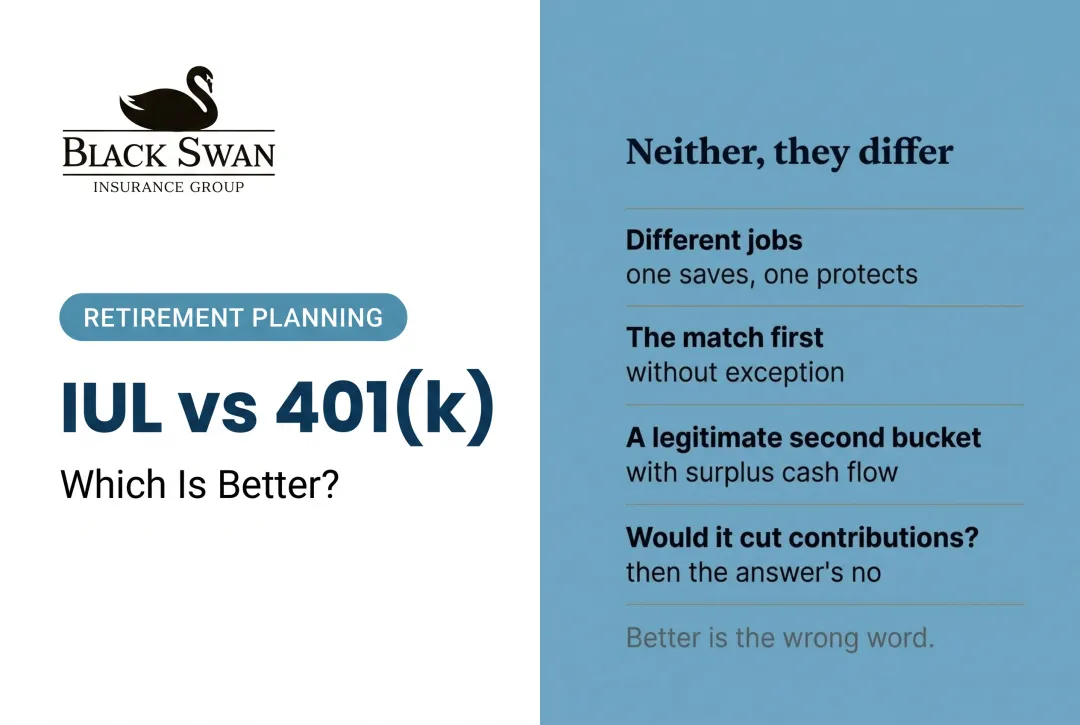
Neither is universally better. A Roth IRA is typically simpler and lower-cost for retirement investing. An IUL may fit someone who needs permanent life insurance alongside additional accumulation capacity, and who can fund it reliably for decades.
Can I have both an IUL and a Roth IRA?
Yes, and many people do when each serves a distinct role. This works best once employer plans, emergency savings and your actual insurance needs have already been settled.
What are the biggest disadvantages of an IUL compared with a Roth IRA?
Higher costs, surrender charges, underwriting requirements and complexity. Caps and participation rates can change after purchase. For pure retirement investing with no insurance need, a Roth IRA is usually the more suitable vehicle.
Do IULs have contribution or income limits?
Not in the Roth sense. There is no income phase-out and no fixed annual dollar cap. Policy design, underwriting and modified endowment contract rules set the practical ceiling instead.
Can I access Roth IRA and IUL funds before retirement?
Roth contributions are withdrawable anytime without tax or penalty, while earnings face restrictions. IUL withdrawals and loans offer access too, but the tax and lapse consequences depend heavily on how the contract is managed.
What should I review before buying an IUL?
The full illustration's guaranteed and non-guaranteed columns, all charges, the surrender schedule, loan provisions and premium requirements. Confirm the insurance need exists, then compare against the Roth, the employer plan, a brokerage account and term life before signing anything.
Sources
- IRS — Revenue Ruling 2007-38
- IRS — 401(k) limit increases to $24,500 for 2026; IRA limit increases to $7,500
Disclosure: This article is educational and is not personal tax, legal or investment advice. Indexed universal life is life insurance first. Tax rules, contribution limits and income phase-outs change annually and must be confirmed against current IRS guidance before acting. Illustrated values are not guarantees; actual results depend on policy terms, crediting, costs and funding. Actual results depend on policy design, carrier, crediting options, caps, participation rates, expenses, funding and ongoing management. This strategy is not appropriate for everyone. Policy loans and withdrawals reduce cash value and the death benefit, and can create tax consequences if the policy lapses or becomes a modified endowment contract. Consult your own tax, legal and financial professionals for advice specific to your situation.
And remember, it's not what you earn, it's what you keep… enjoy the ride.