By Robert Balgac, Founder, Black Swan Insurance Group | October 7, 2026
If you earn $150K+, you have maxed the 401(k), and someone has told you to "fund the policy as hard as you can," there is a line in the tax code you can cross without anyone calling to warn you. It was drawn in 1988. It is called the 7-pay test, and crossing it turns a perfectly good indexed universal life policy into a Modified Endowment Contract.
Here is what makes this one worth your attention: the people most likely to trip it are the people doing everything else right. Strong income, a bonus to deploy, a genuine desire to get the money working. Nobody triggers a MEC by being careless with small amounts. They trigger it by being aggressive with large ones.
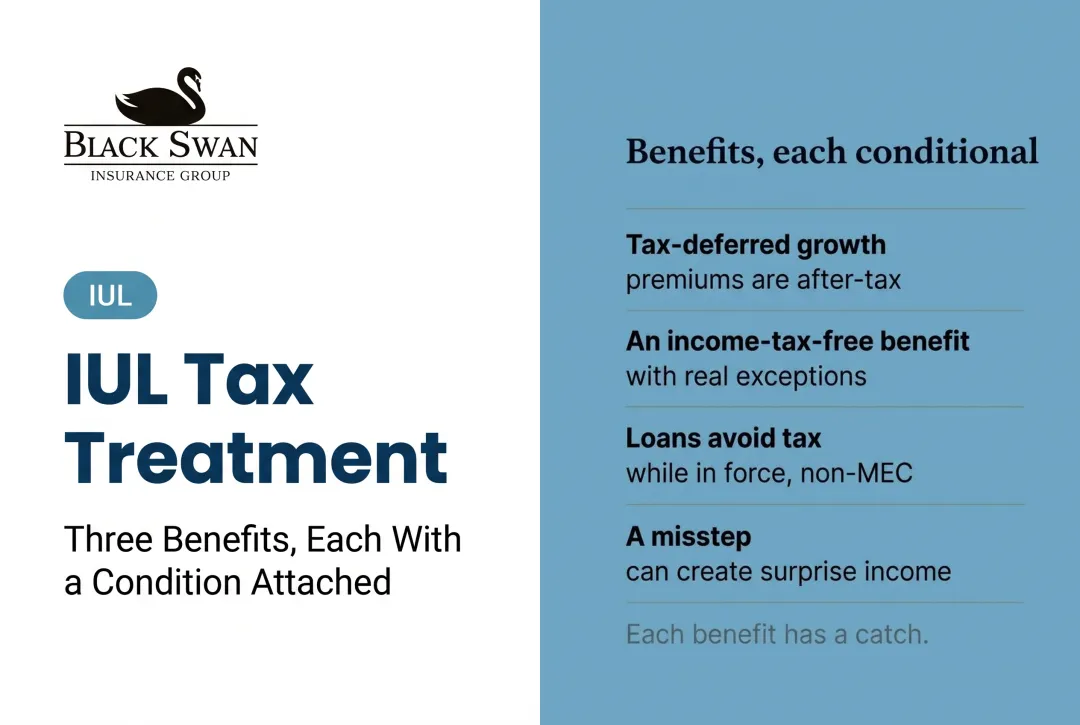
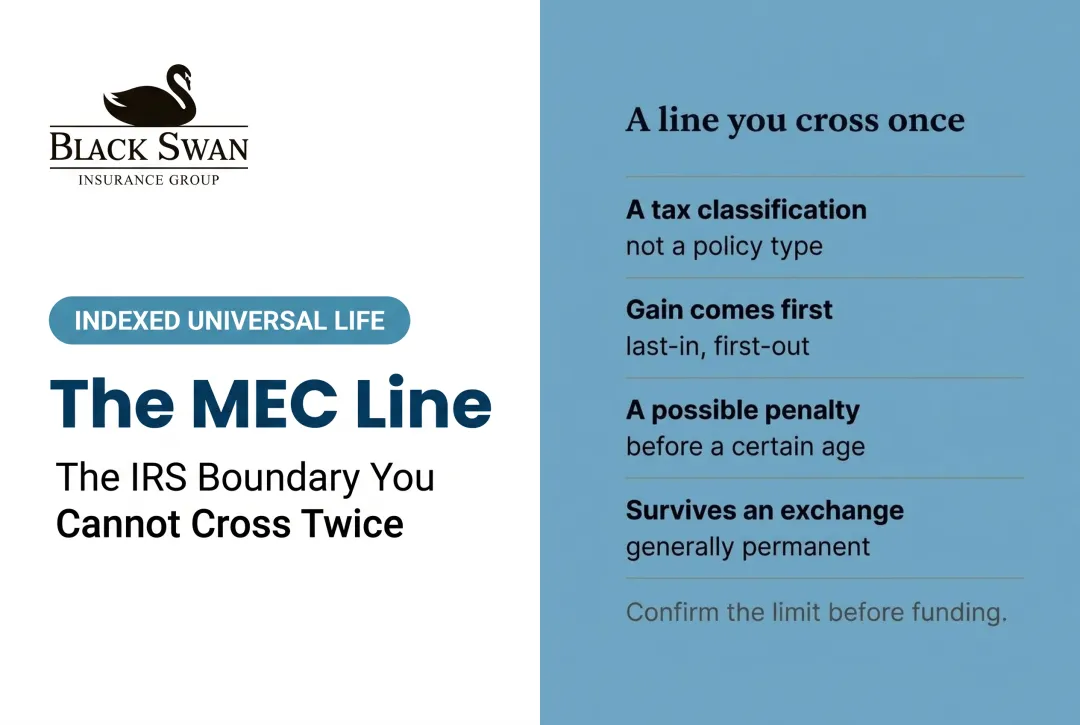
The short answer: A MEC is not a broken policy. It still pays a death benefit, and that death benefit is still generally income-tax-free. What changes is the tax treatment of your access to the cash value while you are alive — withdrawals and loans flip from basis-first to gain-first, and a 10% penalty can apply before age 59½. The status is generally permanent, which is why this is a design question, not a repair question.
This is life insurance first. The cash value is second, and the potential tax-advantaged access is third — and that third thing is precisely what MEC status takes away. So if the reason you bought the policy was living access, the 7-pay test is not a footnote. It is the whole ballgame.
Key Takeaways
- A MEC is created by failing the IRS 7-pay test under IRC Section 7702A — not by having a large cash value
- Lump sums, death-benefit reductions, catch-up payments and rider changes can all trigger it
- Withdrawals and loans are then taxed gain-first (LIFO), with a possible 10% penalty before age 59½
- Once triggered, MEC status is generally permanent — surrendering or exchanging does not undo it
- A funding schedule modelled against the limit, plus an annual review, is what prevents it
What the 7-Pay Test Actually Measures
A policy becomes a MEC when cumulative premiums paid exceed what seven level annual premiums would have funded for that same death benefit, as defined in IRC Section 7702A.
Read that again, because the common misreading causes most of the damage. The test is not a judgment about whether your policy is "overfunded" in some general sense. It is a cumulative, time-based comparison against a specific number derived from your specific death benefit. Two policies with identical premiums can land on opposite sides of the line because their death benefits differ.
IULs need closer watching than fixed-premium policies for one structural reason: the premium is flexible. That flexibility is a feature — it is most of why high earners with uneven income like the product. It is also the mechanism by which people walk across the line without noticing. A whole life policy with a fixed premium cannot drift. An IUL can.
How a Policy Crosses the Line
Paying Too Much, Too Quickly
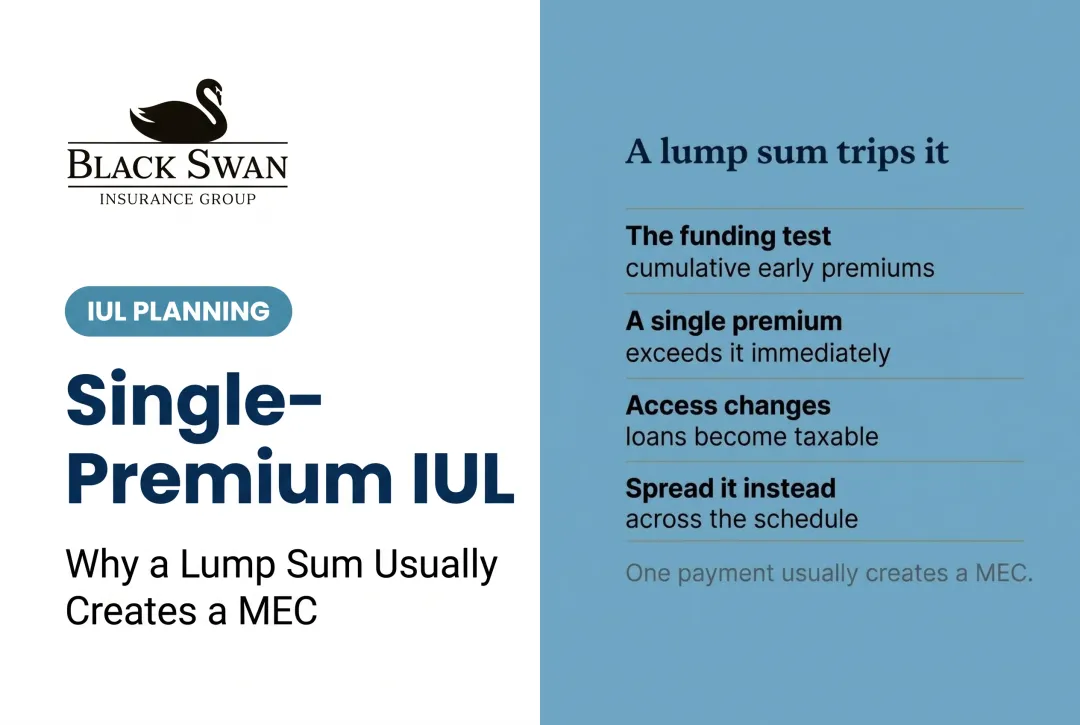
Front-loading, a single large deposit, or dropping an unexpected windfall into the contract during the first seven years can clear the cumulative limit quickly. Maximum cash-value funding and non-MEC funding are related goals, but they are not the same goal, and a max-funded design only works if the contract was built to accept the premium pattern you actually intend to use.
A Death Benefit Too Small for the Premium
The limit is derived partly from the death benefit. A death benefit set low relative to planned premiums leaves less non-MEC room. This is the trap inside an apparently sensible instinct: reducing the death benefit to cut the cost of insurance also cuts your funding headroom, and it can push you over the line without you adding a single dollar.
Unplanned Premium Changes
The usual suspects:
- An extra payment outside the normal schedule
- Switching from monthly to annual funding
- Catching up several missed premiums at once
- Redirecting a bonus, inheritance or business distribution into the policy
"Flexible premium" does not mean every amount is safe. Confirm the allowable figure with the carrier before the money moves.
Material Contract Changes
A substantial death-benefit adjustment, certain rider additions, or other contract modifications can force a fresh 7-pay test — and that retest sometimes starts an entirely new testing period. Review any planned change for its MEC consequence, not only its effect on cost or cash value.

What Changes When a Policy Becomes a MEC
MEC status does not cancel the death benefit or stop the cash value accumulating. It changes how you are taxed when you reach for the money during your lifetime.
| Transaction | Non-MEC IUL | MEC |
|---|---|---|
| Partial withdrawal | Basis out first (FIFO) | Gain taxed first (LIFO) |
| Policy loan | Generally not a taxable event | Treated as a distribution, taxable to the extent of gain |
| Death benefit | Generally income-tax-free | Generally income-tax-free |
The ordering rule is the whole story:
- Non-MEC withdrawals generally come out basis-first, so you recover what you paid in before you touch taxable gain
- MEC withdrawals pull gain first, so an early distribution can be fully taxable as ordinary income
- MEC policy loans are treated as distributions and taxed to the extent of gain, per IRS Revenue Procedure 2008-39
Then there is the penalty layer. Taxable distributions before age 59½ can carry an additional 10% federal tax under IRC 72(v), on top of ordinary income tax on the gain. Narrow exceptions exist for disability and certain substantially equal periodic payments. Death-benefit taxation follows separate rules under IRS Publication 525.
So the death benefit survives intact. What dies is the living access strategy — which, for most high earners who bought an IUL as a second bucket, was the point.

The Version Where MEC Status Is Deliberate
Not every MEC is an accident. If the objective is wealth transfer rather than lifetime income, gain-first withdrawal rules matter a great deal less — you were never planning to withdraw. A single-premium contract funded for legacy is a MEC by design, and that can be entirely rational.
The distinction is intent.
A MEC you chose is a planning decision. A MEC you discovered is a planning failure.
Either way it belongs in a conversation with a tax advisor who can see your whole estate plan, because an income-tax-free death benefit does not mean an estate-tax-free one.
The Ultimate IUL Blueprint
If you are weighing how hard to fund a policy, the Blueprint walks through what the design has to survive: funding levels, the MEC line, loan timing, and what to demand from an illustration before you sign it.
What the Critics Get Right
The sceptics have a fair point here, and it is worth stating plainly rather than waiting for someone else to say it.
The MEC rules are genuinely easy to trip, the consequence is effectively irreversible, and the person most motivated to encourage aggressive funding — the agent earning on the premium — is not the person who pays the tax bill if the design was wrong. That is a real conflict and pretending otherwise insults your intelligence.
What the criticism usually misses is that this is a design and monitoring problem, not a product defect. The 7-pay limit is a known, calculable number. Your carrier can tell you what it is. The failures happen when nobody asks.
Warning Signs You Are About to Trip the Test
Catch these before the money moves, not after.
- The payment is bigger than your original illustration showed. Most dangerous in the first seven policy years, while the testing window is live.
- You are making a change without a fresh MEC test. Lump sums, catch-up payments, death-benefit reductions and rider additions should each trigger a new illustration request first.
- Your statement is already hinting. Reduced remaining 7-pay room, an overfunding flag, or a MEC designation on a carrier notice means the clock has largely run.
If any of those appear, stop. Do not send another payment or submit another change until you have written confirmation from the insurer and have read the policy ledger alongside a qualified professional and your tax advisor.
How the Funding Schedule Should Have Been Built
Prevention is unglamorous and it works. The intended premium, death benefit, policy structure and funding duration all get modelled together in a carrier-specific illustration before the first dollar moves. That illustration should show the MEC limit year by year, your planned premium against that limit, and the remaining capacity under the proposed design.
This is not set-it-and-forget-it. It is design-it, fund-it, review-it.
The target is a schedule you can sustain, not the largest number the contract will accept. Leave room for emergencies, for retirement account contributions, and for the year your income does something unexpected.
Then confirm every additional payment before sending it — effect on cumulative premiums, current status, remaining room, and any correction deadline if an overpayment has already landed. Carriers will usually refund an excess premium inside a short window. Miss the window and the status sets.
And review it annually. A review comparing premiums actually paid against the planned schedule catches drift while drift is still cheap. At Black Swan this is Step 5 of the five-step process, and it exists because the alternative is finding out from a 1099.

This matters most for high-income professionals, business owners and late-start earners making larger contributions, or anyone planning to lean on policy cash value for future income. The bigger the funding, the smaller the margin for error.
Stronger Fit
Careful MEC management is worth your time if you:
- Earn $150K+ and intend to use the policy for living access, not only a death benefit
- Are funding at or near the maximum the design allows
- Have variable income — bonuses, distributions, commissions — that tempts off-schedule payments
- Are willing to request an illustration before each material change, rather than after
Weaker Fit
Aggressive funding is probably the wrong conversation if you:
- Have no emergency reserve, or high-interest debt that should be cleared first
- Cannot commit to the premium schedule for the full funding period
- Only need a death benefit, in which case term is cheaper and simpler and you should buy term
- Want the policy to be set and forgotten — this product does not reward that
Risks to Understand Before You Send Another Premium
- The status is generally permanent. Stopping premiums, reducing future payments, surrendering or exchanging does not reverse it.
- The floor protects crediting, not charges. A 0% floor limits negative index credit; cost of insurance, surrender charges and administrative expenses continue regardless.
- Loans are the sharp edge. In a MEC, a policy loan is a taxable distribution to the extent of gain. The loan is not the problem; the unmanaged loan is the problem.
- Underfunding is its own failure. Backing off premiums to stay clear of the line can leave the policy too thin to survive rising insurance costs later.
- Rules change, and so do carriers. Caps, participation rates and charges are not fixed for life, which is why the annual review exists.
Find Out Where You Actually Stand
This starts with the Tax-Free Wealth Blueprint Fit Review. If you earn $150K+ and you are funding a policy — or about to — we model the premium schedule against the 7-pay limit, show the remaining room, stress-test the funding across lower-return and zero-credit years, and lay out the loan assumptions in plain numbers. If a MEC is the right answer for your goal, we will say so. If IUL does not fit at all, we will tell you that too.
Frequently Asked Questions
Is a MEC always a bad outcome?
No. For a wealth-transfer objective, where nobody intends to touch the cash value during life, gain-first taxation is largely irrelevant. It is only damaging when the plan depended on tax-advantaged living access.
How is the 7-pay test calculated?
It compares premiums paid during the first seven years against seven level annual premiums for the same death benefit. The figure is carrier- and design-specific, so request the illustration rather than estimating.
Can I undo MEC status?
Generally no. A carrier may permit a corrective refund of excess premium inside a limited window, so if you suspect an overpayment, raise it immediately. After that window, treat the status as permanent.
What is the average premium for an IUL?
There is no meaningful national average — it depends on age, health, death benefit, design and underwriting. Whatever figure you land on still has to be tested against your own non-MEC limit.
Does a MEC affect the death benefit my family receives?
Generally no. The death benefit remains income-tax-free to beneficiaries whether or not the contract is a MEC. The tax consequence attaches to lifetime access.
How do I exit an IUL I no longer want?
You can reduce or stop premiums, surrender, exchange under Section 1035, or adjust coverage. Each route has different consequences for cash value, tax and death benefit, and none of them removes MEC status. Get a policy-specific review before acting.
Sources
- 26 U.S.C. § 7702A — Modified endowment contract defined
- IRS Revenue Procedure 2008-39
- IRS Publication 525 — Taxable and Nontaxable Income
- NAIC — Life Insurance
- NAIC — Life Insurance Illustrations
Disclosure: This article is educational and is not personal tax, legal or investment advice. Indexed universal life is life insurance first. MEC determination is contract-specific and governed by IRC Sections 7702A and 72; review your own situation with your CPA or tax attorney before changing premiums or coverage. Any potential tax-advantaged access depends on the policy being properly structured, funded and managed. Actual results depend on policy design, carrier, crediting options, caps, participation rates, expenses, funding and ongoing management. This strategy is not appropriate for everyone. Policy loans and withdrawals reduce cash value and the death benefit, and can create tax consequences if the policy lapses or becomes a modified endowment contract. Illustrated values are not guarantees; actual results depend on policy terms, crediting, costs and funding. Consult your own tax, legal and financial professionals for advice specific to your situation.
And remember, it's not what you earn, it's what you keep… enjoy the ride.