By Robert Balgac, Founder, Black Swan Insurance Group | October 9, 2026
Every quote you get for an indexed universal life policy will look different, and the reason is not that carriers are being evasive. It is that the question contains four questions and nobody separates them for you.
If you earn $150K+, have maxed the 401(k) and are past the Roth phase-out, the number that matters to you is almost certainly not the number a search result gives you. An $80 monthly illustration for a healthy 35-year-old has nothing to say about what a 50-year-old business owner needs to fund.
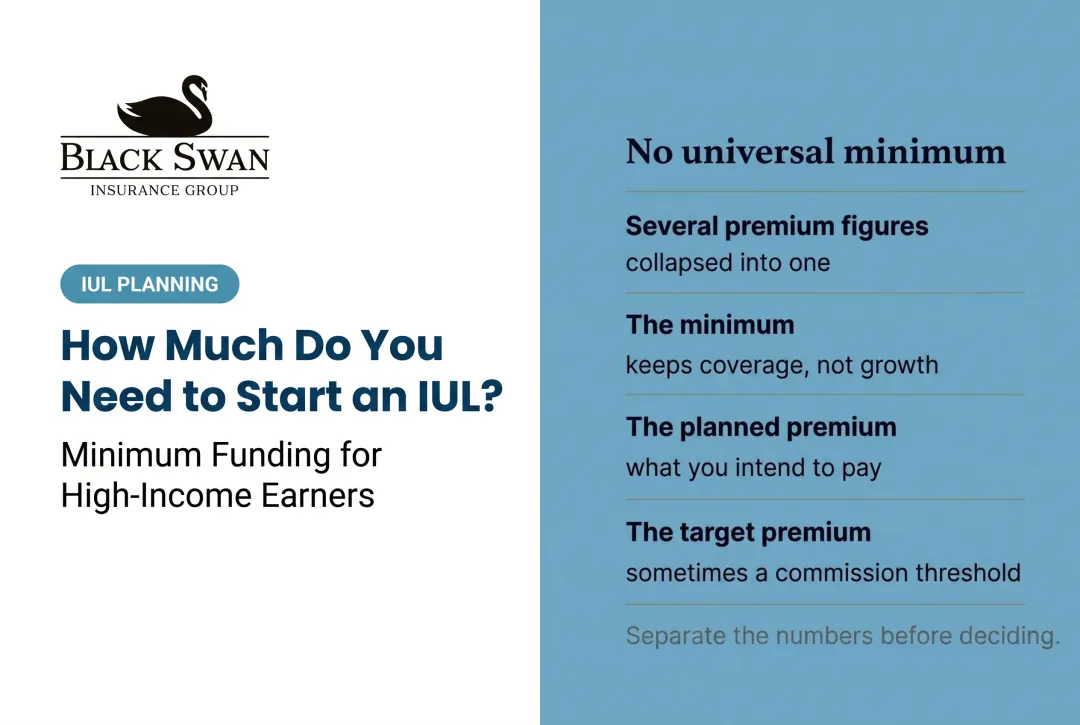
The short answer: "How much to start an IUL" means four different things — the carrier's minimum to issue, the premium that keeps coverage in force, the amount intended for cash value accumulation, and a max-funded design pushed as high as IRS rules allow. They produce wildly different figures, and a generic answer is useless because it never says which one it is answering.
This is life insurance first. Everything downstream depends on that.
Key Takeaways
- No single industry minimum exists — premiums depend on carrier, age, health, death benefit and design
- A premium that only keeps the policy in force rarely builds meaningful cash value
- Higher funding grows cash value only with sustainable surplus income and annual monitoring
- 20-year cumulative cost for the same death benefit can differ fourfold by age and sex
- Compare IUL against emergency savings, 401(k) matching, IRAs and term insurance before committing
The Four Questions Hiding in One
- The carrier's minimum premium to issue the policy
- The premium needed to keep coverage in force under no-lapse guarantees
- The amount intended for cash value accumulation
- A max-funded design built to push cash value as high as IRS rules allow
Each produces a different number. When someone quotes you "the cost of an IUL," your first question should be which of those four they just priced.
What Real Illustrations Show
Mutual of Omaha's Indexed Universal Life Express guide includes an example where a $150,000 death benefit illustration runs about $80 per month. That figure reflects current assumed rates for one hypothetical applicant — not a published minimum, not a guaranteed price.
A separate Mutual of Omaha comparison for a $200,000 death benefit shows how age and sex change 20-year cumulative premiums:
- 30-year-old non-tobacco female: about $15,860
- 50-year-old non-tobacco male: about $63,204
Same death benefit. Same carrier. Four times the cost, because underwriting math moves with the applicant. That spread is the real answer to "how much does it cost" — it costs what your mortality risk costs.

North American's Builder Plus IUL 4 brochure confirms premiums can be paid monthly, quarterly, semiannually or annually, and gives no flat minimum dollar amount. It depends on the case, every time.
Four Buyers, Four Funding Patterns
- Healthy 32-year-olds often start with a modest monthly premium for moderate permanent protection and little cash value emphasis
- High-income professionals aged 35 to 55 usually set a higher planned premium when the goal is supplemental retirement income
- Business owners balance death benefit protection against cash value accessible outside the company
- Late-start high earners aged 45 to 55, with a compressed runway, often need larger annual premiums over fewer years to build meaningful value
None of these is a personal quote. A real illustration requires your age, health class, death benefit, riders and planned funding period, then shows guaranteed and non-guaranteed values side by side.
What Moves Your Premium
Age and Health
Age, tobacco use, medical history, family history, occupation and underwriting class all drive cost of insurance. A preferred applicant pays materially less for the same death benefit than someone with health complications or a hazardous occupation — and the gap widens with age, since insurance charges climb as mortality risk rises.
Death Benefit and Design
A larger death benefit creates higher insurance costs, and also permits greater premium capacity for accumulation. A level death benefit (Option 1) pays the stated amount only. An increasing option (Option 2) pays the stated amount plus accumulated cash value — and often costs more in net amount at risk early on, so more of each premium goes to insurance charges rather than growth.
Funding Goal and Horizon
A policy built only for permanent protection is funded differently from one designed to supplement retirement income. Buyers with a 20 to 30 year runway can spread funding gradually. Late-start high earners with fewer accumulation years need to fund more aggressively or adjust expectations about what the policy can realistically deliver. Both responses are legitimate. Pretending the compressed timeline does not exist is not.
Carrier Charges
Every IUL carries a layered expense structure. Mutual of Omaha's Income Advantage IUL guide lists a current $8 monthly administrative charge plus a charge per $1,000 of specified amount (guaranteed maximum $10); a 4.5% premium charge up to target premium and 3% above target (guaranteed maximum 10%); and surrender charges during the first 14 policy years.
Caps, participation rates, spreads and floors affect how much interest is credited. They do not eliminate these underlying charges.
Zero is your hero in a down year — but the floor applies to the credit, not to the charges.
Insurability Is Not Suitability
Approval for a given death benefit or premium does not prove the policy is affordable. Your existing coverage, emergency reserves, retirement contributions, debt load and capacity to sustain payments all matter more than what a carrier will approve you for.

The Ultimate IUL Blueprint
Before you pick a starting figure, the Blueprint covers what the design has to survive: funding levels, caps and charges, the MEC line, loan timing, and what to demand from an illustration before you sign it.
Lower Funding Versus Higher Funding
The premium needed to issue a policy is routinely different from what is needed to sustain it. Flexible premiums do not mean you can scale back indefinitely — Pacific Life's client guide notes plainly that coverage may expire if later payments are insufficient.
A lower-funded policy may suit someone wanting modest permanent protection without accumulation goals. More of each premium dollar supports insurance costs, cash value builds slowly if at all, and the policy becomes more sensitive to missed payments, rising charges or low crediting years.
A higher-funded or max-funded policy builds more cash value relative to the death benefit, within IRS limits. "Max funded" is relative to the 7-pay test, not a universal dollar figure. Under IRS Revenue Ruling 2005-6, a policy fails the 7-pay test if premiums paid in the first seven years exceed cumulative net level premiums for a seven-pay paid-up contract — triggering MEC status and less favourable tax treatment on distributions.
Max-funded does not mean unlimited. It still has to be sustainable against your actual income.
| Factor | Lower-Funded | Higher-Funded |
|---|---|---|
| Primary purpose | Protection | Cash value + protection |
| Cash value growth | Slower | Faster, within MEC limits |
| Lapse sensitivity | Higher | Lower, if sustained |
| Monitoring needs | Moderate | Higher |
Every illustration should show guaranteed and current assumptions, premium duration, surrender values, and what happens if funding stops.
Setting Your Budget
- Calculate surplus cash flow after emergency savings, debt payments, essential protection and employer 401(k) matching
- Match the budget to your objective — protection, retirement income, tax diversification, or business and estate planning
- Stress-test the plan against low index crediting years, rising insurance charges, reduced income and an unplanned need for liquidity
- Request full disclosure — guaranteed values, all fees, surrender schedules, cap and participation-rate assumptions, and lapse protection requirements
This is not set-it-and-forget-it. It is design-it, fund-it, review-it.

What the Critics Get Right
The criticism worth taking seriously is that policies that look affordable at issue become hard to maintain, and the data supports it. LIMRA's lapse study found IUL lapse rates rose significantly in 2019 to 2020 compared with 2015 to 2018. Income changes, reduced premiums and policy loans all add real risk over time, and a lapsed policy returns nothing for the years of premium that went into it.
That is a genuine indictment of how these are often sold — on the premium you can afford this year rather than the premium you can afford in your worst year.
What it does not indict is the contract. A policy funded from honest surplus, reviewed annually and stress-tested at purchase behaves very differently from one sold on a best-case ledger.
A great IUL is engineered. A bad IUL is sold.
Stronger Fit
- Earning $150K+ with surplus that survives a bad year, not just a good one
- A genuine permanent insurance need alongside any accumulation objective
- Emergency reserves and employer match already handled
- A long enough runway for the design to work, honestly assessed
- Willing to monitor funding, charges and caps every year
Weaker Fit
This strategy is not appropriate for everyone. Step back if:
- Surplus cash flow is thin or unpredictable
- You carry high-interest debt or lack emergency reserves
- The protection need is temporary — term is cheaper and simpler
- You may need liquidity inside the 14-year surrender window
- You want to buy once and never look at it again
Risks to Understand Before You Fund
- The first premium tells you little. The real test is whether you can sustain funding when income changes.
- Charges continue in flat years — cost of insurance, administrative fees, premium loads, rider costs and surrender charges.
- A 0% floor protects against index losses, not against fees or an early surrender.
- Policy loans are real debt. They accrue interest, reduce cash value and the death benefit, and can create a taxable event if the policy lapses with a balance outstanding.
- MEC status is generally permanent once the seven-pay limit is exceeded.
- Illustrated values are not forecasts. An illustration is a model, not a guarantee.
Find Out Where You Actually Stand
This starts with the Tax-Free Wealth Blueprint Fit Review. If you earn $150K+ and want to know which of the four starting figures applies to you, we establish the objective first, calculate genuine surplus cash flow, compare funding scenarios across carriers against your existing priorities, and build in annual check-ins rather than a one-time premium estimate. Treat this as a fit-or-no-fit decision, not a race to the largest premium you can afford. If IUL does not fit, we will tell you that too.
Frequently Asked Questions
Is it smart to get an IUL?
It can work well for someone who wants permanent protection plus long-term cash value, but it is not universally smart. Fit depends on affordability, horizon, design and whether other retirement priorities are already maxed.
What is the minimum needed to start an IUL?
Carrier minimums vary widely, and the minimum to open a policy is usually far below what is needed for meaningful cash value growth. Request a carrier-specific illustration before assuming any figure applies.
How much should I contribute each month?
Whatever reflects sustainable surplus cash flow, your coverage need, age, health and funding period — not a generic percentage or a sales target someone hands you.
Can I max-fund an IUL with a small amount?
Max funding is relative to your death benefit and IRS limits, not a fixed dollar figure. A small contribution might technically be the maximum for a small design, but it will not produce substantial cash value.
Does age affect how much I need to start?
Yes, significantly. Older age increases insurance costs, which reduces how much of each premium reaches cash value. The $15,860 versus $63,204 comparison above is the same coverage, 20 years apart in age.
Should I fund an IUL before my 401(k) or Roth IRA?
Address emergency savings and any employer match first. From there, compare IUL as a supplemental strategy with a licensed professional, not as a replacement.
Sources
- Mutual of Omaha — IUL Express guide
- IRS Revenue Ruling 2005-6 — 7-pay test
- LIMRA — universal life lapse rate study, 2015–2021
- NAIC — Life Insurance Illustrations
Disclosure: This article is educational and is not personal tax, legal or investment advice. Indexed universal life is life insurance first. Premium figures shown are documented carrier illustrations for specific profiles, not quotes; charges and product terms vary by carrier and state and must be confirmed. Illustrated values are not guarantees; actual results depend on policy terms, crediting, costs and funding. Any potential tax-advantaged access depends on the policy being properly structured, funded and managed. Actual results depend on policy design, carrier, crediting options, caps, participation rates, expenses, funding and ongoing management. This strategy is not appropriate for everyone. Policy loans and withdrawals reduce cash value and the death benefit, and can create tax consequences if the policy lapses or becomes a modified endowment contract. Consult your own tax, legal and financial professionals for advice specific to your situation.
And remember, it's not what you earn, it's what you keep… enjoy the ride.