By Robert Balgac, Founder, Black Swan Insurance Group | October 7, 2026
You have maxed the 401(k). The Roth phase-out has closed that door. The brokerage account works but every dollar in it is fully taxable, and your plan now has one tax treatment running through nearly all of it.
That is the point at which indexed universal life enters the conversation — usually introduced by someone who makes money if you buy it. Worth knowing what you are actually looking at.
The short answer: An IUL plan is permanent life insurance with a cash value account credited by reference to an index. It is life insurance first. The cash value is second, and the potential tax-advantaged access third — and that third benefit only survives if the contract is properly structured, funded and managed for decades. Caps, participation rates and charges, not headline index returns, decide what you actually get.
Key Takeaways
- IUL is permanent life insurance with a cash-value feature, not a standalone investment account
- Caps, participation rates, spreads and ongoing charges determine real performance — not index headlines
- A 0% floor protects against negative crediting; charges, loans and withdrawals can still shrink cash value
- Treat it as a complement to term, the 401(k) and brokerage accounts, never a replacement
- Underfunding, not market performance, is the usual cause of failure
How the Plan Actually Works
Permanent coverage designed to stay in force for life, provided premiums and policy charges are adequately funded. If funding falls short the policy lapses, whatever the original illustration projected.
Two components: a death benefit paid to beneficiaries, generally income-tax-free, and a cash value account that builds over time and can cover future charges or provide access to funds.
Your premium is not a deposit. It is divided across cost of insurance (the mortality charge), administrative and premium load charges, rider costs if any, and whatever remains goes to cash value.
The Four Levers
The insurer credits interest by reference to an external index while you own none of its securities. Four terms control the result:
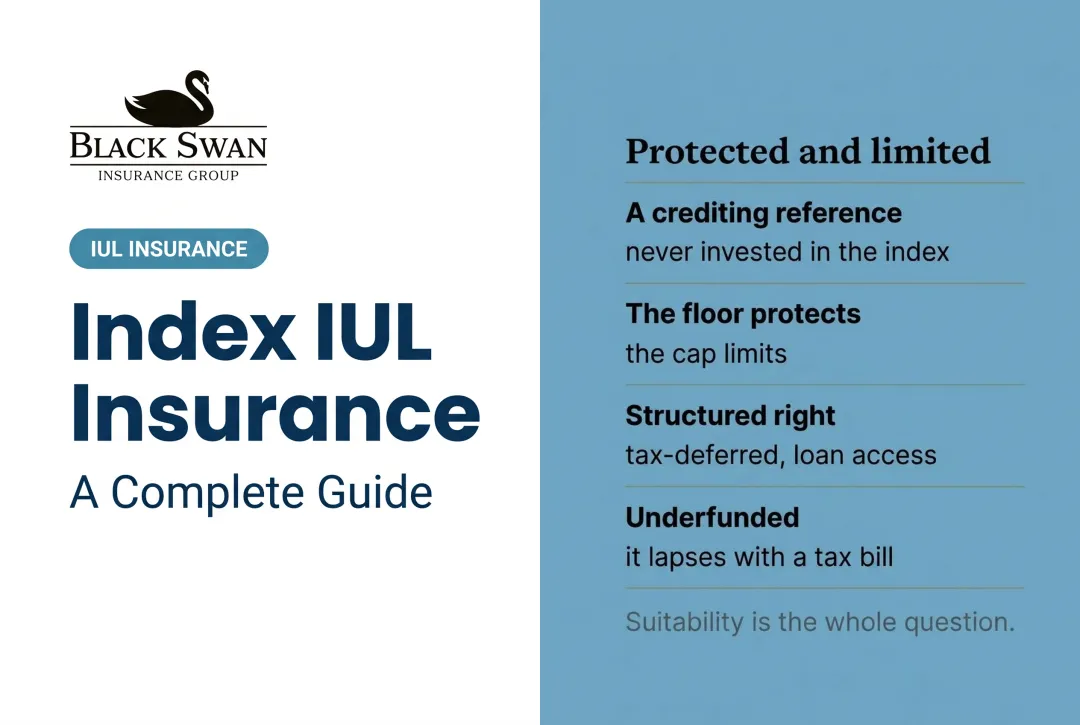
- Floor — the minimum crediting rate, often 0%, in a down year
- Cap — the maximum crediting rate, however far the index rises
- Participation rate — the share of index growth used in the calculation
- Spread — a deduction some carriers take before crediting
Index gains 12% against an 8% cap, you are credited 8%. Index drops 10% against a 0% floor, you are credited nothing rather than a loss.
That is not the same as your account staying flat. Monthly cost-of-insurance and administrative charges still come out, so cash value can fall in a year the floor worked exactly as designed.
Zero is your hero in a down year — but the floor applies to the credit, not to the charges.

The NAIC structures its own illustration benchmark with a 0% floor, an annual cap and 100% participation — a regulatory reference point, not a description of any carrier's actual terms. Request the real numbers from your illustration.
Most contracts let you adjust premiums, choose between fixed and indexed accounts, modify the death benefit and add riders. Loans and withdrawals provide liquidity, at a price: loans accrue interest, both reduce the death benefit, and an unmanaged loan accelerates lapse risk.
The Ultimate IUL Blueprint
Before funding a plan, the Blueprint covers what the design has to survive: funding levels, caps and charges, the MEC line, loan timing, and what to demand from an illustration.
What It Can Genuinely Do
A death benefit lasting your whole life rather than 20 or 30 years supports income replacement, debt payoff, business continuity, education funding and a legacy.
Premium flexibility, with a catch. You can often lower, skip or increase payments — but only while the policy holds enough cash value to absorb charges. Skip too often without reserves and the lapse notice arrives.
Tax-deferred growth, with conditions. Cash value generally grows without current taxation, and a distribution from a non-MEC contract is generally taxed only on the amount exceeding basis. In one IRS worked example, a $78,000 surrender against $64,000 of basis produced $14,000 of taxable income — not tax on the full amount.

That treatment depends on the contract staying non-MEC, proper funding and ownership, the policy remaining in force, and how withdrawals and loans are structured. Four conditions, any one of which can fail.
Growth without direct market exposure, unlike variable universal life — traded against caps and participation rates that limit how much of a gain reaches you. You are buying downside crediting protection with upside you give away.
This tends to interest physicians, attorneys and executives already maxing qualified plans; business owners wanting assets outside a concentrated company; and families seeking tax diversification alongside existing accounts.
What the Critics Get Right
The common criticism — that IUL is a complicated, expensive product sold on optimistic illustrations to people who would do better with term and an index fund — is correct often enough that it deserves a straight answer rather than a rebuttal.
The charges are real and front-loaded. The attractive numbers are non-guaranteed. The person recommending it is usually paid on the premium. And for someone who has not maxed their tax-advantaged accounts, the criticism is simply right.
Where it stops being right is for the high earner who has done all of that and still faces a one-bucket retirement. At that point the question is not whether an index fund beats an insurance contract — it does, on returns — but whether you want every retirement dollar sitting in the same tax treatment.
The Costs That Quietly Erode It
Cost of insurance rising with age, premium loads and administrative fees, rider charges, surrender charges on early exit, and loan interest on any balance. All of these apply whether the index cooperates or not.
Underfunding accelerates everything. As cost of insurance climbs, a thinly funded policy sees charges outpace crediting, and cash value drains.

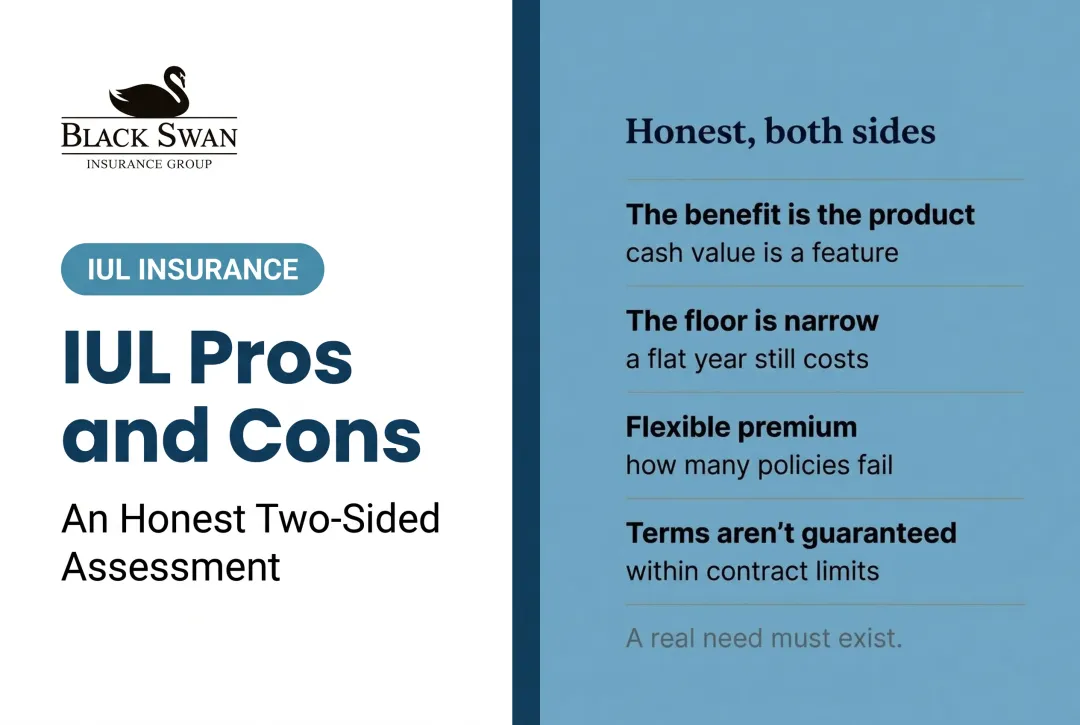
Non-guaranteed elements change. Caps, participation rates, fixed-account rates and the assumptions behind your illustration are not locked. Carriers can adjust within contract limits, and the illustration you signed may not resemble performance a decade on.
| Scenario | Assumption | Result over time |
|---|---|---|
| Original illustration | Mid-range crediting, current charges | Cash value grows steadily |
| Guaranteed scale | Minimum rates, maximum charges | Grows slowly or needs higher premiums |
| Lower-crediting stress test | Below-average index years, current charges | May underperform; added funding needed |
Not a forecast — a sensitivity check you should run before committing.
Lapse risk is real. New York's Department of Financial Services has warned that universal life premiums and cash value must cover ongoing expenses or the policy lapses. Lower-than-assumed crediting can mean owing more than planned simply to keep coverage alive.
And the MEC line. Push premium in too fast and the seven-pay test converts the contract into a Modified Endowment Contract. Withdrawals and loans then tax income-first, with a possible extra 10% before 59½. The test is structural, not a dollar cap, so design matters from day one.
Before buying, request both guaranteed and current illustrations, the expense and charge pages, historical cap and participation rate changes, the surrender charge schedule, loan provisions and rates, and the insurer's financial-strength ratings.
How It Compares
| Option | Key difference from IUL |
|---|---|
| Term life | Temporary, simpler, far cheaper; no cash value |
| Whole life | Fixed premiums, guaranteed growth; less flexibility |
| Standard UL | Similar flexibility, fixed-rate crediting rather than index-linked |
| Variable UL | Direct subaccount investment; higher volatility and risk |
| 401(k) / IRA / Roth | Built for retirement saving, with matching and contribution limits; not insurance |
| Taxable brokerage | Full liquidity and market access; no death benefit, no deferral |
Retirement and brokerage accounts exist to grow money you will spend. IUL exists first as life insurance. Before treating it as a retirement supplement, weigh any unclaimed employer match, the contribution limits you have not used, the fees and investment choices in each option, near-term liquidity, and whether you genuinely need permanent protection at all.
Stronger Fit
- Earning $150K+ with strong, sustainable cash flow and reserves already set aside
- A genuine, lasting need for permanent death-benefit protection
- Insurable, with a long horizon and willingness to review annually
- Lower-cost tax-advantaged accounts already maximised
Weaker Fit
Not everyone should buy this. It is a poor fit if you:
- Want the cheapest possible death benefit — buy term
- Need only short-term coverage
- Require guaranteed accumulation
- Need liquidity soon
- Want something you never have to revisit
Risks to Understand Before You Fund
- Underfunding is the leading cause of failure, and it surfaces decades later when replacing coverage is expensive.
- Caps and participation rates can be lowered going forward, within contract limits.
- Cost of insurance rises with age and can overtake crediting in a thin policy.
- MEC status is generally permanent and removes the living-access advantage entirely.
- A loan outstanding at lapse or surrender can create taxable income with no cash received.
- Surrender charges can consume much of the cash value if you exit early.
This is not set-it-and-forget-it. It is design-it, fund-it, review-it.
Find Out Where You Actually Stand
This starts with the Tax-Free Wealth Blueprint Fit Review. If you earn $150K+ and a plan has been proposed, we define the protection need first, calculate a premium you can genuinely sustain, compare guaranteed against non-guaranteed columns, and stress-test the design through lower-crediting and zero-credit years with the charges shown in plain numbers. Not every client ends up with a policy, and that is deliberate. If IUL does not fit, we will tell you that too.
Frequently Asked Questions
How much does an IUL plan cost per month?
It varies widely with age, health, coverage amount, design, riders and underwriting. Compare guaranteed costs alongside illustrated values rather than relying on a generic figure.
Is an IUL plan a good idea?
It depends on your permanent coverage need, funding capacity, time horizon and willingness to monitor the contract. It is not right for everyone, and confirming that before you buy is the point of a fit review.
Is it better than a 401(k)?
They do different jobs. Consider employer matching, contribution limits, fees, tax treatment and liquidity before treating IUL as a substitute rather than a complement. If you have an unclaimed match, that comes first.
What happens if the policy lapses?
Coverage terminates, and outstanding loans or gains may create tax consequences. Reinstatement, where available, usually requires new underwriting or repayment under the contract's terms.
Can I access the cash value?
Loans and withdrawals may be available. Both reduce cash value and the death benefit, loans accrue interest, and poor management increases lapse risk.
Does it guarantee returns?
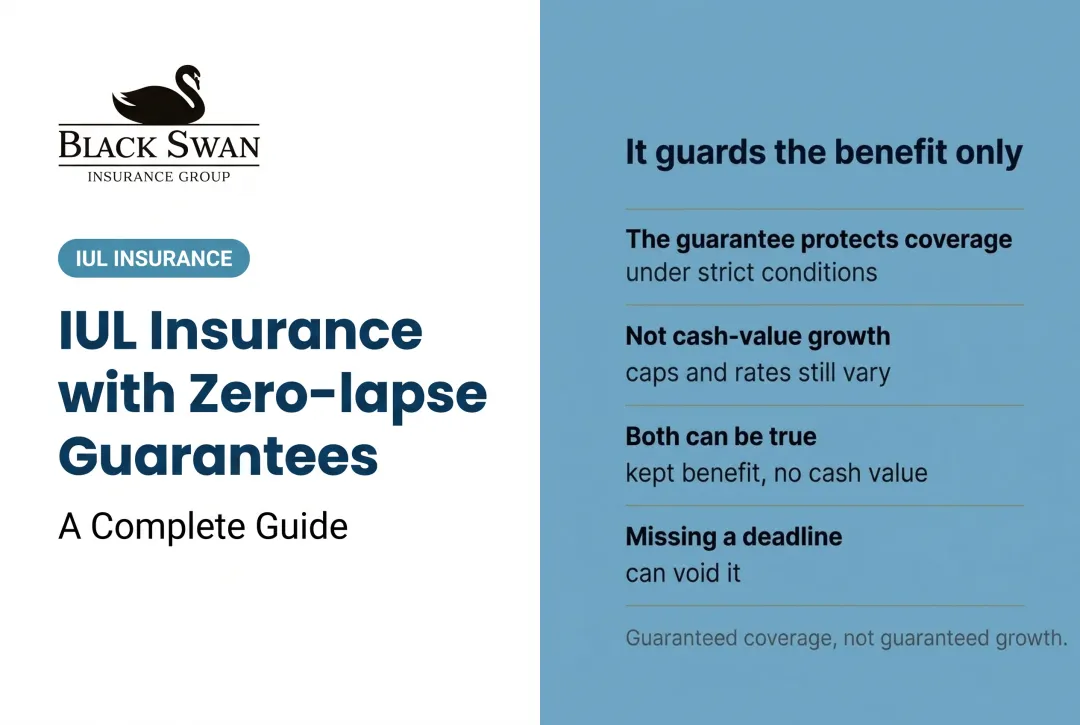
No. The floor applies to index crediting, not to policy charges or your total outcome. Caps, participation rates and spreads are generally non-guaranteed and can change.
Would term insurance serve me better?
If your need is a death benefit for a defined period, almost certainly. Term is cheaper and simpler. Permanent coverage earns its cost only when the need genuinely outlives a term.
Sources
- NAIC — Actuarial Guideline 49-A
- IRS Revenue Ruling 2009-13 — surrender and basis
- New York DFS — universal life premium and expense warning
- NAIC — Life Insurance Illustrations
Disclosure: This article is educational and is not personal tax, legal or investment advice. Indexed universal life is life insurance first. Product features, charges, guarantees and availability vary by carrier and state, and guarantees are subject to the issuing insurer's claims-paying ability. Illustrated values are not guarantees; actual results depend on policy terms, crediting, costs and funding. Actual results depend on policy design, carrier, crediting options, caps, participation rates, expenses, funding and ongoing management. This strategy is not appropriate for everyone. Policy loans and withdrawals reduce cash value and the death benefit, and can create tax consequences if the policy lapses or becomes a modified endowment contract. Consult your own tax, legal and financial professionals for advice specific to your situation.
And remember, it's not what you earn, it's what you keep… enjoy the ride.