By Robert Balgac, Founder, Black Swan Insurance Group | October 5, 2026
Retirement income planning is not about reaching a savings number. It is about converting what you have built — savings, benefits, insurance, investments — into cash flow that arrives every month whether or not the market cooperates.
The distance between "saved enough" and "confident about income" surprises most people. 31% of retirees in EBRI's 2024 study said their spending was higher than they could afford, up from 27% two years earlier. These are not people who failed to save. They are people whose income plan assumed conditions that did not hold.
If you earn $150K+ and have been accumulating diligently into tax-deferred accounts, the uncomfortable part is that accumulation and income are different disciplines. A large balance is not an income plan, and the tax treatment of every withdrawal was decided years before you retired.
The short answer: Start with a real spending budget split into essential and discretionary. Subtract guaranteed income — Social Security, pensions — to find the gap your assets have to cover. Build the sequence of withdrawals with taxes, RMDs and Medicare thresholds in view, keep one to two years of expenses liquid to blunt sequence-of-returns risk, and stress-test the whole thing against lower returns, higher inflation and a longer life than you expect. Most durable plans blend several sources rather than relying on one.
Key Takeaways
- Compare essential and discretionary expenses against guaranteed income to find the gap your portfolio actually has to fund
- Durable plans mix guaranteed income, portfolio withdrawals, growth assets, tax-aware sequencing and liquid reserves
- Social Security, pensions, annuities, cash-value life insurance, rental income and investments each carry different rules and trade-offs
- Test against inflation, market drops, healthcare costs and a long lifespan — not one scenario
- Sequence-of-returns risk is the specific danger of the first few years, and it is addressable
Step 1: Define the Target
Start with a budget, not a rule of thumb.
- Essential costs — housing, food, utilities, insurance premiums, taxes, routine healthcare
- Discretionary spending — travel, gifts, hobbies, entertainment
Then account for how these shift. Early retirement usually means more travel. Later years usually mean more medical spending. Fidelity's 2025 estimate puts lifetime healthcare costs for a single 65-year-old at roughly $172,500 after tax, excluding long-term care. That single figure reshapes most budgets.
The generic "70% of income" replacement figure is not a plan. Your number depends on your mortgage status, your health and how you intend to live.
Step 2: Inventory Every Source
Social Security and pensions. 401(k), 403(b), traditional and Roth IRAs. Taxable brokerage. Annuities and cash-value life insurance. Rental income, business income, part-time work.
Classify each across four dimensions:
- Guaranteed or market-dependent — a pension check versus a stock portfolio
- Taxable or tax-advantaged — traditional IRA withdrawals versus qualified Roth distributions
- Liquid or restricted — brokerage cash versus an annuity inside its surrender period
- Temporary or lifelong — consulting work versus Social Security
Confirm real numbers before relying on any of them. Pull current Social Security estimates, pension payout elections, account statements and policy illustrations. Figures on old paperwork are frequently wrong by a wide margin.
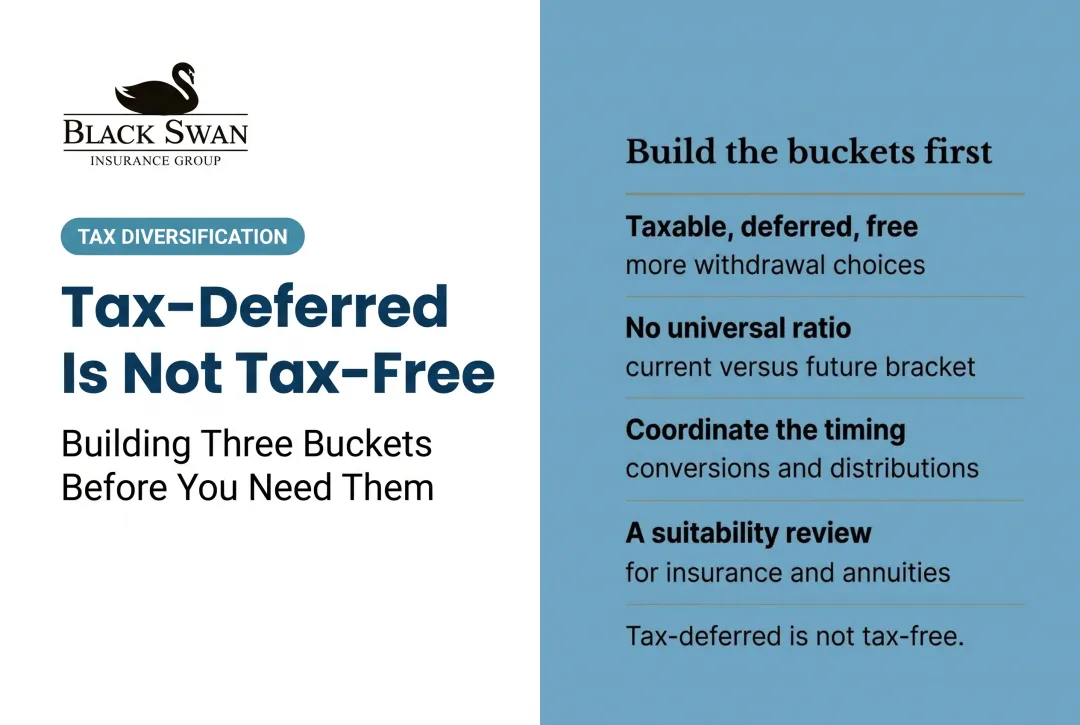
Tax-deferred is not tax-free. The IRS is waiting, not gone — and in retirement it stops waiting.
Step 3: Calculate the Gap, in Two Parts
Subtract guaranteed income from projected expenses. What remains is what your assets must cover.
Split it:
- Essential gap — non-negotiable costs
- Discretionary gap — lifestyle spending
The separation matters because it identifies what must be reliable versus what can flex in a bad year. Model both under lower returns, higher inflation, a longer lifespan and an unplanned healthcare event.

Step 4: Sequence the Withdrawals
Decide the order you draw from accounts, how much cash stays on hand, and how you adjust after a strong or weak year.
Coordinate Social Security and pension timing with the account mix rather than deciding each separately. Delaying Social Security raises the monthly benefit for life — but that decision has to account for tax-deferred balances that will trigger required minimum distributions later, potentially in the same years.
Withdrawals from taxable, tax-deferred and Roth accounts do more than change your tax bill. They can push more Social Security into taxable territory and raise Medicare premiums through IRMAA surcharges. Before locking a withdrawal order, verify current IRS thresholds for RMDs, Social Security taxation breakpoints, and the Medicare income-related monthly adjustment amounts.
Sequence-of-Returns Risk Is the Real Enemy
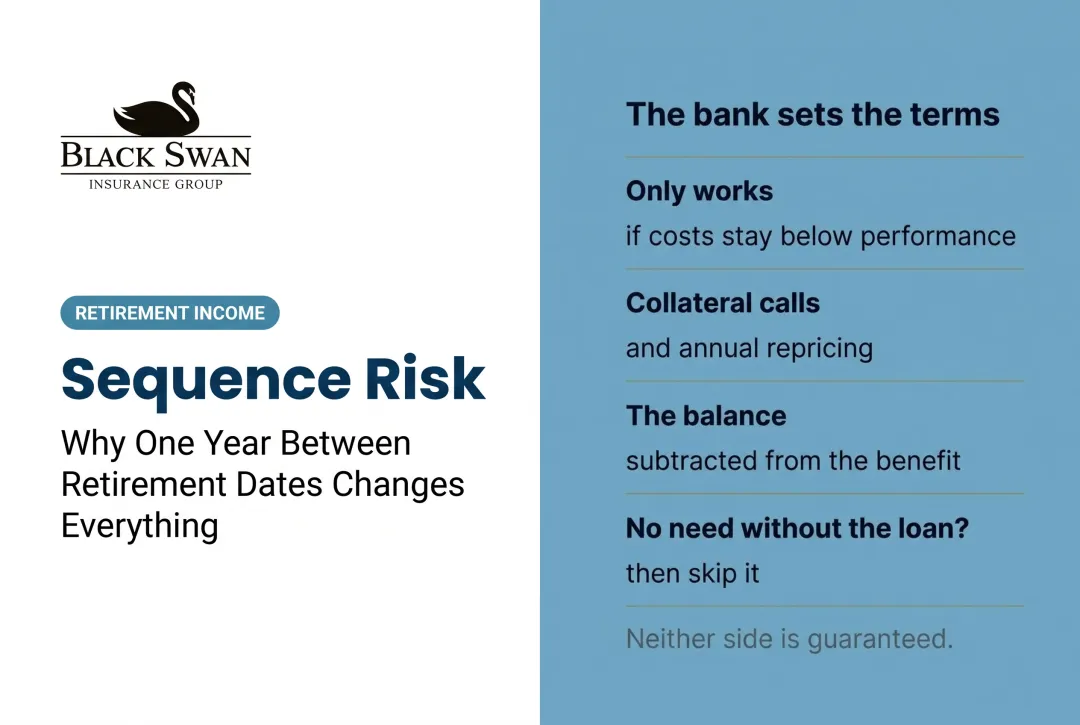
Withdrawing from a falling portfolio early in retirement can permanently damage its ability to recover. This is not theoretical.
Vanguard's bear-market research found retirees who hit a poor sequence of returns were 31% more likely to outlive their wealth, with 11% lower income streams and 37% smaller bequests than retirees with better timing — identical portfolios, identical withdrawal rates, different luck.

Practical responses:
- Keep one to two years of expenses in liquid reserves
- Use a bucket approach separating near-term spending from long-term growth assets
- Trim discretionary withdrawals temporarily after a down year
Hope is not a retirement strategy. If the plan only works when the market cooperates in your first five years, it is not a plan — it is a bull-market assumption wearing a suit.
What the Critics Get Right
Anyone skeptical of insurance products showing up in a retirement income article is right to be, and the skepticism should be named rather than worked around.
They are right that annuities and cash-value policies are frequently sold as income solutions to people whose actual problem was a spending plan. They are right that illiquidity is a genuine cost, and that a contract you cannot exit is a serious commitment at exactly the age when flexibility matters. And they are right that the fee disclosure in this corner of the industry has historically been poor.
Where the criticism runs out is in treating every guarantee as a rip-off. Longevity risk is real, sequence risk is real, and a household that wants its essential expenses covered by something that does not depend on market timing is making a defensible choice. The question is how much of the portfolio that job requires — and the honest answer is usually a slice, not the whole thing.
The Strategies, and What Each Costs
Portfolio Withdrawals
Flexible, for households comfortable with market risk. Morningstar's 2025 research puts a base-case starting withdrawal rate around 3.9% for steady inflation-adjusted spending, rising to nearly 5.7% under more flexible strategies that cut spending after bad years.

Trade-off: growth potential and full access, against sequence risk and the ongoing management burden.
Guaranteed Income Through an Annuity
Useful when a household wants predictable lifetime income covering a defined share of essential expenses. Fixed, variable, immediate and fixed indexed contracts carry different guarantees and payout structures.
Trade-off: contract costs, surrender restrictions, inflation risk on fixed payments, and dependence on the insurer's claims-paying ability. Guaranteed income and full access to principal rarely coexist, and once income payments begin the amount usually cannot be changed.
Cash-Value Life Insurance as a Supplement
Indexed universal life can serve as a supplemental piece for someone with a genuine permanent death-benefit need, stable cash flow for premiums and a long horizon. It is permanent life insurance first; any potential tax-advantaged access to cash value is secondary and conditional on the policy being properly structured, funded and managed.
Loans accrue interest and reduce both cash value and the death benefit. A lapse with an outstanding loan and gain in the contract can create taxable income. It never replaces emergency reserves or diversified retirement accounts.
Bridges and Other Sources
Delaying retirement a year or two. Part-time or consulting work. Rental income. Bond or CD ladders for near-term needs. Strategic Social Security timing. These fit best where a household needs temporary income, more liquidity, or simply a less complicated approach than any insurance contract offers.
And on the protection side of the plan: if the remaining need is covering a spouse for a defined period rather than permanently, term insurance is usually the cheaper and cleaner answer, and it should be priced before any permanent design.
The Ultimate IUL Blueprint
If permanent coverage is part of your income picture, the Blueprint covers what has to be true for it to work: funding levels, loan timing, the MEC line, and the numbers to demand from an illustration.
Who Needs the Structured Version
Stronger Fit for a Formal Income Plan
- Household income of $150K+ with meaningful tax-deferred balances facing future RMDs
- Near-term retirees with little time to recover from a downturn
- Early retirees whose assets must stretch across 30 years or more
- Late-start high earners coordinating income, tax diversification and protection on a shorter runway
- Business owners whose wealth is concentrated in a company or in real estate
- Married or partnered households where one spouse may outlive the other by a decade
Weaker Fit for Adding Insurance to the Mix
Not everyone should buy an IUL to build retirement income. For most households the qualified accounts and a taxable brokerage account will do more.
- Guaranteed income already covers essential expenses comfortably
- Reserves are thin, or high-interest debt is still running
- Liquidity is the dominant need over the next several years
- No permanent protection need exists on its own merits
- Unwillingness to monitor a contract for decades
What to Gather First
Current spending and expected retirement date. Account balances, contribution rates and outstanding debt. Insurance coverage and Social Security estimates. Pension payout options and recent tax returns. Healthcare assumptions and estate documents. For every account and policy, note ownership and tax treatment, required distributions and withdrawal restrictions, surrender charges, policy loans and beneficiary designations.
Five Mistakes That Recur
| Mistake | Likely cause | Practical check |
|---|---|---|
| One flat return assumption | No stress-testing | Model low-return and high-inflation scenarios |
| Ignoring taxes and healthcare | Treating sources in isolation | Recalculate at household level |
| Claiming Social Security too early | Not weighing lifetime value | Compare breakeven ages across strategies |
| Investing too conservatively | Fear of short-term losses | Match allocation to a 25–30 year horizon |
| Overfunding an illiquid product | Skipping liquidity planning | Confirm surrender terms and access before funding |
Risks to Understand Before You Commit Assets
- Sequence-of-returns risk in the first several years can permanently reduce what the portfolio supports
- Inflation erodes a flat payout across a 25-year retirement unless the income adjusts
- RMDs and IRMAA can raise your effective tax rate and Medicare premiums in ways the accumulation years never previewed
- Annuity surrender periods restrict access, and once income begins the payment usually cannot be changed
- Insurance and annuity guarantees depend on the issuing insurer's claims-paying ability
- Policy loans reduce cash value and death benefit, and a lapse with a loan outstanding and gain in the contract can create taxable income with no cash received
- Cost of insurance rises with age inside permanent policies and is charged in flat crediting years
- Healthcare and long-term care costs are the most commonly underestimated line in a retirement budget
- Longevity is the risk that amplifies every other one on this list
Find Out Where You Actually Stand
This starts with the Tax-Free Wealth Blueprint Fit Review. If you earn $150K+ and are within sight of drawing income, we calculate the essential and discretionary gaps, model the withdrawal sequence against RMDs and Medicare thresholds, stress-test a poor sequence in the first five years, and price the alternatives — including doing nothing more than you already are. If it does not fit, we will tell you that too.
Frequently Asked Questions
What is the best way to create retirement income?
It depends on expenses, guaranteed benefits, assets, taxes, longevity and liquidity needs. Most households end with a coordinated mix rather than one source, because no single tool handles longevity, inflation, taxes and flexibility at once.
How much monthly income will $500,000 generate?
There is no universal figure. It depends on the withdrawal method, returns, taxes, inflation, your age and how long the money has to last. Get a personalised projection rather than applying a percentage.
What percentage of Americans retire with $1,000,000?
Per a Congressional Research Service analysis of 2022 Federal Reserve data, about 4.6% of U.S. households hold retirement-account balances above $1,000,000, rising to 9.2% for households aged 55–64. Household figures, not individual.
Should I use an annuity?
Possibly, for a defined slice of essential expenses. Review liquidity limits, fees, inflation protection, contract terms and the insurer's claims-paying ability first. Covering essentials is a reasonable job for a guarantee; covering everything is not.
How do I avoid running out of money?
A realistic spending plan, diversified income sources, tax-aware sequencing, cash reserves, and a plan that has been tested against weak markets and inflation rather than one projection. Then review it annually.
Does life insurance belong in a retirement income plan?
Only when a permanent protection need exists independently. As an income source alone it is a poor first choice; as a supplement alongside a real protection need and disciplined funding, it can have a place.
Sources
- EBRI — 2024 Spending in Retirement Study
- Vanguard — Safeguarding retirement in a bear market
- Congressional Research Service — Retirement account balances
- NAIC — Life Insurance
- NAIC — Life Insurance Illustrations
Disclosure: This article is educational and is not personal tax, legal or investment advice. Indexed universal life is life insurance first. Actual results depend on policy design, carrier, crediting options, caps, participation rates, expenses, funding and ongoing management. Policy loans and withdrawals may reduce cash value and death benefit and can create tax consequences if the policy lapses or becomes a modified endowment contract. Insurance and annuity guarantees are subject to the claims-paying ability of the issuing insurer; investments can lose value. This strategy is not appropriate for everyone. Illustrated values are not guarantees; actual results depend on policy terms, crediting, costs and funding. Consult your own tax, legal and financial professionals for advice specific to your situation.
And remember, it's not what you earn, it's what you keep… enjoy the ride.