By Robert Balgac, Founder, Black Swan Insurance Group | October 5, 2026
Indexed universal life turns up in almost every conversation about tax-advantaged retirement planning for high earners, and it arrives with more noise attached than almost any product in this industry. Half the internet says it is a scam. The other half is selling it.
Both camps are describing the same thing badly. An IUL is permanent life insurance with a cash-value account credited on a formula that references a market index. It is not market participation. It is not a retirement account. It is a contract with a cost structure, a set of non-guaranteed levers the carrier controls, and a funding requirement that runs for decades.
If you earn $150K+, have maxed the 401(k), are past the Roth income limits and are being shown an illustration with an appealing number in year thirty, the question is not whether IUL is good or bad. It is whether this specific design, funded at a level you can actually sustain, does a job your existing buckets cannot.
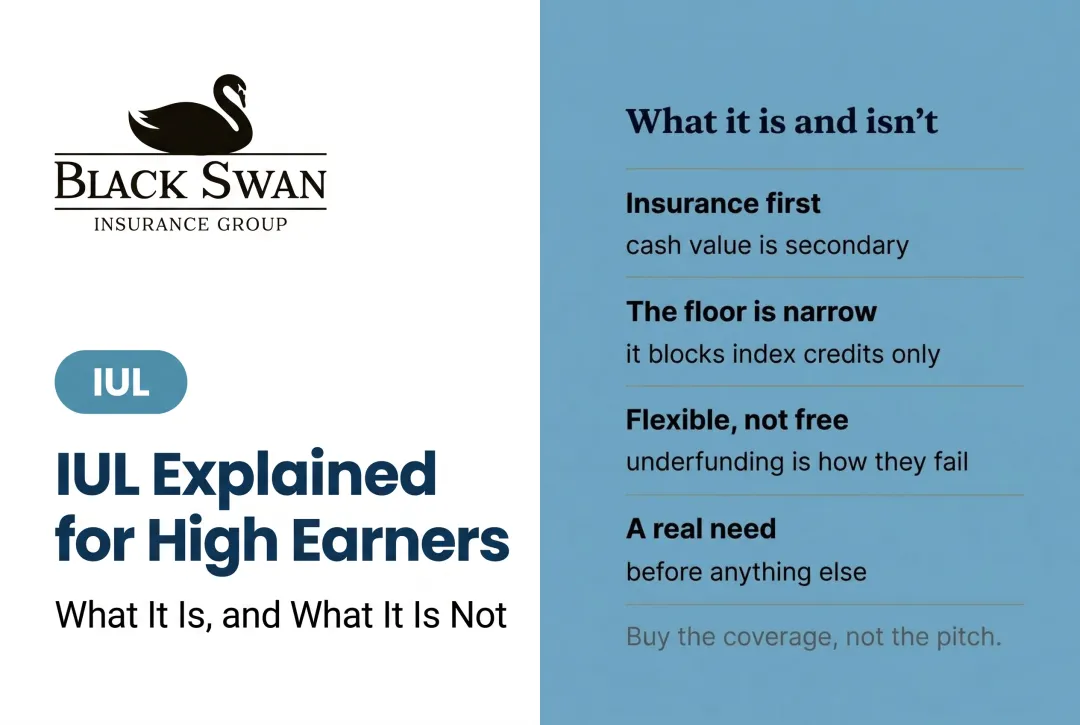
The short answer: An IUL is life insurance first. Premium pays the cost of insurance and policy charges, and what remains is credited on an index-linked formula limited by a cap, scaled by a participation rate, sometimes reduced by a spread, and floored at typically 0%. The floor protects credited interest, not the charges — cash value can fall in a 0% year. Caps and participation rates are non-guaranteed. It may fit someone with a genuine permanent insurance need and stable surplus cash flow, and it has to be compared honestly against term insurance, whole life and ordinary retirement accounts before anyone funds it.
Key Takeaways
- An IUL provides a death benefit first; cash value grows on a crediting formula tied to an index, not on direct ownership of it
- A floor can protect credited interest from a negative index year, but fees, insurance costs and loans still reduce policy value
- Caps limit the upside, so a strong bull market is not fully captured
- Caps, participation rates and cost of insurance are non-guaranteed and can change
- It suits a narrow profile: permanent insurance need, stable cash flow, long horizon, willingness to monitor
How the Mechanics Work
A portion of your premium pays policy expenses and the cost of insurance — the pure cost of the death benefit. The remainder goes into cash value, which you allocate between a fixed-interest option and one or more indexed crediting strategies.
Your money is not invested in the S&P 500 or any other index. The index is a benchmark the carrier uses to calculate the interest credit added to your cash value.
Floors, Caps, Participation Rates and Spreads
These are non-guaranteed elements set by the insurer, and they can change.
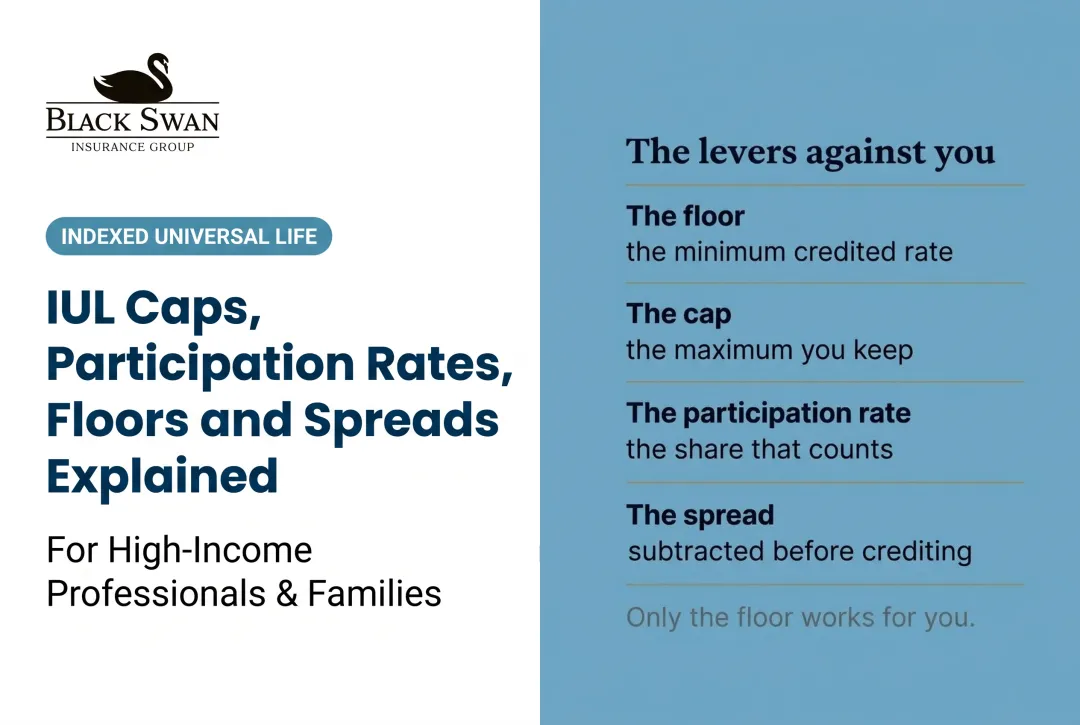
- Floor — the minimum credited rate on an indexed account. A 0% floor is common: a negative index period produces no credit and no direct index loss
- Cap — the maximum credited interest for the period, however high the index goes. Index up 15%, cap at 9%, credit is 9%
- Participation rate — the percentage of the index gain used in the calculation. At 50% participation, a 10% index gain starts the calculation at 5%
- Spread — a percentage subtracted from the index return, used instead of or alongside a cap. Index up 10% with a 2% spread credits 8%
Policy charges and the cost of insurance are deducted each period regardless, so cash value can fall in a 0% credit year.
A worked example: index performance +12%, cap 9%, participation 100%, spread 0% — the credit is 9%, because the index exceeded the cap. If the index returns −5%, the credit is 0% because of the floor. The charges come out either way.

Flexibility, and What It Obligates You To
Premiums and death benefits adjust within set limits. That flexibility carries responsibility: reduce or skip premiums and the cash value still has to cover ongoing policy costs, or the contract lapses.
Cash value is reachable through loans or withdrawals, which some owners use for supplemental retirement income. Loans accrue interest, and both loans and withdrawals reduce the available death benefit. A policy that lapses with an outstanding loan and gain in the contract can create a significant tax liability with no cash received to pay it.
This is not set-it-and-forget-it. It is design-it, fund-it, review-it.
The Benefits, and What Each One Costs
What it genuinely offers: a permanent death benefit while adequately funded; premium flexibility within contractual limits; a floor that shields credited interest from a negative index year; tax-deferred cash value growth, with potential tax-advantaged access through loans and withdrawals when the policy is properly structured, funded and managed and is not a modified endowment contract.
What each of those costs:
- Capped upside. You will not capture the full gains of a strong bull market. That is the trade for the floor, and it should be stated as a trade
- Non-guaranteed elements. Caps, participation rates and cost of insurance can move. Illustrated returns reflect current assumptions
- Complexity. Crediting methods, loan provisions and internal charges interact in ways that reward study and punish inattention
- Lapse risk. If cash value is drained by costs, loans and weak crediting, the policy can terminate — leaving no coverage and a potential tax bill
| Product | Key distinction from IUL |
|---|---|
| Whole life | More predictable. Generally fixed premiums and guaranteed cash value growth, typically lower than IUL's potential |
| Variable universal life | Direct investment in subaccounts. Higher return potential, direct market losses, no floor |
| Term life | Pure death benefit for a set period. No cash value, and significantly cheaper — usually the right answer when the need is temporary |
An illustration is a projection, not a promise. Ask for guaranteed values beside the non-guaranteed assumptions, then stress-test with lower crediting and higher costs.
What the Critics Get Right
The critics are right about three things, and pretending otherwise would cost this page its credibility.
They are right that the "market upside with no downside" pitch is false, because the floor applies to the credit and not to the charges, and a policy can lose value in a year the index was flat. They are right that caps and participation rates are levers the carrier can pull after you are committed, which makes any thirty-year projection a statement of hope. And they are right that a large share of these policies were sold to people who never had a permanent insurance need in the first place.
What they miss is the one situation where the tool makes sense: a high earner who needs permanent coverage regardless, has already funded the obvious accounts, can sustain the premium through a bad decade, and wants tax diversification alongside the protection. Bad design is real. It is not the same thing as a bad tool.
Who It Fits
Stronger Fit
- A clear, long-term need for a permanent death benefit that stands on its own merits
- Household income of $150K+ with stable cash flow, comfortable funding the planned premium for decades
- Traditional retirement accounts already maxed, and past the Roth income limits
- Looking specifically for tax diversification rather than raw accumulation
- Roughly $500–$2,500 a month of capacity that does not touch emergency reserves
- The patience to monitor a complex contract and review it annually
For executives and professionals, the role is tax diversification after the qualified accounts are full. For business and practice owners, it can build protection and assets outside the company — supporting buy-sell planning, key-person needs and personal liquidity not tied to the company's value. Both belong in a conversation with your legal and tax advisors.
Weaker Fit
Not everyone should buy an IUL. For most households the expensive mistake is the more likely outcome, and that is worth saying plainly.
- The goal is the lowest-cost death benefit — term insurance does that better and cheaper, and it is frequently the whole answer
- You cannot commit to meaningful premiums for 15 years or more
- You need short-term liquidity from these dollars
- You expect market-level returns without caps or internal costs
- You prefer simple, low-maintenance products
- Emergency reserves are thin, or core retirement saving has not started
Compare it against term life for low-cost temporary protection, whole life for stronger guarantees and simpler mechanics, VUL where you want direct market participation and can carry the risk, and simply investing the premium difference in a brokerage account for maximum liquidity.

The Ultimate IUL Blueprint
If you are at the point of comparing designs rather than deciding whether to look, the Blueprint covers the decisions that determine the outcome: funding levels, minimum death benefit, the MEC line, index-strategy selection and loan timing.
Costs, Taxes and the Lapse Problem
The Charges
- Cost of insurance — the pure cost of the death benefit, rising with age
- Premium load — a percentage taken from each payment
- Administrative charges — monthly or annual fees to keep the contract in force
- Rider charges — for optional benefits such as long-term care
- Surrender charges — exit fees, often running the first 10 to 15 years
These compound. An illustration that glosses over them overstates long-term cash value.
The Tax Rules
- Tax-deferred growth — cash value is not taxed year by year
- Death benefit — usually paid to beneficiaries income-tax-free
- Loans and withdrawals — loans generally are not taxed while the policy is in force; withdrawals are generally tax-free up to basis
- MEC status — overfunding too fast reclassifies the contract, and loans and withdrawals then face less favourable treatment plus a possible 10% penalty on gains before age 59½
- Lapse with a loan — the outstanding balance can be treated as a taxable distribution
Review IRS Publication 525 for the general rules and confirm your own position with a tax professional.
Lapse Is the Structural Risk
If cash value cannot cover the monthly charges, the policy terminates. The triggers are predictable: cost of insurance rising with age, premiums falling short of what the design needs, and loans or withdrawals draining value too far.
A 2019 New York Department of Financial Services alert warned that many universal life policies were at risk of lapse for exactly these reasons — in some cases surfacing only as a large, unexpected premium demand to keep coverage in force.
How to Evaluate a Proposal
- Confirm the basics — the planned premium schedule, the minimum premium required to prevent lapse, and how long you are expected to fund it
- Compare guaranteed against illustrated — read the guaranteed column first and weight it heavily
- Review the crediting factors — current and guaranteed caps, participation rates and spreads, and how often the carrier can change them
- Identify every charge — administrative fees, premium loads and the full surrender schedule
- Stress-test it — supplemental illustrations with lower crediting, higher internal costs, and a future policy loan

Do not buy the highlight reel. Watch the game film. If the design only works in the best-case column, that is not a plan.
Risks to Understand Before You Fund One
- Charges continue in a 0% crediting year, so cash value can fall with the floor fully intact
- Cost of insurance rises with age and is deducted regardless of index performance
- Caps, participation rates and spreads are non-guaranteed and can be reset at renewal
- Surrender charges commonly run 10 to 15 years, making an early exit expensive
- Underfunding is the most common failure mode, and premium flexibility makes it easy
- Loans accrue interest and reduce the death benefit, and a lapse with a loan outstanding and gain in the contract can create taxable income with no cash received
- Crossing the seven-pay limit makes the contract a MEC under I.R.C. § 7702A and permanently changes distribution taxation
- Lapse leaves you with no coverage and a possible tax bill, at an age when replacing the policy may be impossible
- Illustrated values are not guarantees
Find Out Where You Actually Stand
This starts with the Tax-Free Wealth Blueprint Fit Review. If you earn $150K+ and are weighing an IUL, we run your numbers, stress-test the funding, show the fees, caps and loan assumptions, and compare the whole thing honestly against term insurance plus diversified savings. If it does not fit, we will tell you that too.
Frequently Asked Questions
What is indexed universal life insurance?
Permanent life insurance with flexible premiums and a death benefit, where cash value earns interest tied to a market index without direct market investment. Policy charges still apply and reduce the result.
Can I lose money in an IUL?
Yes. A 0% floor protects against a negative index credit, but cash value falls when policy charges, cost of insurance and loan interest exceed the interest credited. That is the single most misunderstood fact about this product.
What are the main disadvantages?
Complexity, capped upside, non-guaranteed growth assumptions and ongoing costs that erode value. Underfunding can cause a lapse, and surrender charges make early exits expensive.
How does it compare with whole life?
An IUL offers flexible premiums and index-linked crediting with caps and floors. Whole life typically has fixed premiums, guaranteed growth and more predictability, often with lower potential.
Is it a good place to put money?
It is life insurance first, and evaluating it purely as a place to put money is how people end up disappointed. It can suit a high earner with a genuine long-term insurance need who can fund it consistently. Suitability depends on your goals, the costs, and the alternatives.
Should I buy term instead?
If the requirement is maximum death benefit for the lowest premium over a defined period, term is the cleaner answer and worth saying outright. Permanent coverage earns its place when the protection need genuinely outlasts a term.
Sources
- IRS Publication 525 — Taxable and Nontaxable Income
- New York Department of Financial Services — universal life lapse risk alert
- NAIC — Life Insurance Illustrations
- NAIC — Life Insurance
- I.R.C. § 7702A and Rev. Proc. 2008-39 (modified endowment contracts and the seven-pay test)
Disclosure: This article is educational and is not personal tax, legal or investment advice. Indexed universal life is life insurance first. Actual results depend on policy design, carrier, crediting options, caps, participation rates, expenses, funding and ongoing management. Policy loans and withdrawals may reduce cash value and death benefit and can create tax consequences if the policy lapses or becomes a modified endowment contract. This strategy is not appropriate for everyone. Illustrated values are not guarantees; actual results depend on policy terms, crediting, costs and funding. Consult your own tax, legal and financial professionals for advice specific to your situation.
And remember, it's not what you earn, it's what you keep… enjoy the ride.