By Robert Balgac, Founder, Black Swan Insurance Group | October 5, 2026
Florida buyers get a particular version of this pitch, and it usually leans on the state having no income tax as though that settles something. It does not. If anything, the absence of state income tax weakens one of the common arguments for a tax-advantaged insurance bucket, not strengthens it.
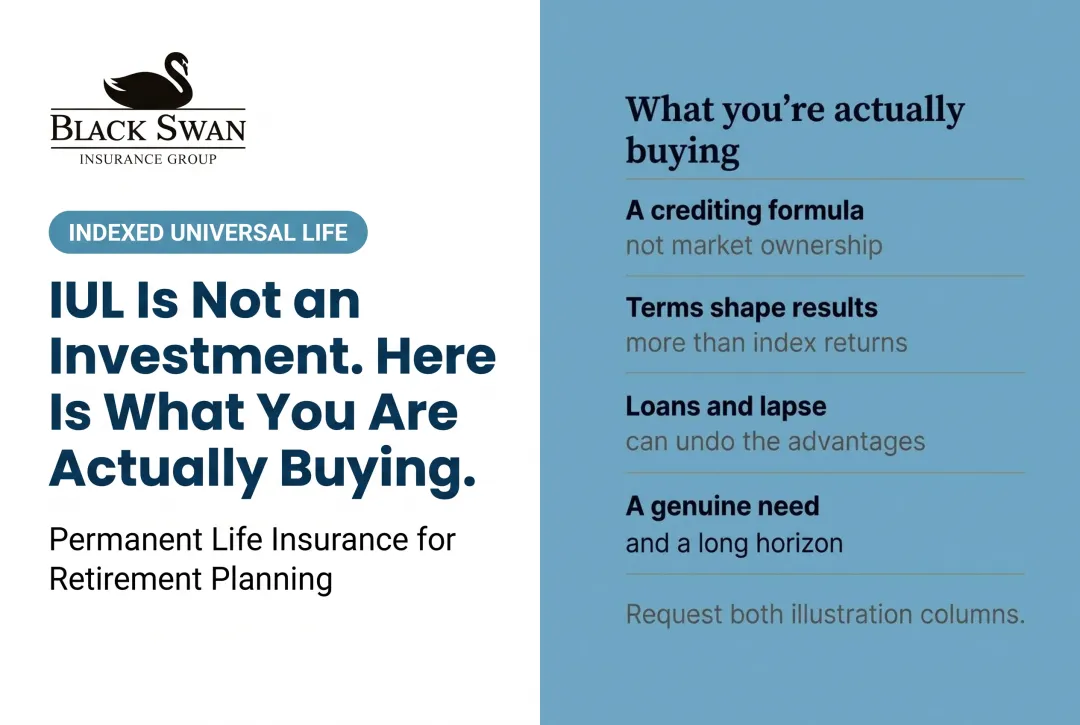
What is true is that indexed universal life blends lifelong coverage with flexible premiums and cash value credited on an index-linked formula. It is more complicated than term or whole life, and the fine print decides the outcome.
If you earn $150K+ in Florida and someone is showing you an illustration, here is the order to think in: establish the life insurance need, confirm you can fund the policy long term, then evaluate the cash-value goals, and only then compare carriers. Nobody honest will hand you a guaranteed number.
The short answer: An IUL pairs permanent death-benefit protection with index-linked cash-value potential, where caps, participation rates, fees and charges shape the real result. A 0% floor blocks direct index losses — not policy charges, loan interest, withdrawals or lapse. There is no reliable Florida-average premium, because cost depends entirely on your age, health and design. Compare guaranteed against non-guaranteed illustrations and stress-test lower crediting before you decide anything.
Key Takeaways
- Permanent death-benefit protection plus index-linked cash-value potential; caps, fees and charges shape real results
- A 0% floor blocks direct index losses, not policy charges, loans, withdrawals or lapse
- Compare guaranteed and non-guaranteed illustrations and stress-test lower-crediting scenarios
- A poor fit if you need cheap temporary coverage or simple guaranteed growth
- No state income tax means the tax-diversification argument here is weaker in Florida, not stronger
How the Policy Works
Permanent life insurance with a death benefit, a cash-value account, and premiums adjustable within policy limits. Interest crediting is linked to one or more external indices such as the S&P 500.
The part most buyers miss: your money never touches the market. The policy does not invest in an index. The insurer uses index performance as a reference point to determine how much interest is credited, per National Life Group.
Where the premium goes: a portion covers the cost of insurance, a portion covers administrative expenses and rider charges, and the remainder can build cash value.
Floor, Cap, Participation Rate
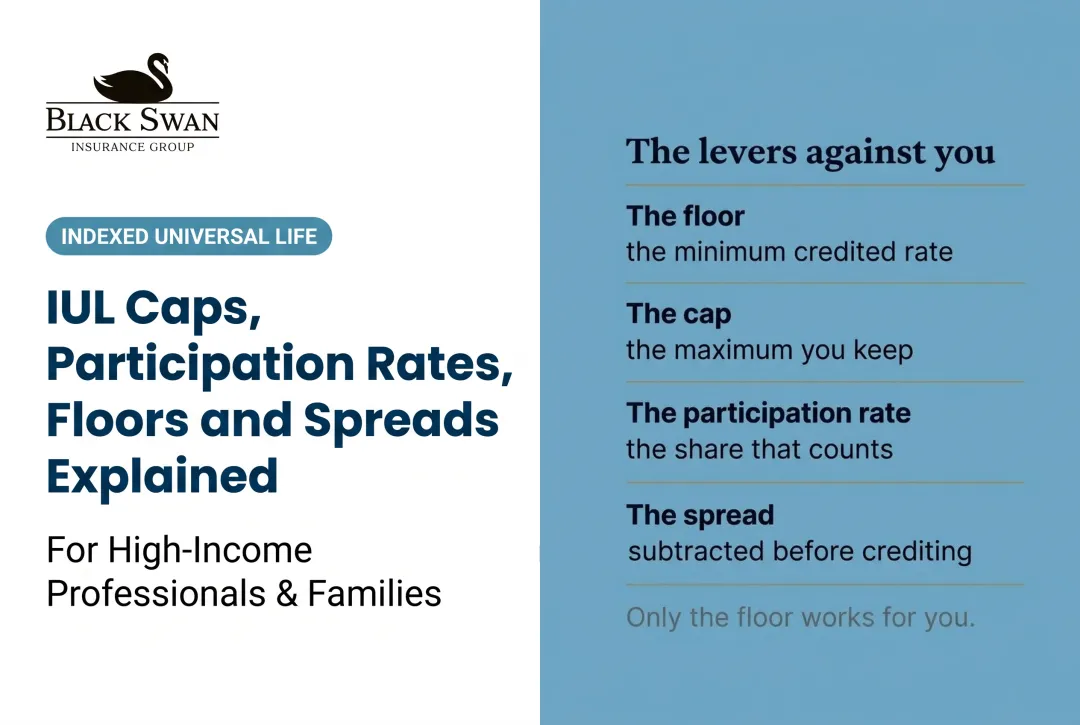
- Floor — the minimum credited rate, often 0%, preventing a negative credit in a down market
- Cap — the maximum rate in a crediting period, however well the index performed
- Participation rate — the percentage of the index gain used to calculate your credit
If an index gains 12% and your cap is 9%, you are credited 9%. If the index drops 15%, a 0% floor credits 0% — and the policy fees still apply.

Index calculations typically exclude dividends, so even a strong index year credits less than the headline return suggests.
Zero is your hero in a down year — but the floor applies to the credit, not to the charges.
Reaching the Cash Value
- Loans accrue interest and reduce the death benefit if unrepaid
- Withdrawals reduce cash value and may trigger charges
- A lapsed policy with an outstanding loan and gain in the contract can create a tax bill with no cash received
Internal growth is generally tax-deferred, and loans or withdrawals may offer potential tax-advantaged access while the policy stays in force and is not a modified endowment contract — conditional on the contract being properly structured, funded and managed.
What It Costs in Florida
There is no reliable Florida-specific average premium, and any article publishing one is guessing.
If you searched "how much is a $1 million IUL policy a month," the honest answer is that it varies too much by age, health and design to quote. A healthy 35-year-old non-smoker and an unhealthy 55-year-old smoker will see dramatically different numbers for identical coverage.
What drives your premium: age at application; health and family medical history; tobacco use; occupation and lifestyle risks; the death benefit requested; level versus increasing death-benefit design; and whether the policy is built primarily for protection or accumulation.
Three Funding Paths
- Minimum premium — keeps the policy technically in force with little cushion if crediting underperforms
- Planned premium — a middle-ground target based on your goals
- Maximum non-MEC funding — the highest amount payable without triggering modified endowment contract status
Paying only the minimum is the risky path. The NAIC Life Insurance Buyer's Guide is explicit that coverage stays in force only while cash value covers policy costs. If crediting comes in low or charges rise, you may need to pay more than planned simply to keep it alive.
The charges that erode cash value: cost of insurance rising with age, premium loads, administrative fees, rider costs, surrender charges commonly running years one through 10 to 15, and loan interest.
Stress-test any premium level against your emergency reserves, retirement contributions and other insurance obligations — not just what fits this month's budget.
What the Critics Get Right
Florida sees more than its share of aggressive insurance marketing, and the scepticism that produces is healthy.
Critics are right that "no state income tax" is used as a selling point where it is closer to an argument against — the federal tax treatment is the same everywhere, and one of the motivations for a tax-advantaged bucket is weaker here than in California or New York. They are right that minimum-funded policies sold to people who could not sustain more are a known failure pattern. And they are right that a published average premium is a fiction.
Where the criticism stops is the protection need itself. Retirees and business owners with estate liquidity problems or concentrated assets have a genuine issue that term insurance cannot solve past a certain age. The state tax angle is noise. The protection question is not.
Who It Fits
Stronger Fit
- A genuine permanent death-benefit need standing on its own merits
- Household income of $150K+ with stable surplus cash flow beyond other priorities
- A long time horizon and insurability at a reasonable rate
- Already funding retirement accounts, and deliberately seeking tax diversification
- Willingness to review the policy annually
Typical profiles: high-income professionals and executives, often 35 to 55, wanting a clearer retirement paycheck alongside existing savings; business and practice owners building assets outside a concentrated business; and families with estate liquidity needs.
Weaker Fit
Not everyone should buy an IUL. The absence of a state income tax removes one of the main arguments for holding one.
- Cheap temporary coverage is the requirement — term insurance answers that better and costs a fraction
- Simple guaranteed growth is the goal, where whole life offers more certainty
- Funding cannot be sustained through a downturn
- Liquidity is needed within a few years
- Nobody intends to review the contract after issue

The Ultimate IUL Blueprint
If a permanent need genuinely exists, the Blueprint covers what follows: funding levels, the MEC line, index-strategy selection and loan timing.
Reading the Illustration
- Model conservative crediting well below the illustrated cap
- Stress-test extended periods of 0% crediting
- Factor in higher cost-of-insurance charges over time
- Assume lower caps or participation rates later
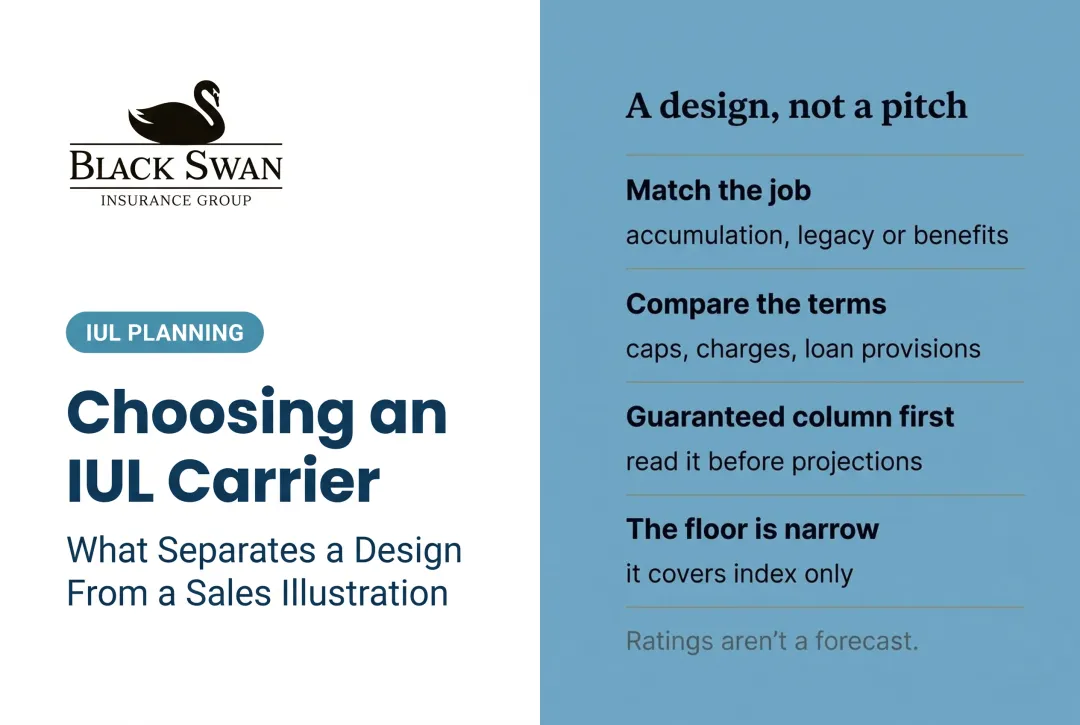
Inspect line by line: premium timing and amounts; the death-benefit option and any changes over time; cash surrender value against account value; the surrender charge schedule; loan balances and loan interest rates; MEC limits and how close your funding comes to them.
Verify the Carrier and the Agent
Ratings from AM Best, Moody's and S&P Global reflect an insurer's claims-paying ability, not a recommendation for your policy. Before applying, verify the carrier through the Florida Office of Insurance Regulation company search and the agent's licence through the Florida Department of Financial Services licensee search.
Florida law, Section 626.9541, treats misrepresentation and false advertising of insurance as unfair practices. If something feels off, consult a licensed attorney rather than drawing your own conclusions.
Buying It Properly
Step 1 — assess the actual need. Beneficiaries and income-replacement needs, outstanding debts and estate or business obligations, available surplus cash flow, and what you genuinely want cash value to do.
Step 2 — underwriting. Expect questions on medical history, prescriptions, lifestyle and existing coverage. Accelerated or simplified no-exam underwriting exists, and eligibility depends on carrier rules, age, coverage amount and health — not preference.
Step 3 — compare at least two designs using the same coverage amount, funding schedule, death-benefit option and assumptions. Mismatched illustrations tell you nothing.
Step 4 — application through issue. Submit the application and underwriting information; underwriting review and carrier offer; policy delivery, typically with a free-look period; beneficiary confirmation and premium setup; then ongoing annual monitoring. Confirm timelines with the carrier, since these are not standardised.
Step 5 — review annually. Compare actual crediting against illustrated assumptions, check charges and loan balances, and revisit beneficiaries as life changes.

This is not set-it-and-forget-it. It is design-it, fund-it, review-it.
Risks to Understand Before You Apply
- Charges continue in a 0% crediting year, so cash value can fall with the floor intact
- Cost of insurance rises with age and is deducted regardless of crediting
- Caps and participation rates are non-guaranteed and can be reduced after issue
- Dividends are excluded from index crediting, so headline index returns overstate what you receive
- Minimum funding is fragile by design and is the most common path to lapse
- Surrender charges commonly run 10 to 15 years
- Loans reduce the death benefit, and a lapse or surrender with a loan outstanding and gain in the contract creates taxable income with no cash received
- Crossing the seven-pay limit makes the contract a MEC and changes distribution taxation permanently
- Illustrated values are projections, not commitments
Find Out Where You Actually Stand
This starts with the Tax-Free Wealth Blueprint Fit Review. If you earn $150K+ in Florida, we read the guaranteed column, stress-test a stretch of 0% crediting, check where your funding sits relative to the MEC line, and price term plus your existing accounts on identical terms. If it does not fit, we will tell you that too.
Frequently Asked Questions
How much is a $1,000,000 policy a month?
It depends on age, health, tobacco use, policy type, death-benefit design and underwriting class. A personalised quote is the only useful answer; a published average is not.
Who qualifies?
Qualification needs insurability, a documented financial need, the ability to sustain long-term funding, and carrier underwriting approval. Qualifying does not mean it is the right fit.
Can I get one without a medical exam?
Accelerated or simplified underwriting is available with some carriers depending on age, coverage amount and health profile. Some applicants will still need a full exam or additional records.
Can you lose money in an IUL?
A floor typically prevents a negative index credit, but fees, insurance charges, loan interest and insufficient funding can still reduce cash value or cause a lapse.
Does Florida having no income tax make this more attractive?
Not really, and it is worth saying plainly. Federal tax treatment is identical everywhere. If anything, the absence of state income tax removes one of the arguments used elsewhere for a tax-diversified bucket.
Is it better than whole life?
Neither is universally better. An IUL suits buyers wanting premium flexibility and index-linked potential; whole life suits those prioritising guarantees and simpler management. Compare personalised illustrations for your own goals.
Sources
- National Life Group — Indexed life insurance: upside potential and downside protection
- NAIC — Life Insurance Buyer's Guide
- Florida Office of Insurance Regulation — company search
- Florida Department of Financial Services — licensee search
- I.R.C. § 7702A and Rev. Proc. 2008-39 (modified endowment contracts and the seven-pay test)
Disclosure: This article is educational and is not personal tax, legal or investment advice. Indexed universal life is life insurance first. State rules, carrier product availability and licensing requirements change; confirm current details before applying. Actual results depend on policy design, carrier, crediting options, caps, participation rates, expenses, funding and ongoing management. Policy loans and withdrawals may reduce cash value and death benefit and can create tax consequences if the policy lapses or becomes a modified endowment contract. This strategy is not appropriate for everyone. Illustrated values are not guarantees; actual results depend on policy terms, crediting, costs and funding. Consult your own tax, legal and financial professionals for advice specific to your situation.
And remember, it's not what you earn, it's what you keep… enjoy the ride.