By Robert Balgac, Founder, Black Swan Insurance Group | October 7, 2026
No. They are both permanent life insurance, and that is roughly where the resemblance stops.
The reason this question matters to a $150K+ earner who has maxed the 401(k) and run into the Roth phase-outs is that the two products fail in completely different ways. Whole life fails by costing more than you wanted to spend. An IUL fails by lapsing twenty years in because nobody checked the funding. Those are not equivalent risks, and the sales conversation rarely makes the distinction.
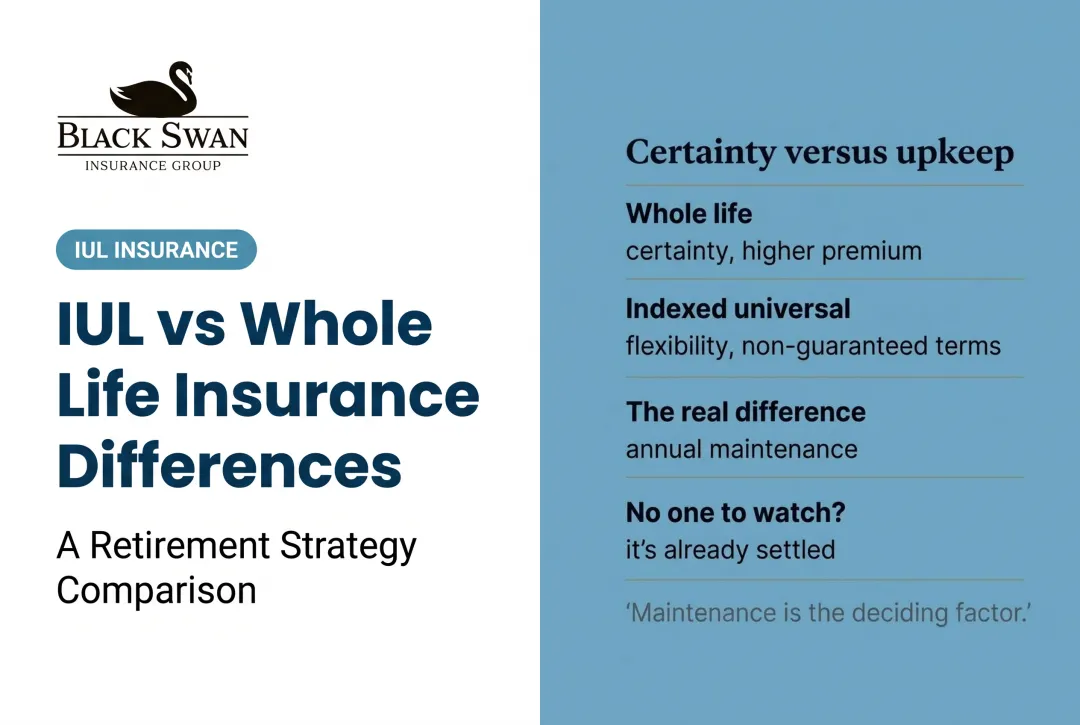
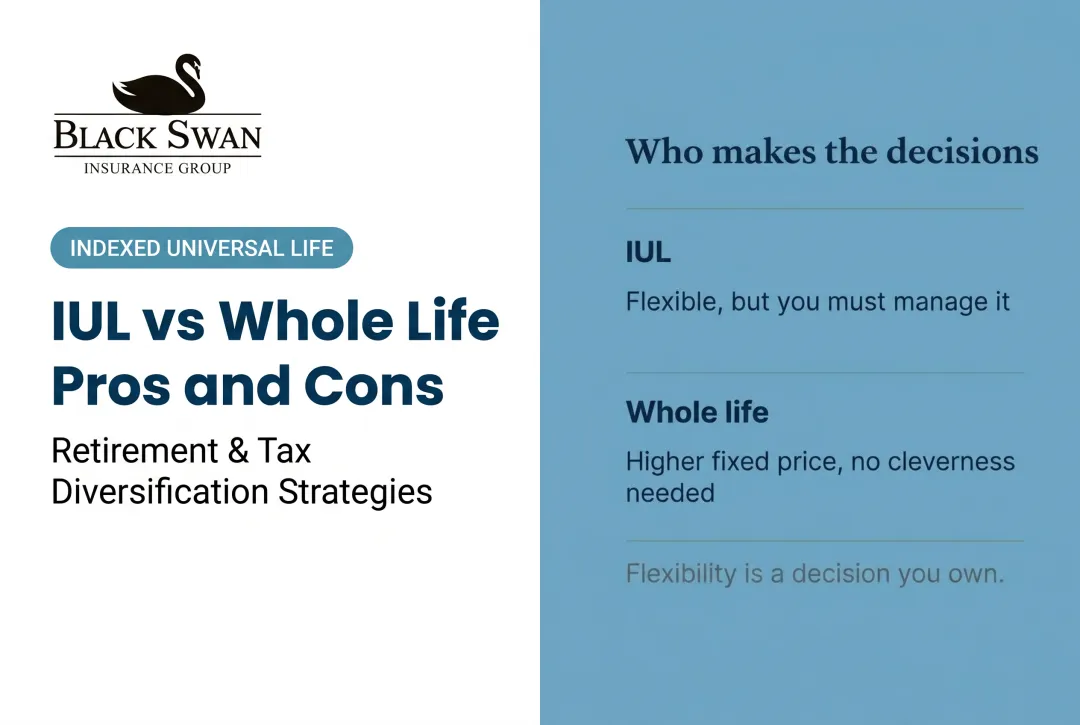
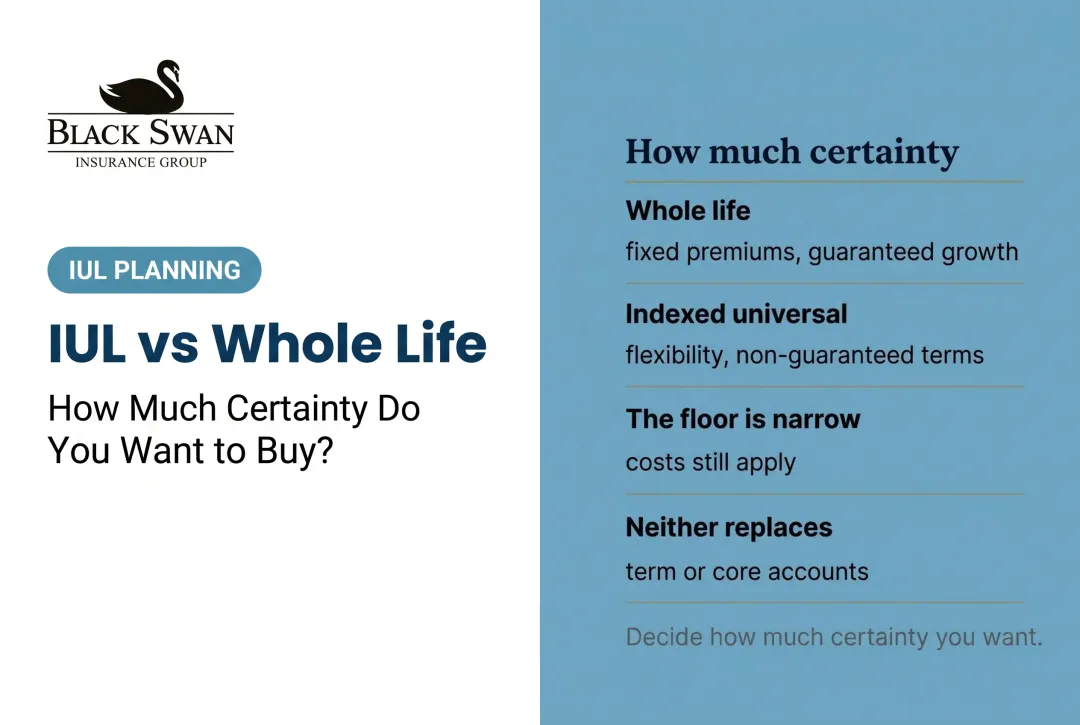
The short answer: Whole life gives you contractual guarantees — fixed premium, guaranteed cash value, fixed death benefit — in exchange for a higher required payment and very little flexibility. IUL gives you flexible premiums and index-linked crediting in exchange for non-guaranteed caps, ongoing charges and a real obligation to monitor the contract. Both are life insurance first. Neither is better in the abstract; they are built for different jobs.
Whether you are protecting a family, planning a legacy, funding a business succession strategy, or looking at supplemental retirement income, the structure you pick shapes the outcome more than the carrier does. Policy terms vary by insurer and by state, so what is true of one contract may not be true of another.
Key Takeaways
- Both combine a death benefit with cash value, but they build and manage that value very differently
- Whole life emphasises fixed premiums, guaranteed cash value growth and predictability
- IUL offers flexible premiums and index-linked growth, constrained by caps, charges and funding levels
- A 0% floor is not a 0% policy return — charges continue in a zero-credit year
- The right answer depends on your protection need, budget, horizon and willingness to review the policy
IUL vs. Whole Life: The Honest Comparison
| Factor | Whole Life | IUL |
|---|---|---|
| Premiums | Generally fixed and contractually scheduled | Flexible within limits, but reduced payments can leave coverage underfunded |
| Cash value growth | Guaranteed per the contract; participating policies may add non-guaranteed dividends | Linked to an external index, subject to floor, cap, participation rate and spread |
| Death benefit | Typically fixed; loans and withdrawals reduce the payout | May be adjustable, but increases can require new underwriting |
| Guarantees | Premium, death benefit and cash value guaranteed, subject to the insurer's claims-paying ability | A floor limits index losses but does not guarantee cash value cannot shrink after charges |
| Management | Easier to monitor; the structure stays put | Requires periodic review of funding, caps and charges |
| Cost | Often a higher fixed premium in exchange for predictability | Lower minimum payments do not mean a lower lifetime cost |
Three caveats before anyone leans on that table:
- A 0% index floor is not a 0% policy return. Cost of insurance and administrative charges keep applying when crediting hits the floor. The floor protects the credit, not the account.
- Dividends are never guaranteed, including on participating whole life policies that have paid them without interruption for a century.
- IUL needs active monitoring. Carrier material, including Guardian's overview of indexed universal life, says plainly that IUL generally requires more long-term oversight than whole life.
This is not set-it-and-forget-it. It is design-it, fund-it, review-it.
What Each Product Actually Is
Indexed Universal Life
IUL is permanent universal life. It pairs a death benefit with a cash value account credited by reference to an external index such as the S&P 500. Your money is not in the index. The insurer calculates a credit from index movement subject to caps, floors, participation rates and spreads.
Part of each premium covers the cost of insurance and policy expenses; the remainder may reach cash value. The split varies by contract, so do not assume a sample allocation applies to yours.
What you get: flexible funding within limits, a potentially adjustable death benefit, index-linked crediting, and access to cash value through loans or withdrawals. All of which is worth precisely nothing if the policy is not kept funded and in force.
What catches people out: underfunding and the lapse risk that follows, rising cost of insurance with age, caps and participation rates the carrier can adjust, outstanding loans eroding cash value and death benefit, and a tax bill if the contract lapses carrying a loan.

Whole Life
Whole life is built to stay in force for life provided you pay the contractual premium. It pairs a death benefit with guaranteed cash value defined in the contract: fixed premiums, a defined growth schedule, lifelong coverage when funded, and dividend eligibility on participating policies — dividends being a possibility, not a promise.
That predictability still rests on the policy language and the insurer's claims-paying ability. Read the contract rather than assuming all whole life guarantees the same things.
Access has trade-offs here too. Loans accrue interest and unpaid balances reduce both cash value and death benefit. A large loan relative to cash value can threaten the contract. Withdrawals permanently reduce cash value and may cut the death benefit.
The Ultimate IUL Blueprint
If you are weighing permanent options, the Blueprint covers what either design has to survive: funding levels, charges, the MEC line, loan timing, and what to demand from an illustration before you sign.
What the Critics Get Right
The criticism of IUL relative to whole life is largely fair and worth saying out loud.
IUL is more complex, its key variables are non-guaranteed, and it transfers the maintenance burden to a policyholder who was usually never told they had one. Whole life's guarantees are boring and expensive, and boring and expensive has a genuine track record. If you want certainty and you do not want a homework assignment, the critics are right that whole life is the cleaner instrument.
Where the criticism overreaches is treating flexibility as a defect. For a business owner whose income moves with the year, the ability to vary premium is the feature that makes permanent coverage survivable at all.
Which One Fits Which Job
Neither is automatically better. The question is what job the policy has to do and whether you can fund it for decades.
Whole life suits you if you want contractual guarantees over flexibility, a fixed premium you can budget around indefinitely, predictable growth and low-maintenance ownership.
IUL suits you if you need permanent coverage with design flexibility, want premium latitude as income shifts, can accept non-guaranteed crediting, and will actually review funding and performance each year.
Do not choose on the highest illustrated cash value or an assumed retirement income figure. Compare guaranteed columns against conservative non-guaranteed assumptions, and read the charges, loan provisions and lapse scenarios first.

For high-income professionals and business owners, permanent insurance does not get evaluated in isolation. Weigh it beside the 401(k), IRA or Roth, taxable brokerage, term coverage, emergency reserves and succession planning. Permanent insurance is one instrument in the plan, not a substitute for the plan.
Stronger Fit
Permanent coverage of either kind is worth examining if you:
- Earn $150K+, have maxed tax-advantaged accounts and still have surplus cash flow
- Have a genuine lifelong protection, legacy or business-continuity need
- Can sustain the premium through an income interruption
- Are insurable at a reasonable cost
- Will commit to an annual review if you choose IUL
Weaker Fit
Step back for now if you:
- Have no emergency reserve, or high-interest debt that should be cleared first
- Need cash within five to ten years
- Only need a death benefit for a defined period — term is cheaper, simpler and the right answer
- Want to buy it and never think about it again, in which case IUL is the wrong half of this comparison
Reading an Illustration Without Being Misled
Every illustration carries guaranteed and non-guaranteed columns. The gap between them is the entire conversation.
Identify the assumed crediting rate behind the non-guaranteed projection. Check the current cap and participation rate, both of which the carrier can change. Review charges and surrender values at years 5, 10 and 20 — not year one. And ask directly what funding level keeps the contract in force long term.
The NAIC's guidance on life insurance illustrations draws a hard line between guaranteed and non-guaranteed benefits, premiums and charges. A single projected cash value number is a model output, not a commitment.
Loans, withdrawals and surrenders are also not interchangeable:
| Method | What happens |
|---|---|
| Policy loan | Accrues interest; unpaid balance reduces death benefit and can force a lapse |
| Withdrawal | Reduces cash value and potentially the death benefit; may carry tax consequences |
| Full surrender | Ends coverage; proceeds reduced by surrender charges and any outstanding loan |
Guardian's guide to life insurance loans is worth reading before assuming cash value is accessible without consequence.

Risks to Understand Before You Choose Either
- Lapse risk is the IUL risk. Underfund it, or let a loan run unmanaged, and the contract can collapse decades in, when replacing coverage is expensive or impossible.
- Caps and participation rates are not fixed. They can be revised going forward, subject to contract minimums.
- Cost of insurance rises with age. A design that works at 45 can strain at 70 if funding never increased.
- Whole life's risk is opportunity cost. The premium is fixed whether or not this year suited a large insurance payment.
- Replacing existing coverage is its own hazard. Confirm new underwriting and effective dates before cancelling anything. A gap between contracts is a real exposure.
- A loan outstanding at lapse can be taxable even though no money reached your pocket.
Find Out Where You Actually Stand
This starts with the Tax-Free Wealth Blueprint Fit Review. If you earn $150K+ and you are choosing between permanent structures — or deciding whether you need one at all — we compare whole life, IUL and term against the actual job you need done, stress-test the funding through lower-crediting and zero-credit years, and show the charges and loan assumptions in plain numbers. If term is the right answer, we will say so. If IUL does not fit, we will tell you that too.
Frequently Asked Questions
Should I get an IUL or whole life insurance?
It depends on your protection need, your budget, your tolerance for non-guaranteed values, and whether you want premium flexibility. Put the guaranteed and non-guaranteed illustrations side by side before deciding.
Is one of them cheaper?
A lower minimum payment is not a lower lifetime cost. IUL can be funded at a lower initial premium, but underfunding is the leading cause of IUL failure. Compare what each design costs to actually work, not what it costs to start.
How much does a $100,000 whole life policy cost per month?
It depends on age, health, underwriting class, design, riders, insurer and state. There is no universal figure — request an individualised illustration.
Can I borrow from or cash out an IUL?
Most contracts permit loans or withdrawals under their terms. Either reduces cash value and the death benefit, adds interest and lapse risk, and can trigger tax if the policy lapses with a loan outstanding.
Is term insurance better than both?
For a defined-period need — a mortgage, children at home, income replacement to retirement — term is usually cheaper and entirely adequate. Permanent coverage earns its cost only when the need genuinely outlives a term, or when you want a tax-diversified place to build accessible value alongside it.
Who is IUL actually suited to?
Someone with a real permanent coverage need, sufficient long-term cash flow, a long horizon, and the willingness to monitor funding, charges and crediting assumptions for the life of the contract.
Sources
- Guardian — Indexed Universal Life Insurance
- Guardian — Life Insurance Loans
- NAIC — Life Insurance Illustrations
- NAIC — Life Insurance
Disclosure: This article is educational and is not personal tax, legal or investment advice. Indexed universal life is life insurance first. Product features, guarantees and availability vary by carrier and by state, and all guarantees are subject to the issuing insurer's claims-paying ability. Any potential tax-advantaged access depends on the policy being properly structured, funded and managed. Actual results depend on policy design, carrier, crediting options, caps, participation rates, expenses, funding and ongoing management. This strategy is not appropriate for everyone. Policy loans and withdrawals reduce cash value and the death benefit, and can create tax consequences if the policy lapses or becomes a modified endowment contract. Illustrated values are not guarantees; actual results depend on policy terms, crediting, costs and funding. Consult your own tax, legal and financial professionals for advice specific to your situation.
And remember, it's not what you earn, it's what you keep… enjoy the ride.