By Robert Balgac, Founder, Black Swan Insurance Group | October 9, 2026
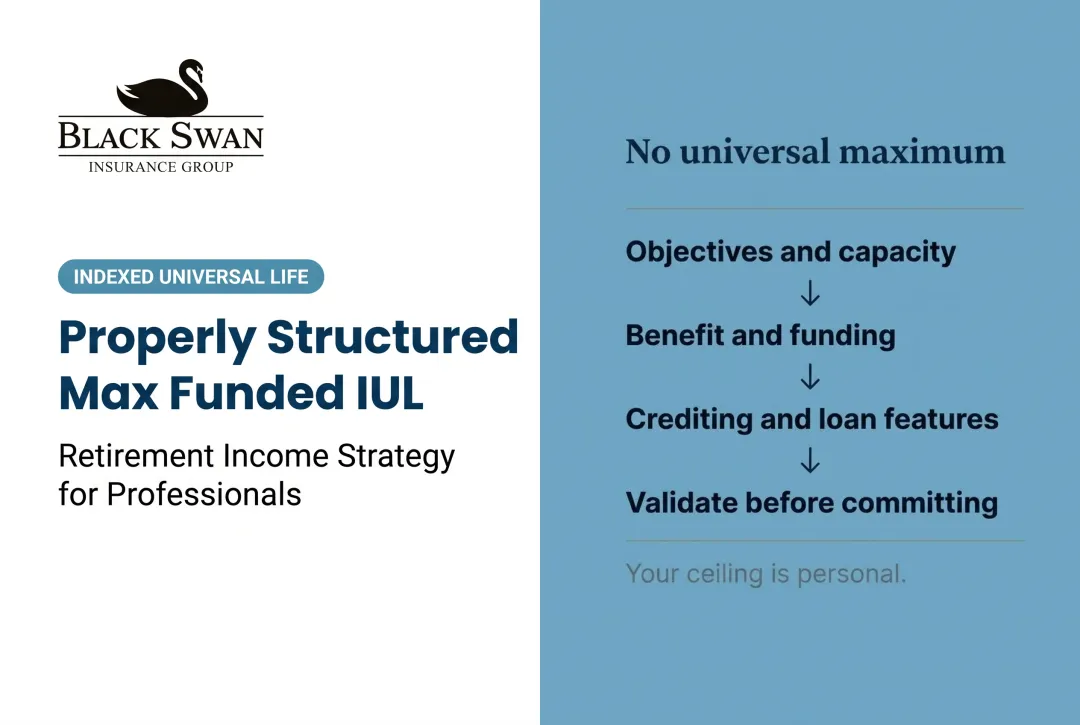
Most people asking how to "max fund" an indexed universal life policy assume the answer is simple: pay as much as possible. It is not. A max-funded IUL has to balance permanent death-benefit protection, cash-value growth, affordability and IRS funding limits simultaneously — and the binding constraint is usually not the IRS. It is whether you can still write the cheque in year nine.
That is the question worth asking if you earn $150K+, have maxed the 401(k), and are looking at what to do with the surplus. U.S. individual life insurance new premium topped $17.5 billion in 2025, with indexed universal life sales climbing 17% year over year to $4.5 billion, according to LIMRA. Popularity is not evidence that policies are being designed correctly. Results depend on your age, health class, death-benefit structure, premium schedule, carrier charges, crediting assumptions, and how consistently you fund it.
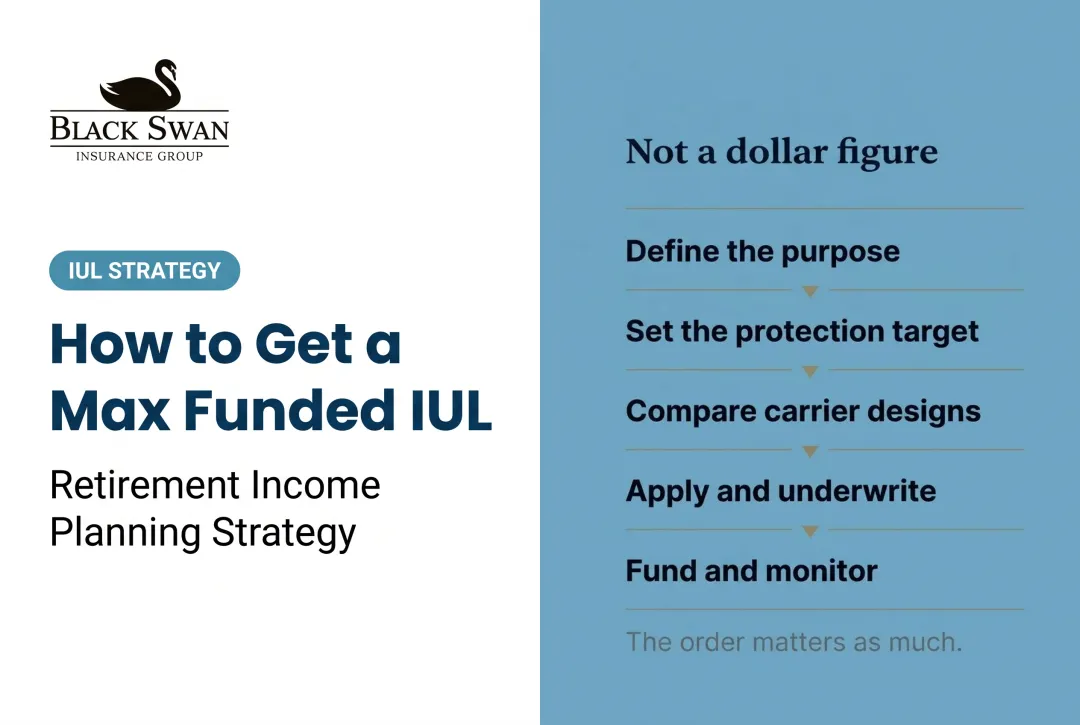
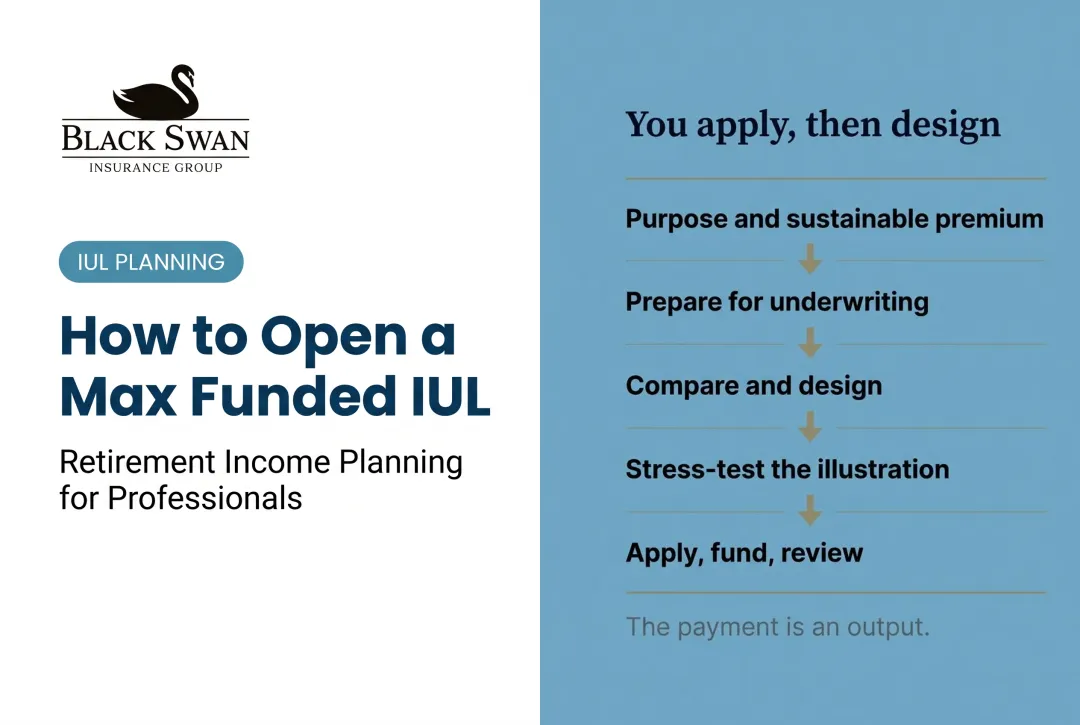
The short answer: "Max funded" means premium pushed as close as possible to the Section 7702A non-MEC ceiling on the smallest death benefit that still meets your protection need — because that ratio is what minimises cost of insurance per dollar of cash value. Setting it up correctly is five steps: define the job, underwrite honestly, model competing designs, fund within the seven-pay limit, and review it every single year. Skip the last one and the first four stop mattering.
Key Takeaways
- Max funding means premium near your policy's IRS non-MEC ceiling, not a flat dollar amount
- Size the death benefit to your family's protection need, not to funding efficiency alone
- Compare guaranteed values, charges, caps, participation rates and loan terms before signing
- Protect emergency reserves and any employer retirement match first — this is a long-term commitment
- Revisit funding, crediting assumptions and life changes every year
Step 1: Define the Policy's Job and Set a Sustainable Premium
Before discussing numbers, decide what the policy has to accomplish. Permanent death-benefit protection, supplemental retirement income, tax diversification, business liquidity, or some combination. That answer shapes everything downstream, including whether you should be doing this at all.
Then look at the full picture: income stability and job security, existing retirement contributions, emergency reserves already in place, outstanding debt and education funding.
Set a base premium you can sustain through a recession or a slow year, not one that depends on bonuses or future raises. Never size a premium around optimistic income projections. If the money dries up, both the policy and the death benefit are at risk.
A physician or practice owner who can comfortably sustain $1,500 a month should build the design around that figure, not a bonus-fuelled $3,000 that disappears in a down year. The design built on $3,000 will look better on paper and fail in practice. That is the entire failure mode of this product in one sentence.
Step 2: Collect Underwriting and Financial Information
Carriers need a complete picture before they can model anything accurately: age, health history, medications and tobacco status; occupation, income, net worth and existing insurance; intended coverage amount and purpose.
Health and underwriting class directly affect cost of insurance, which determines how much of each premium dollar actually reaches cash value. A standard-class applicant needs a meaningfully different design than a preferred-plus applicant funding the same target. Do not accept a design modelled at preferred-plus before you have been underwritten — that is the most common way an illustration flatters itself.
Gather existing policies and retirement-account statements too, so the new policy gets evaluated alongside what you already have rather than in isolation. Confirm state availability and beneficiary designations. If tax or estate issues are in play, have your CPA or attorney weigh in before the design is locked.
Step 3: Run and Compare Competing Designs
Model more than one approach:
- A minimum-death-benefit design, which maximises cash-value efficiency
- A design with extra death-benefit headroom, useful if income and premiums might grow later
Compare level against increasing death-benefit options, funding duration, and available riders, along with how each choice affects insurance charges. Do not settle on a policy because one illustration shows the biggest projected number — review multiple carriers under identical assumptions instead.
Require, at minimum:
- Guaranteed and non-guaranteed values side by side
- Year-by-year premiums, cash surrender values and death benefits
- Full policy charge schedules
- Loan balance and lapse projections
An illustration is a model, not a guarantee.
The Ultimate IUL Blueprint
Before you request a single design, the Blueprint covers what any of them has to survive: funding levels, caps and charges, the MEC line, loan timing, and what to demand from an illustration.
Step 4: Apply, Fund, and Set Up Monitoring
Complete the application honestly. Omitting medical or financial details to land a better rate class can void coverage later, precisely when your family needs the payout.
Once approved, confirm the initial premium and payment frequency, the allocation among crediting strategies, and the beneficiaries, riders and policy options. After issue, check that the contract matches the approved design and that planned premiums stay within non-MEC limits.
Then set a review cadence — at least annually — to track funding, cap and participation-rate changes, loan activity and lapse risk.
This is not set-it-and-forget-it. It is design-it, fund-it, review-it.

The Non-MEC Funding Limit and the Seven-Pay Test
Section 7702 of the tax code sets the rules for a policy to qualify as life insurance. Section 7702A adds the seven-pay test, which caps cumulative premiums during the first seven contract years.
Exceed that limit and the policy becomes a Modified Endowment Contract permanently — even if you later exchange it for another policy. MEC status changes how loans and withdrawals are taxed. Distributions from a MEC are taxed income-first, and the taxable portion can face a 10% additional tax before age 59½, with limited exceptions.
Any increase in death benefit or added premium should be checked against the policy's current non-MEC headroom before you pay it. This is the one error with no remedy.

Death-Benefit Option and Funding Headroom
A lower death benefit generally squeezes more cash value out of each premium dollar. That efficiency has a cost: less protection if something happens to you.
Compare a minimum death-benefit design built for cash-value efficiency against a higher death-benefit design that leaves room for irregular future premiums and more protection. If the lower design creates a real protection gap, a separate term policy or rider may be worth considering, subject to carrier availability and your health.
Crediting Mechanics and Policy Charges
Every indexed account has the same four moving parts:
| Term | What It Means |
|---|---|
| Floor | Minimum indexed credit (often 0%); does not protect against policy charges |
| Cap | Maximum indexed credit, even if the index performs better |
| Participation rate | Share of the index's measured gain used in crediting |
| Spread | Deduction from index performance in some uncapped strategies |
A 0% floor only guards against negative index-crediting. It does not stop monthly cost-of-insurance, administrative and rider charges from reducing cash value in a flat or down year.
Zero is your hero in a down year — but the floor applies to the credit, not to the charges.
Request current carrier-specific caps and participation rates rather than generic averages. Carriers adjust them regularly, and most of these levers are non-guaranteed — they can be reset after you buy.
What the Critics Get Right
The strongest fair criticism of max-funded IUL is that the design is engineered to minimise the thing you are actually buying. You are deliberately holding the death benefit down to the smallest amount the tax code allows for your premium, which means the product is being used as a tax-advantaged accumulation wrapper that happens to carry insurance. If that is the real objective, the critic's question is reasonable: why pay cost of insurance at all?
The honest answer is that there is no other way to get those tax characteristics, and the wrapper only earns its keep if (a) you genuinely want permanent coverage, and (b) you fund it to the limit for long enough to amortise the front-loaded charges. If either fails, the critic is right and you have bought an expensive index fund.
A second fair hit: commissions scale with premium, which gives whoever designs your policy an interest in a larger premium than you can sustain. Ask how you are being paid. We will tell you before anything is funded.
A great IUL is engineered. A bad IUL is sold.
Stronger Fit
- A genuine need for permanent life insurance
- Stable surplus cash flow you can commit for 15–20 years
- Earning $150K+ with reserves, debt and employer match already handled
- A long horizon and health strong enough to qualify at a good rate class
- Willingness to review the policy annually
Weaker Fit
Not everyone should buy one. This is a poor fit if you need short-term liquidity, have inconsistent income, have not built basic emergency reserves, carry high-priority debt, want market exposure with no real insurance need, or have no lasting need for permanent coverage.
Business owners should fund premiums from genuine surplus, not operating capital. The policy should support personal goals without substituting for buy-sell or key-person planning.
Request written illustrations and disclosures, not verbal promises about future income or growth.
Risks to Understand Before You Fund
The setup mistakes that break otherwise sound policies:
- Choosing a premium before confirming affordability, emergency liquidity and retirement priorities
- Accepting one carrier's illustration without comparing guarantees, charges and loan provisions elsewhere
- Assuming a 0% floor means no possibility of loss — charges continue regardless
- Treating index-linked crediting as equivalent to direct market investing
- Assuming policy loans are automatically tax-free in every situation
Missed or reduced premiums, withdrawals and outstanding loans all chip away at cash value, death benefit and policy longevity. Monitor loan interest accruing, available cash value relative to outstanding loans, the projected lapse date under current rather than best-case assumptions, and any overloan protection provisions.
The loan is not the problem. The unmanaged loan is the problem.
Corrective checks when something goes wrong:
- Policy underfunded? Determine whether the shortfall is temporary or structural, then request an updated in-force illustration before cutting coverage.
- Approaching MEC status? Pause extra funding until remaining non-MEC room and tax consequences are confirmed.
- Loan balance growing fast? Weigh repayment, lower borrowing, added premium or a death-benefit adjustment before lapse risk rises.
- Performance lagging the illustration? Compare current caps, participation rates, charges and loan activity against the original assumptions and document what changed.
Alternatives Worth Pricing First
The right alternative depends on your primary need: protection, accumulation, liquidity, guaranteed income, tax diversification or business planning.
Term life insurance fits when the main goal is affordable, temporary death-benefit protection and cash value is not a priority. Guardian's published term-rate examples show a healthy, nonsmoking 40-year-old paying roughly $73 a month for women and $92 a month for men on $1 million of 20-year coverage. You pay far less up front, build no cash value, and coverage ends when the term does.
Whole life insurance suits buyers who want guaranteed cash values, guaranteed death benefits and predictable premiums over index-linked flexibility. When comparing, match guaranteed whole life values to the IUL guaranteed column, do not stack non-guaranteed dividends against non-guaranteed IUL crediting, and factor in each policy's charges and death-benefit design.
Qualified plans, Roth accounts, brokerage and annuities solve different problems than permanent life insurance and can complement an IUL rather than replace it. Before adding premium, compare contribution limits and employer matches, investment risk and potential returns, tax treatment and required distributions, and liquidity and guarantees. If your priority is guaranteed retirement income rather than a death benefit and flexible cash value, evaluate an annuity first.

Find Out Where You Actually Stand
This starts with the Tax-Free Wealth Blueprint Fit Review. If you earn $150K+ and want a max-funded design built properly, we establish the sustainable premium before anyone runs an illustration, confirm the protection need, model competing designs under identical assumptions, read guaranteed values against illustrated ones, check non-MEC headroom, and stress-test through lower crediting, paused funding and extended loans. We explain compensation before anything is funded. Tax and legal questions go to your own CPA or attorney, and we will tell you when that is the right call. If IUL does not fit, we will tell you that too.
Frequently Asked Questions
How much money do I need to start one?
There is no fixed starting amount. Premiums depend on age, health, underwriting class, death benefit, carrier minimums and funding goals. Request an illustration built around a premium you can sustain in a bad year, not a good one.
What does "max-funded" actually mean?
Paying close to the maximum premium allowed under the seven-pay test without triggering MEC status, on the smallest death benefit consistent with your protection need, so the largest possible share of each dollar reaches cash value.
Can a max-funded IUL become a MEC?
Yes. Excess premiums, certain policy changes or added funding can push it over the line. Confirm available premium room with the carrier or your licensed professional before making any change. MEC status is generally permanent.
Is a max-funded IUL better than a 401(k) or Roth IRA?
They serve different purposes under different rules. Capture employer matches and foundational retirement contributions first. An IUL can then add supplemental permanent protection and tax diversification when it genuinely fits.
Can I lose money in a max-funded IUL?
A 0% crediting floor does not eliminate policy charges, surrender costs, loan interest or lapse risk. Early surrender or inconsistent funding can leave you with less than you paid in.
How often should I review it?
At least annually, and again after any material change in income, health, family needs, premiums, loans or crediting assumptions.
Sources
- LIMRA — U.S. individual life insurance new premium tops $17.5 billion in 2025
- IRS — Revenue Procedure 2007-19
- Nationwide — Indexed universal life crediting mechanics
Disclosure: This article is educational and is not personal tax, legal or investment advice. Indexed universal life is life insurance first. Carrier products, charges, caps, participation rates and state availability change frequently and must be confirmed against current policy forms before applying. Illustrated values are not guarantees; actual results depend on policy terms, crediting, costs and funding. Any potential tax-advantaged access depends on the policy being properly structured, funded and managed. Actual results depend on policy design, carrier, crediting options, caps, participation rates, expenses, funding and ongoing management. This strategy is not appropriate for everyone. Policy loans and withdrawals reduce cash value and the death benefit, and can create tax consequences if the policy lapses or becomes a modified endowment contract. Consult your own tax, legal and financial professionals for advice specific to your situation.
And remember, it's not what you earn, it's what you keep… enjoy the ride.