By Robert Balgac, Founder, Black Swan Insurance Group | October 9, 2026
Searching "how to start an IUL investment" usually means one thing: you are ready to apply for an indexed universal life policy. Before you do, understand the word you just used. This is not a brokerage account. You are not buying index funds. You are applying for a life insurance contract, which means underwriting, a medical exam, a death benefit you have to justify, and a funding commitment measured in decades rather than quarters.
That distinction matters most for the reader this is actually written for: a $150K+ earner who has maxed the 401(k), run into the Roth phase-out, and is looking for somewhere else to put surplus cash flow. An IUL has to do two jobs at once — provide a permanent death benefit and build cash value credited by reference to an index. U.S. individual life insurance premium hit $17.5 billion in 2025, with IUL new premium climbing 17% to $4.5 billion, according to LIMRA. More people are looking at this. That does not make it right for everyone.
The short answer: The first step is not an application. It is deciding whether you have a genuine permanent insurance need and a premium you can sustain in a bad year. Everything after that — carrier comparison, underwriting, illustration review, funding — is execution. Most policies that fail were doomed at step one, not step four.
Key Takeaways
- IUL pairs a lifelong death benefit with index-linked cash value, not direct market investment
- Floors can limit credited losses, but policy charges still apply in low-crediting years
- Stack IUL against your 401(k), Roth accounts, emergency savings and term coverage first
- Use a licensed professional for illustrations; you decide whether the funding stays sustainable
- Treat the illustration as a model to stress-test, never as a forecast
What You Are Actually Buying
Every premium you pay splits three ways: insurance costs, policy expenses and cash value. Insurance costs fund the death benefit. Cash value is the accumulation piece that can earn index-linked interest over time.
Your cash value is not parked in the S&P 500 or any other index. Insurers credit interest with a formula tied to index performance, and the cash value stays separate from the market itself (Guardian Life on how IUL interest credits work).
Three terms drive how much interest you actually receive:
- Cap rate — the maximum credited rate, regardless of how high the index climbs
- Participation rate — the percentage of index growth used in the calculation
- Spread — a deduction some carriers subtract from index growth before crediting
Here is the part most people miss. A 0% floor protects you from losing money to index performance. It does not protect you from policy charges. Cost of insurance, administrative fees and rider costs keep deducting from your account in a flat or down year.
Zero is your hero in a down year — but the floor applies to the credit, not to the charges.
Worth knowing before you fall in love with a quoted cap: on most contracts, caps and participation rates are non-guaranteed. The carrier can revise them after issue, within contract limits. The number you were shown at the point of sale is not a term of the deal.
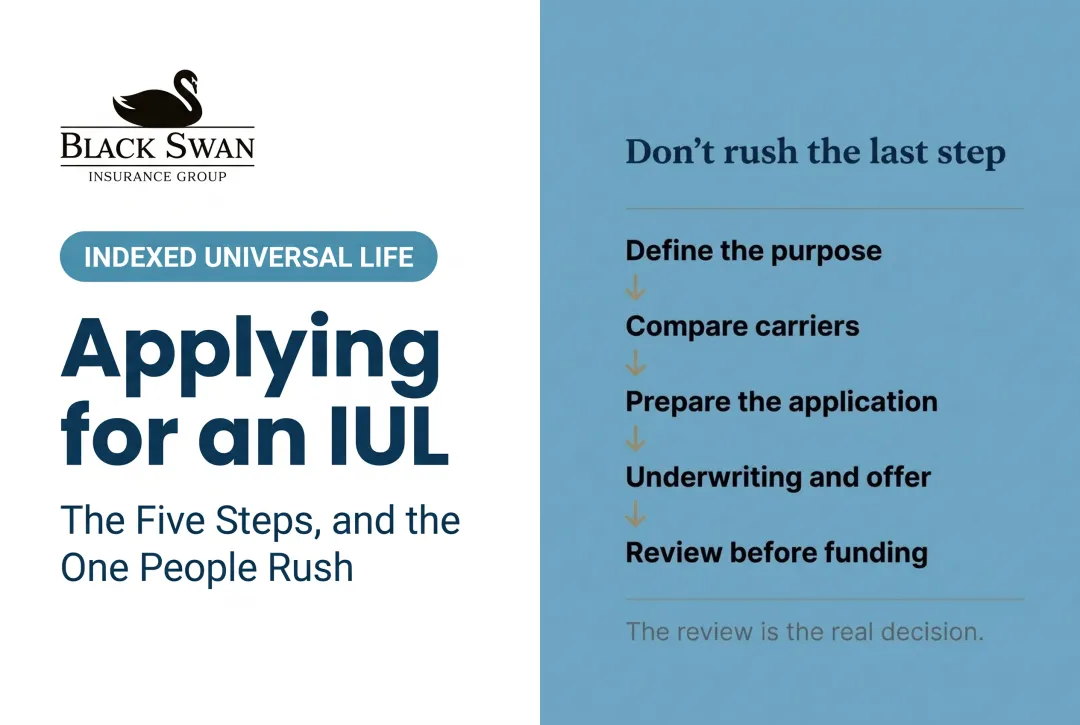
Step 1: Needs Assessment and Budget
Before any paperwork, decide what the policy has to accomplish. Identify beneficiaries, outstanding obligations, income-replacement needs, and any estate or business goals tied to the coverage.
Then build a premium budget that accounts for:
- Current income and cash flow — what can you commit without straining the budget?
- Emergency reserves — do you already hold three to six months of expenses?
- Existing retirement contributions — is the 401(k) or Roth already funded to the limit?
- Debt obligations — would the money do more work retiring high-interest balances?
- Future commitments — college costs, a mortgage, aging-parent care?
A higher premium does not automatically mean a better policy. It means a bigger commitment, which only makes sense if the budget can sustain it through a recession, a practice buy-in or a year with no bonus.
Who It Might Fit, and Who It Does Not
Permanent coverage can serve several purposes — family protection, legacy planning, supplemental retirement flexibility, or business-related coverage. None of them is an automatic fit.
Stronger Fit
- A genuine need for lifelong coverage, not coverage until the kids graduate
- Stable surplus cash flow after essentials and savings goals
- Earning $150K+ with lower-cost tax-advantaged accounts already maxed
- Willingness to review and maintain the policy for decades
Weaker Fit
Not everyone should buy one. Walk away if you need savings access within the next few years, have unstable income or no emergency reserve, carry high-interest debt that should be cleared first, or simply want the cheapest possible death benefit — term insurance does that job properly and for a fraction of the cost.
An IUL works alongside your 401(k), IRA and other investments. It does not replace them.
The Ultimate IUL Blueprint
Before you start an application, the Blueprint covers what the design has to survive: funding levels, caps and charges, the MEC line, loan timing, and what to demand from an illustration.
Step 2: Underwriting and Documentation
Work with a licensed professional who compares multiple carriers on financial strength, crediting methods and policy charges side by side. A single-carrier pitch rarely shows the full picture, and the person showing it usually cannot tell you what the other five would have offered.
Typical application materials:
- Government-issued identification
- Beneficiary designations and relationship details
- Income and net-worth documentation for larger coverage amounts
- Current medications and medical history
- Business or financial records, if coverage ties to a business
Disclose everything accurately. Inconsistencies between your application and your medical records can delay underwriting or create a coverage dispute at claim time, which is the worst possible moment to discover one.
Underwriting may involve health questionnaires, prescription-history checks or a paramedical exam. The industry has moved toward faster paths — Munich Re's 2025 survey found all 27 participating carriers had an accelerated-underwriting program in production, some waiving exams for qualifying applicants. Timelines still vary by carrier, health profile and policy complexity, so treat any promised turnaround as an estimate.

Step 3: Review the Illustration Before You Commit
An illustration is a projection. It is not a promise of future cash value, retirement income or policy longevity.
An illustration is a model, not a guarantee.
Every illustration should show two sets of columns, guaranteed and non-guaranteed. Review both for projected premiums over time, cash surrender value at key policy years, death benefit amount, policy charges deducted annually, and the point at which the policy becomes vulnerable to lapse.
Index-crediting terms can obscure what you actually keep. Pacific Life's client guide shows a $1,000 indexed allocation: 30% index growth with a 5% cap and 100% participation credits $50; a 12% index decline with a 0% floor credits $0, before policy charges.

Read that example twice. A 30% index year credits 5%. That is not a criticism of the product — it is the trade you are making for the floor — but it is the single biggest source of unrealistic expectations in this market.
Stress-Test the Design
Ask for the illustration under less favourable conditions, not just the optimistic scenario. Request versions modelling conservative crediting below the illustrated rate, reduced or missed premium payments, increased policy charges over time, and extended policy loans against cash value.
Review every line-item cost: surrender charges, premium loads, cost of insurance, administrative fees and rider costs.
Then compare the proposed policy with realistic alternatives — term life, whole life, traditional universal life, your 401(k) or Roth, and a taxable brokerage account. If tax, estate or business-ownership issues are involved, bring in a CPA or attorney before you sign.
What the Critics Get Right
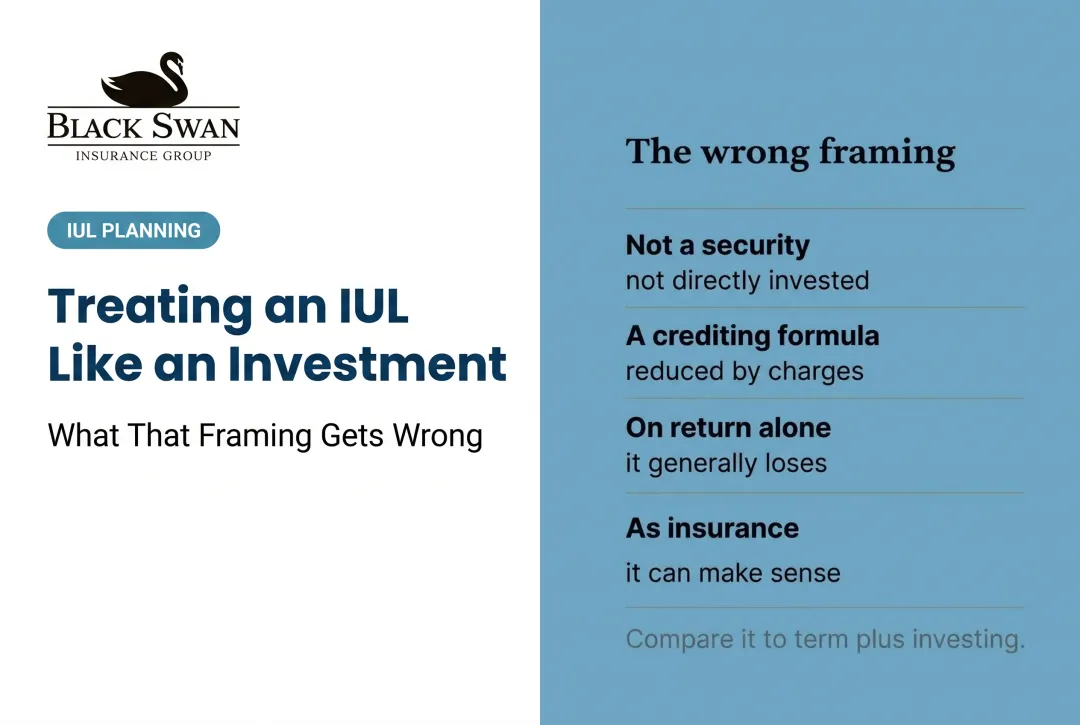
The fairest criticism of "starting an IUL investment" is the word investment. It frames a life insurance contract as a portfolio holding, which encourages people to compare an illustrated 6.5% credit against an equity index and conclude they are getting similar exposure with a safety net. They are not. The cap, the participation rate and the charges all sit between the index and your account, and the carrier controls two of those three after you buy.
The second fair hit is cost structure. Front-loaded charges and a surrender schedule mean early exit is expensive. If there is any realistic chance you abandon this inside ten years, the critics are right and you should not start.
What the criticism usually misses is that none of this applies to someone with a genuine permanent protection need who was going to buy permanent insurance anyway. For that buyer the question is not IUL versus the market — it is IUL versus whole life versus traditional UL. That is a narrower and much more answerable question.
A great IUL is engineered. A bad IUL is sold.
Risks to Understand Before You Fund
IUL premiums are flexible, but skipping or reducing payments can lower cash value accumulation, increase lapse risk if charges outpace the remaining account value, and require larger catch-up funding later.
Policy loans and withdrawals let you access cash value, but they are not free money:
- Loans accrue interest and reduce death benefit and cash value until repaid
- A lapse or surrender with an unpaid loan can create taxable income
- The IRS may treat part of those proceeds as taxable if the policy ends with a loan balance
The loan is not the problem. The unmanaged loan is the problem.
There is also a funding ceiling. IRS Notice 2007-15 explains that a policy becomes a modified endowment contract if cumulative premiums paid within the first seven contract years exceed the 7-pay test limit under Section 7702A. MEC status changes how distributions are taxed — generally income-first, with a possible 10% additional tax — and it is generally permanent. Overfund too aggressively and you trigger it without meaning to.

A policy bought once and ignored for twenty years rarely performs as expected. Review annually: premium payments and funding pace, current cash value against the original illustration, index-crediting elections, death-benefit adequacy, beneficiary designations, and any outstanding loan balance.
This is not set-it-and-forget-it. It is design-it, fund-it, review-it.
Find Out Where You Actually Stand
This starts with the Tax-Free Wealth Blueprint Fit Review. If you earn $150K+ and are considering an application, we confirm the protection need before anything else, establish a premium you can sustain in a bad year, compare designs across carriers under identical assumptions, read guaranteed values against illustrated ones, and stress-test through lower crediting, paused funding and extended loans. We explain compensation before anyone funds anything. Tax and estate questions go to your CPA or attorney, and we will say when that call needs making. If IUL does not fit, we will tell you that too.
Frequently Asked Questions
How does an IUL policy work?
It combines a death benefit with cash value credited through index-linked formulas using caps, floors and participation rates. You do not invest directly in the index, and policy charges continue to apply regardless of crediting results.
How do I get started?
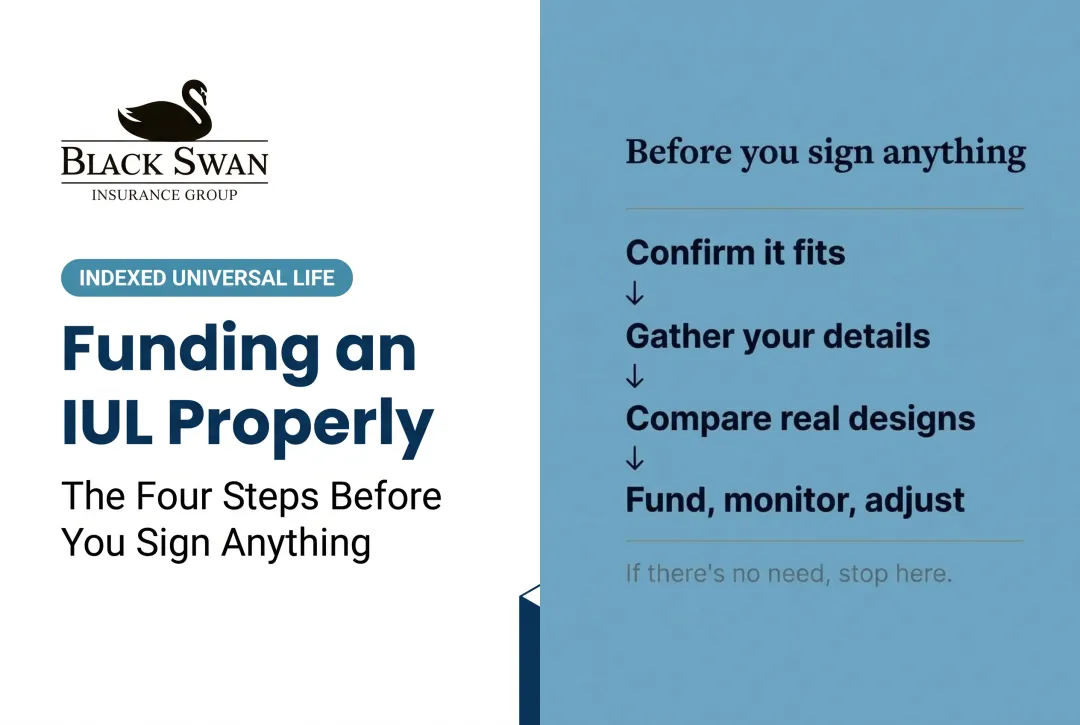
Assess your protection need, budget and long-term goals, then compare carriers and designs with a licensed professional. Complete the application and underwriting, review the illustration against both columns, and fund the first premium only once the design matches the budget you set at the start.
Is an IUL a good investment for retirement?
It may complement retirement planning for some people, but it is not a replacement for diversified investments or qualified retirement accounts. It requires sustained long-term funding and ongoing monitoring to work as intended.
How much money do you need to start a policy?
Required premiums depend on age, health, coverage amount, carrier and policy design. Ask for a personalised illustration rather than relying on a generic minimum figure — and build it around what you can sustain, not what you can currently afford.
What documents are needed to apply?
Most applications require identification, beneficiary details, medical history and current medications, and income or financial documentation for larger coverage amounts. Exact requirements vary by carrier.
What happens if I stop paying?
Charges continue to deduct from cash value. If cash value runs out, the policy lapses — and if a loan is outstanding at that point, you can face a tax bill with no cash arriving to pay it.
Sources
- LIMRA — U.S. individual life insurance new premium tops $17.5 billion in 2025
- Guardian — Indexed universal life insurance
- Munich Re — Accelerated underwriting trends
- Pacific Life — Indexed universal life client guide
- IRS — Notice 2007-15
Disclosure: This article is educational and is not personal tax, legal or investment advice. Indexed universal life is life insurance first. Carrier products, charges, caps, participation rates, underwriting programs and state availability change frequently and must be confirmed against current policy forms before applying. Illustrated values are not guarantees; actual results depend on policy terms, crediting, costs and funding. Any potential tax-advantaged access depends on the policy being properly structured, funded and managed. Actual results depend on policy design, carrier, crediting options, caps, participation rates, expenses, funding and ongoing management. This strategy is not appropriate for everyone. Policy loans and withdrawals reduce cash value and the death benefit, and can create tax consequences if the policy lapses or becomes a modified endowment contract. Consult your own tax, legal and financial professionals for advice specific to your situation.
And remember, it's not what you earn, it's what you keep… enjoy the ride.