By Robert Balgac, Founder, Black Swan Insurance Group | October 5, 2026
Life insurance exists first to pay a death benefit to the people who depend on you. Certain permanent policies also build cash value, and some households use that cash value to supplement retirement income later.
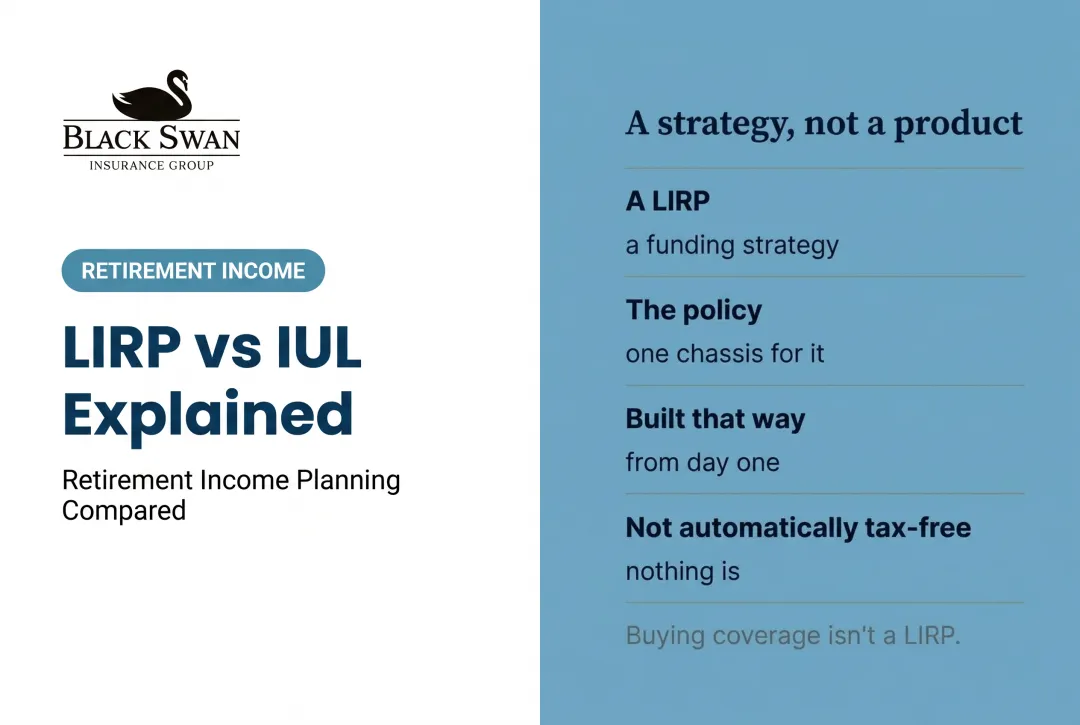
That is the entire idea behind a "life insurance retirement plan." It is worth knowing up front that LIRP is not a product. You will not find it printed on any contract. It is a planning term describing how an ordinary permanent policy is used, and the distance between that reality and how it gets marketed is where most of the trouble starts.
The protection gap it is sold against is real: 51% of U.S. adults report having some life insurance coverage, while 40% believe they need more — close to 100 million people, per the 2025 Insurance Barometer Study from LIMRA and Life Happens. But a protection gap is an argument for coverage, not for a particular funding strategy.
The short answer: A LIRP uses permanent life insurance cash value to supplement — never replace — other retirement income. Results depend heavily on policy design, funding discipline, internal costs and ongoing management. Consider it only after insurance needs, emergency reserves and qualified-plan contributions are handled. Policy loans, withdrawals, MEC status and lapse risk can cut benefits or trigger unexpected taxes, and it carries none of a qualified plan's contribution limits, required distributions or regulatory guardrails.
Key Takeaways
- A LIRP uses permanent life insurance cash value to supplement, not replace, other retirement income
- Results depend on policy design, funding discipline, internal costs and ongoing management
- Consider it only after insurance needs, emergency reserves and qualified-plan contributions are covered
- Policy loans, withdrawals, MEC status and lapse risk can cut benefits or create unexpected taxes
- It is not a qualified retirement account and does not carry the same guardrails
What It Actually Is
A permanent life insurance policy — whole life, universal life, indexed universal life or variable universal life — used as one piece of a broader retirement strategy.
Two functions, one policy: death benefit protection for the people who rely on you, and cash-value accumulation that may later supplement income. The insurer allocates part of each premium to the cost of insurance and policy expenses; what remains may build cash value depending on design and crediting method.
Not a Qualified Account
This distinction matters more than anything else on the page. A LIRP is not an IRS-qualified retirement account. It does not use the same annual contribution caps and does not require minimum distributions.
It also lacks many of the same regulatory guardrails and, in most cases, the same cost efficiency. Those are trade-offs, not features, and they should be presented that way.
A caution worth stating plainly: do not buy permanent coverage for a projected cash-value figure or an assumed tax outcome. Review the costs, the assumptions and the alternatives, and confirm you can keep the policy in force for decades.
How the Cash Value Grows
Part of each premium covers the cost of insurance and administrative charges. The remainder may contribute to cash value, and how that grows depends entirely on policy type.
| Policy type | How cash value grows | Key consideration |
|---|---|---|
| Whole life | Contractual guarantees, possible dividends | Dividends are not guaranteed and vary with insurer performance |
| IUL | Interest credited via an index formula, subject to caps, participation rates and a floor | Not a direct market investment; caps limit upside, the floor limits the credit |
| Variable UL | Cash value invested in subaccounts | Exposed to real market losses and investment fees |
| Fixed or other UL | A declared interest rate, flexible premiums | Crediting rates and guarantees vary by carrier and design |
With an IUL specifically, the floor prevents a negative index return producing a negative credit. It does not eliminate policy charges, and it does not guarantee cash value will hold once fees are counted.
Zero is your hero in a down year — but the floor applies to the credit, not to the charges.
Required premium and optional extra funding are different things. Overfunding can accelerate cash-value growth and has to be structured carefully. Push too much in too fast and the policy fails the seven-pay test, becoming a modified endowment contract and permanently changing how withdrawals and loans are taxed.

Getting the Money Out
- Withdrawals — reduce cash value and potentially the death benefit
- Policy loans — borrowed against cash value, with interest accruing
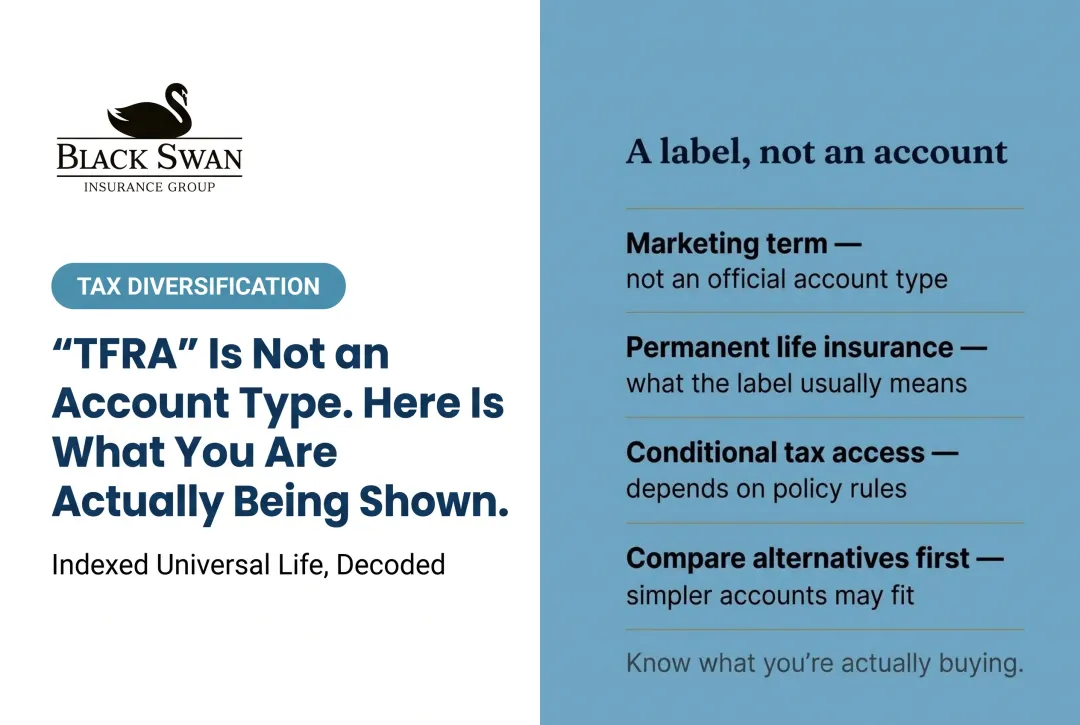
Both have to be managed alongside ongoing premiums, loan interest and projected performance. Draw too much too fast and you risk a lapse, which can create taxable income on any gain — particularly with a loan balance outstanding. Any potential tax-advantaged access is conditional on the contract being properly structured, funded and managed.
What the Critics Get Right
The criticism of LIRPs is among the sharpest in personal finance, and most of it is correct.
Critics are right that the name is marketing — dressing an insurance contract in retirement-account language to borrow credibility it has not earned. They are right that the cost structure makes it an inefficient accumulation vehicle compared with a 401(k), a Roth or a brokerage account, particularly in the early years when charges are heaviest. And they are right that it gets sold to people who had not yet captured an employer match, which is indefensible under any analysis.
Where the criticism runs out is the same place it always does: a household that needs permanent coverage regardless. For them the cash value inside that coverage is not competing with a 401(k) — it is a feature of insurance they were buying anyway. The error is buying the insurance for the feature.
Who It Fits
Stronger Fit
- A legitimate, ongoing need for permanent coverage
- Household income of $150K+ with stable surplus cash flow beyond current savings goals
- Adequate emergency liquidity already in place
- A long time horizon — decades, not years
- Reasonable insurability
- Willingness to maintain and review the policy long term
This typically describes high-income professionals, executives, business owners and affluent families who have already maxed employer plans and IRAs and want additional tax diversification or legacy flexibility.
Late-start high earners need a different lens. A LIRP cannot make up for missed retirement contributions, and assuming otherwise is how a compressed timeline becomes a failed policy. The priorities are a realistic horizon for the policy to perform, current insurability and underwriting class, sustainable funding capacity, and liquidity needs that should not be tied up in a contract.
Weaker Fit
Not everyone should buy an IUL, and a LIRP is not a retirement account. If the qualified accounts are not full, start there instead.
- Limited or unpredictable cash flow
- High-interest debt still outstanding
- Insufficient emergency savings
- No genuine permanent insurance need — where protection is temporary, term insurance is the right answer and costs a fraction
- Near-term liquidity requirements
- Poor insurability or health concerns
- Uncertainty about a long-term premium commitment
It should be weighed alongside term insurance, qualified accounts, taxable investments and estate planning. Never instead of any of them.
The Ultimate IUL Blueprint
If an indexed design is the vehicle under consideration, the Blueprint covers the decisions that determine whether it works: funding levels, the MEC line, loan timing and what to demand from an illustration.
Benefits, Costs and Risk
What it can offer: permanent death benefit protection; tax-deferred cash-value growth; access outside 401(k) and IRA contribution limits; potential legacy and estate-planning flexibility; and liquidity during a market downturn without selling other assets at a loss.
The real costs: premiums generally higher than comparable term coverage; cash value building slowly in the early years when fees are heaviest; and surrender charges, cost of insurance, administrative fees and rider costs all reducing growth.
Lapse Deserves Real Attention
A policy lapses through underfunding relative to illustrated premiums, excessive loans or repeated withdrawals, missed premiums, or rising internal charges over time.
If it lapses with an outstanding loan or unrecognised gain, the IRS treats the excess over your basis as ordinary income — not capital gains — per IRS Revenue Ruling 2009-13. That recharacterisation can produce a large, unexpected bill in the lapse year, with no cash received to pay it.
Loans accrue interest. An unpaid balance reduces the death benefit and, over time, weakens the policy's ability to stay in force at all.
MEC Rules
If cumulative premiums in the first seven years exceed the IRS limit under the seven-pay test, the contract becomes a modified endowment contract. Distributions then follow income-first rules and may trigger early-withdrawal penalties — permanently less favourable treatment than a properly structured non-MEC policy.

Guarantees, credited interest, dividends and death benefits all depend on policy terms and the insurer's claims-paying ability.
Against the Alternatives
| Strategy | Strength | Trade-off |
|---|---|---|
| 401(k) | Employer match, high contribution limits, tax-deferred growth | No death benefit; required distributions later |
| Roth IRA | Tax-free qualified withdrawals | Income limits restrict eligibility; lower caps |
| Term insurance plus investing | Lower-cost protection frees money to invest | Coverage ends; requires genuine savings discipline |
| Annuities | Guaranteed lifetime income options | Surrender periods, liquidity restrictions, distribution taxation |
| LIRP | Permanent protection plus conditional cash-value access | Higher cost, slow early growth, lapse and MEC risk |
A 401(k) is not the enemy here, and the match beats anything a policy illustration can show. Depending on one bucket alone is the part worth examining — and that is an argument for tax diversification, not for any specific product.

The product is not the strategy. The design is the strategy — and calling an insurance policy a retirement plan does not make it one.
Risks to Understand Before You Fund One
- Treating it as a retirement account rather than insurance with a feature is the central error
- Premiums run higher than comparable term coverage, and that gap is the opportunity cost
- Early cash value builds slowly because fees are heaviest in the first years
- Charges continue in a 0% crediting year, so cash value can fall with the floor intact
- Cost of insurance rises with age and is deducted regardless of crediting
- Underfunding, excessive loans or missed premiums cause lapse
- A lapse with a loan outstanding creates ordinary income on gain above basis, with no cash received
- Crossing the seven-pay limit makes it a MEC permanently, taxing distributions income-first
- It has no employer match, no contribution-limit protections and none of a qualified plan's guardrails
Find Out Where You Actually Stand
This starts with the Tax-Free Wealth Blueprint Fit Review. If you earn $150K+ and someone has proposed a LIRP, we check the sequencing first — match, reserves, qualified accounts — then test whether a permanent protection need exists independently, model the funding through a bad decade, and compare a taxable account on identical assumptions. If it does not fit, we will tell you that too, and it frequently does not.
Frequently Asked Questions
Is a LIRP a real product?
No. It is a planning term for using a permanent life insurance policy as part of a retirement strategy. The contract you would sign is an ordinary whole life, universal life, indexed universal life or variable universal life policy.
Is it a retirement account?
No. It is not IRS-qualified, has no contribution caps, requires no minimum distributions, and lacks the regulatory guardrails and cost efficiency of a 401(k) or IRA.
Can it replace my 401(k)?
No, and the employer match alone settles that. A policy is evaluated as a supplement after the obvious accounts are funded and a genuine protection need exists.
What happens if it lapses with a loan?
Gain above your basis is treated as ordinary income in the lapse year, per IRS guidance — potentially a large bill with no cash received to pay it.
What is the MEC risk?
Overfunding past the seven-pay limit in the first seven years makes the contract a modified endowment contract. Distributions are then taxed income-first with possible penalties, and the change is permanent.
Should I buy term and invest the difference instead?
For most households, yes, and it deserves pricing first. It works when the difference genuinely gets invested every year, including through a bad market.
Sources
- LIMRA and Life Happens — 2025 Insurance Barometer Study
- IRS Revenue Ruling 2009-13
- NAIC — Life Insurance
- NAIC — Life Insurance Illustrations
- I.R.C. § 7702A and Rev. Proc. 2008-39 (modified endowment contracts and the seven-pay test)
Disclosure: This article is educational and is not personal tax, legal or investment advice. Indexed universal life is life insurance first. A life insurance retirement plan is not a qualified retirement account. Guarantees, credited interest and dividends depend on policy terms and the issuing insurer's claims-paying ability. Actual results depend on policy design, carrier, crediting options, caps, participation rates, expenses, funding and ongoing management. Policy loans and withdrawals may reduce cash value and death benefit and can create tax consequences if the policy lapses or becomes a modified endowment contract. This strategy is not appropriate for everyone. Illustrated values are not guarantees; actual results depend on policy terms, crediting, costs and funding. Consult your own tax, legal and financial professionals for advice specific to your situation.
And remember, it's not what you earn, it's what you keep… enjoy the ride.