By Robert Balgac, Founder, Black Swan Insurance Group | October 5, 2026
Most people think of life insurance as income replacement for a grieving family. That role is real, and it is only part of what a death benefit does inside an estate plan.
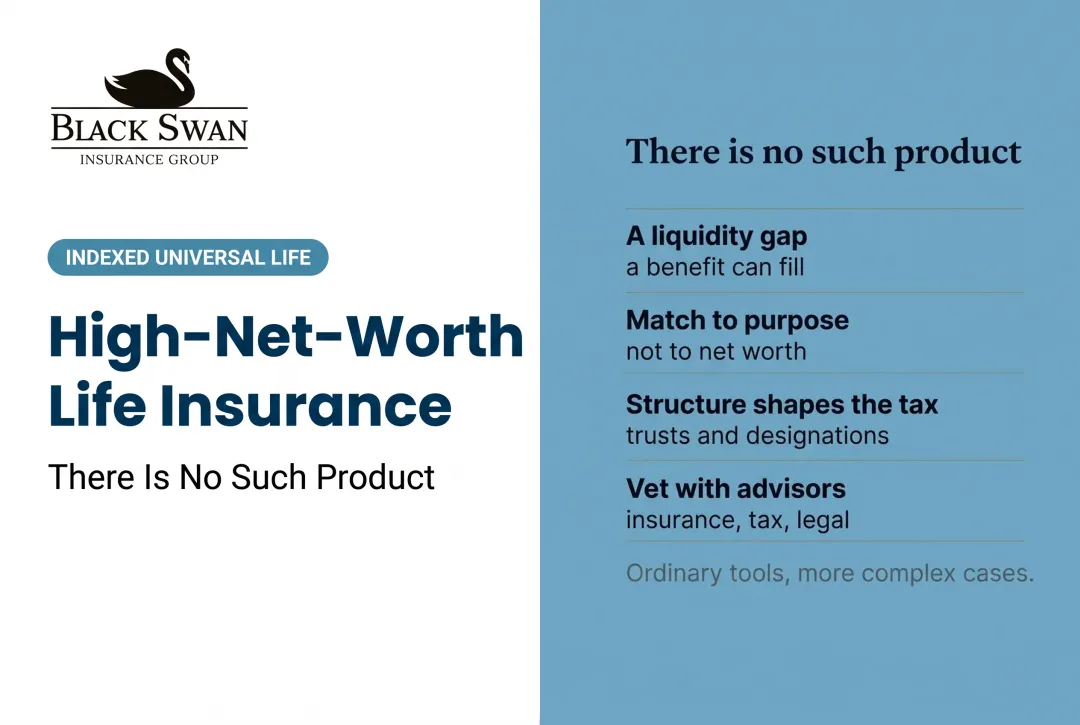
The other role is liquidity. Cash arriving on a predictable trigger, so nobody has to sell a house, a farm or a family practice in a hurry to pay a tax bill. The federal estate tax exclusion sits at $13.99 million for 2025 per the IRS, though that figure moves by tax year and many states set far lower thresholds.
Here is the mistake that costs the most: assuming that naming someone else as beneficiary keeps the proceeds out of your taxable estate. It does not. Ownership determines that, and if you retain the right to change beneficiaries, borrow against the policy or surrender it, the proceeds can be pulled back in regardless of whose name is on the form.
The short answer: Life insurance proceeds fund taxes, debts, final expenses or buyouts so heirs are not forced into a quick sale. Term coverage fits temporary gaps; permanent coverage supports lifetime protection and legacy goals. Ownership and beneficiary designations drive estate-tax treatment and who controls the money — and under IRC § 2042 retained incidents of ownership pull proceeds into the taxable estate. Stress-test premiums, guarantees and cash-value assumptions before buying anything.
Key Takeaways
- Proceeds fund taxes, debts, final expenses or buyouts so heirs are not forced to sell assets quickly
- Term coverage fits temporary gaps; permanent coverage supports lifetime protection and legacy goals
- Ownership and beneficiary designations drive estate-tax treatment and who controls the money
- Income tax and estate tax are two separate questions with two different answers
- Stress-test premiums, guarantees and cash-value assumptions before you buy
Where It Fits
An estate plan has two moving parts: legal documents and funding tools. A will or trust directs where assets go. Life insurance supplies cash — a defined death benefit arriving on a predictable trigger, regardless of how illiquid everything else is.
Probate and Beneficiary Designations
A named beneficiary typically receives proceeds directly, outside probate. That is a meaningful advantage over assets passing through a will, since probate takes months and involves court oversight.
It is not a set-and-forget detail. Beneficiary rules, contingent designations and state law interact in unexpected ways — particularly with blended families, minor children, or a form last updated decades ago. Review designations with an estate-planning attorney, not only an insurance agent.
Income Tax and Estate Tax Are Different Questions
The IRS generally treats death benefits as excluded from the beneficiary's income tax when paid as a lump sum (IRS life insurance proceeds guidance). Interest earned if proceeds are held and paid over time is taxable.
That is separate from whether the death benefit gets pulled into the insured's taxable estate. Ownership and retained control decide that, not how the beneficiary reports income.
The Jobs It Can Do
Liquidity for a Concentrated Estate
Many estates are heavy on illiquid assets and light on cash. Per the 2022 Survey of Consumer Finances, 66.1% of families own a primary residence, 14.6% hold business equity and 54.3% hold retirement accounts. None of those converts to cash quickly.
A death benefit covers expenses or tax obligations without forcing a sale of a home, farmland, artwork or a retirement account. Federal and state thresholds shift by year and jurisdiction, so confirm current rules with a tax professional.

Equalising Inheritances
One adult child runs the family business and the others do not. Giving that child the business while splitting cash among the rest only works if the values actually match.
Proceeds can fund the equalising side. Alignment across documents is non-negotiable: will and trust terms matching the intended split, beneficiary forms naming the same parties and shares, and coverage tracking a current valuation of the business interest. A mismatch between those documents is one of the most common and most preventable estate disputes.
Business Succession and Buy-Sell Funding
Coverage can fund a buy-sell agreement so a surviving partner or the business itself can purchase a deceased owner's interest without scrambling for financing. It works only where policy ownership matches the buy-sell structure, coverage reflects current valuations, and funding obligations are documented and reviewed.
Minor or Special-Needs Beneficiaries
Naming a minor directly usually creates more problems than it solves — courts may need to appoint a guardian to manage the funds. Naming a trust lets a trustee manage and distribute under your instructions.
For a beneficiary on means-tested benefits, structure matters more still. A lump-sum payout can jeopardise eligibility; a properly drafted trust can preserve benefits and still deliver support. That is specialist drafting work for an estate attorney.
A Controlled Legacy
A policy can create a defined inheritance or charitable gift, with a trust adding conditions, timing or trustee oversight. Life insurance does not automatically produce a set return or tax result — policy type, ownership and trust terms all have to match the legacy you intend.
Choosing the Type and the Amount
| Type | Best fit | Cash value | Duration |
|---|---|---|---|
| Term insurance | Temporary needs: income replacement, debt, child-rearing years | None | 10–30 years |
| Whole life | Lifetime protection with a guaranteed premium structure | Yes, guaranteed growth | Permanent |
| Guaranteed universal life | A death-benefit guarantee at lower relative cost | Minimal | Permanent, with funding conditions |
| Indexed universal life | Lifetime protection plus index-linked cash-value potential | Yes, non-guaranteed | Permanent |
| Survivorship | Second-to-die needs, often estate-tax liquidity for couples | Varies | Permanent |
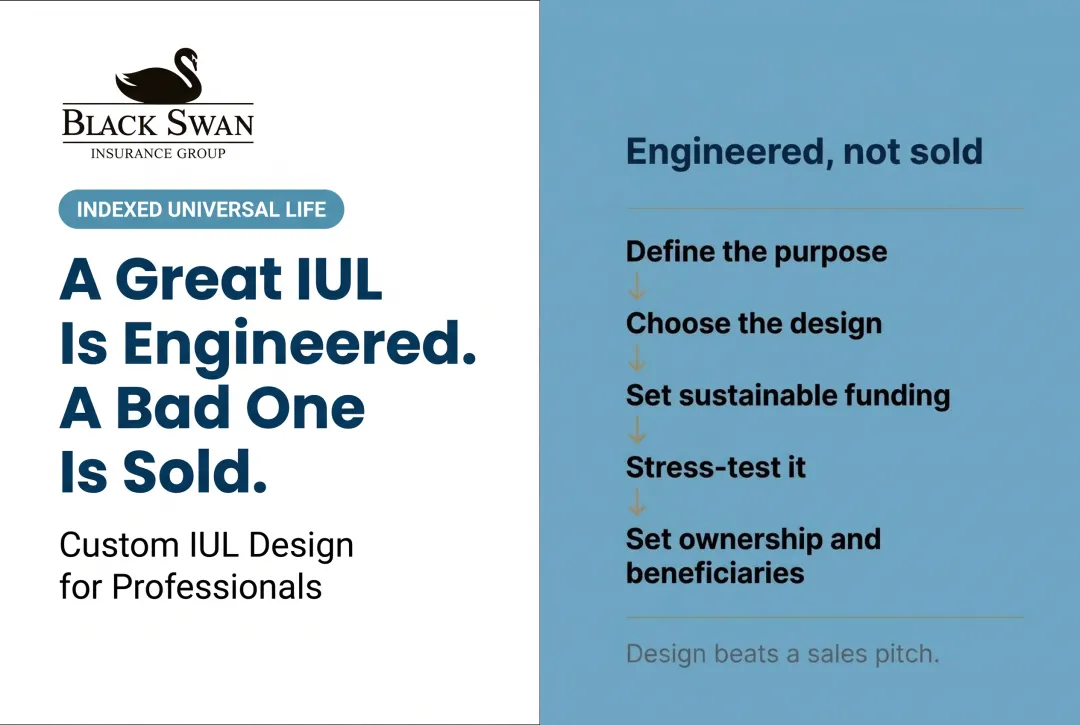
Match the design to the objective. If the goal is a known future death benefit — funding estate taxes or equalising an inheritance — a guaranteed death benefit matters more than cash-value potential, and guaranteed universal life or whole life frequently fits better than an indexed design. If the goal includes flexible lifetime access, a cash-value policy plays a bigger role. Treat them as separate design problems.
Sizing it. Skip generic income multiples. Model against final expenses and outstanding debts; income replacement needs; business valuation where applicable; expected estate or inheritance taxes; intended inheritances and existing assets; and inflation and premium budget over time. Run multiple scenarios rather than picking one number and hoping.
If an IUL Is in the Mix
An indexed universal life policy credits interest from a formula usually including a cap, a participation rate and a floor on the crediting side. The floor does not erase policy charges, so cash value can fall when costs outpace credits.

Before relying on an illustration: compare guaranteed values against non-guaranteed ones; review how loans and withdrawals change the death benefit; ask what happens if caps drop or funding pauses; and confirm the policy stays out of MEC status if potential tax-advantaged access matters. All of it is conditional on the contract being properly structured, funded and managed.
Zero is your hero in a down year — but the floor applies to the credit, not to the charges, and an estate plan that depends on a policy surviving forty years needs that distinction understood.
What the Critics Get Right
Scepticism about life insurance in estate planning is warranted, and it is worth meeting.
Critics are right that with the federal exclusion at $13.99 million, the great majority of households will never owe federal estate tax, and that permanent coverage sold on an estate-tax argument to a family nowhere near the threshold is a poor recommendation. They are right that state thresholds and sunset provisions get used to manufacture urgency. And they are right that a guaranteed universal life policy often funds a known death benefit more cheaply than an indexed one, which makes the frequency of IUL recommendations in this context worth questioning.
Where the criticism stops is liquidity. Estate tax is not the only reason an estate needs cash. A family whose wealth sits in a business, a farm or real estate has a liquidity problem at any exclusion level, because those assets cannot be sold quickly without destroying value. That problem is real and it does not care what the exemption is this year.
Ownership, Trusts and the Tax Lever
Why Ownership Controls the Outcome
Under IRC Section 2042, a decedent's gross estate includes proceeds payable to the executor, and proceeds paid to other beneficiaries if the decedent held "incidents of ownership" at death, as defined in the federal tax code.
Incidents of ownership include the right to change beneficiaries, borrow against the policy, or surrender it.
In plain terms: naming someone else as beneficiary does not remove proceeds from your taxable estate if you still control the policy. Ownership is the lever. The beneficiary form is not.
The ILIT
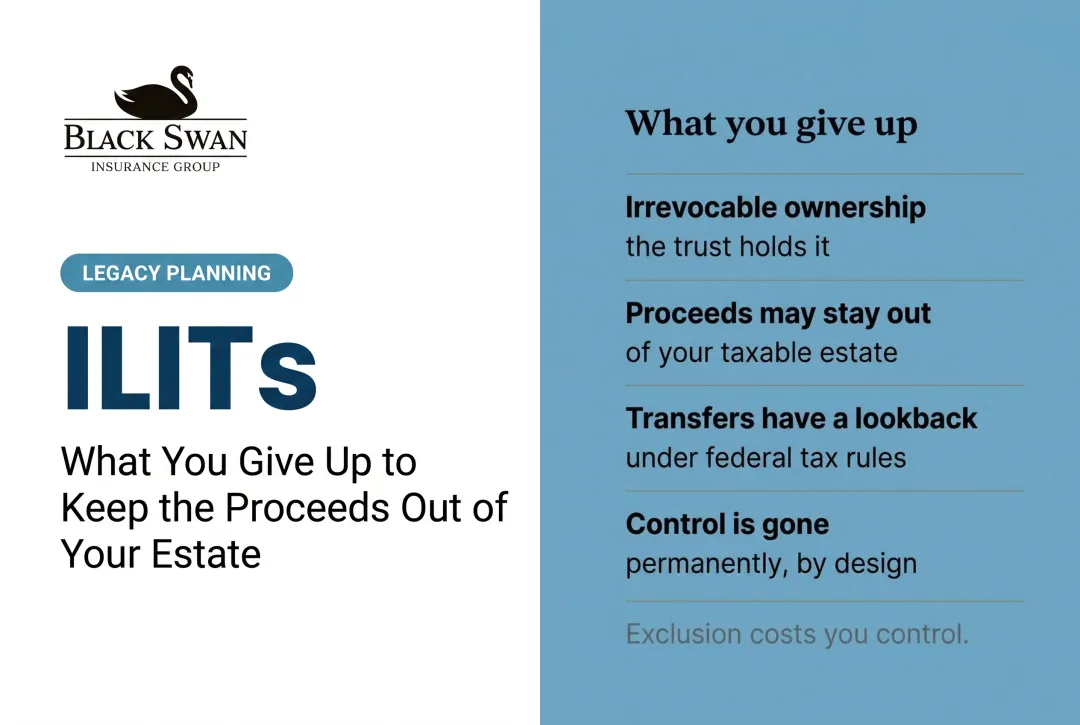
An irrevocable life insurance trust can own a policy so proceeds stay outside the insured's taxable estate, with a trustee managing distributions under the trust terms. The trade-off is genuine: the grantor gives up meaningful control, and an ILIT-owned policy is not a personal account you can tap when convenient.
New Policy Versus Transfer
How the ILIT acquires the policy matters as much as the trust itself. Buying a new policy directly through the trust is different from transferring an existing one — transfers made within three years of death can still be pulled back into the taxable estate. Gift-tax rules also apply when premiums are funded through the trust.
Involve an estate attorney before changing ownership on any existing policy. This is not a paperwork change.

The Ultimate IUL Blueprint
Where permanent coverage is going into an estate structure, the Blueprint covers what it has to survive: funding levels, the MEC line, loan timing and what to demand from an illustration.
Who This Fits
Stronger Fit for Permanent Coverage in an Estate Plan
- Wealth concentrated in illiquid assets — a business, a practice, a farm, real estate
- Household income of $150K+ with cash flow able to sustain premiums for decades
- A genuinely lifetime insurance need, not a temporary one
- Emergency reserves already in place and insurability at a reasonable rate class
- A realistic funding horizon given retirement or business timelines
- Willingness to review ownership, beneficiaries and policy performance annually
Weaker Fit
Not everyone should buy an IUL for estate planning. Below the federal exemption, term insurance covers the liquidity need at a fraction of the cost.
- The estate is comfortably below the exclusion with no liquidity concentration
- The need has a defined end date — term insurance covers that far more cheaply and is frequently the right answer
- Cash flow cannot sustain premiums through a downturn
- Nobody intends to keep documents and designations aligned as circumstances change
Risks to Understand Before You Structure Anything
- Retained incidents of ownership defeat the planning, and they are easy to create accidentally
- The three-year rule under IRC § 2035 can pull a transferred policy back into the estate
- Mismatched documents — will, trust and beneficiary forms disagreeing — cause preventable disputes
- Naming a minor directly can force a court-appointed guardianship
- A lump sum to a means-tested beneficiary can destroy their eligibility
- Underfunding causes lapse, and a lapsed policy inside an ILIT wastes the trust, the fees and the premiums
- Cost of insurance rises with age and is charged regardless of crediting
- Loans reduce the death benefit available to the estate, and a lapse with a loan outstanding and gain can create taxable income
- Exclusion amounts and tax law change, and a structure built for this year may need revisiting
- Business valuations go stale, leaving buy-sell and equalisation coverage undersized
Find Out Where You Actually Stand
This starts with the Tax-Free Wealth Blueprint Fit Review. If you earn $150K+ and your wealth is concentrated in something illiquid, we size the real liquidity gap, check whether current ownership defeats your intent, compare guaranteed universal life against indexed designs for a known death benefit, and price term for any need with an end date. If it does not fit, we will tell you that too. Your attorney drafts the documents and your CPA confirms the tax treatment.
Frequently Asked Questions
Is a life insurance death benefit taxable?
Generally not for income tax when paid as a lump sum to a beneficiary. Interest on proceeds held and paid over time is taxable, and estate tax is an entirely separate question determined by ownership.
Does naming a beneficiary keep proceeds out of my estate?
No. If you retain incidents of ownership — the right to change beneficiaries, borrow against the policy or surrender it — the proceeds can be included under IRC § 2042 regardless of who is named.
Do I need an ILIT?
Most households do not. It becomes relevant where estate size or liquidity concentration creates a real problem, and it requires permanently giving up control of the policy.
Which policy type suits estate planning?
Where the goal is a known future death benefit, guaranteed universal life or whole life often fits better than an indexed design. Where flexible lifetime access also matters, a cash-value policy plays a larger role.
What happens if I transfer an existing policy to a trust?
The three-year lookback applies, and gift-tax rules apply to premium funding. Many attorneys prefer the trust to purchase a new policy from inception for that reason.
Should I just buy term insurance?
If the need has a defined end date, yes. Term is far cheaper and appropriate for temporary obligations. Permanent coverage earns its place where the liquidity need genuinely outlasts a term.
Sources
- IRS — Estate tax
- IRS — Life insurance and disability insurance proceeds
- 26 U.S.C. § 2042 — Proceeds of life insurance
- Federal Reserve — 2022 Survey of Consumer Finances
- IRC § 2035 (transfers within three years of death)
Disclosure: This article is educational and is not personal tax, legal or investment advice. Indexed universal life is life insurance first. Estate planning requires an attorney, and tax treatment requires a qualified tax professional. Exclusion amounts and tax rules change, and state thresholds differ from federal. Actual results depend on policy design, carrier, crediting options, caps, participation rates, expenses, funding and ongoing management. Policy loans and withdrawals may reduce cash value and death benefit and can create tax consequences if the policy lapses or becomes a modified endowment contract. This strategy is not appropriate for everyone. Illustrated values are not guarantees; actual results depend on policy terms, crediting, costs and funding. Consult your own tax, legal and financial professionals for advice specific to your situation.
And remember, it's not what you earn, it's what you keep… enjoy the ride.