By Robert Balgac, Founder, Black Swan Insurance Group | October 5, 2026
Dave Ramsey does not recommend indexed universal life insurance. His guidance is consistent: buy term for the death benefit you need, invest the difference in growth-stock mutual funds. That is the direct answer and it belongs at the top of the page.
It is also, for most of the people who hear it, correct.
There are two separate questions tangled together in this debate, and conflating them is how both sides end up arguing past each other. One is whether an IUL fits a particular household. The other is whether the mechanics are being described accurately. You can agree with every word of Ramsey's caution about fees and complexity and still recognise that permanent coverage does a real job for some families.
If you earn $150K+, have maxed the 401(k), are past the Roth limits and have a protection need that does not expire, the general-audience answer may not be your answer. That is not a loophole. It is a different set of facts.
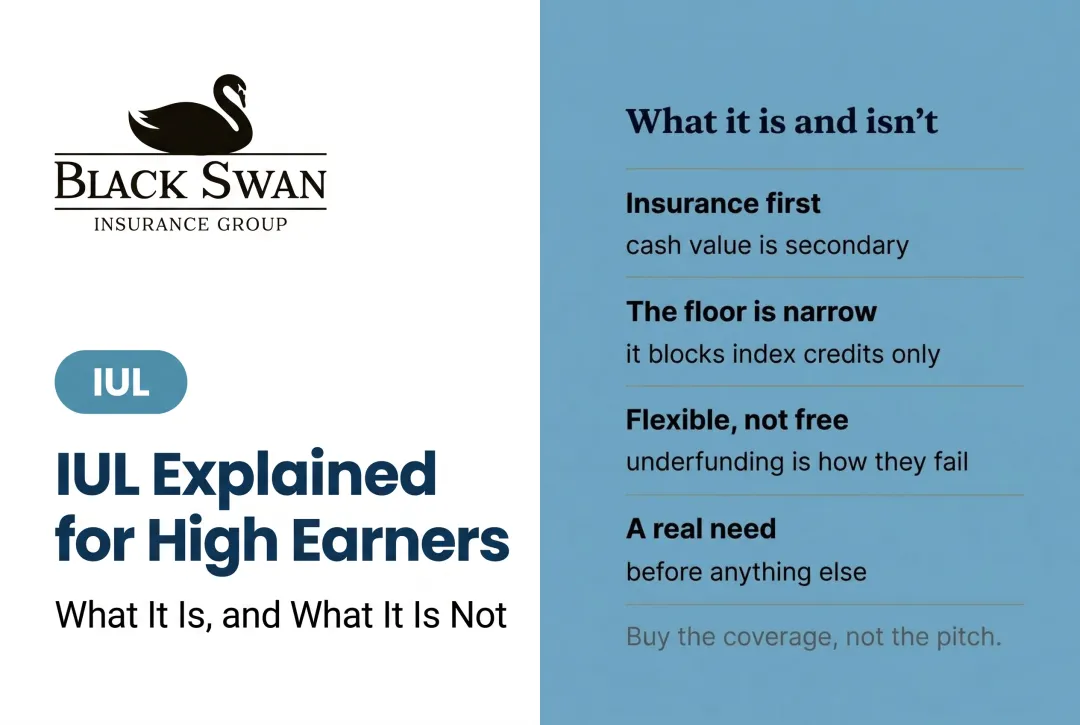
The short answer: Ramsey's objections — high costs, capped upside, complexity, lapse risk — are legitimate and well documented. His guidance is written for a broad audience paying off debt, building reserves and investing in a 401(k) for the first time, and for that audience term plus investing is almost always right. It stops short for households with a genuine permanent death-benefit need, already-maxed qualified accounts and stable surplus cash flow. The honest test is not who to believe; it is whether a permanent insurance need exists independently of the retirement story.
Key Takeaways
- Ramsey favours low-cost term paired with separate investing over any permanent policy, and for most households that is the right call
- Cash value is not invested in an index — caps, participation rates and policy charges shape the actual result
- Judge any policy by its guaranteed values and multiple funding scenarios, never one optimistic illustration
- Fit depends on a real permanent insurance need, cash-flow stability, liquidity and how it coordinates with existing accounts
- Lapse risk is documented, not theoretical
What He Actually Says
Ramsey Solutions' explainer on indexed universal life insurance describes it as expensive and overly complex. The core objections:
- High costs — sales commissions, rider fees, administrative expenses, premium charges
- Capped upside — caps, floors and participation rates limiting how much index growth reaches cash value
- Lapse risk — reduced premiums leaving cash value too thin to cover rising insurance costs, and the policy collapsing
The underlying philosophy is to keep insurance and investing separate. A term policy is cheap, transparent and does one job: replacing income during the years a family depends on it. Investing separately gives full market exposure without insurance drag.
That reasoning holds up well, and it holds up for most people. It is simple, it is transparent, and it avoids paying for permanent coverage nobody needs.
The limit is audience. This guidance is written for someone clearing debt, building an emergency fund and investing in a 401(k) for the first time. It is not individualised planning for a business owner with a succession obligation or a family with an estate-liquidity problem. In those cases the arithmetic changes — and a blanket "never" is the wrong place for the analysis to end.
The critics are not crazy. Bad IUL design is real. But bad design is not the same as a bad tool, and neither of those is the same as a bad fit.
Where Each Premium Dollar Goes
Every payment splits three ways:
- Cost of insurance — the mortality charge funding the death benefit, rising with age
- Fees and riders — administrative charges and any optional benefits
- Cash value — whatever remains
If funding does not keep pace with rising insurance costs, the policy lapses and the death benefit goes with it.
Crediting Is Not Ownership
Cash value is not invested in the S&P 500 or any other index. The insurer credits interest on a formula tied to that index's performance. Per Forbes Advisor's breakdown of IUL mechanics, several contract terms decide what you actually receive:
- Cap — the maximum credited interest, however well the index performs
- Participation rate — the percentage of index gains credited, subject to the cap
- Spread — an amount subtracted from index growth before crediting
- Floor — the minimum credited rate, often 0%, protecting against a negative index result
The floor is genuine, and it applies only to the crediting arithmetic. It does not offset policy charges, loan interest or withdrawals. Cash value still falls when fees outrun credited interest or the contract is underfunded.

Ramsey's concerns about fees, complexity and surrender charges are legitimate on their face. Carriers can also reduce caps or participation rates later, changing the outcome after you have committed. That is a real asymmetry and it deserves to be named rather than explained away.
What the blanket criticism misses is variance. Design, carrier and funding level drive outcomes. Treating every IUL as identical oversimplifies a category where the same premium in two different designs produces completely different results.
What the Critics Get Right
Worth separating the parts of this criticism that are simply true from the parts that are audience-specific.
Simply true: fees are real and front-loaded. Caps limit the upside and the carrier controls them. Surrender charges make an early exit expensive. Underfunded policies lapse, and the people who lapse them usually cannot re-underwrite at the same rate. Anyone selling a policy without walking through the guaranteed column is doing something closer to sales than advice.
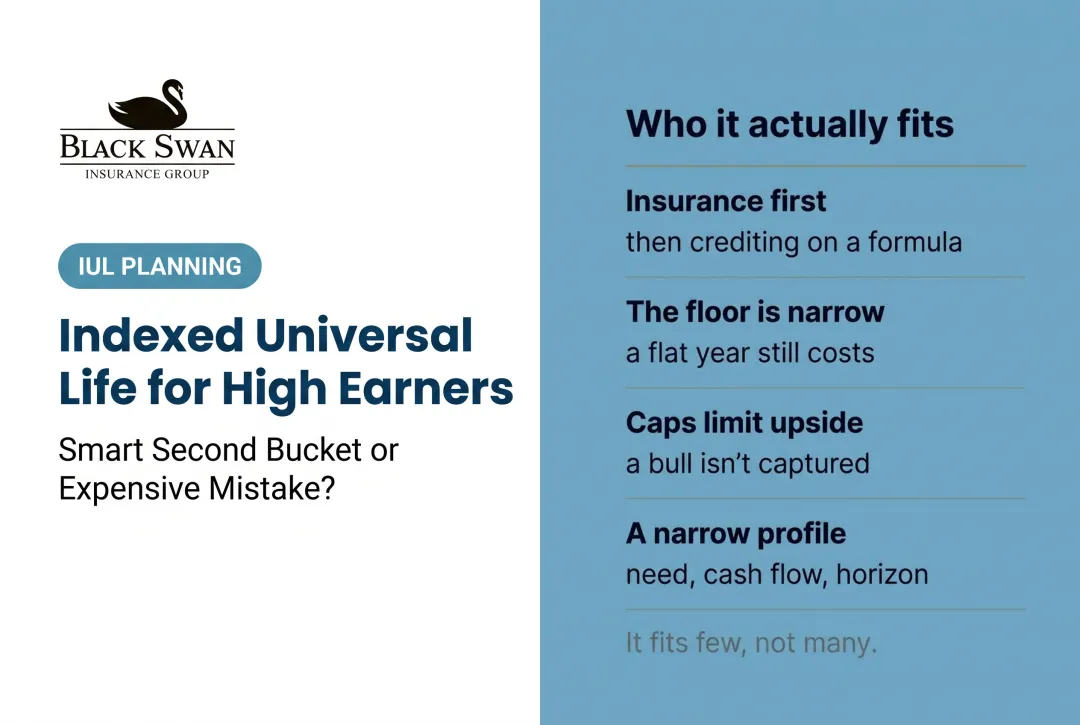
Audience-specific: "you do not need permanent insurance" is true of most households and false of some. Not everyone should buy an IUL — most people reading this page should not, and the honest version of this argument says so out loud. A business owner with a buy-sell obligation, a family with an estate-liquidity problem, a parent of a dependent with lifelong needs — these are permanent needs, and term does not solve them. The general rule is right about the general case.
Any potential tax-advantaged access is conditional on the policy being properly structured, funded and managed. Stated that way, the promise is smaller and considerably more honest than the pitch that draws the criticism.
Which Camp You Fall Into
Stronger Fit for Term Plus Investing
- Consumer debt outstanding, or no emergency fund yet
- Inconsistent income, or uncertainty about sustaining premiums
- Short-term liquidity needs rather than a decades-long commitment
- No permanent coverage need — a term policy covers the actual gap
- A preference for uncapped market participation
- Employer match not yet fully captured
Stronger Fit for Evaluating an IUL
- A genuine permanent life insurance need, not temporary income replacement
- Household income of $150K+ with capacity to sustain premiums through a downturn
- Core retirement accounts already maxed or fully funded
- Tax diversification goals alongside qualified and taxable accounts
- Adequate emergency liquidity held outside the policy
- Willingness to review the contract annually for decades
| Factor | Term plus investing | IUL |
|---|---|---|
| Coverage duration | Temporary, 10–30 years | Permanent, if funded |
| Cost | Low premiums | Higher; funds insurance and cash value |
| Growth potential | Full market exposure | Capped, index-linked crediting |
| Liquidity | Investments held outside the policy | Cash value via loans and withdrawals |
| Complexity | Simple | Moderate to high |
Health, age, underwriting and state rules all shift this. A 35-year-old in excellent health faces a very different cost structure from someone underwriting at 52.
The Ultimate IUL Blueprint
If you land in the second column and want to know what a defensible design looks like — funding levels, the MEC line, loan timing and what to demand from an illustration — that is what the Blueprint covers.
How to Evaluate One Properly
- Request both guaranteed and non-guaranteed ledgers. Compare index strategy, caps, participation rates, spreads, charges, the surrender schedule and loan provisions side by side
- Ask for multiple funding scenarios — your planned premium, a reduced-premium version, and a stress test for missed or lower payments
- Calculate the internal costs and check whether the death benefit and cash value hold up if credited interest comes in below illustration
- Compare against term plus your existing savings and retirement contributions, not against itself

Lapse risk is documented. A Society of Actuaries and LIMRA study covering 2015–2021 found IUL lapse rates increased significantly across policy years between the earlier and later study periods. Underfunding is not a rare error. It is a pattern.
One absolute rule: never cancel or replace an existing policy until the new coverage is approved, issued and active. A coverage gap is a risk you cannot undo.
Five Questions to Answer Honestly
- What permanent insurance need actually exists, independent of the retirement story?
- How long can I sustain premiums, including through a bad year?
- Are emergency reserves and core retirement contributions already handled?
- What alternatives have I genuinely compared, not just heard about?
- What happens to this policy if caps drop or funding stops for three years?
If the decision touches business succession, estate planning or family income replacement, bring in a spouse, a CPA and an attorney before signing. And if you cannot explain the strategy at the kitchen table, it is not ready for your household.

Risks to Understand Before You Choose Either Path
- Fees and commissions are real and front-loaded, and they hit hardest in the years the illustration looks best
- Caps and participation rates are non-guaranteed and can be reduced after you commit
- Cost of insurance rises with age and is charged in flat crediting years
- Surrender charges make an early exit expensive, often for 10 to 15 years
- Underfunding causes lapse, and the SOA and LIMRA data show it happening at scale
- Loan interest compounds, and a lapse with a loan outstanding and gain in the contract can create taxable income with no cash received
- Crossing the seven-pay limit makes the contract a MEC under I.R.C. § 7702A and changes distribution taxation
- Replacing coverage before new coverage is in force creates a gap that cannot be undone
- On the term side: coverage ends, and re-insuring at 60 after a health event may not be possible at any price
Find Out Where You Actually Stand
This starts with the Tax-Free Wealth Blueprint Fit Review. If you earn $150K+ and are trying to decide between the two camps, we test whether a permanent need exists independently, compare term plus investing against a permanent design on identical terms, read the guaranteed column, and stress-test a funding pause. If it does not fit, we will tell you that too — and "Ramsey is right for your situation" is a conclusion we reach regularly.
Frequently Asked Questions
Does Dave Ramsey recommend IUL?
No. He favours term insurance paired with separate investing over permanent policies. For the audience he writes for, that is sound advice.
What are his main objections?
High fees and commissions, complexity, capped credited interest, surrender charges and lapse risk — plus a philosophical preference for separating protection from accumulation.
Is IUL cash value invested in an index fund?
No. Interest is credited on an index-linked formula, not through ownership. Charges, caps and participation rates all affect what you actually keep.
Can an IUL lose money when the market falls?
The floor prevents a negative credit from the index itself. Policy charges, loan interest, withdrawals and inadequate funding can still reduce cash value or put the contract at risk.
Who should actually consider one?
Someone with a genuine permanent insurance need, a long horizon, stable surplus cash flow and solid reserves — who will also compare alternatives and review performance every year.
Is term better than IUL?
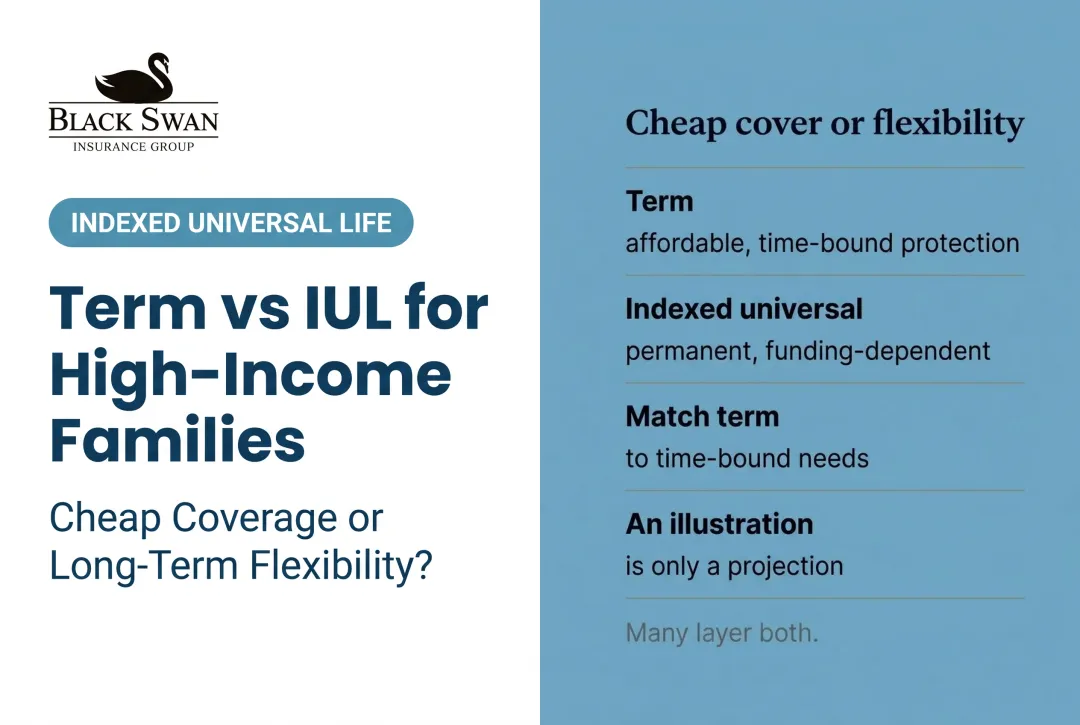
For temporary income replacement and simplicity, usually yes, and it is worth saying plainly. They solve different problems, and the right answer depends on whether your protection need expires.
Sources
- Ramsey Solutions — Indexed universal life insurance
- Forbes Advisor — Indexed universal life insurance mechanics
- Society of Actuaries and LIMRA — 2015–2021 universal life lapse study
- NAIC — Life Insurance Illustrations
- I.R.C. § 7702A and Rev. Proc. 2008-39 (modified endowment contracts and the seven-pay test)
Disclosure: This article is educational and is not personal tax, legal or investment advice. Indexed universal life is life insurance first. Views attributed to third parties are their own. Actual results depend on policy design, carrier, crediting options, caps, participation rates, expenses, funding and ongoing management. Policy loans and withdrawals may reduce cash value and death benefit and can create tax consequences if the policy lapses or becomes a modified endowment contract. This strategy is not appropriate for everyone. Illustrated values are not guarantees; actual results depend on policy terms, crediting, costs and funding. Consult your own tax, legal and financial professionals for advice specific to your situation.
And remember, it's not what you earn, it's what you keep… enjoy the ride.